The Effectiveness of Mindfulness Training on Cognitive Flexibility and Psychosomatic Symptoms in Women with Generalized Anxiety Disorder
Keywords:
Mindfulness Training, Cognitive Flexibility, Psychosomatic Symptoms, Generalized Anxiety Disorder, WomenAbstract
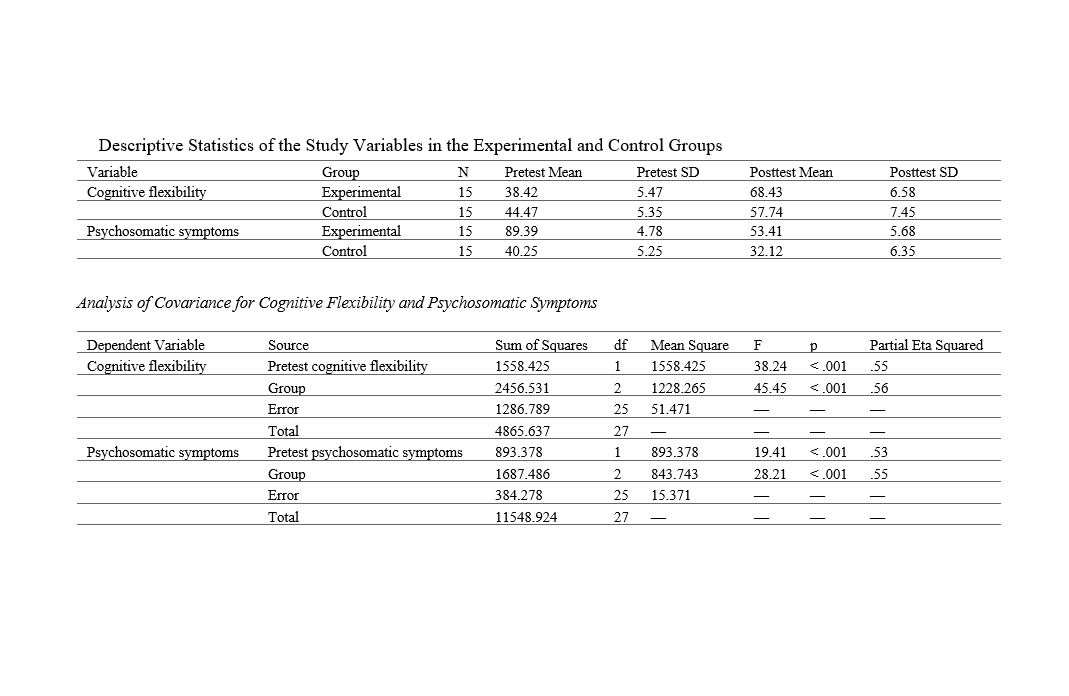
The present study aimed to determine the effectiveness of mindfulness training on cognitive flexibility and psychosomatic symptoms in women with generalized anxiety disorder. This study employed a quasi-experimental pretest–posttest design with a control group. The statistical population consisted of women with generalized anxiety disorder who attended counseling centers in Tehran, Iran, during 2025–2026. Using convenience sampling, 30 eligible participants were selected and randomly assigned to an experimental group (n = 15) and a control group (n = 15). Data were collected using the Generalized Anxiety Disorder-7 scale, the Cognitive Flexibility Inventory, and the 39-item Psychosomatic Symptoms Questionnaire. The experimental group participated in eight weekly 90-minute mindfulness-training sessions, whereas the control group received no specific psychological intervention during the study period. Both groups completed the study measures before and after the intervention. Data were analyzed using descriptive statistics and analysis of covariance after examining the relevant statistical assumptions. Analysis of covariance showed that, after controlling for pretest scores, mindfulness training had a statistically significant effect on cognitive flexibility in women with generalized anxiety disorder (F = 45.45, p < .001, partial η² = .56). The intervention also produced a statistically significant effect on psychosomatic symptoms (F = 28.21, p < .001, partial η² = .55). These effect sizes indicated that mindfulness training accounted for a substantial proportion of the variance in posttest cognitive flexibility and psychosomatic symptoms after adjustment for baseline scores. Mindfulness training appears to be an effective psychological intervention for enhancing cognitive flexibility and reducing psychosomatic symptoms among women with generalized anxiety disorder. By strengthening present-moment awareness, reducing automatic cognitive reactivity, and promoting more adaptive responses to distressing thoughts and bodily sensations, mindfulness training may improve both cognitive and somatic aspects of generalized anxiety disorder. Accordingly, structured mindfulness programs can be considered a potentially useful component of psychological services for women experiencing chronic anxiety.
Downloads
References
Arbabi, F., Saravani, S., Zeynali Pour, M., & Hashemi Sanjani, A. (2022). Effectiveness of mindfulness-based cognitive therapy on psychological well-being, quality of life, and resilience in couples with marital conflicts. Quarterly Journal of Psychology, 102, 140-149.
Asfour, N. M., Helal, S. A., Almahdi, A. H., & Basha, A. M. (2024). Cognitive deficits in generalized anxiety disorder: Impairments in attention, executive functioning, and cognitive flexibility among young adults. Journal of Angiotherapy, 8(11), 1-7. https://doi.org/10.25163/angiotherapy.81110029
Aziz, M. O., Mehrinejad, S. A., Hashemian, K., & Paivastegar, M. (2020). Integrative therapy (short-term psychodynamic psychotherapy & cognitive-behavioral therapy) and cognitive-behavioral therapy in the treatment of generalized anxiety disorder: A randomized controlled trial. Complementary Therapies in Clinical Practice, 39, 101122. https://doi.org/10.1016/j.ctcp.2020.101122
Baugh, L. M., Cox, D. W., Young, R. A., & Kealy, D. (2019). Partner trust and childhood emotional maltreatment: The mediating and moderating roles of maladaptive schemas and psychological flexibility. Journal of Contextual Behavioral Science, 12, 66-73. https://doi.org/10.1016/j.jcbs.2019.02.001
Deh Pour, A., Heidari, S., & Mirzaian, B. (2026). Comparing intensive short-term dynamic psychotherapy and schema therapy for intolerance of uncertainty and cognitive flexibility in patients with generalized anxiety disorder. Health Psychology and Behavioral Disorders, 24(2), 1-15.
Elnazer, H. Y. (2026). A Dual-Stage Model of Hypothalamic-Pituitary-Adrenal (HPA) Axis Dysregulation in Anxiety Disorders: A Systematic Review. Psikiyatride Güncel Yaklaşımlar, 1421-1438. https://doi.org/10.18863/pgy.1860664
Ghanizadeh Balderlou, K., Moheb, N., Alivandi Vafa, M., & Azmoudeh, M. (2025). Comparing emotional schema therapy and mindfulness-based cognitive therapy on cognitive emotion regulation, intolerance of uncertainty, and cognitive flexibility in generalized anxiety disorder. Applied Psychological Research, 16(4), 119-138.
Ionescu, T., Goldstone, R. L., Rogobete, D., & Taranu, M. (2024). Is cognitive flexibility equivalent to shifting? Investigating cognitive flexibility in multiple domains. Journal of Cognition, 7(1), 73. https://doi.org/10.5334/joc.403
Jam, S., Khandah, & Valizadeh, S. (2025). Effectiveness of intensive short-term dynamic psychotherapy on emotion regulation and interpersonal conflict among girls with anxiety disorders. Nursing Rehabilitation Research, 11(1), 121-131.
Jialin, A., Zhang, H. G., Wang, X. H., Wang, J. F., Zhao, X. Y., Wang, C., & Deng, W. (2025). Cortical activation patterns in generalized anxiety and major depressive disorders measured by multi-channel near-infrared spectroscopy. Journal of affective disorders, 379, 549-558. https://doi.org/10.1016/j.jad.2025.02.116
Jones, L., Gold, E., Totsika, V., Hastings, R. P., Jones, M., Griffiths, A., & Silverton, S. (2018). A mindfulness parent well-being course: Evaluation of outcomes for parents of children with autism and related disabilities recruited through special schools. European Journal of Special Needs Education, 33(1), 16-30. https://doi.org/10.1080/08856257.2017.1297571
Lilliengren, P., Johansson, R., Town, J. M., Kisely, S., & Abbass, A. (2017). Intensive short-term dynamic Psychotherapy for generalized anxiety disorder: A pilot effectiveness and process-outcome study. Clinical Psychology & Psychotherapy, 24(6), 1313-1321. https://doi.org/10.1002/cpp.2101
Liu, L., Zhou, M., Yang, X., & Lin, D. (2026). Correlation between clinical features of acute episode of major depressive disorder and hypothalamic-pituitary-adrenal axis (HPA) function: a cross-sectional study. BMC psychiatry, 26(1), 283. https://doi.org/10.1186/s12888-026-07926-0
Makhdoumi, M., Abolghasemi, S., & Khanekeshi, A. (2025). Effectiveness of schema therapy on cognitive avoidance and generalized anxiety disorder symptoms. Journal of Psychological Science, 24(154), 187-203.
Nasiri, A., Sharifi, T., Ghazanfari, A., & Cherami, M. (2022). Comparing schema therapy and reality therapy on psychological flexibility and emotional self-regulation in preschool teachers. Applied Psychology, 16(4), 161-183.
Ottaviani, C., Watson, D. R., Meeten, F., Makovac, E., Garfinkel, S. N., & Critchley, H. D. (2016). Neurobiological substrates of cognitive rigidity and autonomic inflexibility in generalized anxiety disorder. Biological Psychology, 119, 31-41. https://doi.org/10.1016/j.biopsycho.2016.06.009
Raj, A., & Kumar, P. (2018). Efficacy of mindfulness-based stress reduction (MBSR): A brief overview. Journal of Disability Management and Rehabilitation, 4(2), 73-81.
Roemer, L., Eustis, E. H., & González-Garzón, A. M. (2025). Generalized anxiety disorder. In Optimizing Treatment Engagement Processes in CBT for Anxiety and Related Disorders (pp. 213-238). Springer Nature Switzerland. https://doi.org/10.1007/978-3-031-91439-3_12
Segal, Z. V., Williams, J. M. G., & Teasdale, J. D. (2013). Mindfulness-Based Cognitive Therapy for Depression (2nd ed.). The Guilford Press.
Segal, Z. V., Williams, J. M. G., & Teasdale, J. D. (2018). Mindfulnessbased cognitive therapy for depression. Guilford Publications.
Sepahvand, T. (2021). The role of cognitive flexibility in generalized anxiety among individuals with neuroticism. Shenakht Journal of Psychology and Psychiatry, 8(3), 89-100.
Shen, Y., Zhu, S., Liao, S., Zhao, Y., Lin, Z., Jiang, K., Yan, W., & Shen, X. (2025). Generalized anxiety disorder patients' cognitive control in affective contexts. Frontiers in Psychiatry, 16, 1506239. https://doi.org/10.3389/fpsyt.2025.1506239
Soleimani, D., Fallahmanesh, E., & Ershadi Chahardeh, S. (2020). The effect of mindfulness training on psychological hardiness and positive and negative cognitive emotion regulation strategies among women seeking divorce. Social Psychology, 8(57), 41-51.
Straarup, N. S., Renneberg, H. B., Farrell, J., & Younan, R. (2022). Group schema therapy for patients with severe anxiety disorders. Journal of Clinical Psychology, 78(8), 1590-1600. https://doi.org/10.1002/jclp.23351
Thompson, C. J., & Martin-Wagar, C. A. (2025). Cognitive flexibility and emotion regulation in eating disorder patients with comorbid generalized anxiety and posttraumatic stress symptoms. Eating Disorders, 33(5), 666-680. https://doi.org/10.1080/10640266.2024.2405290
Ysbaek-Nielsen, A. T. (2024). Exploring volumetric abnormalities in subcortical L-HPA axis structures in pediatric generalized anxiety disorder. Nordic journal of psychiatry, 78(5), 402-410. https://doi.org/10.1080/08039488.2024.2335980
Zahrakar, K., Sharei, A., & Salmani, A. (2025). Comparing cognitive behavioral therapy and intensive short-term dynamic psychotherapy on state-trait anxiety and resilience among female students with self-harming behaviors. Applied Psychological Research, 2(6), 21-58.
Downloads
Additional Files
Publication Timeline
- Submitted
- Revised
- Accepted