The Role of Metacognitive Beliefs and Emotion Regulation Strategies in Predicting Fear of Self among Adolescents with Obsessive-Compulsive Disorder
Keywords:
obsessive–compulsive symptoms, feared self, metacognitive beliefs, cognitive reappraisal, expressive suppression, adolescenceAbstract
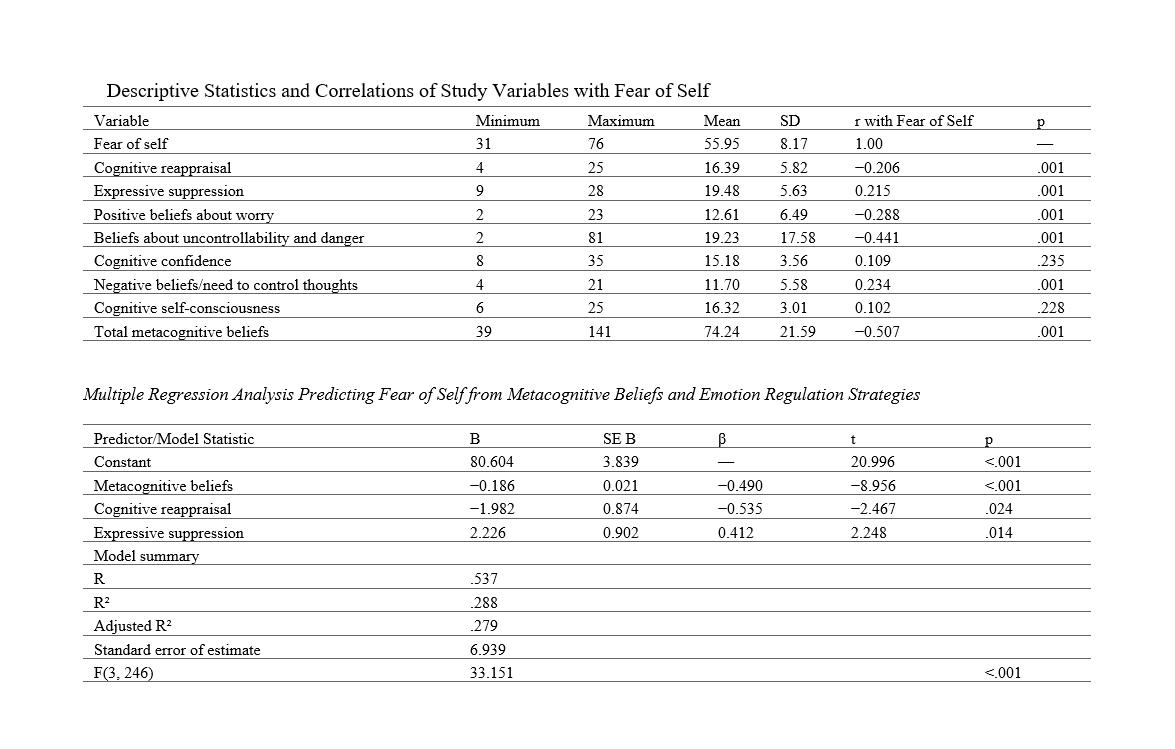
The present study aimed to investigate the role of metacognitive beliefs and emotion regulation strategies in predicting fear of self among adolescents with obsessive-compulsive disorder. This study employed a descriptive correlational design. The statistical population consisted of adolescents with obsessive-compulsive disorder attending schools in Aliabad during the 2025–2026 academic year, from whom 250 participants were selected through convenience sampling. Data were collected using the Metacognitions Questionnaire, the Gross Emotion Regulation Questionnaire, the Fear of Self Questionnaire, and the Maudsley Obsessive-Compulsive Inventory. Data analysis was performed using SPSS version 26 at descriptive and inferential levels. Pearson correlation coefficients were used to examine relationships among the study variables, and multiple regression analysis was applied to determine the predictive contribution of metacognitive beliefs, cognitive reappraisal, and expressive suppression to fear of self. Total metacognitive beliefs were significantly and negatively correlated with fear of self (r = −.507, p < .01). Cognitive reappraisal also showed a significant negative correlation with fear of self (r = −.206, p < .01), whereas expressive suppression was significantly and positively correlated with fear of self (r = .215, p < .01). The regression model was statistically significant, F(3, 246) = 33.151, p < .001, and explained 28.8% of the variance in fear of self (R² = .288; adjusted R² = .279). Metacognitive beliefs (β = −.490, p < .001) and cognitive reappraisal (β = −.535, p = .024) negatively predicted fear of self, whereas expressive suppression positively predicted it (β = .412, p = .014). The findings indicate that metacognitive beliefs and emotion regulation strategies are significant predictors of fear of self among adolescents with obsessive-compulsive disorder, suggesting that interventions targeting maladaptive metacognitive processes, strengthening cognitive reappraisal, and reducing excessive expressive suppression may help decrease self-related fears in this population.
Downloads
References
Cécillon, F. X., Mermillod, M., Leys, C., Lachaux, J. P., Le Vigouroux, S., & Shankland, R. (2024). Trait Anxiety, Emotion Regulation, and Metacognitive Beliefs: An Observational Study Incorporating Separate Network and Correlation Analyses to Examine Associations with Executive Functions and Academic Achievement. Children, 11(1), 123. https://doi.org/10.3390/children11010123
Ebrahimi Ghavam, S., Mohammadi, N., & Niknam, Z. (2024). Structural Equation Modeling of Students' Emotion Regulation Based on Academic Resilience, Coping Strategies, Metacognitive Awareness, and Hardiness. Research in Educational Systems, 18(66), 5-22.
Estévez, A., Momeñe, J., Macía, L., Iruarrizaga, I., Olave, L., & Aonso-Diego, G. (2024). The Mediating Effect of Coping Strategies and Emotion Regulation in the Relationship Between Impulsivity, Metacognition, and Eating Disorders. Nutrients, 16(12), 1884. https://doi.org/10.3390/nu16121884
Fioravanti, G., MacBeth, A., Nicolis, M., Gala, E., & Dimaggio, G. (2026). Metacognitive Interpersonal Therapy-Eating Disorders (MIT-ED) in the Case of an 18-Year-Old Girl With Avoidant and Obsessive-Compulsive Personality Disorders, Binge Eating Disorder and Obesity. Journal of Clinical Psychology, 82(3), 414-423. https://doi.org/10.1002/jclp.70064
Kul, A. T., Uğurlu, G. K., & Gündoğmuş, İ. m. (2024). The Effects of Metacognition on Social Functioning in Patients With Obsessive-Compulsive Disorder. Psychiatric Annals, 54(4). https://doi.org/10.3928/00485713-20240131-01
Merkebu, J., Kitsantas, A., Durning, S. J., & Ma, T. (2023). What is metacognitive reflection? The moderating role of metacognition on emotional regulation and reflection [Original Research]. Frontiers in Education, 8. https://doi.org/10.3389/feduc.2023.1166195
Mısır, E., & Özbek, M. M. (2025). Obsessive Beliefs, Metacognitive Beliefs, and Rumination in Parents of Adolescents With and Without Obsessive–Compulsive Disorder: A Linear Mixed-Effects Model. Brain Sciences, 15(10), 1093. https://doi.org/10.3390/brainsci15101093
Nanava, F. J., & Raisi, A. (2025). The Mediating Role of Attachment Styles in the Relationship Between Fear of Self and Obsessive-Compulsive Symptoms. Journal of Psychological Injuries Volume, 1(2), 13-26. https://jpsi.medilam.ac.ir/article-1-49-fa.html
Sadeghzadeh, R., Razani, M., & Piriaei, H. (2024). Comparing the Effectiveness of Cognitive-Behavioral Therapy and Metacognitive Therapy on Improving Resilience and Quality of Life in Adolescents with Obsessive-Compulsive Disorder. Applied Psychology Quarterly, 18(1), 36-62. https://apsy.sbu.ac.ir/article_104150.html
Sarwar, S., & Alimirza, Z. I. (2025). Breaking the Silence: How Self-Compassion Reduces Fear of Self Disclosure in Women with Obsessive Compulsive Disorder. Journal of Political Stability Archive, 3(3), 290-302. https://doi.org/10.63468/jpsa.3.3.21
Scheepbouwer, V., Hanssen, I., Collin, G., Huijbers, M. J., Schuling, R., & Speckens, A. E. (2025). Mindfulness-based compassionate living for recurrent depression: Examining experiential avoidance, fear of self-compassion, and positive affect as mediators of response in a randomized controlled trial. Cognitive therapy and research, 49(1), 140-154. https://doi.org/10.1007/s10608-024-10556-z
Tajizadegan, F., & Sharifi Isfahani, M. (2026). The effectiveness of schema therapy on metacognitive beliefs and positive and negative emotional dimensions in married women with symptoms of obsessive-compulsive disorder. International Journal of Body, Mind and Culture, e2026-2673. https://doi.org/10.61838/ijbmc.v13i8.673
Üzümcü, E., Evliyaoğlu, E. S., & Inozu, M. (2023). The role of gender, fear of self and disgust propensity in mental contamination: A model test using mental contamination induction. Current Psychology, 42, 9596-9608. https://doi.org/10.1007/s12144-021-02285-3
Zargarinejad, G., Mokhtari, S., Mahdavi, S., Bakizadeh, F., Nohesara, S., Akbari Koli, P., Keshavarz-Akhlaghi, A. A., & Shalbafan, M. (2025). Combining cognitive remediation and metacognitive therapy for improving cognitive functions and reducing symptoms severity of adult patients with obsessive-compulsive disorder in Tehran, Iran: Study protocol for a randomized, controlled trial. Trials, 26, 494. https://doi.org/10.1186/s13063-025-09219-5
Downloads
Additional Files
Publication Timeline
- Submitted
- Revised
- Accepted