Identification and Explanation of Mechanisms Regulating Closeness and Distance from Affective Objects in Individuals with Depression: A Mixed-Methods Study with Emphasis on Attachment, Fear of Intimacy, and Rejection Sensitivity
Keywords:
Depression, Attachment, Fear of Intimacy, Rejection Sensitivity, Affective Objects, Closeness–Distance Regulation, Mixed MethodsAbstract
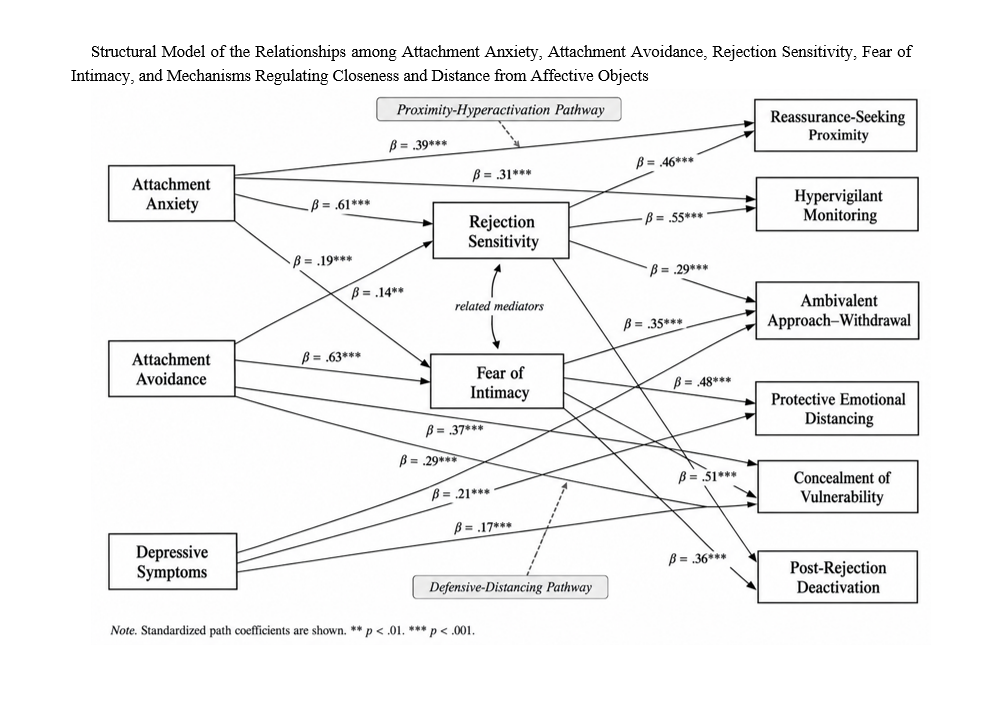
This study aimed to identify and explain the mechanisms regulating closeness to and distance from affective objects among individuals with depression, with particular emphasis on attachment, fear of intimacy, and rejection sensitivity. An exploratory sequential mixed-methods design was conducted in Tehran, Iran. In the qualitative phase, 22 adults with depression were selected purposively and interviewed using in-depth semi-structured interviews until theoretical saturation was achieved. Qualitative data were analyzed through constant comparative coding. In the quantitative phase, 420 adults with depression completed the Beck Depression Inventory-II, Experiences in Close Relationships-Revised questionnaire, Fear of Intimacy Scale, Adult Rejection Sensitivity Questionnaire, and the researcher-developed Closeness–Distance Regulation Mechanisms Questionnaire. Data were analyzed using exploratory and confirmatory factor analysis, Pearson correlations, and structural equation modeling with bootstrap estimation. Six mechanisms were identified: reassurance-seeking proximity, hypervigilant monitoring, ambivalent approach–withdrawal, protective emotional distancing, concealment of vulnerability, and post-rejection deactivation. The six-factor measurement model showed satisfactory fit, χ²/df = 2.11, RMSEA = .052, SRMR = .046, CFI = .951, and TLI = .945. Attachment anxiety strongly predicted rejection sensitivity (β = .61, p < .001), while attachment avoidance strongly predicted fear of intimacy (β = .63, p < .001). Rejection sensitivity predicted reassurance-seeking proximity (β = .46, p < .001) and hypervigilant monitoring (β = .55, p < .001), whereas fear of intimacy predicted protective emotional distancing (β = .48, p < .001) and concealment of vulnerability (β = .51, p < .001). Significant indirect effects supported the mediating roles of rejection sensitivity and fear of intimacy. Closeness–distance regulation in depression appears to operate through two interconnected pathways, with attachment anxiety and rejection sensitivity driving proximity hyperactivation and attachment avoidance and fear of intimacy driving defensive distancing.
Downloads
References
Alareqe, N. A., Roslan, S. B., Taresh, S. M., & Nordin, M. S. (2021). Universality and Normativity of the Attachment Theory in Non-Western Psychiatric and Non-Psychiatric Samples: Multiple Group Confirmatory Factor Analysis (CFA). International journal of environmental research and public health, 18(11), 5770. https://doi.org/10.3390/ijerph18115770
Badulescu, A. L. (2023). Covid-19 Pandemic Effects at Students. 5, 305-312. https://doi.org/10.15405/epes.23045.32
Davani, S. A., Rahimi, C., & Imani, M. (2022). Comparison of Family Communication Patterns and Attachment Styles Among Depressed OCD Patients. Journal of Advanced Pharmacy Education and Research, 12(4), 107-113. https://doi.org/10.51847/vopw1uoqbj
Deiana, V., Paribello, P., Suprani, F., Arzedi, C., Garzilli, M., Arru, L., Manchia, M., Carpiniello, B., & Pinna, F. (2025). Association Between Current Suicidal Ideation and Personality Traits: Analysis of the Personality Inventory for DSM-5 in a Community Mental Health Sample. Medicina, 61(9), 1541. https://doi.org/10.3390/medicina61091541
DemİRcİ, Ö., & İnan, E. (2023). Postpartum Paternal Depression: Its Impact on Family and Child Development. Psikiyatride Guncel Yaklasimlar - Current Approaches in Psychiatry, 15(3), 498-507. https://doi.org/10.18863/pgy.1153712
Dorai, D. R., & Badawy, A. S. (2024). Balancing Acts: A Multi-Criteria Decision-Making Exploration of Psychological Factors in Marital Conflict and Intervention Strategies. https://doi.org/10.21203/rs.3.rs-3935051/v1
E., S. A., & A., N. C. (2024). Body Image Avoidance, Fear of Intimacy, and Social Avoidance Among Young Adults. International Journal for Multidisciplinary Research, 6(2). https://doi.org/10.36948/ijfmr.2024.v06i02.16161
Elsayes, H. A., Zewiel, M. A. A., Amina Ahmed Wahba El, s., Ghoneim, N. I. A., Mohammed, A. M. S., Almadani, N. A., Alharbi, J. N., Abdeldafie, S. Y., Alsharif, F. H., & El-Refaay, S. M. M. (2023). Attachment Style, Affective Temperament, and Psychological Distress Among Mental Health Nurses During the COVID‐19 Pandemic. Perspectives in psychiatric care, 2023(1). https://doi.org/10.1155/2023/7281075
Ghapanchi, A., Masjedi‐Arani, A., Lavasani, F. F., & Vahid, M. K. A. (2022). Object Relations and Core Conflictual Relationship Theme in Patients With Major Depression and Normal Individuals. Practice in Clinical Psychology, 10(2), 165-176. https://doi.org/10.32598/jpcp.10.2.812.3
Infortuna, C., Wang, R., Pandolfo, G., Dupont, J., Hanna, V., Iosim, V., Mikhail, M., Terlecky, S. R., Thomas, F. P., Cao, W., Han, Z., & Battaglia, F. (2025). Medical Students' Distress During the Transition to the Endemic Phase of COVID-19 in China: The Association With Temperament Traits and Attachment Styles. Aims Public Health, 12(1), 1-15. https://doi.org/10.3934/publichealth.2025001
Jehangir, S., & Khalid, S. S. (2024). Association Between Attachment Styles and Depression Severity in Young Adults From Divorced or Single-Parent Households - A Cross-Sectional Study. Allied Medical Research Journal, 18-25. https://doi.org/10.59564/amrj/02.01/004
Júnior, O. N., & Esperandio, M. R. G. (2026). Spirituality in Mental Health Care in Brazil: Reflections on Bioethics Informed by Empirical Evidence. Religions, 17(5), 599. https://doi.org/10.3390/rel17050599
K., N., & K., N. (2024). Perceived Parental Involvement in Childhood and Its Relationship With Adult Attachment Styles and Depression in Adults. International Journal for Multidisciplinary Research, 6(3). https://doi.org/10.36948/ijfmr.2024.v06i03.20856
Karmakar, A., & Parmar, V. (2024). Reducing Alexithymic Traits Using an Ideal Attachment Style Approach; A Correlational Study. Eatp. https://doi.org/10.53555/kuey.v30i5.3616
Karveli, S., Karademas, E. C., Poulakaki, F., Antonopoulou, Z., & Arkadopoulos, N. F. (2025). The Mediating Role of Early Maladaptive Schemas in the Relationship Between Attachment Styles and Adjustment to Early‐Stage Breast Cancer. Psycho-Oncology, 34(6). https://doi.org/10.1002/pon.70196
Maestre-Lorén, F., Castillo‐Garayoa, J. A., López-i-Martín, X., Sàrquella, J., Andrés, A., & Cifré, I. (2021). Psychological Distress in Erectile Dysfunction: The Moderating Role of Attachment. Sexual Medicine, 9(5), 1-1. https://doi.org/10.1016/j.esxm.2021.100436
Nourialeagha, B., Ajilchi, B., & Kisely, S. R. (2020). The Mediating Role of Gratitude in the Relationship Between Attachment Styles and Psychological Well-Being. Australasian Psychiatry, 28(4), 426-430. https://doi.org/10.1177/1039856220930672
Papapetrou, C., Panoulis, K., Mourouzis, I. S., & Kouzoupis, A. V. (2020). Pregnancy and the Perinatal Period: The Impact of Attachment Theory. Psychiatriki, 31(3), 257-270. https://doi.org/10.22365/jpsych.2020.313.257
Pasquale, C. D., Pistorio, M. L., Veroux, M., Sapienza, G., Florio, A., Hichy, Z., Ekser, B., Giaquinta, A., & Veroux, P. (2023). Attachment and Parental Bond: Impact on Psychopathology, Mental Health and Quality of Life of Hemodialysis Patients: A Cross-Sectional Study. BMC psychology, 11(1). https://doi.org/10.1186/s40359-023-01246-8
Pinto‐Cortez, C., Peñaloza-Díaz, G., Díaz, S. A. C., Valdovino, N., Zavala, M., Muzatto-Negrón, P., & Zapata-Sepúlveda, P. (2023). Adverse Childhood Experiences and Psychopathology in Adolescents From Northern Chile: The Moderating Role of the Attachment Style. Psicologia Reflexão E Crítica, 36(1). https://doi.org/10.1186/s41155-023-00273-z
Pistorio, M. L., Moretta, T., Musumeci, M. L., Lacarrubba, F., Petralia, A., Micali, G., & Pasquale, C. D. (2024). Impact of Attachment Style and Temperament Traits on the Quality of Life of Patients With Psoriasis. Behavioral Sciences, 14(6), 434. https://doi.org/10.3390/bs14060434
Pistorio, M. L., Pasquale, C. D., Veroux, M., Bottesi, G., Granziol, U., Panzeri, A., Giambra, M. M., Giaquinta, A., & Veroux, P. (2025). The Role of Attachment and Parental Bonding in the Psychosocial Assessment of Transplant Candidates: A Cross-Sectional Study. BMC psychology, 13(1). https://doi.org/10.1186/s40359-025-02558-7
Raja, D. (2026). Silent Bedrooms, Speaking Bodies: A Case Series on Hidden Emotional and Intimacy-Related Distress Behind Chronic Psychosomatic Symptoms in Women. Cureus. https://doi.org/10.7759/cureus.110392
Rezaei, M., Elyasi, F., Nikbakht, H.-A., Hashemi, S. N., & Hajizade-Valokolaee, M. (2026). The Relationship Between Fear of Childbirth and Attachment Style, and Associated Factors Among Pregnant Women Registered at Comprehensive Health Service Centers: A Cross-Sectional Study in Iran. Iranian Journal of Nursing and Midwifery Research, 31(5), 885-891. https://doi.org/10.4103/ijnmr.ijnmr_34_25
Sirancova, K., Raudenská, J., Zajíček, R., & Javůrková, A. (2021). Psychological Aspects in Early Adjustment After Severe Burn Injury. Journal of Burn Care & Research, 43(1), 9-15. https://doi.org/10.1093/jbcr/irab038
Sobhani, F. F., Shiroudi, S. G., & Khodabakhshi‐Koolaee, A. (2021). Effect of Two Couple Therapies, Acceptance and Commitment Therapy and Schema Therapy, on Forgiveness and Fear of Intimacy in Conflicting Couples. Practice in Clinical Psychology, 9(4), 271-282. https://doi.org/10.32598/jpcp.9.4.746.3
Suárez, L., María Ángeles de la, C., Martín-González, M., Tamayo‐Morales, O., & Andrade‐González, N. (2026). Correlation Between Insecure Attachment Style and Symptomatology in Patients With Bipolar Disorder: A Systematic Review. Actas espanolas de psiquiatria, 54(2), 516-527. https://doi.org/10.62641/aep.v54i2.2108
Terrone, G., Bianciardi, E., Fontana, A., Pinci, C., Castellani, G., Sferra, I., Forastiere, A., Merlo, M., Marinucci, E., Rinaldi, F., Falanga, M., Pucci, D., Siracusano, A., & Niolu, C. (2023). Psychological Characteristics of Women With Perinatal Depression Who Require Psychiatric Support During Pregnancy or Postpartum: A Cross-Sectional Study. International journal of environmental research and public health, 20(8), 5508. https://doi.org/10.3390/ijerph20085508
Turtonen, O., Saarinen, A. I. L., Nummenmaa, L., Tuominen, L. J., Tikka, M., Armio, R.-L., Hautamäki, A., Laurikainen, H., Raitakari, O. T., Keltikangas‐Järvinen, L., & Hietala, J. A. (2021). Adult Attachment System Links With Brain Mu Opioid Receptor Availability In Vivo. Biological Psychiatry Cognitive Neuroscience and Neuroimaging, 6(3), 360-369. https://doi.org/10.1016/j.bpsc.2020.10.013
Wagner‐Skacel, J., Bengesser, S., Dalkner, N., Mörkl, S., Painold, A., Hamm, C., Pilz, R., Rieger, A., Kapfhammer, H. P., Hiebler‐Ragger, M., Jauk, E., Butler, M., & Reininghaus, E. Z. (2020). Personality Structure and Attachment in Bipolar Disorder. Frontiers in Psychiatry, 11. https://doi.org/10.3389/fpsyt.2020.00410
Wang, B., & Kuroki, T. (2023). Association Between Negatively Perceived Parenting Attitudes and Dissociation: A Cross-Sectional Study on the General Population in Japan. Frontiers in psychology, 14. https://doi.org/10.3389/fpsyg.2023.1235447
Wheatley, R., Winder, B., & Kuss, D. J. (2020). What Are the Features of Psychopathology for Men Who Commit Stalking Offences? A Systematic Review. Aggression and Violent Behavior, 55, 101461. https://doi.org/10.1016/j.avb.2020.101461
Yazici-Celebiİ, G., Yılmaz, M., Karacoskun, M. E., & ŞAhİN, A. İ. (2024). Examination of the Mediating Role of Attachment Dimensions in the Link Between Suicide Probability and Cognitive Distortions About Relationships in University Students. Journal of Education in Science Environment and Health, 60-68. https://doi.org/10.55549/jeseh.1419349
Zain, E., Fukui, N., Watanabe, Y., Hashijiri, K., Motegi, T., Ogawa, M., Egawa, J., & Someya, T. (2023a). High Care and Low Overprotection From Both Paternal and Maternal Parents Predict a Secure Attachment Style With a Partner Among Perinatal Japanese Women. Scientific reports, 13(1). https://doi.org/10.1038/s41598-023-42674-1
Zain, E., Fukui, N., Watanabe, Y., Hashijiri, K., Motegi, T., Ogawa, M., Egawa, J., & Someya, T. (2023b). Perceived Parenting Before Adolescence Is Associated With Adult Attachment Among Japanese Women During the Perinatal Period: A Path Models Comparison. https://doi.org/10.21203/rs.3.rs-2465939/v1
Downloads
Additional Files
Publication Timeline
- Submitted
- Revised
- Accepted