Structural Modeling of High-Risk Sexual Behaviors Based on Misophonia and Sensation Seeking: The Mediating Role of Childhood Trauma in Individuals with Psychopathic Traits
Keywords:
misophonia, sensation seeking, childhood trauma, high-risk sexual behaviors, psychopathic traits, structural equation modelingAbstract
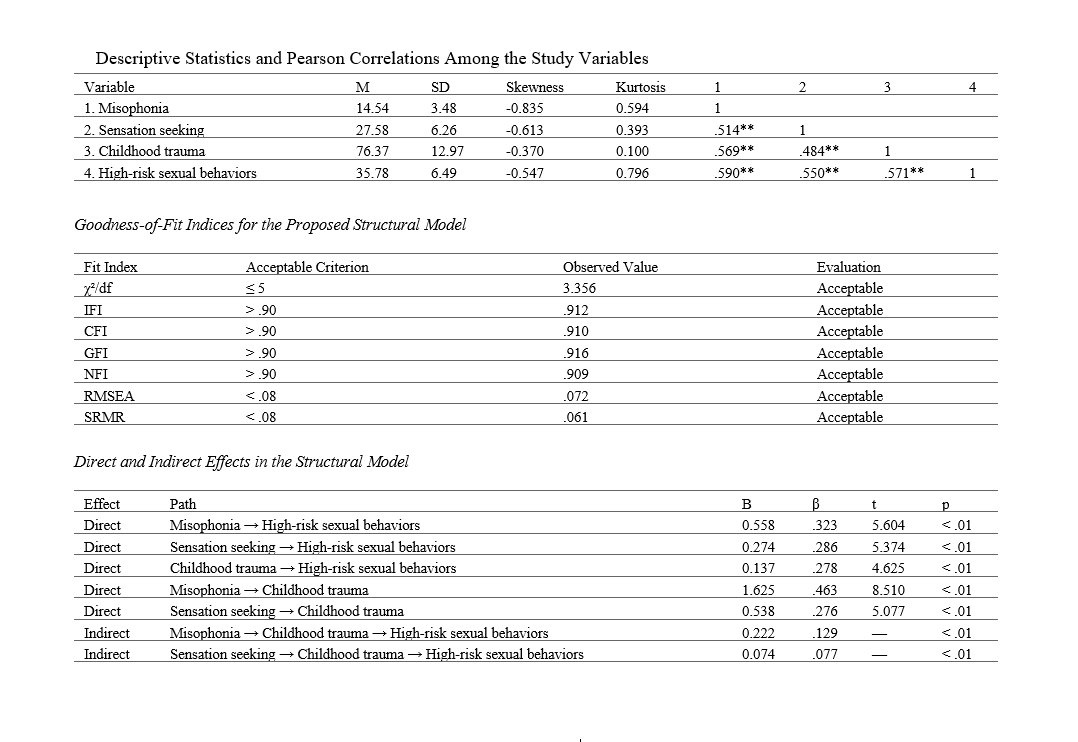
The present study aimed to model the structural relationships of misophonia and sensation seeking with high-risk sexual behaviors through the mediating role of childhood trauma in individuals with psychopathic traits. The study employed a descriptive-correlational design using structural equation modeling (path analysis). The statistical population consisted of individuals with psychopathic traits or a diagnosis of antisocial personality disorder who were identified during 2025–2026 through psychiatric centers, psychological clinics, counseling centers, and Qazvin Central Prison. Using purposive sampling, 240 participants (67 women and 173 men) were selected as the final sample. Data were collected using the Childhood Trauma Questionnaire (Bernstein et al., 2003), the High-Risk Sexual Behaviors Questionnaire (Zarei et al., 2010), the Zuckerman Sensation Seeking Scale (Zuckerman, 1978), and the Amsterdam Misophonia Scale (Schröder et al., 2013). Data were analyzed using correlation and regression analyses in SPSS 27 and structural equation modeling (path analysis) in AMOS. The findings indicated that the proposed conceptual model, incorporating the mediating role of childhood trauma, demonstrated an acceptable fit to the data (χ²/df = 3.356, RMSEA = .072, CFI = .910, GFI = .916, p < .01). All direct relationships among misophonia, sensation seeking, childhood trauma, and high-risk sexual behaviors were positive and statistically significant (p < .01). Furthermore, the mediating role of childhood trauma was confirmed both in the relationship between misophonia and high-risk sexual behaviors (β = .129) and in the relationship between sensation seeking and high-risk sexual behaviors (β = .077; p < .01). These findings suggest that high-risk sexual behaviors among individuals with psychopathic traits may result from the concurrent interplay of heightened emotional-sensory sensitivity (misophonia), a persistent need for stimulation (sensation seeking), and unresolved adverse experiences from childhood (trauma).
Downloads
References
Abbasi, H., Mohammadi, S., & Hassani, F. (2026). Phenomenology of Misophonia in the Iranian Population: A Grounded Theory Study. KMAN Counseling & Psychology Nexus, 4, 1-17. https://doi.org/10.61838/kman.psynexus.6545
Amponsah, E. B., Abdullah, A., Eltigani, B., & Cluver, L. (2024). Risk and Protective Factors of Commercial Sexual Exploitation of Children and Adolescents in Sub-Saharan Africa: A Systematic Review. Trauma Violence & Abuse, 25(4), 3177-3190. https://doi.org/10.1177/15248380241241021
Black, V. K., Allen, K. J. D., Aazh, H., Johnson, S. L., & Erfanian, M. (2026). Misophonia Symptom Severity Is Linked to Impaired Flexibility and Heightened Rumination. British Journal of Psychology, 117(1), 271-300. https://doi.org/10.1111/bjop.70025
Chan, H. C., & Beech, A. (2024). Risky sexual behavior and psychopathy: testing the relationship in a non-clinical sample of young adults in Hong Kong. Behavioral Sciences, 14(2), 94. https://doi.org/10.3390/bs14020094
Charnigo, R., Noar, S. M., Garnett, C., Crosby, R., Palmgreen, P., & Zimmerman, R. S. (2012). Sensation Seeking and Impulsivity: Combined Associations With Risky Sexual Behavior in a Large Sample of Young Adults. The Journal of Sex Research, 50(5), 480-488. https://doi.org/10.1080/00224499.2011.652264
Dubé, V., Tremblay-Perreault, A., Allard-Cobetto, P., & Hébert, M. (2024). Alexithymia as a Mediator between Intimate Partner Violence and Post-Traumatic Stress Symptoms in Mothers of Children Disclosing Sexual Abuse. Journal of family violence, 39(3), 359-367. https://doi.org/10.1007/s10896-023-00512-y
Ghasemi, N., Rezaei, F., & Sadeghi, M. (2022). Influential components in the psychopathology and treatment of female sexual desire disorder from the perspective of Iranian specialists: A qualitative study. Quarterly Journal of Nursing, Midwifery and Paramedical Sciences, 8(1), 82-95.
Humolli, M., Poerio, G., & Simner, J. (2026). Social Context in Misophonia: Does Misophonia Impact Social Judgements (& Do Social Judgements Impact Misophonia)? Hearing Research, 470, 109512. https://doi.org/10.1016/j.heares.2025.109512
Kalichman, S. C., Simbayi, L. C., Jooste, S., Vermaak, R., & Cain, D. (2008). Sensation Seeking and Alcohol Use Predict HIV Transmission Risks: Prospective Study of Sexually Transmitted Infection Clinic Patients, Cape Town, South Africa. Addictive behaviors, 33(12), 1630-1633. https://doi.org/10.1016/j.addbeh.2008.07.020
Kulkarni, J., Leyden, O., Gavrilidis, E., Thew, C., & Thomas, E. H. X. (2022). The prevalence of early life trauma in premenstrual dysphoric disorder (PMDD). Psychiatry research, 308, 114381. https://doi.org/10.1016/j.psychres.2021.114381
Lewin, A. B., Milgram, L., Cepeda, S. L., Karlovich, A., Dickinson, S., Bolen, M., Harmon, S. L., Small, B. J., & Ehrenreich-May, J. (2026). Treatment of Youth Misophonia: A Randomized Controlled Trial Comparing Transdiagnostic Cognitive-Behavioral Therapy to Psychoeducation and Relaxation Training. Behavior therapy, 57(1), 63-78. https://doi.org/10.1016/j.beth.2025.04.006
Murphy-Oikonen, J., Vis, J. A., & Egan, R. (2023). Exploring the Increased Risk of Post-Traumatic Stress Following a Sexual Assault: Implications for Individuals Who Identify as a Sexual Minority. Trauma Care, 3(4), 352-361. https://doi.org/10.3390/traumacare3040029
Salehi, H., Sheykholeslami, A., & Taklavi, S. (2024). The effectiveness of behavioral activation training on sexual satisfaction and sexual assertiveness of women suffering from sexual problems. Journal of Research in Psychopathology, 5(15), 31-38. https://doi.org/10.22098/jrp.2023.13004.1179
Savard, M. A., & Coffey, E. B. J. (2025). Toward Cognitive Models of Misophonia. Hearing Research, 458, 109184. https://doi.org/10.1016/j.heares.2025.109184
Seabra, D., Gato, J., Petrocchi, N., & Salvador, M. d. C. (2023). Shame Experiences and Psychopathology: The Mediating Role of Self-Compassion and Social Support in Sexual Minority Individuals. Journal of Evidence-Based Psychotherapies, 22(1), 137-152. https://doi.org/10.24193/jebp.2023.1.6
Steil, R., Schneider, A., & Schwartzkopff, L. (2021). How to Treat Childhood Sexual Abuse Related PTSD Accompanied by Risky Sexual Behavior: A Case Study on the Use of Dialectical Behavior Therapy for Posttraumatic Stress Disorder (DBT-PTSD). Journal of Child & Adolescent Trauma, 15(2), 471-478. https://doi.org/10.1007/s40653-021-00421-6
Strickland, N. J., Tang, K. T., Wekerle, C., & Stewart, S. H. (2023). Fostering resilience and countering stigma: A qualitative exploration of risk and protective factors for negative psychological consequences among alcohol-involved sexual assault survivors. Psychological Trauma: Theory, Research, Practice, and Policy, 15(6), 1012. https://doi.org/10.1037/tra0001300
Thomas, J. C., & Kopel, J. (2023). Male Victims of Sexual Assault: A Review of the Literature. Behavioral Sciences, 13(4).
Ullete, D., & Lyons, M. A. (2015). Sexual Sensation Seeking, Compulsivity, and HIV Risk Behaviors in College Students. Journal of Community Health Nursing, 22(1), 47-60. https://doi.org/10.1207/s15327655jchn2201_5
Wang, W., Yang, Y., Kelifa, M. O., Li, S., Cao, Y., Li, X., & Yan, H. (2020). Associations Between Personality Traits and Patterns of HIV Risk Behaviors Among Young Men Who Have Sex with Men in China. AIDS Research and Human Retroviruses, 36(9), 775-781. https://doi.org/10.1089/aid.2019.0291
Woolley, M. G., Ramos, A. M., Bowers, E. M., Muñoz, K., Petersen, J. M., & Twohig, M. P. (2025). Recognizing Individual Variability in Misophonia: Identifying Symptom-Based Subgroups with Gaussian Mixture Modeling. Journal of psychiatric research, 184, 232-240. https://doi.org/10.1016/j.jpsychires.2025.02.054
Downloads
Additional Files
Publication Timeline
- Submitted
- Revised
- Accepted