Effectiveness of a Continuous Care Model for Treatment Adherence Based on the ACT Approach on Perceived Stress in Patients with Diabetes
Keywords:
diabetes, perceived stress, continuous care model, Treatment Adherence, Acceptance and Commitment TherapyAbstract
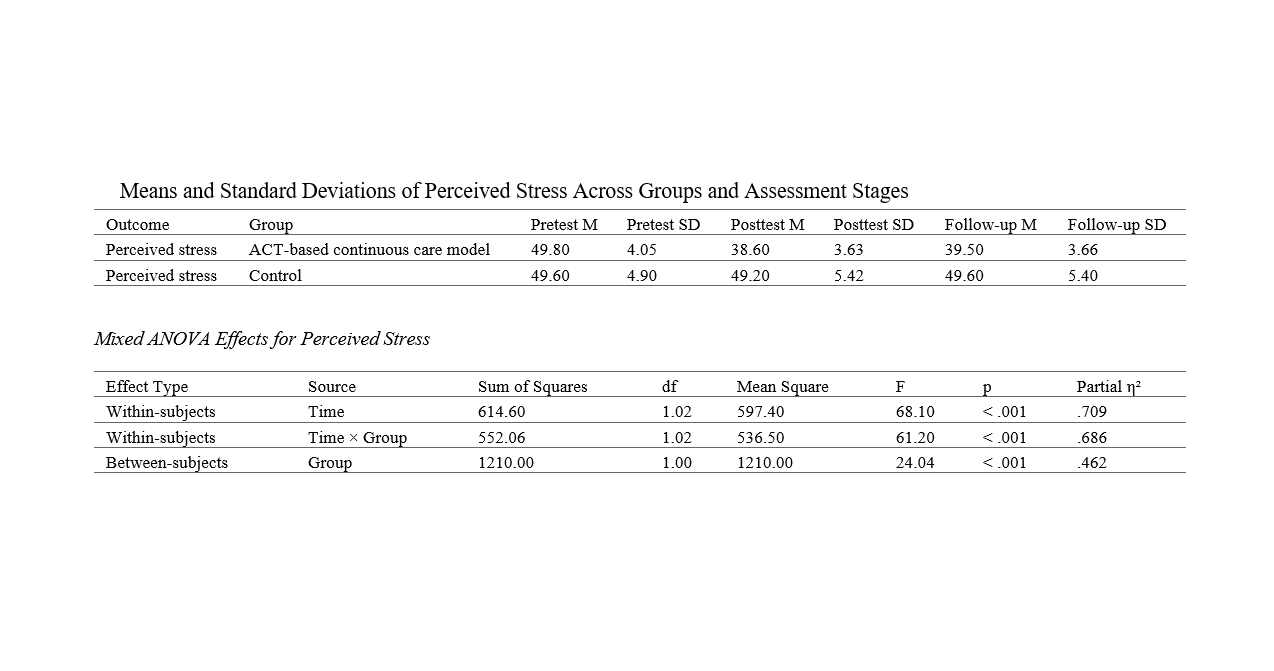
This study aimed to determine the effectiveness of a continuous care model for treatment adherence based on Acceptance and Commitment Therapy (ACT) in reducing perceived stress among patients with diabetes. This quasi-experimental study employed a pretest–posttest control-group design with a two-month follow-up. The statistical population consisted of patients with type 1 or type 2 diabetes living in Isfahan, Iran, in 2024. Thirty eligible participants were selected through purposive sampling and randomly assigned to an experimental group (n = 15) and a control group (n = 15). The experimental group received eight weekly 90-minute sessions of an ACT-based continuous care intervention focused on acceptance, mindfulness, emotional and cognitive experiences, lifestyle adjustment, adherence barriers, coping strategies, and maintenance planning, while the control group received no psychological intervention. Perceived stress was assessed using the Perceived Stress Scale at pretest, posttest, and two-month follow-up. Data were analyzed in SPSS version 26 using mixed repeated-measures analysis of variance after examination of normality, homogeneity of variance, and sphericity assumptions. The mixed ANOVA showed a significant main effect of time on perceived stress, F = 68.10, p < .001, partial η² = .709. The time-by-group interaction was also statistically significant, F = 61.20, p < .001, partial η² = .686, indicating that changes in perceived stress across the three assessment stages differed significantly between the experimental and control groups. In addition, the between-subjects effect of group was significant, F = 24.04, p < .001, partial η² = .462. These findings indicated a substantial intervention-related reduction in perceived stress that was largely maintained at follow-up. The ACT-based continuous care model appears to be an effective psychological intervention for reducing perceived stress in patients with diabetes, with effects that persisted for at least two months after treatment.
Downloads
References
Adiloğlu, Z. (2023). Effectiveness of the Acceptance and Commitment Therapy-Based Intervention Program for Women. Türk Psikolojik Danışma Ve Rehberlik Dergisi, 13(69), 240-255.
Ahmadian, A., Taghipour, B., Alirezaei-Hoor, M., Sabzi, N., Davoodi, S. M., & Mirzapour-Binkalaei, M. (2022). Effectiveness of Acceptance and Commitment Therapy on Coping Styles and Perceived Stress in Infertile Women. Quarterly Journal of New Psychological Research, 17(66), 25-33.
Bigdeli, R., Chinaveh, M., & Jafari, D. (2023). Comparison of Emotion-Focused Therapy and Acceptance and Commitment Therapy on Emotional Self-Regulation and Diabetes-Management Self-Efficacy in Women with Type 2 Diabetes. Diabetes Nursing Quarterly, 11(2), 2142-2159.
Chen, Z., Zhang, Z., Zeng, F., & Wu, S. (2023). Visualizing Detection of Diabetic Liver Injury by a Biomarker-Activatable Probe via NIR-II Fluorescence Imaging. Chemical & Biomedical Imaging, 1(8), 716-724.
Dehghani, A., Korozhdehi, H., Hossein Khalilzadeh, S., Fallahzadeh, H., & Rahmanian, V. (2023). Prevalence of Diabetes and Its Correlates among Iranian Adults: Results of the First Phase of Shahedieh Cohort Study. Health Science Reports, 6(4), e1170. https://doi.org/10.1002/hsr2.1170
Graham, C. D., McCracken, L. M., Harrison, A., Walburn, J., & Weinman, J. (2022). Outlining an Acceptance and Commitment Therapy Approach to Treatment Non-Adherence. British Journal of Health Psychology, 27(1) 1-13. https://doi.org/10.1111/bjhp.12579
Jin, X., Li, H., Chong, Y., Mann, K., Yao, W., & Wong, C. (2023). Feasibility and Preliminary Effects of Acceptance and Commitment Therapy on Reducing Psychological Distress and Improving Quality of Life among Parents of Children with Cancer: A Pilot Randomized Controlled Trial. Psycho-Oncology, 32(1), 165-169.
Maltseva, K. (2024). Stress Exposure, Perceived Stress, Protective Psychosocial Factors, and Health Status in Ukraine after the Full-Scale Invasion. Journal of Health Psychology, 29(14), 1640-1652. https://doi.org/10.1177/13591053241259728
McGloin, H., Devane, D., McIntosh, C. D., Winkley, K., & Gethin, G. (2021). Psychological Interventions for Treating Foot Ulcers, and Preventing Their Recurrence, in People with Diabetes. Cochrane Database of Systematic Reviews, 2(2), CD012835. https://doi.org/10.1002/14651858.CD012835.pub2
Mishu, M. P., Uphoff, E., Aslam, F., Philip, S., Wright, J., Tirbhowan, N., Ajjan, R. A., Al Azdi, Z., Stubbs, B., Churchill, R., & Siddiqi, N. (2021). Interventions for Preventing Type 2 Diabetes in Adults with Mental Disorders in Low- and Middle-Income Countries. Cochrane Database of Systematic Reviews, 2(2), CD013281. https://doi.org/10.1002/14651858.CD013281.pub2
Parker, E. D., Lin, J., Mahoney, T., Ume, N., Yang, G., Gabbay, R. A., ElSayed, N. A., & Bannuru, R. R. (2024). Economic Costs of Diabetes in the U.S. in 2022. Diabetes Care, 47(1), 26-43. https://doi.org/10.2337/dci23-0085
Putri, A., & Rustam, J. S. (2021). Psychological Stress and Long-Term Risk of Type 2 Diabetes Mellitus among Civil Servants: A Prospective Cohort Study. Malaysian Journal of Medical Research, 5(1), 19-24. https://doi.org/10.31674/mjmr.2021.v05i01.004
Rahimi, R., Ahadi, H., Tajeri, B., & Khoshlehjeh-Sedgh, A. (2023). Effectiveness of Acceptance and Commitment Therapy on Perceived Stress, Chronic Pain, and Treatment Adherence in Older Adults with Diabetes. Islamic Lifestyle Centered on Health, 7, 76-85.
Rauwenhoff, J., Bol, Y., van Heugten, C., Batink, T., Geusgens, C., van Hout, A., & Peeters, F. (2023). Acceptance and Commitment Therapy for People with Acquired Brain Injury: Rationale and Description of the BrainACT Treatment. Clinical Rehabilitation, 37(8), 1011-1025.
Rosengren, A., & Dikaiou, P. (2023). Cardiovascular Outcomes in Type 1 and Type 2 Diabetes. Diabetologia, 66(3), 425-437. https://doi.org/10.1007/s00125-022-05857-5
Seyed Alitabar, S. H. (2025a). The Biopsychosocial Model in Modern Healthcare: Overcoming Barriers to Holistic Patient Care. International Journal of Body, Mind and Culture, 12(2), 1-4. https://doi.org/10.61838/ijbmc.v12i2.950
Seyed Alitabar, S. H. (2025b). The Cultural Imprint on the Mind-Body Connection: Rethinking Health beyond the Biomedical Model. International Journal of Body, Mind and Culture, 12(4), 1-4. https://doi.org/10.61838/ijbmc.v12i4.1086
Sharif-Nia, H., Froelicher, E. S., Hoseinzadeh, E., Kaveh, O., Fatehi, R., & Nowrozi, P. (2024). Assessing the Validity and Reliability of the 10-Item Persian Version of the Perceived Stress Scale in Post-Surgery Patients. Frontiers in Psychiatry, 15, 1402122. https://doi.org/10.3389/fpsyt.2024.1402122
Stefanescu, C., Tatu, A. L., Nechita, A., Iacob, C. I., Secara, E., Nicolescu, S., & Huiu, G. A. (2024). Brief Online Acceptance and Commitment Therapy for Adults with Type 1 Diabetes: A Pilot Study. Frontiers in Clinical Diabetes and Healthcare, 5, 1378946. https://doi.org/10.3389/fcdhc.2024.1378946
Downloads
Additional Files
Publication Timeline
- Submitted
- Revised
- Accepted