Comparison of the Effectiveness of Existential Therapy and Schema Therapy on Marital Self-Regulation in Married Women with Multiple Sclerosis
Keywords:
Existential Therapy, Schema Therapy, Marital Self-Regulation, Relational Self-Regulation, Multiple Sclerosis, Married WomenAbstract
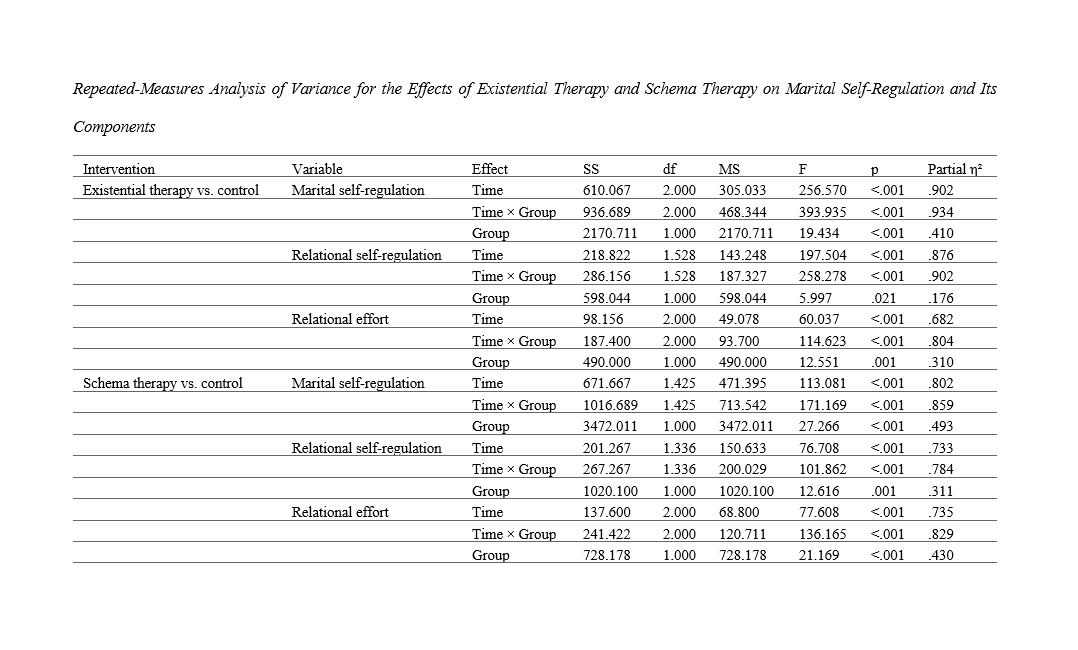
This study aimed to compare the effectiveness of existential therapy and schema therapy on marital self-regulation and its components in married women with multiple sclerosis. This quasi-experimental study employed a pretest-posttest control-group design with a three-month follow-up. The statistical population included married women with multiple sclerosis receiving services from the Iranian Multiple Sclerosis Society, Tehran Branch, during the first six months of 2026. Forty-five eligible participants were selected through purposive sampling and randomly assigned to existential therapy, schema therapy, and control groups, with 15 participants in each group. The two experimental groups received 10 weekly group sessions of existential therapy or schema therapy, while the control group received no psychological intervention during the study period. Marital self-regulation was assessed using the 16-item Marital Self-Regulation Questionnaire at pretest, posttest, and follow-up. Data were analyzed using repeated-measures analysis of variance and LSD post-hoc comparisons. Repeated-measures analysis showed significant time, group, and time-by-group interaction effects for marital self-regulation and its components in both intervention comparisons (p < .05). For existential therapy, the time-by-group interaction was significant for marital self-regulation (F = 393.935, p < .001, partial η² = .934), relational self-regulation (F = 258.278, p < .001, partial η² = .902), and relational effort (F = 114.623, p < .001, partial η² = .804). For schema therapy, significant interaction effects were also observed for marital self-regulation (F = 171.169, p < .001, partial η² = .859), relational self-regulation (F = 101.862, p < .001, partial η² = .784), and relational effort (F = 136.165, p < .001, partial η² = .829). LSD comparisons indicated that both interventions significantly outperformed the control group at posttest and follow-up, whereas differences between existential therapy and schema therapy were not statistically significant (p > .05). Both existential therapy and schema therapy were effective in improving marital self-regulation and its components in married women with multiple sclerosis, and neither intervention demonstrated statistically significant superiority over the other.
Downloads
References
Abbasi, M., Ghanbari, S., & Nazari, M. (2022). The role of existential emptiness in predicting marital dissatisfaction. Journal of Family Counseling and Psychotherapy, 12(4), 45-61.
Abdekhodaie, Z. (2021). Cognitive-Behavioral and Existential Therapies for Marital Satisfaction in Women: A Comparative Investigation of the Efficacy, Stability and Mechanisms of Changes. Journal of Contemporary Psychotherapy, 51(2), 173-179. https://doi.org/10.1007/s10879-020-09488-y
Bozkaya, A. (2026). The Effect of Early Maladaptive Schemas on Marital Dynamics in Married Individuals: A Model of Happiness, Relationship Satisfaction, and Perceived Power in the Relationship. International Journal of Social Science and Human Research, 9(3), 2043-2050. https://doi.org/10.47191/ijsshr/v9-i3-42
Dahmani, Z., Asgharnejad Farid, A. A., & Golpour, R. (2025). Comparing the effectiveness of existential psychotherapy and acceptance and commitment therapy on fear of intimacy and sexual self-expression in women with marital conflicts. Knowledge and research in applied psychology, 26(100), 121-141.
Dinparast, O., Qotb, S. I., & Rasouli, N. (2024). Comparing the Effects of Schema Therapy and Mindfulness Techniques on Sleep Disorders in Individuals with Multiple Sclerosis. Journal Name Not Provided. https://www.sid.ir/fileserver/jf/300811402sup23.pdf
Farmani Shahreza, S., Khani, S., Ghaedaniay Jahromi, A., & Imani, S. (2019). Effectiveness of Cognitive-Existential Therapy on Fatigue, Demoralization Syndrome and Perceived Stress in Patients with Multiple Sclerosis (MS). Alborz-Health, 8(2), 135-149. https://doi.org/10.29252/aums.8.2.135
Hajibabaei, M., Kajbaf, B., Harirchian, M. H., & Montazeri, A. (2020). Impact of an Existential-Spiritual Intervention Compared With a Cognitive-Behavioral Therapy on Quality of Life and Meaning in Life Among Women With Multiple Sclerosis. Iranian Journal of Psychiatry. https://doi.org/10.18502/ijps.v15i4.4298
Hashemi Fesharaki, S. S., & Salehi, M. (2026). Comparing Schema Therapy and Cognitive-Behavioral Therapy on Psychological Distress and Forgiveness in Divorced Women Affected by Marital Infidelity. Quarterly Journal of New Psychological Research, 21(81), 148-165.
Hicks, T., Johnson, L., & Miller, R. (2026). Schema Modes and Relationship Conflict: Cognitive Emotional Predictors of Romantic Instability. Journal of marital and family therapy, 52(1), 88-103.
Hosseini Kiasari, S. T., Ghamari Kivi, H., & Khaleghkhah, A. (2014). The effectiveness of cognitive-existential group therapy on depression, anxiety and stress in patients with multiple sclerosis (MS). Majalle-ye Daneshgah-e Olum-e Pezeshki-ye Mazandaran, 24(122), 368-372. https://search.ebscohost.com/login.aspx?direct=true&profile=ehost&scope=site&authtype=crawler&jrnl=17359260&AN=114301747&h=CEhmQcrDnPX0s72OD7rnRtXNW44zxo%2BSPywyhG8tGRoOa2H9%2FN9KI%2BO1Mzg1lSyQZyhFwTa3qSkuxrdXKVt%2FOw%3D%3D&crl=c
Karbasdehi, R., Ebrahim, Abolghasemi, A., Hosein, K., & Rahbar, K. (2021). Effectiveness of Acceptance and Commitment Therapy on Cognitive Emotion Regulation and Existential Anxiety in Patients with Multiple Sclerosis. Clinical Psychology and Personality, 18(2), 1-9. https://cpap.shahed.ac.ir/article_3220_en.html
Khanlari Aziz, S., Shahgholian, M., & Abdollahi, M. H. (2023). Predicting the Mental Health of Multiple Sclerosis (MS) Patients Based on Relationship Quality, Early Maladaptive Schemas, and Fear of Disease Progression. Iranian Evolutionary Educational Psychology Journal, 5(3), 231-244.
Mansourzadeh, A., Shaygannejad, V., Mirmosayyeb, O., Afshari-Safavi, A., & Gay, M. C. (2024). Effectiveness of schema therapy on anxiety, depression, fatigue, quality of life, and sleep in patients with multiple sclerosis: A randomized controlled trial. Middle East Journal of Rehabilitation and Health Studies, 11(1), e132571. https://doi.org/10.5812/mejrh-132571
Mazarei Sotoudeh, A., Bakhshipour, A., & Jajarmi, M. (2022). The Effectiveness of Existential Group Therapy on Increasing Intimacy and Marital Satisfaction in Married Depressed Women. Razi Journal of Medical Sciences, 29(2), 39-50.
Namdari, M. (2013). The effectiveness of existential group therapy on resilience and hope among married women with multiple sclerosis [Master's thesis, Kharazmi University].
Nameni, E., Jajarmi, M., & Soliemanian, A. (2021). Comparison of the Effectiveness of Existential Therapy and Compassion-based therapy on Psychological Well-being and Marital Disturbance of Conflicting Women. Journal of Sabzevar University of Medical Sciences, 28(4), 608-620. https://jsums.medsab.ac.ir/article_1450_23870c2330fc5c68434926fb98fa5235.pdf?lang=en
Nazari, A., Saedi, S., & Abdi, M. (2023). Comparing the effectiveness of schema therapy and acceptance and commitment therapy on chronic fatigue syndrome in patients with multiple sclerosis. Journal of Personality and Psychosomatic Research (JPPR), 1(1), 25-28. https://doi.org/10.61838/kman.jppr.1.1.6
Parast, O. D., Rasouli, N., & Ghotb, S. I. (2024). Comparison of the Effect of Schema Therapy and Mindfulness Technique on Existential Anxiety in Individuals With Multiple Sclerosis. Jayps, 5(6), 145-155. https://doi.org/10.61838/kman.jayps.5.6.16
Rezapour Mirsaleh, Y., Aryanpour, H., Amini, R., & Fallah, T. (2020). The effectiveness of existential therapy on marital forgiveness and family functioning in women affected by marital infidelity. Clinical Psychology and Counseling Research, 10(2), 105-122.
Shoaa Kazemi, M., Hamamra, B., Hosseini, S., Bdier, D., & Mahamid, F. (2026). Predicting Marital Infidelity Based on Incompatible Mental Schemas and Emotional Divorce in Women Referring to Counseling Centers in Iran. Journal of Ethnicity in Substance Abuse. https://doi.org/10.1080/15332640.2026.2631710
Downloads
Additional Files
Publication Timeline
- Submitted
- Revised
- Accepted