Pathways to Psychological Resilience: The Mediating Roles of Cognitive Emotion Regulation and Social Support in the Link Between Ego Strength and Adaptation to Type II Diabetes
Keywords:
Cognitive emotion regulation strategies, Social support, Ego strength, Disease adaptation, Type II diabetesAbstract
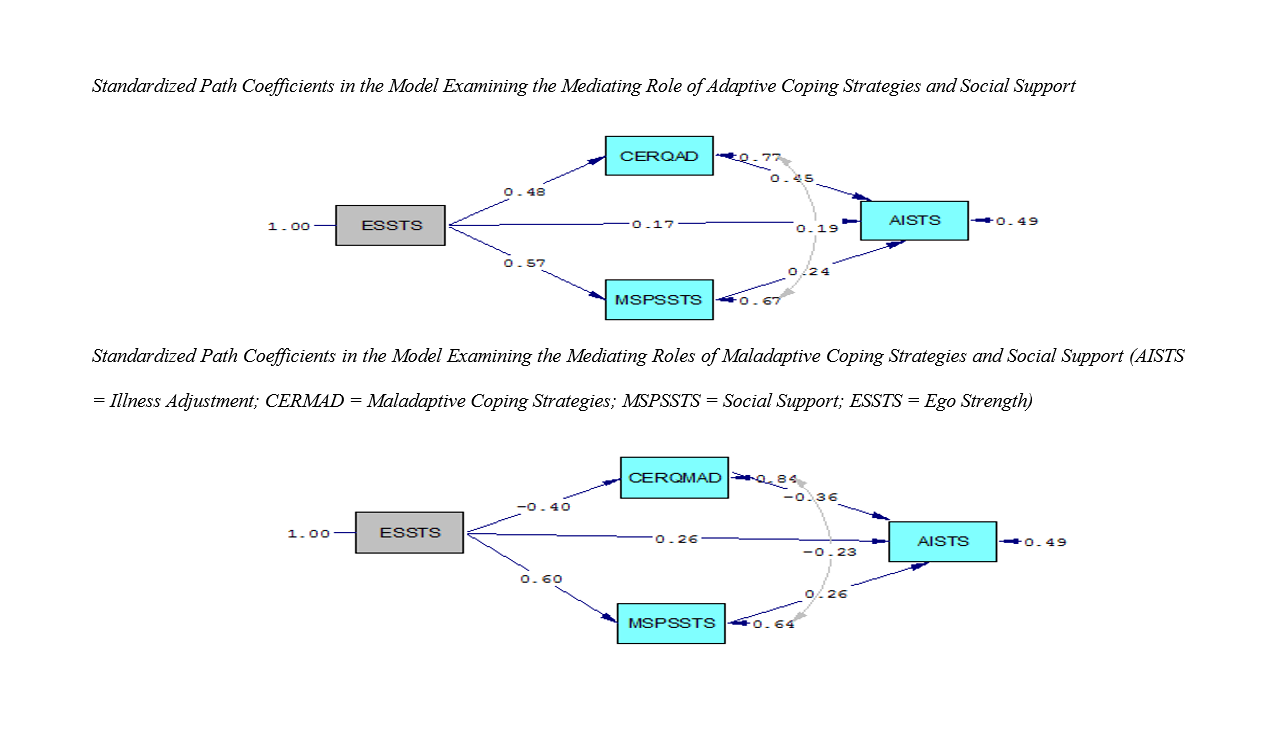
This study aimed to investigate the mediating roles of cognitive emotion regulation strategies and social support in the relationship between ego strength and adaptation to type II diabetes. This descriptive-correlational study employed a path analysis design. The statistical population consisted of patients with type II diabetes aged 30–75 years who attended the Taban Diabetes Clinic in Tehran, Iran. A total of 250 patients were selected through random sampling. Data were collected using standardized questionnaires assessing ego strength, cognitive emotion regulation strategies, perceived social support, and adaptation to diabetes. Two mediation models were examined to distinguish the roles of adaptive and maladaptive cognitive emotion regulation strategies. Structural relationships among the study variables and the significance of direct and indirect effects were evaluated using structural equation modeling and path analysis in AMOS software. Structural equation modeling demonstrated that ego strength had a significant direct effect on adaptation to type II diabetes and also exerted significant indirect effects through cognitive emotion regulation strategies and social support. Adaptive cognitive emotion regulation strategies significantly mediated the relationship between ego strength and disease adaptation, with an indirect effect of 0.21. Social support also showed a significant positive mediating effect, with an indirect effect of 0.14. In the alternative model, maladaptive cognitive emotion regulation strategies significantly mediated the association between ego strength and adaptation in a negative direction, with an indirect effect of −0.14. Thus, higher ego strength was associated with better adaptation through greater use of adaptive regulatory strategies and stronger social support, whereas maladaptive strategies constituted a negative pathway linking psychological functioning to disease adaptation. Ego strength contributes to adaptation to type II diabetes through both direct and mediated psychological and social pathways. Adaptive cognitive emotion regulation and social support facilitate successful adjustment, whereas maladaptive emotion regulation may undermine adaptation.
Downloads
References
Akbarzadeh, Y., & Hashemi, S. (2024). Prediction of psycho-social adjustment to illness based on health locus of control with the mediation of perceived social support in women with polycystic ovary syndrome. Journal of Health Promotion Management, 13(2), 14-26.
Arunraj, M., Vijay, V., Kumpatla, S., & Viswanathan, V. (2025). The effect of progressive muscle relaxation therapy on diabetes distress & anxiety among people with type 2 diabetes. The Indian Journal of Medical Research, 161(1), 72. https://doi.org/10.25259/IJMR_1227_2024
Besharat, M. A., & Ramesh, S. (2019). The relation between resilience, spiritual well-being, and social support with adjustment to heart disease. Health and Development Journal, 8(1), 1-15.
Feng, W., Wu, H., Ma, H., Yin, Y., Tao, Z., Lu, S., Zhang, X., Yu, Y., Wan, C., & Liu, Y. (2025). Deep Learning Based Prediction of Depression and Anxiety in Patients with Type 2 Diabetes Mellitus Using Regional Electronic Health Records. International Journal of Medical Informatics, 105801. https://doi.org/10.1016/j.ijmedinf.2025.105801
Garandeau, C. F., Turunen, T., Trach, J., & Salmivalli, C. (2025). Admitting to bullying others or denying it: Differences in children's psychosocial adjustment and implications for intervention. International Journal of Behavioral Development, 49(1), 1-11. https://doi.org/10.1177/01650254241242690
Garavand, H. (2023). The Role of Cognitive Flexibility in Corona Anxiety in Undergraduate Students: The Mediation of Cognitive Emotion Regulation. Positive Psychology Research, 9(1), 65-86.
Geetha, A., Mala, T., Priyanka, D., & Uma, E. (2024). Multimodal emotion recognition with deep learning: advancements, challenges, and future directions. Information Fusion, 105, 102218. https://doi.org/10.1016/j.inffus.2023.102218
Ghashghaee, S. A. K., Javidi, H., Baghouli, H., & Barzegar, M. (2024). A Comparison of Cognitive Emotion Regulation Strategies, Anxiety Sensitivity and Parenting Style among Mothers Whose Adolescents Show or Do not Show Anxiety Symptoms. Quarterly Journal of Psychological Methods and Models Winter, 14(54).
Gross, J. J. (2024). Conceptual foundations of emotion regulation.
Holt, R. I., Cockram, C. S., Ma, R. C., & Luk, A. O. (2024). Diabetes and infection: review of the epidemiology, mechanisms and principles of treatment. Diabetologia, 67(7), 1168-1180. https://doi.org/10.1007/s00125-024-06102-x
Jafarvand, E., Ataey, A., & Edalati, S. (2021). Epidemiology and death trends due to diabetes in Iran. Internal Medicine Today, 27(2), 198-213. https://doi.org/10.32598/hms.27.2.2764.1
Jahangiri, J., Ranjbaripour, T., Pashang, S., & Tarimoradi, A. (2022). Designing and Testing the Prediction Model of Adaptation to Pain Based on Attachment Style and Ego Strength with the Mediating Role of Cognitive Emotion Regulation in Patients with Rheumatoid Arthritis in Tehran in 2021: A Descriptive Study. Journal of Rafsanjan University of Medical Sciences, 21(6), 625-642. https://doi.org/10.52547/jrums.21.6.625
Jang, Y., & Yang, Y. (2025). Effects of e-health literacy on health-related quality of life in young adults with type 2 diabetes: Parallel mediation of diabetes self-efficacy and self-care behaviors. Applied Nursing Research, 151917. https://doi.org/10.1016/j.apnr.2025.151917
Jastreboff, A. M., le Roux, C. W., Stefanski, A., Aronne, L. J., Halpern, B., Wharton, S., Wilding, J. P., Perreault, L., Zhang, S., & Battula, R. (2025). Tirzepatide for obesity treatment and diabetes prevention. New England Journal of Medicine, 392(10), 958-971. https://doi.org/10.1056/NEJMoa2410819
Karakolias, S., & Iliopoulou, A. (2025). Health-Related Quality of Life and Psychological Burden Among and Beyond Children and Adolescents With Type 1 Diabetes: A Family Perspective. Cureus, 17(4). https://doi.org/10.7759/cureus.81744
Mohammadi, M., Shagholian, M., & Abdollahi, M. H. (2024). The mediating role of ego strength in the effect of attachment styles on executive functions of people with mild cognitive impairment. Advances in Cognitive Science, 25(4), 17-32.
Rahimzadegan, S., Basharpour, S., Mikaeili, N., & Narimani, M. (2022). Causal modeling of psychological adjustment to disease in cancer patients based on emotion regulation and self-compassion with the mediating role of spiritual health. Navid No, 25(82), 13-26.
Rast, A., Aflakseir, A., Petramfar, P., & Kazemi Rezaei, S. V. (2022). The Role of Disease Perception, Religious Coping Strategies, and Cognitive Regulation of Emotion in Predicting Adaptation to the Disease in People with Multiple Sclerosis (MS). Sadra Medical Journal, 10(3), 267-284.
Restoy, D., Oriol-Escudé, M., Alonzo-Castillo, T., Magán-Maganto, M., Canal-Bedia, R., Díez-Villoria, E., Gisbert-Gustemps, L., Setién-Ramos, I., Martínez-Ramírez, M., & Ramos-Quiroga, J. A. (2024). Emotion regulation and emotion dysregulation in children and adolescents with Autism Spectrum Disorder: A meta-analysis of evaluation and intervention studies. Clinical psychology review, 102410. https://doi.org/10.1016/j.cpr.2024.102410
Rodríguez-Rubio, P., Martín-Ávila, J., Rodríguez-Jiménez, E., Valero-Moreno, S., Montoya-Castilla, I., & Pérez-Marín, M. (2025). Emotional Contagion Among Adolescents with Type 1 Diabetes Mellitus (T1DM) and Their Primary Caregivers: Benefits of Psychological Support for Family Systems in Pilot Study. Children, 12(2), 151. https://doi.org/10.3390/children12020151
Shi, L. (2025). The integration of advanced AI-enabled emotion detection and adaptive learning systems for improved emotional regulation. Journal of Educational Computing Research, 63(1), 173-201. https://doi.org/10.1177/07356331241296890
Song, P., Guo, D., Yang, X., Tang, S., & Wang, M. (2024). Emotional video captioning with vision-based emotion interpretation network. IEEE Transactions on Image Processing, 33, 1122-1135. https://doi.org/10.1109/TIP.2024.3359045
Stubley, T., & McCroy, C. (2024). Psychosocial adjustment (Includes psychosocial functioning and well-being). In Encyclopedia of quality of life and well-being research (pp. 5574-5577). Springer. https://doi.org/10.1007/978-3-031-17299-1_2316
Tamir, M., Ito, A., Miyamoto, Y., Chentsova-Dutton, Y., Choi, J. H., Cieciuch, J., Riediger, M., Rauers, A., Padun, M., & Kim, M. Y. (2024). Emotion regulation strategies and psychological health across cultures. American psychologist, 79(5), 748. https://doi.org/10.1037/amp0001237
Teymouri, Z., Mojtabaei, M., & Rezazadeh, S. M. R. (2020). The effectiveness of emotionally focused couple therapy on emotion regulation, anger rumination, and marital intimacy in women affected by spouse infidelity. Caspian Journal of Health Research, 5(4), 78-82. https://doi.org/10.52547/cjhr.5.4.78
Tomic, D., Harding, J. L., Jenkins, A. J., Shaw, J. E., & Magliano, D. J. (2025). The epidemiology of type 1 diabetes mellitus in older adults. Nature Reviews Endocrinology, 21(2), 92-104. https://doi.org/10.1038/s41574-024-01046-z
Zidan, M., & Hmooud, M. A. (2024). Social anxiety and its relationship to ego strength in university students. Social Empowerment Journal, 6(2), 27-48. https://doi.org/10.34118/sej.v6i2.3913
Downloads
Additional Files
Publication Timeline
- Submitted
- Revised
- Accepted