Development of an Integrative Intervention Combining Emotion-Focused Couple Therapy and the Relationship Enhancement Model and Evaluation of Its Effectiveness on Family Resilience and Posttraumatic Stress in Couples Experiencing Marital Infidelity
Keywords:
posttraumatic stress, family resilience, marital infidelity, Emotion-Focused Couple Therapy, Relationship Enhancement, marital relationship qualityAbstract
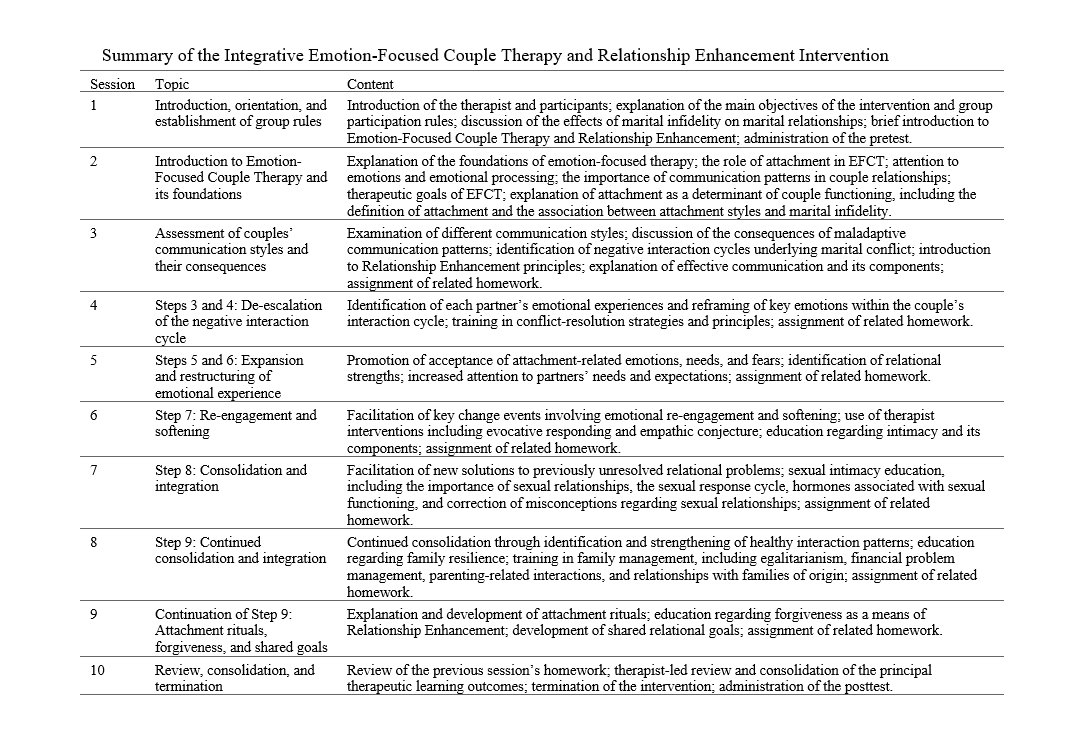
This study aimed to develop an integrative intervention combining Emotion-Focused Couple Therapy and the Relationship Enhancement model and to evaluate its effectiveness in improving family resilience and reducing posttraumatic stress among couples experiencing marital infidelity. The study used a mixed qualitative–quantitative design. In the qualitative phase, inductive thematic analysis was conducted on 28 relevant academic sources, and the resulting 10-session intervention protocol was evaluated by 15 experts in psychology and family counseling. Content validity was assessed using the Content Validity Ratio (CVR) and Content Validity Index (CVI). In the quantitative phase, a quasi-experimental pretest–posttest control-group design with a two-month follow-up was employed. Thirty couples experiencing marital infidelity and attending counseling centers in Tehran during winter 2024–2025 were purposively recruited and randomly assigned to experimental and control groups; after attrition, 28 couples remained. The experimental group received the 10-session integrative intervention, whereas the control group continued routine services. Data were collected using the Family Resilience Questionnaire and Posttraumatic Stress Questionnaire and analyzed using mixed-design ANOVA and Bonferroni post hoc tests in SPSS version 23. The intervention demonstrated acceptable content validity, with CVR values ranging from .600 to .866 and CVI values from .800 to .933. Significant Time × Group interaction effects were found for family resilience, F(2, 108) = 89.01, p < .001, ηp² = .62, and posttraumatic stress, F(2, 108) = 101.46, p < .001, ηp² = .65. Significant interaction effects were also observed for problem solving, social resources, acceptance of problems, re-experiencing, emotional numbing, and hyperarousal (all p < .001). Bonferroni comparisons showed significant pretest-to-posttest and pretest-to-follow-up improvements, whereas posttest-to-follow-up differences were nonsignificant. The integrative Emotion-Focused Couple Therapy and Relationship Enhancement intervention appears to be an effective and relatively stable approach for strengthening family resilience and reducing posttraumatic stress among couples affected by marital infidelity.
Downloads
References
Aignesberger, V., & Greitemeyer, T. (2024). Morality in romantic relationships: The role of moral disengagement in relationship satisfaction, definitions of infidelity, and committed cheating. Personal Relationships, 12, 1-22.
Chen, F., & Luo, W. (2026). The role of assortative mating in marital infidelity: Insights from China. Social science research, 133, 1032-1035. https://doi.org/10.1016/j.ssresearch.2025.103280
Elyasi, F., Mirzahosseini, H., & Sharifi Rad, G. (2024). The effectiveness of a group marital enrichment program using Gottman's method on difficulties in emotion regulation, communication patterns, and attachment styles among couples in Qom Province. Rooyesh-e-Ravanshenasi, 13(12), 43-54.
Firouzi, M., Golparvar, M., & Aghaei, A. (2022). Comparing the effectiveness of emotionally focused couple therapy, cognitive behavioral couple therapy, and Gottman's systemic-cognitive couple therapy on affective balance and dysfunctional expectations in women with symptoms of sexual dysfunction. Iranian Journal of Psychiatric Nursing, 10(1), 1-17.
Ghasemi, F., Afsharinia, K., & Amiri, H. (2023). Comparing the effectiveness of emotionally focused couple therapy and cognitive behavioral couple therapy on couple burnout. Razi Journal of Medical Sciences, 30(3), 81-90.
Ghiasi, N., Rasoal, D., Haseli, A., & Feli, R. (2024). The interplay of attachment styles and marital infidelity: A systematic review and meta-analysis. Heliyon, 10(1), 232-236.
Goldstein, Z., Goldman, R., & Rollet, D. (2026). Emotion-focused therapy. In L. Hoffman, L. X. Vallejos, D. Hocoy, P. Tummala-Narra, & E. M. DeRobertis (Eds.), APA handbook of humanistic and existential psychology: Clinical and social applications (pp. 369-388). American Psychological Association. https://doi.org/10.1037/0000432-019
Greenman, P. S., Campbell, T. L., & Allan, R. (2024). Attachment, emotion, and change: Emotionally focused individual therapy (EFIT) within a process-based therapy (PBT) framework. Journal of Contextual Behavioral Science, 32, 1007-1011.
Greenman, P. S., & Johnson, S. M. (2022). Emotionally focused therapy: Attachment, connection, and health. Current opinion in psychology, 43, 146-150.
Henry, M. C., Burks-Wright, M. A., & Robertson, D. (2025). Emotionally focused therapy in sexually diverse intimate partnerships. The Family Journal, 34(1), 1026-1029. https://doi.org/10.1177/10664807251378706
Hesami, S., & Sotoudeh, F. (2022). The effect of Olson's marital relationship enrichment training on couples' marital quality of life. New Ideas in Psychology, 15(19), 75-78.
Hosseini, F., & Hossein Chari, M. (2013). Examining evidence of the validity and reliability of the Family Resilience Scale. Quarterly Journal of Family Counseling and Psychotherapy, 3(2), 181-209. https://dorl.net/dor/20.1001.1.22516654.1392.3.2.2.6
Hosseini, F. S., & Hosseinchari, M. (2014). The survey of validation and reliability of Family Resiliency Scale. Quarterly Journal of Family Counseling and Psychotherapy, 3(2), 181-209. https://dorl.net/dor/20.1001.1.22516654.1392.3.2.2.6
Kazemi, A., Bani Jamali, S., Ahadi, H., & Farrokhi, N. (2012). Examining the effectiveness of cognitive behavioral strategy training in reducing secondary posttraumatic stress disorder symptoms and psychological problems among spouses of veterans with chronic war-related PTSD. Medical Sciences Journal of Islamic Azad University, 22(2), 122-129.
Ke, J., Lin, J., Lin, X., Chen, W., & Huang, F. (2023). Dyadic effects of family resilience on quality of life in patients with lung cancer and spousal caregivers: The mediating role of dyadic coping. European Journal of Oncology Nursing, 66, 1024-1028.
Khojasteh Mehr, R., Shirmardi, S., Omidian, M., & Soudani, M. (2023). The effectiveness of an emotion-focused marital enrichment program in improving couples' marital virtues. Positive Psychology Research, 9(1), 1-26.
Kılıçarslan, S., & Parmaksız, I. (2023). The mediator role of effective communication skills on the relationship between plumbing tendencies and marriage satisfaction in married individuals. Computers in human Behavior, 147, 1078-1082.
Kim, S. H., & Im, Y. J. (2024). Factors related to post-traumatic stress disorder symptoms among intensive care unit nurses. Asian Nursing Research, 18(2), 159-166.
Li, X., & Liu, Q. (2020). Parent–grandparent coparenting relationship, marital conflict and parent–child relationship in Chinese parent–grandparent coparenting families. Children and Youth Services Review, 109, 104-108.
Menteş, A., & Yıldırım, I. (2024). The effect of marriage enrichment program on spousal burnout of married women. Turkish Journal of Counseling Psychology and Guidance, 14(72), 124-136.
Mohagheghi, H., & Roshanai, M. (2022). The effect of emotionally focused couple therapy on posttraumatic stress disorder resulting from marital infidelity. Research in Behavioral Sciences, 20(2), 305-316.
Pourrahimi, J., Zeinali, A., & Shaker Dolagh, A. (2025). The effectiveness of emotionally focused couple therapy on marital burnout and dysfunctional attitudes in couples experiencing emotional divorce. Journal of Psychological Science, 24(148), 137-152.
Ragucci, F., Dragan, M., Cuomo, A., Fagiolini, A., & Pozza, A. (2024). Psychological interventions for post-traumatic stress disorder in women survivors of intimate partner violence: A systematic review and meta-analysis. Journal of Affective Disorders Reports, 17, 1008-1012.
Rouhi Karimi, T., Shirazi, M., & Sanagouye Moharrer, G. (2021). Examining the effectiveness of cognitive behavioral couple therapy on resilience and quality of life among women affected by marital infidelity. Disability Studies, 11(1), 111-124.
Sobhaninia, A., Abbaspour, Z., & Kian Ersi, S. (2025). The effectiveness of a couple relationship enrichment program based on the transition to parenthood on tolerance and relationship maintenance strategies. Counseling Culture and Psychotherapy.
Stroeh, O. M., Hirose, S., Yoon, M. Y., Yao, X., & Rendleman, R. (2023). Managing interfamilial conflict: Catching the bullet from emotionally focused therapy. Journal of the American Academy of Child & Adolescent Psychiatry, 62(10), 422-427.
Wei, M., Adler-Baeder, F., McGill, J. M., & Novak, J. R. (2024). Healthy couple, better sleep: Exploring connections and changes in couple relationship education participants. Family Process, 63(3), 218-227.
Zhu, Y., Zhang, L., Zhou, X., Li, C., & Yang, D. (2021). The impact of social distancing during COVID-19: A conditional process model of negative emotions, alienation, affective disorders, and post-traumatic stress disorder. Journal of affective disorders, 281, 131-137.
Downloads
Additional Files
Publication Timeline
- Submitted
- Revised
- Accepted