Comparing the Effectiveness and Durability of Acceptance and Commitment Therapy, Cognitive Behavioral Therapy, and Their Combination with Repetitive Transcranial Magnetic Stimulation on Sleep Quality in Patients with Multiple Sclerosis
Keywords:
Multiple Sclerosis, Sleep Quality, Acceptance and Commitment Therapy, Cognitive Behavioral Therapy, Repetitive Transcranial Magnetic StimulationAbstract
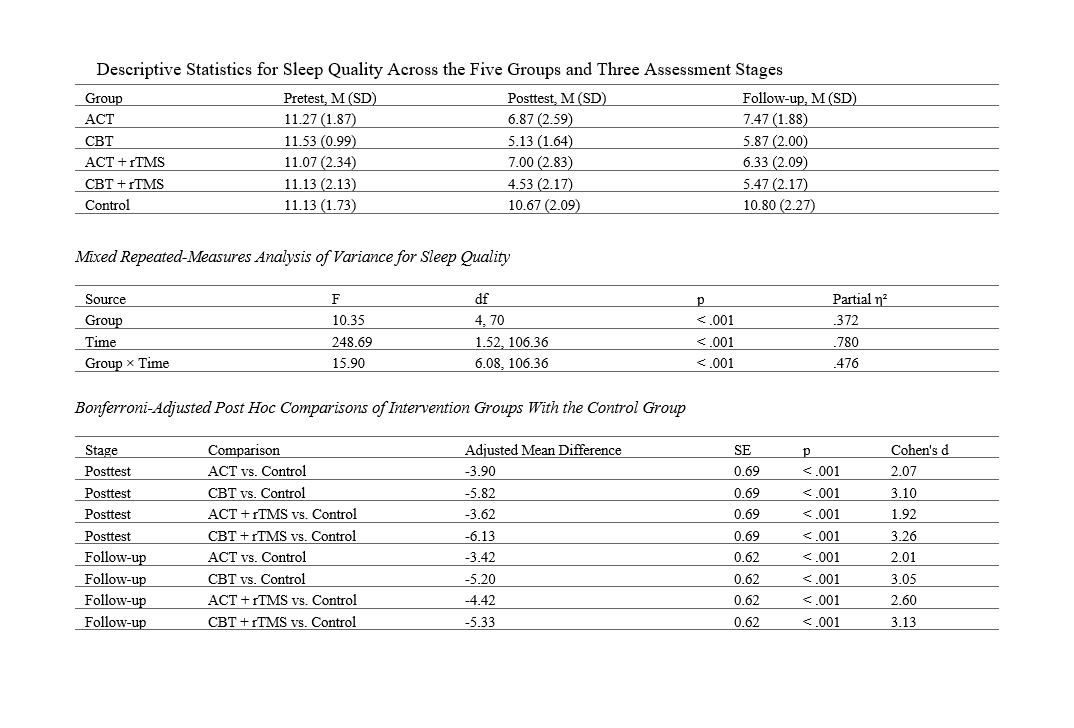
This study aimed to compare the effectiveness and durability of Acceptance and Commitment Therapy (ACT), Cognitive Behavioral Therapy (CBT), and the combination of each intervention with repetitive transcranial magnetic stimulation (rTMS) on sleep quality in patients with multiple sclerosis. This applied quantitative study used a longitudinal multigroup quasi-experimental design with pretest, posttest, and follow-up assessments. The statistical population consisted of patients with a confirmed diagnosis of multiple sclerosis in Kerman, Iran, in 2025. Seventy-five eligible patients were selected through convenience sampling and randomly allocated to five groups of 15 participants: ACT, CBT, ACT + rTMS, CBT + rTMS, and control. The ACT and CBT groups received 12 weekly 90-minute group sessions. Participants in the combined groups additionally received 30 sessions of high-frequency rTMS over the left dorsolateral prefrontal cortex at 10 Hz and 120% of the resting motor threshold. Sleep quality was assessed using the Pittsburgh Sleep Quality Index at pretest, posttest, and follow-up. Data were analyzed using mixed repeated-measures analysis of variance with Greenhouse-Geisser correction and Bonferroni-adjusted post hoc comparisons in SPSS version 26. The mixed repeated-measures analysis revealed significant effects of group, F(4,70) = 10.35, p < .001, partial η² = .372, time, F(1.52,106.36) = 248.69, p < .001, partial η² = .780, and Group × Time interaction, F(6.08,106.36) = 15.90, p < .001, partial η² = .476. Bonferroni-adjusted comparisons showed that all four intervention groups had significantly better sleep quality than the control group at both posttest and follow-up (all p < .001). The largest posttest effect relative to the control group was observed for CBT + rTMS (d = 3.26), followed by CBT (d = 3.10), ACT (d = 2.07), and ACT + rTMS (d = 1.92). ACT, CBT, and their combinations with rTMS significantly improved sleep quality in patients with multiple sclerosis, and the effects remained evident at follow-up, with CBT + rTMS showing the strongest immediate therapeutic effect.
Downloads
References
Ebrahimi, F., Barghi irani, Z., & Ali Akbari, M. (2023). Comparison of Cognitive-Behavioral Therapy and Acceptance and Commitment Therapy in Reducing Mood Swings, Sleep Quality and Sexual Performance in Postmenopausal Women. Health Psychology, 11(44), 73-88. https://doi.org/10.30473/hpj.2023.59513.5289
Emami Khotbesara, Z., Mahdian, H., & Bakhshipour, A. (2024). Comparing the Effectiveness of Academic Buoyancy and Psychological Capital Training on Academic Procrastination in Female High School Students [Research Article]. Iranian Journal of Educational Sociology, 7(3), 149-160. https://doi.org/10.61838/kman.ijes.7.3.18
Gibson Watt, T., Gillanders, D., Spiller, J. A., & Finucane, A. M. (2023). Acceptance and Commitment Therapy (ACT) for people with advanced progressive illness, their caregivers and staff involved in their care: A scoping review. Palliative Medicine, 37(8), 1100-1128. https://doi.org/10.1177/02692163231183101
Hajatnia, B., Tajeri, B., & Haji-Alizadeh, K. (2023). Comparing the Effectiveness of Spirituality Therapy and Acceptance and Commitment Therapy on Sleep Quality, Resilience, and Death Anxiety in the Elderly: Spirituality therapy and ACT in the elderly. International Journal of Body, Mind and Culture, 10(2), 207-215. https://doi.org/10.22122/ijbmc.v10i2.327
Hellrigel-Holderbaum, M., Romanczuk-Seiferth, N., Glos, M., & Fietze, I. (2023). Effects of mindfulness meditation and Acceptance and Commitment Therapy in patients with obstructive sleep apnea with residual excessive sleepiness: A randomized controlled pilot study. Sleep Medicine, 106, 33-41. https://doi.org/10.1016/j.sleep.2023.03.022
Koukabi, A., & Jahangiri, M. M. (2023). Comparison of cognitive-behavioral therapy and acceptance and commitment therapy on sleep disorders and quality of life in mothers of children with learning disabilities. Journal of Faculty of Medicine, Mashhad University of Medical Sciences, 66(6). https://mjms.mums.ac.ir/article_24750.html
McCrory, S., Crawford, M., MacMahon, K., Ross, C., Mohanty, D., & Mistry, D. (2026). Developing a cognitive behavioural therapy for insomnia intervention for adolescents with co-morbid mental health using an iterative expert consultation process. Journal of Sleep Research, 35(2), e70174. https://doi.org/10.1111/jsr.70174
Mottaghi, R., Maredpour, A., & Karamin, S. (2022). A Comparison Study on the Effectiveness of Acceptance and Commitment Therapy and Sleep Hygiene Education on Sleep Quality and Physiological Parameters in Older Adults [Research]. Salmand: Iranian Journal of Ageing, 17(2), 170-185. https://doi.org/10.32598/sija.2022.1438.3
Ralfs, B., Meschkat, S. F., Schoone, T., Brauer, H., Rieck, J. H., Munz, M., & Prehn-Kristensen, A. (2026). Digital Treatment for Insomnia in Adolescents: Study Protocol for a Randomized Controlled Trial Comparing Digital Cognitive Behavioral Therapy for Insomnia to Sleep Hygiene. Frontiers in Child and Adolescent Psychiatry, 5, 1686491. https://doi.org/10.3389/frcha.2026.1686491
Ruan, J., Chen, S., Liang, J., Mak, Y. W., Ho, F. Y. Y., Chung, K. F., Tong, A. K. K., Zhang, X. L., & Yeung, W. F. (2022). Acceptance and commitment therapy for insomnia and sleep quality: A systematic review and meta-analysis. Journal of Contextual Behavioral Science, 26, 139-155. https://doi.org/10.1016/j.jcbs.2022.09.002
Sadeqnejadi, D., Mahdilou, S., Alizadeh, Z., & Esmkhani Akbarinejad, H. (2023). The Effectiveness of Acceptance and Commitment Therapy on Sleep Quality and Psychological Health of Postmenopausal Women. Journal of Women Interdisciplinary Researches, 5(4), 61-71. https://doi.org/10.22034/jwir.2024.725804
Saldana, K. S., McGowan, S. K., & Martin, J. L. (2023). Acceptance and commitment therapy as an adjunct or alternative treatment to cognitive behavioral therapy for insomnia. Sleep Medicine Clinics, 18(1), 73-83. https://doi.org/10.1016/j.jsmc.2022.09.003
Sforza, M., Morin, C. M., Dang-Vu, T. T., Pomares, F. B., Perrault, A. A., Gouin, J. P., & Ferini-Strambi, L. (2026). The Effectiveness of Cognitive Behavioral Therapy for Insomnia on Sleep EEG Hyperarousal: A Multicentric Polysomnographic Study. Translational psychiatry, 16(1), 88. https://doi.org/10.1038/s41398-026-03882-1
Shafiei Far, N., Abolmaali Alhosseini, K., Kazemi, A. S., & Sabet, M. (2026). Comparison of Mindfulness-Based Training and Transcranial Direct Current Stimulation on Cognitive Load in Electronics Students in Tehran. Quarterly of Experimental and Cognitive Psychology.
Summerell, E., Bradley, J., Thalody, K., Ford, K. A., Gilam, G., Riva, P., & Denson, T. F. (2025). Transcranial Direct Current Stimulation Over the Ventrolateral Prefrontal Cortex Improves Anger Regulation in Intoxicated Individuals High in Trait Anger. https://doi.org/10.31234/osf.io/w2buz_v1
Tabatabaei, A., Nelson, E., Glaser, A., Ludwig, R., Russell, J., Phadnis, M. A., & Siengsukon, C. F. (2026). Predictors of Cognitive Behavioral Therapy for Insomnia in Older Adults. Behavioral Sleep Medicine, 1-10. https://doi.org/10.1080/15402002.2026.2657913
Talebi, S., & Hashemi Mad, R. (2025). The Effectiveness of Meditation Exercises, Transcranial Direct Current Stimulation (tDCS), and Brain Exercise on Cognitive Abilities and Psychological Well-Being in Inactive Elderly Individuals. Journal of North Khorasan University of Medical Sciences, 17(2), 44-37. https://www.sid.ir/paper/1664152/fa
Tian, Y., Lai, J., Qiao, Y., & Song, Y. (2026). Impact of a WeChat Mini Program-Based Cognitive Behavioral Therapy for Insomnia on Sleep Quality and Cognitive Function in Older Adults with Mild Cognitive Impairment and Insomnia: A Randomized Controlled Trial. Journal of Gerontological Nursing, 52(4), 41-53. https://doi.org/10.3928/00989134-20251210-02
Wang, D., Lin, B., Du, J., Liu, W., Sun, T., Li, Q., & Xiao, L. (2025). Acceptance and commitment therapy for nurses’ sleep, rumination, psychological flexibility, and it's neural mechanism: A randomized controlled fNIRS study. International Journal of Clinical and Health Psychology, 25(1), 100543.
Wang, H., Zhang, H., Li, X., & Zhu, J. (2025). The Impact of Transcranial Direct Current Stimulation on the Neuro-Muscular Control Strategies of Penalty Kicks in Soccer Players. Frontiers in Sports and Active Living, 7. https://doi.org/10.3389/fspor.2025.1649809
Wang, L., Liao, W., & Yang, R. (2025). Efficacy and Safety of Transcranial Direct Current Stimulation for Attention Deficit Hyperactivity Disorder: A Meta-Analysis. Alpha Psychiatry, 26(5), 47294. https://doi.org/10.31083/AP47294
Yan, P., Feng, S., Ma, M., Li, B., & Liu, J. (2026). Summary of the Best Evidence that Cognitive Behavioral Therapy for Insomnia Improves Sleep Quality in Patients with Chronic Insomnia. Frontiers in Psychiatry, 16, 1688561. https://doi.org/10.3389/fpsyt.2025.1688561
Yousefi Siahkoucheh, A., Narimani, M., & Hajloo, N. (2024). Comparing the Effectiveness of Acceptance and Commitment Therapy and Mindful Self-Compassion Therapy on Psychological Distress and Sleep Quality in Working Women with Migraine Headache. Rooyesh-e Ravanshenasi, 13(5), 33-44.
Zakiei, A., Korani, D., Sahraei, Z., Rostampour, M., & Khazaie, H. (2022). Predicting sleep quality and insomnia severity using the components of the acceptance and commitment therapy (ACT) model: A new perspective. Journal of Contextual Behavioral Science, 26, 227-233. https://doi.org/10.1016/j.jcbs.2022.10.006
Zhang, Y. L., Ding, Y. X., Chen, X. L., Li, Y. H., Li, J. J., & Hu, X. L. (2023). Effectiveness of acceptance and commitment therapy on psychological flexibility, fatigue, sleep disturbance, and quality of life of patients with cancer: A meta-analysis of randomized controlled trials. Worldviews Evid.-Based Nurs., 1-11. https://doi.org/10.1111/wvn.12652
Downloads
Additional Files
Publication Timeline
- Submitted
- Revised
- Accepted