The Relationship of Personality Traits and Marital Satisfaction With Fear of Childbirth: The Mediating Role of Self-Efficacy
Keywords:
fear of childbirth, personality traits, marital satisfaction, self-efficacy, pregnant womenAbstract
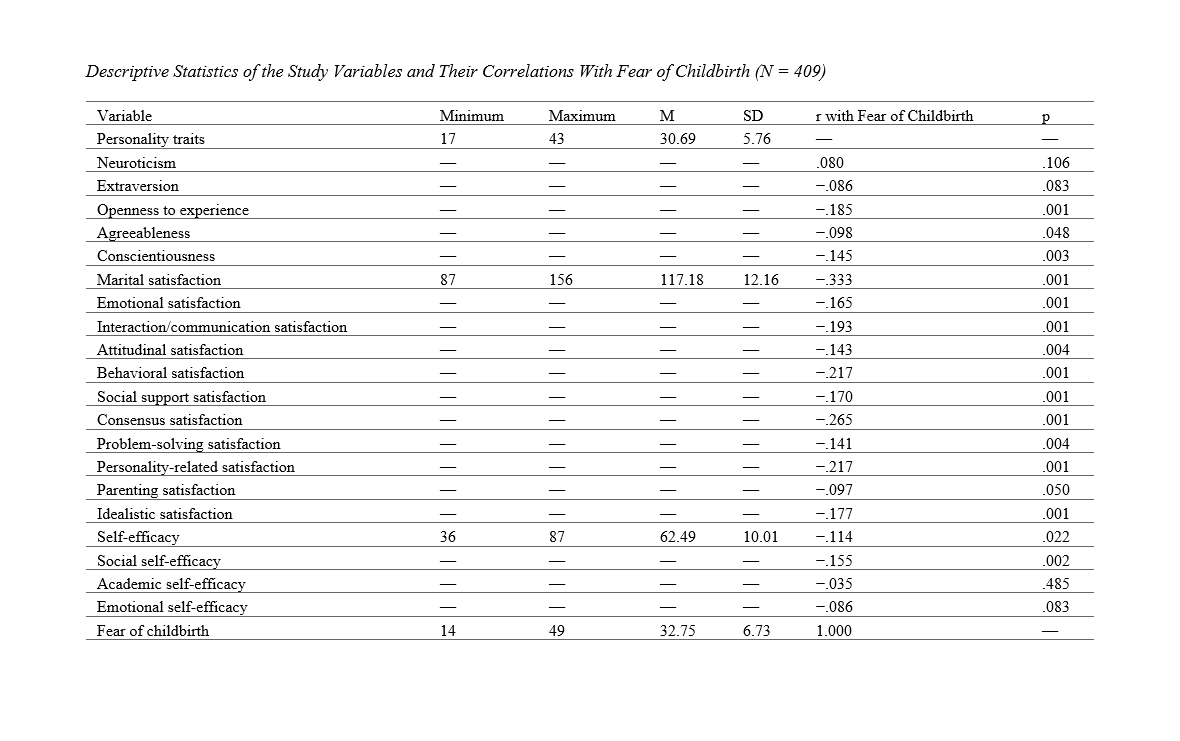
The present study aimed to examine the relationships of personality traits and marital satisfaction with fear of childbirth and to determine the mediating role of self-efficacy in these relationships. This study employed a descriptive-correlational design and structural equation modeling (SEM). The statistical population consisted of pregnant women attending the prenatal clinics affiliated with Shiraz University of Medical Sciences during 2025–2026, of whom 420 were selected through convenience sampling. Data were collected using the Childbirth Attitudes Questionnaire, the Morris General Self-Efficacy Questionnaire, the NEO Five-Factor Inventory–Short Form, and the Afrooz Marital Satisfaction Scale and were analyzed using Pearson’s correlation coefficient and structural equation modeling. The findings indicated that the proposed model demonstrated an acceptable fit to the data. Personality traits and marital satisfaction were positively associated with self-efficacy, whereas marital satisfaction and personality traits had significant negative direct associations with fear of childbirth. Among the personality dimensions, openness to experience, agreeableness, and conscientiousness were associated with lower fear of childbirth, with openness to experience demonstrating the strongest predictive power. Moreover, all dimensions of marital satisfaction showed significant negative associations with fear of childbirth, and overall marital satisfaction exhibited the strongest negative association. Although overall self-efficacy did not have a significant direct effect on fear of childbirth, social self-efficacy was significantly and negatively associated with fear of childbirth. Overall, the findings indicate that fear of childbirth results from the interaction of personality factors, interpersonal resources, and psychological beliefs, and that simultaneous attention to personality traits, the quality of the marital relationship, and self-efficacy resources may contribute to a better understanding and management of this fear among pregnant women.
Downloads
References
Ahmadi, A., Mohammadi, Z., & Hosseini, S. R. (2021). The role of personality traits and marital satisfaction in predicting fear of childbirth: The mediating role of social support. Clinical Psychology, 12(3), 45-60.
Akhlaghi, F. (2012). Relation between depression, anxiety, self-esteem, marital satisfaction, demographical factors and maternal complications with fear of childbirth in nulliparous women. Journal of Fundamentals of Mental Health, 14(54), 31-122.
Anderson, L., Smith, J. P., & Johnson, M. (2022). Fear of childbirth across cultures: The mediating role of social support and self-efficacy. Journal of Reproductive Health, 15(2), 123-135.
Banaei Haravan, M. (2023). The association between childbirth self-efficacy and maternal-fetal attachment in primigravid women. Journal of Gorgan University of Medical Sciences, 25(1), 85-91.
Bilgin, N. Ç., Coşkun, H., Tunç, G. Ç., Boyuk, M., & Değer, H. Ş. (2024). Predictive power of self-efficacy on the fear of childbirth in pregnant women: Underlying mechanisms of social support as a mediator and the COVID-19 fear as a moderator. Nigerian Journal of Clinical Practice, 27(3), 330-337.
Calpbinici, P., Terzioglu, F., & Koc, G. (2023a). The relationship of perceived social support, personality traits and self-esteem of the pregnant women with the fear of childbirth. Health Care for Women International, 44(10–11), 1423-1437.
Calpbinici, P., Terzioglu, F., & Koc, G. (2023b). Relationship of perceived social support, personality traits, and self-esteem with fear of childbirth in pregnant women. Health Care for Women International, 44(10–11), 1423-1437. https://doi.org/10.1080/07399332.2022.2126567
Daryani, F. E., Mohammadi, A., & Mirghafourvand, M. (2023). Childbirth self-efficacy and fear of childbirth and their predictors in adolescent and adult pregnant women referring to health centres of Urmia-Iran: A cross-sectional study. BMJ open, 13(10), e077043.
Garcia, M., Martinez, P., & Lopez, R. (2020). The impact of online educational programs on increasing self-efficacy and reducing childbirth fear: A randomized controlled trial. Computers in human Behavior, 112, 106476.
Ghodrati, M., Afrooz, G., Sharifi Daramadi, D., & Houman, H. (2011). Predicting creativity among gifted students based on age, intelligence quotient, and parents' marital satisfaction. Psychology of Exceptional Individuals, 1(3), 1-22. https://doaj.org/article/293ef2b385794e069d5bb78ab943fb5a
Gholamalian, F., Hamidia, N., & Moayed, H. (2022). A review of fear of childbirth and ways of coping with it Seventh International Conference on New Findings in Midwifery, Women, Childbirth, and Infertility,
Gottman, J. (2018). The seven principles for making marriage work. Hachette UK.
Gottman, J., & Silver, N. (2015). The seven principles for making marriage work (Revised ed.). Harmony Books. https://www.gottman.com/product/the-seven-principles-for-making-marriage-work/
Han, L., Bai, H., Lun, B., Li, Y., Wang, Y., & Ni, Q. (2022). The prevalence of fear of childbirth and its association with intolerance of uncertainty and coping styles among pregnant Chinese women during the COVID-19 pandemic. Frontiers in Psychiatry, 13, 935760.
Huang, Y., Zhong, Y., Chen, Q., Zhou, J., Fu, B., & Deng, Y. (2024). Childbirth self-efficacy, fear of childbirth, and labor pain intensity between primiparas and multiparas in the latent phase of labor: A cross-sectional study. BMC Pregnancy and Childbirth, 24, 400. https://doi.org/10.1186/s12884-024-06616-2
Huang, Y., Zhong, Y., Deng, Y., Zheng, J., Zou, H., & Chen, Q. (2022). Correlation between fear of childbirth and childbirth self-efficacy during labor. Clinical and Experimental Obstetrics & Gynecology, 49(11), 258.
Khorsandi, M., Ghofranipour, F., Heydarnia, A., Faghihzadeh, S., Akbarzadeh Baghban, A., & Vafaei, M. (2008). Examining perceived childbirth self-efficacy in pregnant women. Journal of the Medical Council of the Islamic Republic of Iran, 26(1), 89-95.
King, M. E. (2016). Marital satisfaction. In C. L. Shehan (Ed.), The Wiley Blackwell Encyclopedia of Family Studies. Wiley. https://doi.org/10.1002/9781119085621.wbefs054
Lee, S., Garcia, M., & Thompson, R. (2021). A predictive model of childbirth fear based on the Big Five personality traits and perceived stress. Journal of Obstetric and Gynecological Psychology, 44(3), 289-301.
Maghalian, M., Alizadeh-Dibazari, Z., & Mirghafourvand, M. (2026). Global prevalence and associated factors of severe fear of childbirth: A systematic review and meta-analysis. Archives of Women’s Mental Health, 29(1), 1-22. https://doi.org/10.1007/s00737-025-01648-0
Mohammadirad, N., Hosseini, Z., & Karimi, F. (2025). The relationship between fear of vaginal childbirth and self-efficacy among primigravid Afghan migrant women. Iranian Journal of Health Education and Health Promotion, 14(1), 12-24.
Mousavi, S. A., Karimi, M., & Rahmani, M. (2019). The role of personality traits and marital satisfaction in fear of childbirth: The mediating role of self-efficacy. Health Psychology, 8(2), 23-38.
Mozaffari, E., Delshad Noghabi, A., Mansourian, M., & Bahri, N. (2023). The effect of group inquiry model-based training on fear of childbirth. Payesh, 22(4), 455-463. https://doi.org/10.61186/payesh.22.4.455
Muller, D., Hansen, E., & Petersen, K. (2019). Marital satisfaction and fear of childbirth: A three-year longitudinal study. Journal of Family Psychology, 33(5), 567-578.
Munkhondya, B. M., Munkhondya, T. E., Chirwa, E., & Wang, H. (2020). Companion-integrated childbirth preparation for reducing childbirth fear and improving self-efficacy and maternal support in primigravid women in Malawi. BMC Pregnancy and Childbirth, 20, 459. https://doi.org/10.1186/s12884-020-03170-4
O’Connell, M. A., Leahy-Warren, P., Khashan, A. S., & O’Neill, S. M. (2017). Worldwide prevalence of tocophobia: A systematic review and meta-analysis. Acta Obstetricia et Gynecologica Scandinavica, 96(8), 907-920. https://doi.org/10.1111/aogs.13138
Parsa, Z., Mirzaei, F., & Yazdani, S. (2014). The mediating role of self-efficacy in the relationship between personality traits and fear of childbirth. Health Psychology, 7(1), 12-25.
Reyhan, F. A., & Dağlı, E. (2024). Association of personality traits with fear of childbirth, birth satisfaction, and postpartum depression. Revista Da Associação Médica Brasileira, 70(8), e20231730. https://doi.org/10.1590/1806-9282.20231730
Rezaei, S., Mohammadi, N., & Karimi, H. (2024). The effectiveness of Replan training on fear of childbirth and self-efficacy in pregnant women with anxiety about vaginal birth. Hamadan Faculty of Nursing and Midwifery, 33(3), 238-252.
Rouhe, H., Salmela-Aro, K., Halmesmäki, E., & Saisto, T. (2009). Fear of childbirth according to parity, gestational age, and obstetric history. BJOG: An International Journal of Obstetrics & Gynaecology, 116(1), 67-73.
Rúger-Navarrete, A., Vázquez-Lara, J. M., Antúnez-Calvente, I., Rodríguez-Díaz, L., Riesco-González, F. J., Palomo-Gómez, R., Gómez-Salgado, J., & Fernández-Carrasco, F. J. (2023). Antenatal fear of childbirth as a risk factor for a bad childbirth experience. Healthcare, 11(3), 297. https://doi.org/10.3390/healthcare11030297
Schustack, M. W., & Friedman, H. S. (2008). The personality reader (2 ed.). Pearson College Division.
Shabbakhti, L., Rouhani, K., Matbouei, M., & Jafari, N. (2020). Tokophobia as a pathological fear of childbirth: A systematic review. Hayat, 26(1), 84-104. https://doi.org/10.32598/SIJH.26.1.84
Shahid, A., Malik, N. I., Shahid, F., Ullah, I., & Abbass, Z. (2022). Psychosocial predictors of mental health among pregnant women. Perspectives in psychiatric care, 58(3), 1071-1076. https://doi.org/10.1111/ppc.12900
Taheri, Z., Khorsandi, M., Amiri, M., & Hasanzadeh, A. (2015). Examining causes of fear of childbirth among pregnant women in Shahrekord in 2013–2014: A brief report. Journal of Rafsanjan University of Medical Sciences, 14(4), 345-350. http://journal.rums.ac.ir/article-1-2512-fa.html
Unkazan, S., Unlu Bidik, N., Turan, Z., & Sevimli Guler, D. (2025). Predictors of desire to avoid pregnancy: The roles of marital satisfaction and fear of childbirth. BMC Women’s Health, 25, 531. https://doi.org/10.1186/s12905-025-04067-6
Weng, X., Zhang, T., Wang, R., Yang, C., & Luo, D. (2025). The role of personality traits on fear of childbirth in pregnant women: A systematic review and meta-analysis. Journal of psychosomatic research, 199, 112441. https://doi.org/10.1016/j.jpsychores.2025.112441
Zhu, J. S., Wang, R., Li, Y., Fu, Y. J., Liu, H. Y., Li, J. Q., Yao, G. X., & Guan, S. Z. (2023). The mediating effect of perceived social support in the relationship between maternal personality traits and pregnancy-related anxiety. Zhonghua Yu Fang Yi Xue Za Zhi, 57(2), 187-192. https://doi.org/10.3760/cma.j.cn112150-20220504-00438
Downloads
Additional Files
Publication Timeline
- Submitted
- Revised
- Accepted