Effectiveness of Short-Term Psychodynamic Psychotherapy on Defense Styles, Alexithymia, and Parent–Child Relationship Quality in Adolescents with Emotional and Behavioral Problems
Keywords:
adolescence, psychodynamic psychotherapy, defense mechanisms, alexithymia, parent-child relationship, emotional problems, behavioral problemsAbstract
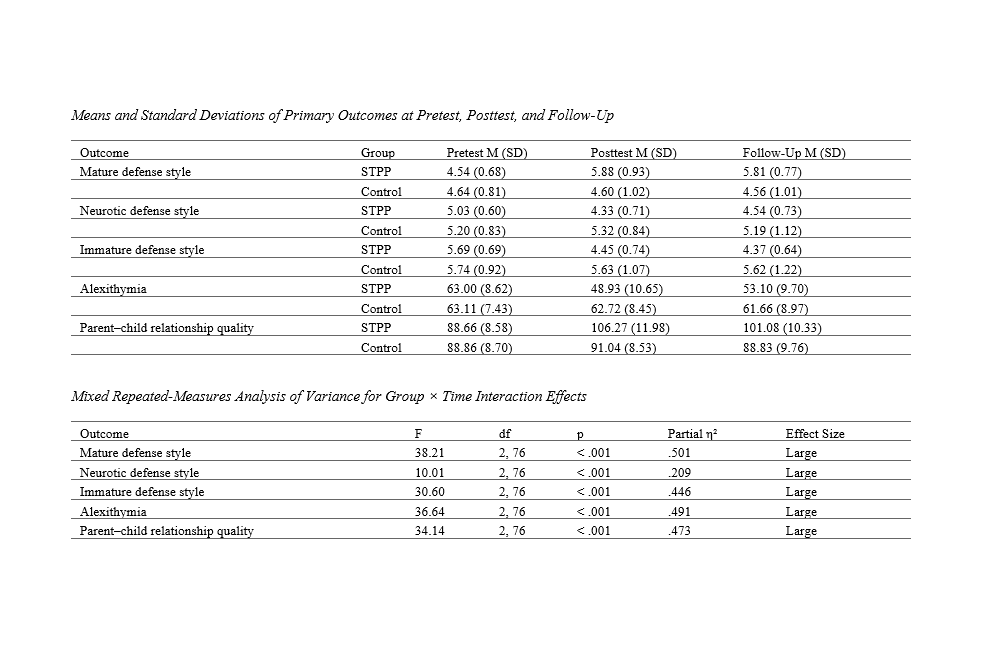
This study aimed to determine the effectiveness of short-term psychodynamic psychotherapy in improving defense styles, reducing alexithymia, and enhancing parent–child relationship quality among adolescents with emotional and behavioral problems. This randomized controlled trial was conducted in 2026 among 40 adolescents aged 13–17 years referred to the Child and Adolescent Psychiatry Clinic of the Tehran Psychiatric Institute, Iran University of Medical Sciences. After eligibility screening, participants were randomly assigned in equal numbers to short-term psychodynamic psychotherapy and wait-list control groups. The intervention group received 16 weekly individual psychotherapy sessions, each lasting approximately 50 minutes, while the control group remained on a waiting list. Assessments were conducted at pretest, posttest, and eight-week follow-up. Data were collected using the Defense Style Questionnaire-40, Toronto Alexithymia Scale-20, and Child–Parent Relationship Scale. Mixed repeated-measures analysis of variance was used to evaluate Group × Time interaction effects across the three assessment points. Significant Group × Time interaction effects were observed for mature defense style, F(2, 76) = 38.21, p < .001, ηp² = .501; neurotic defense style, F(2, 76) = 10.01, p < .001, ηp² = .209; immature defense style, F(2, 76) = 30.60, p < .001, ηp² = .446; alexithymia, F(2, 76) = 36.64, p < .001, ηp² = .491; and parent–child relationship quality, F(2, 76) = 34.14, p < .001, ηp² = .473. Secondary analyses also showed significant improvements in closeness, conflict, and dependence dimensions of the parent–child relationship. Most treatment gains were maintained at the eight-week follow-up. Short-term psychodynamic psychotherapy was effective in promoting more adaptive defense functioning, reducing alexithymia, and improving parent–child relationship quality among adolescents with emotional and behavioral problems, with most improvements persisting beyond the active treatment period.
Downloads
References
Abareshi, Z., Tahmasian, K., Mazaheri, M. A., & Panaghi, L. (2010). The impact of psychosocial child development training program, done through improvement of mother-child interaction, on parental self-efficacy and relationship between mother and child under three. Quarterly Journal of Psychological Health Research, 3(3), 49-58. https://rph.khu.ac.ir/article-1-115-en.html
Abbass, A. A., Rabung, S., Leichsenring, F., Refseth, J. S., & Midgley, N. (2013). Psychodynamic psychotherapy for children and adolescents: A meta-analysis of short-term psychodynamic models. Journal of the American Academy of Child & Adolescent Psychiatry, 52(8), 863-875. https://doi.org/10.1016/j.jaac.2013.05.014
Abedi Barzi, F. (2025). Modeling self-worth in female adolescents: The mediating role of parenting styles in the parent-child relationship. International Journal of Body, Mind and Culture, 12(7), 121-131. https://doi.org/10.61838/ijbmc.v12i7.1010
Bekes, V., Starrs, C. J., Perry, J. C., Prout, T. A., Conversano, C., & Di Giuseppe, M. (2023). Defense mechanisms are associated with mental health symptoms across six countries. Research in Psychotherapy: Psychopathology, Process and Outcome, 26(3), 729. https://doi.org/10.4081/ripppo.2023.729
Besharat, M. A. (2007). Reliability and factorial validity of a Farsi version of the 20-item Toronto Alexithymia Scale with a sample of Iranian students. Psychological Reports, 101(1), 209-220. https://doi.org/10.2466/pr0.101.1.209-220
Bond, M. (2004). Empirical studies of defense style: Relationships with psychopathology and change. Harvard Review of Psychiatry, 12(5), 263-278. https://doi.org/10.1080/10673220490886167
Brett, J. D., Zarei, M., Preece, D. A., Becerra, R., & Gross, J. J. (2025). How alexithymia increases mental health symptoms in adolescence: Longitudinal evidence for the mediating role of emotion regulation. Affective science, 6, 428-437. https://doi.org/10.1007/s42761-025-00318-9
Davies, R. N., & Griffin, K. (2025). A systematic review of alexithymia in young people and their parents. Journal of affective disorders, 390, 119855. https://doi.org/10.1016/j.jad.2025.119855
Goodyer, I. M., Reynolds, S., Barrett, B., Byford, S., Dubicka, B., & Hill, J. (2017). Cognitive behavioural therapy and short-term psychoanalytical psychotherapy versus a brief psychosocial intervention in adolescents with unipolar major depressive disorder (IMPACT): A multicentre, pragmatic, observer-blind, randomised controlled superiority trial. The Lancet Psychiatry, 4(2), 109-119. https://doi.org/10.1016/S2215-0366(16)30378-9
Habibi Asgarabad, M., Besharat, M. A., Fadaei, Z., & Najafi, M. (2009). Confirmatory factorial structure, reliability and validity of the Achenbach Youth Self-Report Scale (YSR): Monozygotic and dizygotic twins. Journal of Clinical Psychology, 1(1), 1-18. https://doi.org/10.22075/jcp.2017.1993
Lilliengren, P. (2025). The efficacy of experiential dynamic therapies: A 10-year systematic review and meta-analysis update. Clinical Psychology & Psychotherapy, 32(3), e70086. https://doi.org/10.1002/cpp.70086
Midgley, N., Mortimer, R., Cirasola, A., Batra, P., & Kennedy, E. (2021). The evidence-base for psychodynamic psychotherapy with children and adolescents: A narrative synthesis. Frontiers in psychology, 12, 662671. https://doi.org/10.3389/fpsyg.2021.662671
Mohammadian, F., Majidi, A., & Ghorbanhoseini, T. (2024). Effectiveness of schedule-based paradoxical therapy on separation anxiety symptoms and mother-child relationship functioning in children aged 6 to 9 years. International Journal of Body, Mind and Culture, 11(6), 236-241. https://doi.org/10.61838/ijbmc.v11i6.999
Nilsson, K. K., Gronnebaek, L., & Ostergard, O. K. (2025). Characteristics of the parent-child relationship at 18-months of age predict the onset and type of mental disorders in childhood and adolescence: A longitudinal nested birth cohort study. JCPP Advances, 5(3), e12304. https://doi.org/10.1002/jcv2.12304
Sammer-Schreckenthaler, S., Lagetto, G., Unterrainer, H. F., & Gelo, O. C. G. (2025). Specific and common therapeutic factors in psychodynamic psychotherapy for children and adolescents: An overview. Frontiers in psychology, 16, 1525849. https://doi.org/10.3389/fpsyg.2025.1525849
Schroeders, U., Kubera, F., & Gnambs, T. (2022). The structure of the Toronto Alexithymia Scale (TAS-20): A meta-analytic confirmatory factor analysis. Assessment, 29(8), 1806-1823. https://doi.org/10.1177/10731911211033894
Shabanpour, R., Zahiroddin, A. R., Janbozorgi, M., & Ghaeli, P. (2012). Assessment of defense styles and mechanisms in Iranian patients suffering from obsessive-compulsive or panic disorders versus normal controls using Persian version of Defense Style Questionnaire-40. Iranian Journal of Psychiatry, 7(1), 31-35. https://pubmed.ncbi.nlm.nih.gov/23056115/
Taghizade, N. (2022). The relationship model among parent-child relationship, coping responses and behavioral problems in children with attention deficit hyperactivity disorder. BMC psychiatry, 22, 596. https://doi.org/10.1186/s12888-022-04224-3
Downloads
Additional Files
Publication Timeline
- Submitted
- Revised
- Accepted