Comparative Effectiveness of Neurofeedback and Cognitive Behavioral Therapy on Inattention, Anxiety, and Hyperactivity in Children With Attention-Deficit/Hyperactivity Disorder
Keywords:
attention-deficit/hyperactivity disorder, neurofeedback, cognitive behavioral therapy, inattention, anxiety, hyperactivity, childrenAbstract
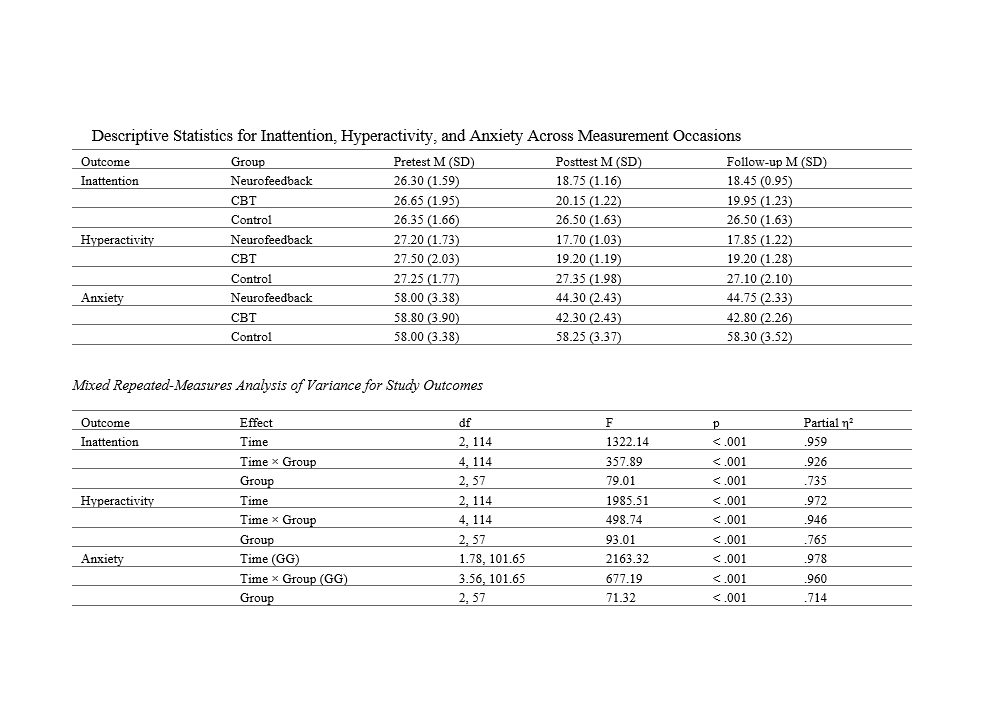
This study aimed to compare the effectiveness of neurofeedback and cognitive behavioral therapy (CBT) in reducing inattention, anxiety, and hyperactivity among children with attention-deficit/hyperactivity disorder (ADHD). This quasi-experimental study employed a three-group pretest–posttest–follow-up design with a no-treatment control group. Sixty children aged 7–12 years with DSM-5-confirmed ADHD in Karaj, Iran, were purposively recruited and randomly assigned to neurofeedback, CBT, or control groups (n = 20 each). Neurofeedback consisted of 20 twice-weekly 40-minute sessions, whereas CBT consisted of nine weekly 45–60-minute sessions. Inattention, hyperactivity, and anxiety were assessed using the Integrated Visual and Auditory Continuous Performance Test, Conners Parent Rating Scale, and Spence Children’s Anxiety Scale, respectively. Data were analyzed using mixed repeated-measures analysis of variance and Bonferroni-adjusted pairwise comparisons in SPSS 26. Significant time-by-group interactions were observed for inattention, F(4, 114) = 357.89, p < .001, partial η² = .926; hyperactivity, F(4, 114) = 498.74, p < .001, partial η² = .946; and anxiety, F(3.56, 101.65) = 677.19, p < .001, partial η² = .960. Neurofeedback significantly outperformed CBT for inattention at posttest (mean difference = −1.40, p = .006) and follow-up (−1.50, p < .001), and for hyperactivity at posttest (−1.50, p = .006) and follow-up (−1.35, p ≈ .028). Both interventions significantly outperformed the control condition. Although CBT produced lower anxiety scores than neurofeedback, between-treatment differences were not significant at posttest (p = .080) or follow-up (p = .090). Both neurofeedback and CBT appear effective in producing sustained improvements in inattention, hyperactivity, and anxiety among children with ADHD. Neurofeedback demonstrated a comparative advantage for core attentional and hyperactivity symptoms, whereas the two interventions showed comparable effectiveness for anxiety reduction. These findings support symptom-oriented treatment selection while emphasizing the need for larger and methodologically rigorous comparative trials.
Downloads
References
Aazh, H. (2025). Cognitive Behavioural Therapy (CBT) for Managing Tinnitus, Hyperacusis, and Misophonia: The 2025 Tonndorf Lecture. Brain Sciences, 15(5), 526. https://doi.org/10.3390/brainsci15050526
Hassani, R., Mirzaeeian, B., & Khalilian, A. R. (2013). Effectiveness of Cognitive Behavior-based Play Therapy on Anxiety and Self-steem of Children with Attention Deficit/Hyperactivity Disorder (ADHD) Children. Modern psychological research, 8(29), 163. https://www.magiran.com/paper/1170210
Jalil-Abkenar, S. S. (2025). Effectiveness of Cognitive Behavioral Play Therapy on Social Anxiety and Emotional Intelligence in Students with Intellectual Disability. Journal of Exceptional Children, 25(2), 45-58.
Karimi Aliabad, M., Najafian Razavi, M., Sadeghi, M., Farokhi, A., & Rezaei, M. (2024). The Effects of Physical Activity on Key Variables That Influence the Characteristics of Children with Attention Deficit Hyperactivity Disorder. International Journal of Sport Studies for Health, 7(4), 95-105. https://doi.org/10.61838/kman.intjssh.7.4.10
Kiani, M., Mojahedi, M., Salehiniya, H., & Sahranavard, S. (2025). The Effect of Acceptance and Commitment-Based Group Training on Self-Esteem and Perceived Stress in Mothers of Children with Attention Deficit-Hyperactivity Disorder. Journal of Rational-Emotive & Cognitive-Behavior Therapy, 43(2), 22. https://doi.org/10.1007/s10942-024-00577-8
Kim, J., Kim, S., Lee, J., & Park, S. (2024). Real-time fMRI neurofeedback targeting the insula reduces trait anxiety: A randomized controlled trial. NeuroImage: Clinical, 41, 103158. https://doi.org/10.1016/j.nicl.2024.103158
Li, X., Wang, Y., Zhang, L., & Chen, J. (2024). EEG neurofeedback as an adjunct to pharmacotherapy for anxiety in schizophrenia: A systematic review and meta-analysis. Schizophrenia Research, 263, 45-53. https://doi.org/10.1016/j.schres.2023.12.012
Lotfinia, S., Shahkaram, H., Yaseri, A., Kianimoghadam, A. S., & Sarani Yaztappeh, J. (2025). A clinical trial comparing the efficacy of two EEG-based neurofeedback protocols for generalized anxiety disorder: Sensory motor rhythm and alpha-theta. Iranian journal of psychiatry and behavioral sciences, 19(2), e158451. https://doi.org/10.5812/ijpbs-158451
Nasiri, M., & Abizadeh, F. (2025). The Effect of Cognitive Behavioral Therapy on Symptoms of Attention Deficit Hyperactivity Disorder in Men with Substance Use Disorder. Behavioral Sciences Research, 22(1).
Nicholson, A. A., Ros, T., Densmore, M., Frewen, P. A., Théberge, J., Jetly, R., & Lanius, R. A. (2024). Amygdala downregulation via real-time fMRI neurofeedback in generalized anxiety disorder: A multi-session randomized controlled trial. Biological Psychiatry, 95(8), 712-721. https://doi.org/10.1016/j.biopsych.2023.10.015
Sadeghi Ahouei, J., Haji Mousaei, M., & Banisi, V. (2025). The Effect of Neurofeedback on Improving Executive and Academic Functions in Children and Adolescents with Attention Deficit/Hyperactivity Disorder and Learning Disabilities: A Review Study. Mental Health in School, 3(1), 21-27.
Shojaei, B. (2024). Reducing Symptoms of Attention Deficit/Hyperactivity Disorder (ADHD) in Elementary Students: The Effectiveness of Neurofeedback. Annals of medicine and surgery, 86(5), 2651-2656. https://doi.org/10.1097/ms9.0000000000001861
Tosti, B., Corrado, S., Mancone, S., Di Libero, T., Carissimo, C., Cerro, G., Rodio, A., da Silva, V. F., Coimbra, D. R., Andrade, A., & Diotaiuti, P. (2024). Neurofeedback Training Protocols in Sports: A Systematic Review of Recent Advances in Performance, Anxiety, and Emotional Regulation. Brain Sciences, 14(10), 1036. https://doi.org/10.3390/brainsci14101036
Wu, G., He, Q., Li, D., Zhang, Z., Miao, J., & Shu, Y. (2024). Comparative Efficacy of Neurofeedback Interventions for Attention-Deficit/Hyperactivity Disorder in Children: A Network Meta-Analysis. Brain and Behavior, 14(12), e70194. https://doi.org/10.1002/brb3.70194
Xu, J., Akhter, S., & Apuke, O. (2025). The Effectiveness of Combining Interactive Media-Based Cognitive Behaviour Therapy with Art and Music Therapies for Ameliorating Generalized Anxiety Disorder of Children Exposed to Abduction. Psychiatry research, 349, 116498. https://doi.org/10.1016/j.psychres.2025.116498
Zhang, F., Li, X., Wang, J., & Chen, S. (2024). Comparative Efficacy of Neurofeedback Interventions for Children With Attention-Deficit/Hyperactivity Disorder: A Network Meta-Analysis. Brain and Behavior, 14(5), e70194. https://doi.org/10.1002/brb3.70194
Zhang, R., Zhang, Y., & Wang, J. (2025). Real-time fMRI neurofeedback for depression and anxiety: A systematic review. Translational psychiatry, 15(3), 123. https://doi.org/10.1038/s41398-025-03123-4
Downloads
Additional Files
Publication Timeline
- Submitted
- Revised
- Accepted