The Effectiveness of Dialectical Behavior Therapy on Health Anxiety, Perfectionism, and Identity Crisis among 15- to 18-Year-Old Students in Selective and Gifted Schools
Keywords:
Dialectical Behavior Therapy, Health Anxiety, Perfectionism, Identity Crisis, Gifted Students, AdolescentsAbstract
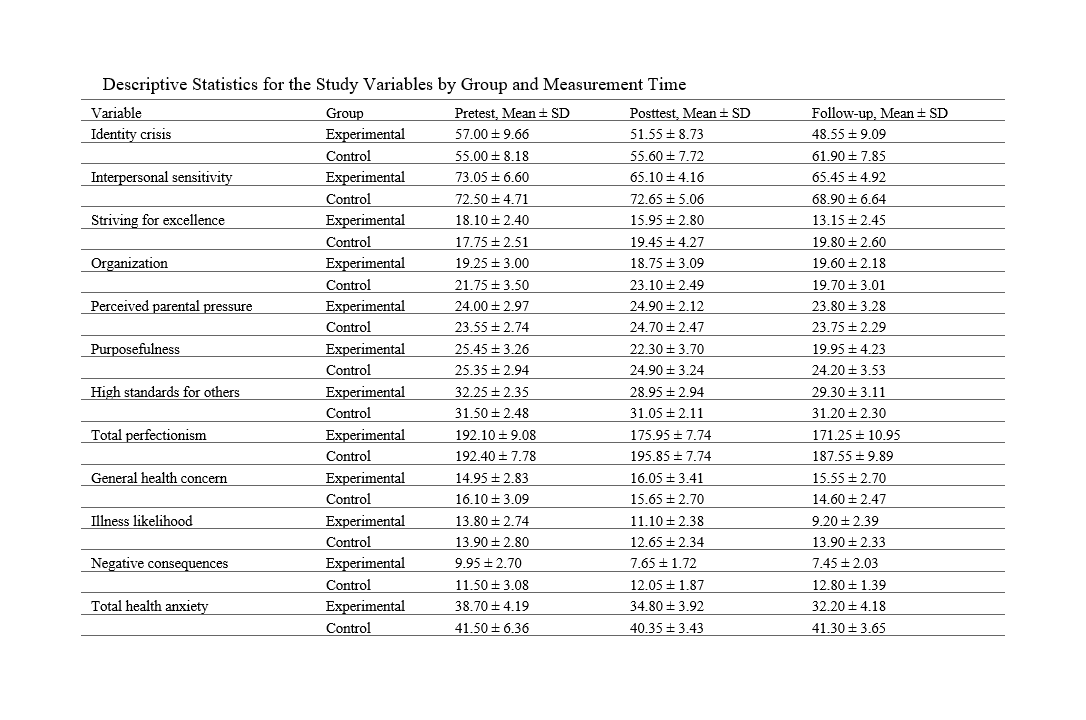
This study aimed to investigate the effectiveness of dialectical behavior therapy in reducing health anxiety, perfectionism, and identity crisis among 15- to 18-year-old male students enrolled in selective public and gifted schools. This applied, quasi-experimental study employed a pretest-posttest control-group design with a one-month follow-up. The statistical population consisted of approximately 1,500 male students aged 15-18 years attending selective public and gifted schools in Kermanshah, Iran, during the 2024-2025 academic year. Using convenience sampling and predetermined inclusion criteria, 40 eligible students were selected and randomly assigned to an experimental group and a control group, with 20 participants in each. Data were collected using the Ahmadi Identity Crisis Questionnaire, Hill Perfectionism Questionnaire, and Short Health Anxiety Inventory. The experimental group received eight 60-minute group-based dialectical behavior therapy sessions delivered twice weekly over one month, whereas the control group received no intervention. Assessments were conducted at pretest, posttest, and one-month follow-up. Data were analyzed using repeated-measures analysis of variance and Bonferroni-adjusted comparisons in SPSS version 27. Significant time-by-group interaction effects were observed for total health anxiety (F=5.418, p=.010, η²=.125), illness likelihood (F=9.257, p=.001, η²=.196), and negative consequences (F=7.840, p=.002, η²=.171), whereas general health concern was not significant (p=.252). Significant interaction effects were also found for total perfectionism (F=12.735, p=.001, η²=.251), interpersonal sensitivity (F=5.631, p=.005), striving for excellence (F=14.009, p=.001), organization (F=6.730, p=.002), purposefulness (F=4.874, p=.010), and high standards for others (F=3.890, p=.025), while perceived parental pressure was not significant (p=.943). Identity crisis also showed a significant time-by-group interaction (F=7.659, p=.001, η²=.168). Bonferroni comparisons confirmed significantly lower total health anxiety, total perfectionism, and identity crisis scores in the experimental group. Dialectical behavior therapy was effective in reducing health anxiety, most dimensions of perfectionism, and identity crisis among male students in selective and gifted schools, with effects generally maintained at one-month follow-up.
Downloads
References
Adib Manesh, M. (2023). The Effectiveness of Responsibility Training Using Reality Therapy on the Identity Crisis of Female High School Students in Islamabad Gharb. Quest in Human Sciences Education, 9(30), 19-36. https://humanities.cfu.ac.ir/article_2740.html
Ahmadian, A., Momeni, K., & Karami, J. (2024). The Effectiveness of Dialectical Behavior Therapy on Reducing Irritability and Aggression in Adolescents with Disruptive Mood Dysregulation Disorder. Journal of Modern Psychological Researches, -. https://doi.org/10.22034/jmpr.2023.58914.5898
Amighi, H., Ebrahimi Moghadam, H., & Kashani Vahid, L. (2025). Comparing the Effectiveness of Dialectical Behavior Therapy and Cognitive Behavioral Therapy on the Attention Level of Female Students with Obsessive-Compulsive Disorder. Sadra Medical Sciences Journal, 13(2), 256-270. https://smsj.sums.ac.ir/article_51030.html?lang=en
Amini, F., Rezaei, A., Zarnaghsh, M., & Kouroshnia, M. (2026). Predicting Identity Crisis Based on Social Capital and the Generational Gap among University Students. Rooyesh-e-Ravanshenasi, 15(3), 237-246.
Astaneh, R., Mirzaian, B., & Hassanzadeh, R. (2020). The Effectiveness of Skill Training based on Dialectical Behavior Therapy on emotional regulation, social avoidance and distress in Adolescents with Social Anxiety Disorder. thums-jms, 8(3), 52-60. http://jms.thums.ac.ir/article-1-834-en.html
Bowers, D., Colón, M., Morgan, C., & Wood, T. (2024). Impact of Dialectical Behavioral Therapy on Anxiety Levels Among African American Adolescents. Journal of Psychosocial Nursing and Mental Health Services, 62(8), 7-10. https://doi.org/10.3928/02793695-20240111-01
Cohen, J. M., Norona, J. C., Yadavia, J. E., & Borsari, B. (2021). Affirmative Dialectical Behavior Therapy Skills Training With Sexual Minority Veterans. Cognitive and Behavioral Practice, 28(1), 77-91. https://doi.org/10.1016/j.cbpra.2020.05.008
Dong, C., Zhao, J., Wei, Y., Wu, D., & Cai, Z. (2024). Comparative Analysis of Cognitive Behavioral Therapy and Dialectical Behavior Therapy in Enhancing Psychological Capital Among Medical Students: A Randomized Controlled Trial. Frontiers in psychology. https://doi.org/10.3389/fpsyg.2024.1479310
Du, H. (2026). The Dual Impact of Perfectionism on Sleep Quality in Medical Students: A Mediation Analysis of Depression and Anxiety. https://doi.org/10.21203/rs.3.rs-9673905/v1
Jameson, K., Salsman, N., & Eshleman Latimer, S. R. (2024). A Randomized Controlled Pilot Trial of a Brief Dialectical Behavior Therapy Skills Training-Informed Intervention for Test Anxiety. Journal of College Student Mental Health, 1-17. https://doi.org/10.1080/28367138.2024.2333369
Kakia, L. (2014). Effect of group counseling based on reality therapy on identity crisis in students of guidance school. Journal of Fundamentals of Mental Health, 84(12), 30-52.
Liu, X. (2026). The Relationship Between Perfectionism and Sleep Quality Among Master’s Students: The Mediating Role of Competitive Personality and the Moderating Effect of Resilience. Behavioral Sciences, 16(5), 749. https://doi.org/10.3390/bs16050749
Molnar, D. S. (2026). Under Pressure: Teacher Perspectives and Understandings of Perfectionism Among Students. American Educational Research Journal. https://doi.org/10.3102/00028312251412913
Nemeti, F., Boland, H., & Sayadi, A. (2022). Investigating the Mediating Role of Identity Crisis and Family Cohesion in Determining the Relationship Between Social Networks Participation with Body Image Issues Among Students. Journal of counseling research, 21(81), 256-280. https://doi.org/10.18502/qjcr.v21i81.9499
Rahmawati, A., I, N., Hidayah, N., Muslihati, M., Rahman, D. H., & Ariffudin, I. (2026). Perfectionism of Gifted Students' Long Term Psychological Impact: A Qualitative Study. COUNSENESIA: Indonesia Journal of Guidance and Counseling, 7(1), 1-11. https://doi.org/10.36728/cijgc.v7i1.6207
Sadeghi, E. (2024). The Effectiveness of Dialectical Behavior Therapy on Academic Emotion Components and Self-Control of Students with Attention Deficit/Hyperactivity Disorder. Research in School and Virtual Learning, 11(3), 85-85. https://etl.journals.pnu.ac.ir/?_action=article&kw=54140&_kw=Academic+emotion&lang=en
Sehati, M., Nasab, A. A., & Yousefian, Z. (2019). The Efficiency of Emotion Regulation and Distress Tolerance Based on Dialectical Behavior Therapy on Anxiety Sensitivity and Emotion Regulation Difficulties in Women With Irritable Bowel. Social Behavior Research & Health. https://doi.org/10.18502/sbrh.v3i1.1034
Shafiee Sourak, S., & Shamsoddinpour, A. (2026). The effectiveness of emotional intelligence training on social anxiety and perfectionism of art students in Kerman city. Motaleat-e Novin dar Olum-e Tarbiati, 1(2), 9-25. https://doi.org/10.30473/ns.2026.77125.1038
Yarvaisi, F., Mihandoust, Z., & Mami, S. (2021). The Effectiveness of Dialectical Behavioral Therapy (DBT) on Psychological Components (Stress, Anxiety, Depression) and Problem Solving Styles in Students with Depression [Research]. Journal of Health Promotion Management, 10(1), 60-73. http://jhpm.ir/browse.php?a_id=1197&sid=1&slc_lang=en&ftxt=1
Downloads
Additional Files
Publication Timeline
- Submitted
- Revised
- Accepted