Structural Model of Workplace Spirituality Based on Spiritual Health, Meaning in Life, and Self-Differentiation with the Mediating Roles of Job Crafting and Moral Identity among Faculty Members of Islamic Azad University, Zanjan Branch
Keywords:
Workplace spirituality, Spiritual health, Meaning in life, Self-differentiation, Job crafting, Moral identityAbstract
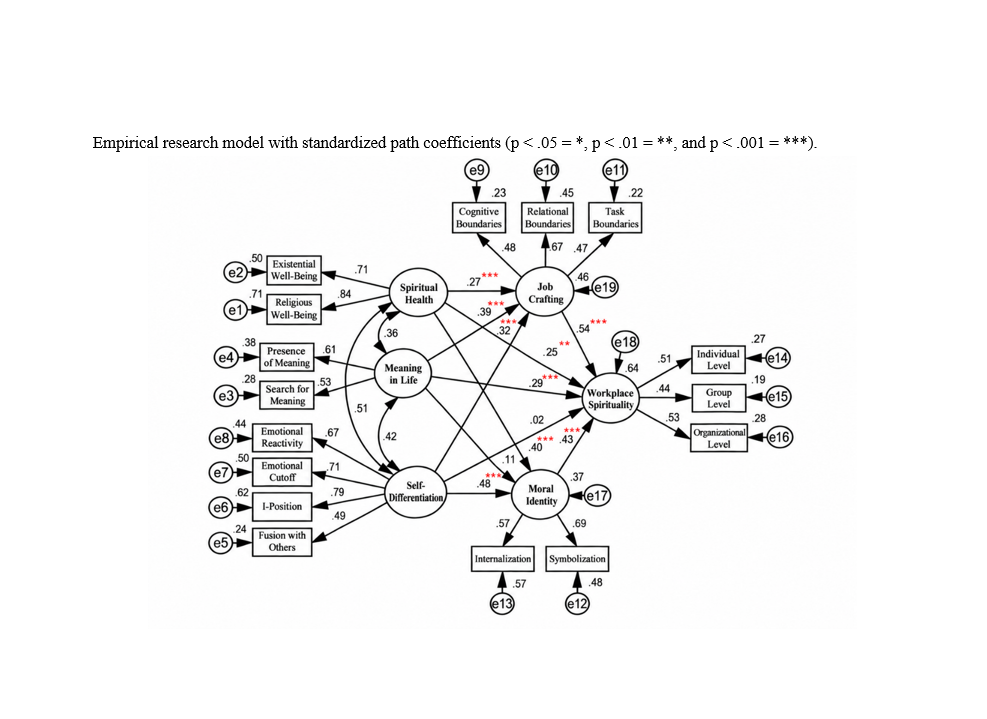
The present study aimed to develop a structural model of workplace spirituality based on spiritual health, meaning in life, and self-differentiation, with the mediating roles of job crafting and moral identity among faculty members of Islamic Azad University, Zanjan Branch. This research was applied in terms of purpose and correlational in terms of nature and method, utilizing structural equation modeling (SEM). The statistical population comprised all faculty members of Islamic Azad University, Zanjan Branch, during the academic year 2025–2026, totaling 476 individuals, from which 300 participants were selected through convenience sampling. Data were collected using standardized questionnaires including the Workplace Spirituality Questionnaire (Milliman et al., 2003), Spiritual Well-Being Scale (Paloutzian & Ellison, 1982), Meaning in Life Questionnaire (Steger et al., 2006), Differentiation of Self Inventory (Skowron, 2000), Job Crafting Questionnaire (Laurence, 2010), and Moral Identity Questionnaire (Aquino & Reed, 2002). Data analysis was performed using SPSS version 28 and AMOS version 24, employing Pearson correlation tests and structural equation modeling. The findings indicated that the proposed model demonstrated a good fit (RMSEA = 0.054, CFI = 0.90, GFI = 0.90, AGFI = 0.91, IFI = 0.94). Examination of direct effects revealed that all paths were statistically significant (p < 0.05), except for the effect of self-differentiation on workplace spirituality (p = 0.873) and the effect of meaning in life on moral identity (p = 0.086). Furthermore, the indirect effects of spiritual health (β = 0.146, p = 0.002), meaning in life (β = 0.209, p < 0.001), and self-differentiation (β = 0.174, p < 0.001) on workplace spirituality through job crafting, as well as the indirect effects of spiritual health (β = 0.206, p < 0.001) and self-differentiation (β = 0.206, p < 0.001) on workplace spirituality through moral identity, were all confirmed. Based on the findings, spiritual health, meaning in life, and self-differentiation directly and indirectly influence workplace spirituality through the mediating roles of job crafting and moral identity. Therefore, simultaneous attention to enhancing these constructs through intervention and professional development programs can facilitate the promotion of workplace spirituality in academic environments.
Downloads
References
Alomar, A., Mydin, A. A., & Alaklabi, S. (2022). A Review of Authentic Leadership and Workplace Spirituality & Campus Sustainability in Educational Institutions. International Transaction Journal of Engineering, Management, & Applied Sciences & Technologies, 13(2), 1-13.
Arabshahi, A., & Karimi, M. (2023). The Role of Workplace Spirituality in Employee Trust with the Moderating Role of Organizational Justice. Journal of Islamic Studies in Health, 17(2), 79-92.
Azimi, K., Shahni Yeylagh, M., & Khoshnamvand, M. (2023). Designing and Testing a Causal Model of the Relationship between Moral Identity and Bullying with the Mediation of Moral Disengagement in Iranian Adolescents. Social Psychology Research, 13(52), 13-30.
Bantha, T., & Nayak, U. (2023). The Relation of Workplace Spirituality with Employee Creativity among Indian Software Professionals: Mediating Role of Psychological Empowerment. South Asian Journal of Business Studies, 12(3), 427-443. https://doi.org/10.1108/SAJBS-08-2020-0270
Calatrava, M., Martins, M. V., Schweer-Collins, M., Duch-Ceballos, C., & Rodríguez-González, M. (2022). Differentiation of Self: A Scoping Review of Bowen Family Systems Theory's Core Construct. Clinical psychology review, 91, 102101. https://doi.org/10.1016/j.cpr.2021.102101
Chirico, F., Acquadro Maran, D., & Sharma, M. (2023). Spirituality in the Workplace. Frontiers in psychology, 14, 1162716. https://doi.org/10.3389/fpsyg.2023.1162716
Dik, B. J., & Alayan, A. J. (2023). Meaningfulness and Religious/Spiritual Meaning Systems at Work: A Multilevel Framework. In (pp. 429). https://doi.org/10.1007/978-3-031-10274-5_27
Dik, B. J., Daniels, D., & Alayan, A. J. (2024). Religion, Spirituality, and the Workplace: A Review and Critique. Annual Review of Organizational Psychology and Organizational Behavior, 11(1), 279-305. https://doi.org/10.1146/annurev-orgpsych-110721-041458
Dubey, S., & Bedi, S. S. (2024). Workplace Spirituality: A Systematic Review and Future Research Agenda. Journal of Management, Spirituality & Religion, 21(1), 83-128. https://doi.org/10.51327/CQER6430
Faseleh, M., Tavakkol, M., & Tavakkol, N. (2024). Examining the Association among Moral Distress, Spiritual Sensitivity, and Workplace Spirituality in Nurses: A Cross-Sectional Study Protocol. Education and Ethics in Nursing, 13(1-2), 126-134.
Garg, N., Kumari, S., & Punia, B. K. (2022). Resolving Stress of University Teacher: Exploring Role of Workplace Spirituality and Constructive Workplace Deviance. South Asian Journal of Business Studies, 11(3), 295-315. https://doi.org/10.1108/SAJBS-04-2020-0118
Goering, M., Espinoza, C. N., Mercier, A., Eason, E. K., Johnson, C. W., & Richter, C. G. (2024). Moral Identity in Relation to Emotional Well-Being: A Meta-Analysis. Frontiers in psychology, 15, 1346732. https://doi.org/10.3389/fpsyg.2024.1346732
Hunsaker, W. D., & Ding, W. (2022). Workplace Spirituality and Innovative Work Behavior: The Role of Employee Flourishing and Workplace Satisfaction. Employee Relations: The International Journal, 44(6), 1355-1371. https://doi.org/10.1108/ER-01-2021-0032
Jain, R. (2024). Explore the Relationship Between Birth Order and Level of Differentiation of Self Northern Illinois University].
Krettenauer, T., Lefebvre, J. P., Hardy, S. A., Zhang, Z., & Cazzell, A. R. (2022). Daily Moral Identity: Linkages with Integrity and Compassion. Journal of personality, 90, 663-674. https://doi.org/10.1111/jopy.12689
Kshash, A. F. (2024). Self-Differentiation of the Professor and Staff of the Technical Institute in Diwaniyah.
Kuhn, N., Lopes, L. F. D., Silva, W. V. D., da Silva, L. S. C. V., & Veiga, C. P. D. (2025). Spirituality and Workplace Performance: A Theoretical Insight. Social Responsibility Journal, 21(2), 351-377. https://doi.org/10.1108/SRJ-10-2023-0570
Lahmar, H., Chaouki, F., & Rodhain, F. (2024). In Search of a Consensual Definition of Organizational Spirituality: A Systematic Literature Review and Validation with Managers. Human Systems Management, 1-18. https://doi.org/10.3233/HSM-230141
Lianto, L. (2023). Spirituality at Workplace: A Brief Literature Review. Journal of Social Research, 2(2), 271-280. https://doi.org/10.55324/josr.v2i2.551
Liiwong, F. C. (2024). Bowen's Theory: Case Study Review in the Light of Differentiation of Self. International Journal of Research and Innovation in Social Science, 8(8), 2132-2140. https://doi.org/10.47772/IJRISS.2024.8080157
Lin, Y., Jiang, C., Pan, Y., & Xu, Z. (2024). The Impact of Mindfulness on Nurses' Perceived Professional Benefits: The Mediating Roles of Workplace Spirituality and Work-Life Balance. Frontiers in psychology, 15, 1346326. https://doi.org/10.3389/fpsyg.2024.1346326
Mhatre, S. G., & Mehta, N. K. (2023). A Review of Workplace Spirituality: Identifying Present Development and Future Research Agenda. Management Research Review, 46(9), 1185-1206. https://doi.org/10.1108/MRR-11-2021-0800
Miles, A., & Upenieks, L. (2022). Moral Self-Appraisals Explain Emotional Rewards of Prosocial Behavior. Journal of Happiness Studies, 23(5), 1793-1814. https://doi.org/10.1007/s10902-021-00434-w
Mohammadi, B. S., Naami, A., Zarei, E., & Khalafi, A. (2023). The Relationship of Career Calling with Career Success and Mastery-Oriented Teaching Style through the Mediation of Job Crafting and Professional Commitment in Teachers. Rooyesh-e Ravanshenasi, 12(10), 57-68.
Morrison, S. (2025). The Power of Meaning. Journal of Prisoners on Prisons, 34(1), 72-82. https://doi.org/10.18192/jpp.v34i1.7349
Obregon, S. L., Lopes, L. F. D., Kaczam, F., Da Veiga, C. P., & Da Silva, W. V. (2022). Religiosity, Spirituality and Work: A Systematic Literature Review and Research Directions. Journal of Business Ethics, 179(2), 573-595. https://doi.org/10.1007/s10551-021-04856-7
Park, S., & Park, S. (2023). Contextual Antecedents of Job Crafting: Review and Future Research Agenda. European Journal of Training and Development, 47(1/2), 141-165. https://doi.org/10.1108/EJTD-06-2021-0071
Pawar, B. S. (2024). A Review of Workplace Spirituality Scales. Journal of Organizational Change Management, 37(4), 802-832. https://doi.org/10.1108/JOCM-04-2023-0121
Rahman, A. A., Hanum, F. F., & Firdaus, D. F. (2023). Moral Identity and Electronic Aggression on Instagram Users: Self-Control as a Moderating Variable. Indigenous: Jurnal Ilmiah Psikologi, 8(1), 1-8. https://doi.org/10.23917/indigenous.v8i1.19831
Ramos-Luna, M. E., & Oliver, J. (2024). Relationship between Differentiation of Self, Emotional Intelligence and Self-Esteem in a Spanish Sample. Current Psychology, 43(8), 6797-6806. https://doi.org/10.1007/s12144-023-04822-8
Roczniewska, M., Rogala, A., Marszałek, M., Hasson, H., Bakker, A. B., & von Thiele Schwarz, U. (2023). Job Crafting Interventions: What Works, for Whom, Why, and in Which Contexts? Research Protocol for a Systematic Review with Coincidence Analysis. Systematic Reviews, 12(1), 10. https://doi.org/10.1186/s13643-023-02170-z
Salimi, M., Labaf, A., & Zare, S. (2024). The Role of Spiritual Health and Money Ethics in Countering Deviant Behavior among Employees of Sports Organizations with the Mediating Role of Work Ethics. Ethics in Science and Technology, 19(1), 82-91.
Satvat Ghasriki, H., Bakhshipour Roudsari, A., Hashemi Nosratabad, T., & Mahmoud Alilou, M. (2023). Effectiveness of Cognitive Analytic Therapy on Self-Compassion and Meaning in Life among Patients with Persistent Depressive Disorder in Urmia. Journal of Medical Sciences Studies, 34(3), 169-181.
Seabrook, J. A. (2025). Powering Nutrition Research: Practical Strategies for Sample Size in Multiple Regression. Nutrients, 17(16), 2668. https://doi.org/10.3390/nu17162668
Singh, R. K., & Singh, S. (2022). Spirituality in the Workplace: A Systematic Review. Management Decision, 60(5), 1296-1325. https://doi.org/10.1108/MD-11-2020-1466
Sode, R., & Chenji, K. (2024). The Mediating Role of Workplace Spirituality: Exploring the Relationship between Self-Transcendence, Spiritual Transcendence, and Innovative Work Behavior. Acta Psychologica, 245, 104228. https://doi.org/10.1016/j.actpsy.2024.104228
Zarei, S. (2021). The Mediating Role of Job Crafting in the Relationship between Career Adaptability and Work Engagement. Career and Organizational Counseling, 13(2), 97-112.
Downloads
Additional Files
Publication Timeline
- Submitted
- Revised
- Accepted