Comparison of the Effectiveness of Rumination-Focused Cognitive Behavioral Therapy and Classical Cognitive Behavioral Therapy on Rumination and Positive Beliefs About Rumination in Individuals With Obesity: A Single-Case Multiple-Baseline Study
Keywords:
rumination, positive beliefs about rumination, rumination-focused cognitive behavioral therapy, classical cognitive behavioral therapy, obesity, single-case experimental design, multiple-baseline designAbstract
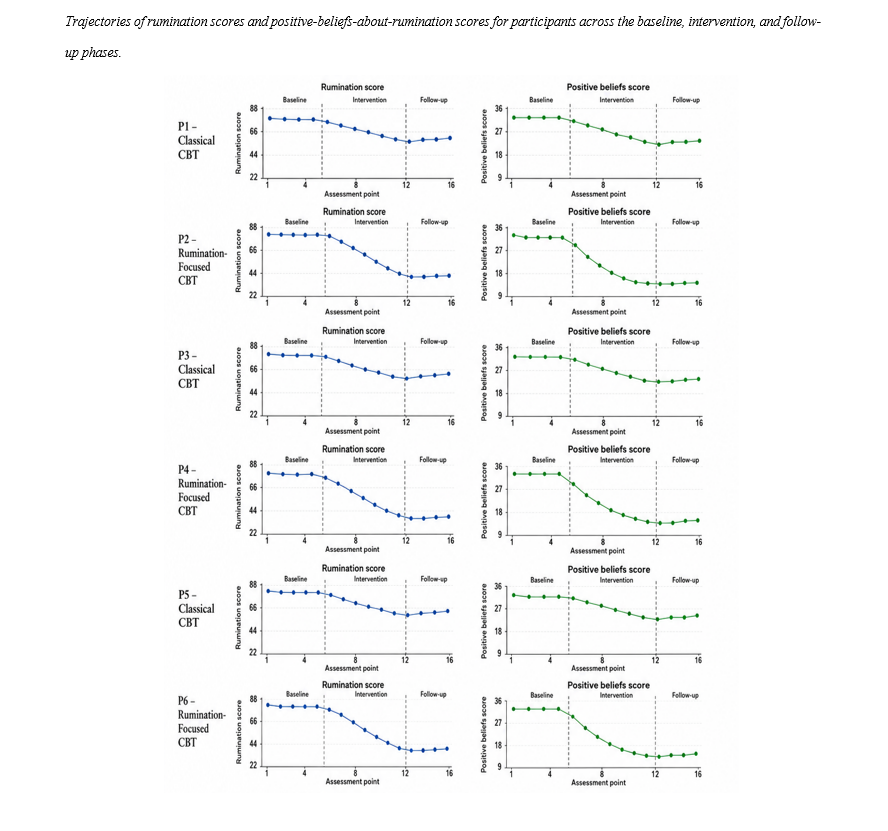
The present study aimed to compare the effectiveness of rumination-focused cognitive behavioral therapy and classical cognitive behavioral therapy in reducing rumination and positive beliefs about rumination among individuals with obesity. The study employed a single-case experimental design using a multiple-baseline design across participants. Following screening, six adults with obesity were randomly assigned to two treatment conditions, with three participants in each condition. Baseline phases included four to six measurement points, the intervention phase included eight measurement points, and the follow-up phase included four measurement points. Both interventions were delivered in ten weekly 60-minute sessions; the eight assessment occasions during the intervention phase did not correspond one-to-one with the ten treatment sessions. Rumination was assessed using the Ruminative Responses Scale, and positive beliefs were assessed using the nine-item Positive Beliefs About Rumination Scale. Data were analyzed using visual analysis, percentage improvement, and the Nonoverlap of All Pairs (NAP) and Tau-U indices. The mean of the final two baseline data points in both groups was 76 for rumination and 32 for positive beliefs. At posttreatment, the percentage improvement in rumination was 24.6% in classical cognitive behavioral therapy and 52.7% in rumination-focused cognitive behavioral therapy; at follow-up, these values were 21.7% and 51.8%, respectively. For positive beliefs, posttreatment improvement was 23.9% and 61.5% for the two approaches, respectively, and follow-up improvement was 20.3% and 59.4%, respectively. In comparisons of baseline with intervention, NAP for rumination was near the ceiling in both treatments, whereas Tau-U slightly favored classical cognitive behavioral therapy. In contrast, both indices for positive beliefs favored rumination-focused cognitive behavioral therapy. Individual graphs indicated that reductions in positive beliefs began earlier in the rumination-focused condition and were followed shortly thereafter by an accelerated reduction in rumination. Final score levels, improvement percentages, and visual patterns in this sample favored rumination-focused cognitive behavioral therapy, particularly for positive beliefs about rumination. However, the limited inconsistency in the Tau-U index for rumination indicates that conclusions should be based on convergence across multiple indicators and interpreted cautiously.
Downloads
References
Cano-López, J. B., García-Sancho, E., Fernández-Castilla, B., & Salguero, J. M. (2022). Empirical evidence of the metacognitive model of rumination and depression in clinical and nonclinical samples: A systematic review and meta-analysis. Cognitive therapy and research, 46(2), 367-392. https://doi.org/10.1007/s10608-021-10260-2
Cook, L., Mostazir, M., & Watkins, E. R. (2019). Reducing stress and preventing depression (RESPOND): Randomized controlled trial of web-based rumination-focused cognitive behavioral therapy for high-ruminating university students. Journal of medical Internet research, 21(5), e11349. https://doi.org/10.2196/11349
Dargahian, R., Mohammadkhani, S., Hasani, J., & Shams, J. (2011). Effectiveness of metacognitive therapy on improving metacognitive beliefs, rumination, and depressive symptoms: A single-case study. Clinical Psychology Studies, 2(3), 81-104.
Ehring, T., & Watkins, E. R. (2008). Repetitive negative thinking as a transdiagnostic process. International Journal of Cognitive Therapy, 1(3), 192-205. https://doi.org/10.1680/ijct.2008.1.3.192
Eshtad, E., Gholamali Lavasani, M., Hamidpour, H., & Pournaghash Tehrani, S. S. (2022). Effectiveness of rumination-focused cognitive-behavioral therapy in reducing rumination, depressive symptoms, and improving problem-solving strategies. Journal of Modern Psychological Research, 17(67), 25-34. https://doi.org/10.22034/jmpr.2022.15300
Farrokhi, H., Seyedzadeh, I., & Mostafapour, V. (2017). Examining the factor structure, validity, and reliability of the Persian version of the Positive and Negative Beliefs about Rumination Scale and the Ruminative Responses Scale. Modern Advances in Behavioral Sciences, 2(14), 21-37.
Fingerhut, J., Xu, X., & Moeyaert, M. (2021). Selecting the proper Tau-U measure for single-case experimental designs: Development and application of a decision flowchart. Evidence-Based Communication Assessment and Intervention, 15(3), 99-114. https://doi.org/10.1080/17489539.2021.1937851
Hasani, M., Zenoozian, S., Ahmadi, R., Khakpoor, S., Saberi, S., Pirzeh, R., & Saed, O. (2025). Evaluating the efficacy of rumination-focused cognitive-behavioral therapy in alleviating depression, negative affect, and rumination among patients with recurrent major depressive disorder: A randomized multicenter clinical trial. BMC psychiatry, 25, 626. https://doi.org/10.1186/s12888-025-07065-y
Hvenegaard, M., Moeller, S. B., Poulsen, S., Gondan, M., Grafton, B., Austin, S. F., Kistrup, M., Rosenberg, N. G. K., Howard, H., & Watkins, E. R. (2020). Group rumination-focused cognitive-behavioural therapy versus group cognitive-behavioural therapy for depression: Phase II trial. Psychological medicine, 50(1), 11-19. https://doi.org/10.1017/S0033291718003835
Kazdin, A. E. (2011). Single-Case Research Designs: Methods for Clinical and Applied Settings (2nd ed.). Oxford University Press.
Kratochwill, T. R., Hitchcock, J., Horner, R. H., Levin, J. R., Odom, S. L., Rindskopf, D. M., & Shadish, W. R. (2010). Single-Case Designs Technical Documentation.
Li, Y., & Tang, C. (2024). A systematic review of the effects of rumination-focused cognitive behavioral therapy in reducing depressive symptoms. Frontiers in psychology, 15, 1447207. https://doi.org/10.3389/fpsyg.2024.1447207
Luppino, F. S., de Wit, L. M., Bouvy, P. F., Stijnen, T., Cuijpers, P., Penninx, B. W. J. H., & Zitman, F. G. (2010). Overweight, obesity, and depression: A systematic review and meta-analysis of longitudinal studies. Archives of General Psychiatry, 67(3), 220-229. https://doi.org/10.1001/archgenpsychiatry.2010.2
McLaughlin, K. A., & Nolen-Hoeksema, S. (2011). Rumination as a transdiagnostic factor in depression and anxiety. Behaviour Research and Therapy, 49(3), 186-193. https://doi.org/10.1016/j.brat.2010.12.006
Moayedfar, H., Yaghoubi, H., Hassanabadi, H., & Mahdavian, A. (2020). Comparing the effectiveness of rumination-focused cognitive-behavioral therapy and classical cognitive-behavioral therapy on rumination and depressive symptoms. Journal of Disability Studies, 10(1), 27.
Nolen-Hoeksema, S., Wisco, B. E., & Lyubomirsky, S. (2008). Rethinking rumination. Perspectives on Psychological Science, 3(5), 400-424. https://doi.org/10.1111/j.1745-6924.2008.00088.x
Parker, R. I., & Vannest, K. J. (2009). An improved effect size for single-case research: Nonoverlap of all pairs. Behavior therapy, 40(4), 357-367. https://doi.org/10.1016/j.beth.2008.10.006
Parker, R. I., Vannest, K. J., Davis, J. L., & Sauber, S. B. (2011). Combining nonoverlap and trend for single-case research: Tau-U. Behavior therapy, 42(2), 284-299. https://doi.org/10.1016/j.beth.2010.08.006
Smith, K. E., Mason, T. B., & Lavender, J. M. (2018). Rumination and eating disorder psychopathology: A meta-analysis. Clinical psychology review, 61, 9-23. https://doi.org/10.1016/j.cpr.2018.03.004
Soleimani, A., Sohrabi, F., & Shams, J. (2015). The relationship of worry and rumination with metacognitive beliefs and major depressive symptoms. Journal of Modern Psychological Research, 9(33), 111-124.
Treynor, W., Gonzalez, R., & Nolen-Hoeksema, S. (2003). Rumination reconsidered: A psychometric analysis. Cognitive therapy and research, 27(3), 247-259. https://doi.org/10.1023/A:1023910315561
Wang, S. B., Lydecker, J. A., & Grilo, C. M. (2017). Rumination in patients with binge-eating disorder and obesity: Associations with eating-disorder psychopathology and weight-bias internalization. European Eating Disorders Review, 25(2), 98-103. https://doi.org/10.1002/erv.2499
Watkins, E. R. (2008). Constructive and unconstructive repetitive thought. Psychological bulletin, 134(2), 163-206. https://doi.org/10.1037/0033-2909.134.2.163
Watkins, E. R. (2016). Rumination-Focused Cognitive-Behavioral Therapy for Depression. Guilford Press.
Watkins, E. R., Mullan, E., Wingrove, J., Rimes, K. A., Steiner, H., Bathurst, N., Eastman, R., & Scott, J. (2011). Rumination-focused cognitive-behavioural therapy for residual depression: Phase II randomised controlled trial. The British Journal of Psychiatry, 199(4), 317-322. https://doi.org/10.1192/bjp.bp.110.090282
Watkins, E. R., & Roberts, H. (2020). Reflecting on rumination: Consequences, causes, mechanisms and treatment of rumination. Behaviour Research and Therapy, 127, 103573. https://doi.org/10.1016/j.brat.2020.103573
Downloads
Additional Files
Publication Timeline
- Submitted
- Revised
- Accepted