
Development and Psychometric Evaluation of the Migraine Perceptions and Lived Experience Questionnaire: Evidence for Face, Content, and Construct Validity and Reliability
Keywords:
Migraine, Lived Experience, Illness Perception, Questionnaire Development, Psychometric EvaluationAbstract
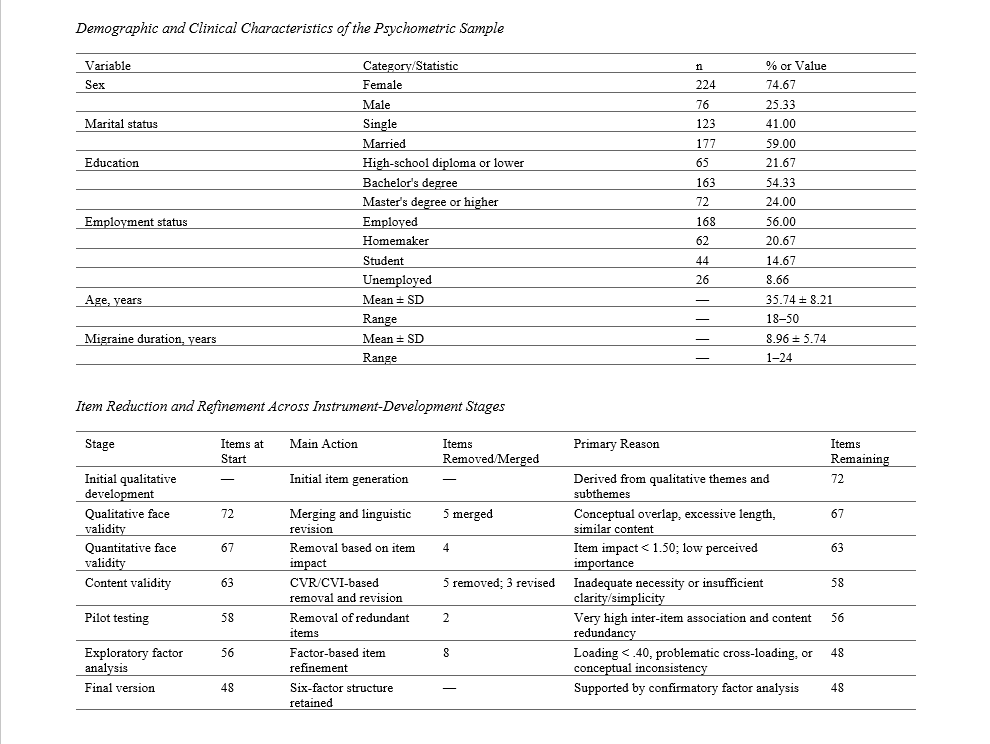
This study aimed to develop the Migraine Perceptions and Lived Experience Questionnaire (MPLEQ) and evaluate its face validity, content validity, construct validity, internal consistency, composite reliability, and convergent validity among patients with migraine. This instrument-development study constituted the psychometric phase of an exploratory sequential mixed-methods project. Questionnaire items were generated from a preceding phenomenological study and relevant literature, producing an initial 72-item pool. Qualitative and quantitative face validity, expert-based content validity, and pilot testing were conducted sequentially. The main psychometric sample comprised 300 patients with migraine attending Mehraram Clinic in Tehran, Iran. The dataset was divided into two independent subsamples of 150 participants for exploratory factor analysis (EFA) and confirmatory factor analysis (CFA). EFA was performed using principal components extraction with Varimax rotation. CFA used maximum likelihood estimation. Reliability was assessed using Cronbach's alpha, McDonald's omega, composite reliability (CR), and average variance extracted (AVE). The Kaiser–Meyer–Olkin coefficient was .91, and Bartlett's test of sphericity was significant, χ²(1540) = 5874.32, p < .001. EFA supported a six-factor, 48-item structure explaining 64.38% of total variance, with factor loadings ranging from .62 to .83. CFA supported the six-factor model, χ²/df = 2.13, CFI = .92, IFI = .92, TLI = .91, GFI = .88, AGFI = .85, RMSEA = .062, and SRMR = .054. Standardized CFA loadings ranged from .53 to .80 and were all significant at p < .001. Cronbach's alpha ranged from .81 to .90 across subscales and was .94 for the total scale; McDonald's omega ranged from .82 to .91 and was .95 overall. CR ranged from .83 to .91, and AVE ranged from .50 to .54. The 48-item MPLEQ demonstrated satisfactory multidimensional construct validity, internal consistency, composite reliability, and convergent validity and may serve as a patient-centered measure of migraine perceptions and lived experience.
Downloads
References
Abo-Elghiet, F., Elosaily, H., Hussein, D. K., El-Shiekh, R. A., A’aqoulah, A., Yousef, E. M., & El-Dessouki, A. M. (2025). Bridging Gaps in Migraine Management: A Comprehensive Review of Conventional Treatments, Natural Supplements, Complementary Therapies, and Lifestyle Modifications. Pharmaceuticals, 18(2), 139.
Amin Sorkhi, M., Hassanzadeh, R., Asadi, J., & Pourasghar, M. (2022). Effectiveness of cognitive-behavioral hypnotherapy on pain in patients with premenstrual dysphoric disorder. Avicenna Journal of Nursing and Midwifery Care, 31(1), 29-37.
Bagherzadeh Hamamchi, N., Abkhoy, S., & Esmakhani Akbarinejad, H. (2023). Effectiveness of mindfulness-based cognitive therapy on sleep quality and pain intensity in women with migraine. Anesthesiology and Pain, 14(3), 39-49.
De la Peña-Arteaga, V., Cano, M., Porta-Casteràs, D., Vicent-Gil, M., Miquel-Giner, N., Martínez-Zalacaín, I., & Cardoner, N. (2024). Mindfulness-based cognitive therapy neurobiology in treatment-resistant obsessive-compulsive disorder: A domain-related resting-state networks approach. European Neuropsychopharmacology, 82, 72-81.
Demir, V., Eryürek, S., & Savaş, E. (2024). The effect of mindfulness-based art therapy on psychological symptoms and happiness levels in patients with migraine: a pilot study. Current Psychology, 43(19), 17664-17672.
Esmaeili, M., Hashemi, S. E., Mehrabizadeh Honarmand, M., Hamid, N., & Ahmadian, M. (2023). Exploring the lived emotional experiences of patients with migraine disorder. Psychological Sciences, 22(132), 2467-2484.
Estave, P. M., Gillespie, C. L., Zlateva, S., Seng, E. K., Williams, D. A., & Ziadni, M. S. (2023). Mechanisms of mindfulness in patients with migraine: Results of a qualitative study. Global Advances in Integrative Medicine and Health, 12, 1-9.
Fernández-Gamero, L., Reinoso-Cobo, A., Ruiz-González, M. D. C., Cortés-Martín, J., Muñóz Sánchez, I., Mellado-García, E., & Piqueras-Sola, B. (2024). Impact of hypnotherapy on fear, pain, and the birth experience: a systematic review. Healthcare, 12(6), 616.
İnce, M. S., Güzel, İ., Akgör, M. C., Bahçelioğlu, M., & Bolay, H. (2023). Sensory sensitivity in migraine without aura patients is correlated with the duration of the disease and comorbid anxiety. Yüksek İhtisas Üniversitesi Sağlık Bilimleri Dergisi, 4(3), 90-95. https://doi.org/10.51261/yiu.2023.1395459
Jensen, M. (2024). Hypnosis and chronic pain management. In The Routledge International Handbook of Clinical Hypnosis (pp. 77-107).
Kruse, J. A., & Seng, E. K. (2023). Changes in cognitive appraisal in a randomized controlled trial of mindfulness-based cognitive therapy for patients with migraine. Headache, 63(10), 1403-1411.
Mangrum, L. F., Buse, D. C., Serrano, D., Agosti, R., & Lipton, R. B. (2024). The impacts of migraine on functioning: Results from two qualitative studies of people living with migraine. The Journal of Headache and Pain, 25(1).
Mangrum, R., Bryant, A. L., Gerstein, M. T., McCarrier, K. P., Houts, C. R., McGinley, J. S., Buse, D. C., Lipton, R. B., & Wirth, R. J. (2024). The impacts of migraine on functioning: Results from two qualitative studies of people living with migraine. Headache, 64(2), 156-171. https://doi.org/10.1111/head.14664
Mendak, M., Hanslik, A., Białek, A., Walczak, A., Olszanecka, M., Olszanecki, T., & Hovagimyan, A. (2025). The Impact of Migraine and Therapeutic Intervention Methods on Subjective Quality of Life Assessment. Information overview. Quality in Sport, 38, 58161-58161.
Milling, L. S. (2023). Evidence-Based Practice in Clinical Hypnosis. American Psychological Association.
Mohammadi Sahlabadi, F. (2023). Effectiveness of mindfulness-based therapy training on improving quality of life, sleep quality, and pain intensity in individuals with migraine Hakim Tous Institute of Higher Education].
Motaghizadeh, S., Ahmadi, E., & Esmakhani Akbarinejad, H. (2023). Effectiveness of mindfulness-based cognitive therapy on quality of life and pain intensity in men with migraine. Anesthesiology and Pain, 14(4), 47-57.
Paterniti, S., Raab, K., Sterner, I., Collimore, K. C., Dalton, C., & Bisserbe, J. C. (2022). Individual mindfulness-based cognitive therapy in major depression: A feasibility study. Mindfulness, 13(11), 2845-2856.
Paudel, P., & Sah, A. (2025). Efficacy of biofeedback for migraine: A systematic review and meta-analysis. Complementary Therapies in Medicine, 103153.
Peel, A. J., Oginni, O., Assary, E., Krebs, G., Lockhart, C., McGregor, T., Palaiologou, E., Ronald, A., Danese, A., & Eley, T. C. (2023). A multivariate genetic analysis of anxiety sensitivity, environmental sensitivity and reported life events in adolescents. Journal of Child Psychology and Psychiatry, 64, 289-298.
Rosenbloom, B. N., Slepian, P. M., Azam, M. A., Aternali, A., Birnie, K. A., Curtis, K., & Weinrib, A. Z. (2024). A Randomized Controlled Trial of Clinical Hypnosis as an Opioid-Sparing Adjunct Treatment for Pain Relief in Adults Undergoing Major Oncologic Surgery. Journal of Pain Research, 17, 45-59.
Rostamnejad, M., & Ahmadi, E. (2021). The effect of mindfulness training on pain intensity and quality of life in patients with migraine Ninth International Conference on Research in Psychology, Counseling, and Educational Sciences,
Saramadis, P., & Nagarajan, P. (2024). In adults with chronic migraine, is neuromodulatory therapy effective for reducing migraine frequency and severity of pain? Evidence-Based Practice.
Sezagli Shahkhasse, M., Hassani, J., & Shakerim. (2022). Comparative effectiveness of mindfulness-based cognitive-behavioral therapy and cognitive-behavioral therapy on psychological distress in patients with migraine headache. Psychological Sciences, 21(120), 2519-2533.
Simshauser, S., Kalisch, R., & Wippert, P. M. (2022). Mindfulness-based cognitive therapy as migraine intervention: A randomized waitlist controlled trial. Applied Psychophysiology and Biofeedback, 47, 137-148.
Sohi, F. (2023). Examining the effect of mindfulness-based resilience training on quality of life, frequency of panic attacks, and perceived stress in adults with migraine Al-Mahdi Institute of Higher Education].
Steiner, T. J., Stovner, L. J., Jensen, R., Uluduz, D., & Katsarava, Z. (2023). Global epidemiology of migraine and its implications for public health and health policy. Nature Reviews Neurology, 19, 109-117. https://doi.org/10.1038/s41582-022-00763-1
Surbhi, S. S. (2024). Effect of Mindfulness-based Cognitive Therapy (MBCT) in Reducing Anxiety among Cancer Patients. Indian Journal of Positive Psychology, 15(1), 64.
Tekin, R. T., Aslan, H., Uludağ, V., Gümüşyayla, Ş., & Vural, G. (2025). Novel Conservative Therapies in Migraine Management: The Impact of Fascia Exercises in a Randomized Controlled Trial. Journal of clinical medicine, 14(2), 539.
van Lohuizen, R., Paungarttner, J., Lampl, C., MaassenVanDenBrink, A., & Al-Hassany, L. (2024). Considerations for hormonal therapy in migraine patients: a critical review of current practice. Expert Review of Neurotherapeutics, 24(1), 55-75.
Downloads
Additional Files
Publication Timeline
- Submitted
- Revised
- Accepted