The Structural Relationship Model of Cyberspace Addiction and Rejection Sensitivity: Examining the Mediating Role of Emotional Self-Efficacy
Keywords:
cyberspace addiction, rejection sensitivity, emotional self-efficacy, structural equation modelingAbstract
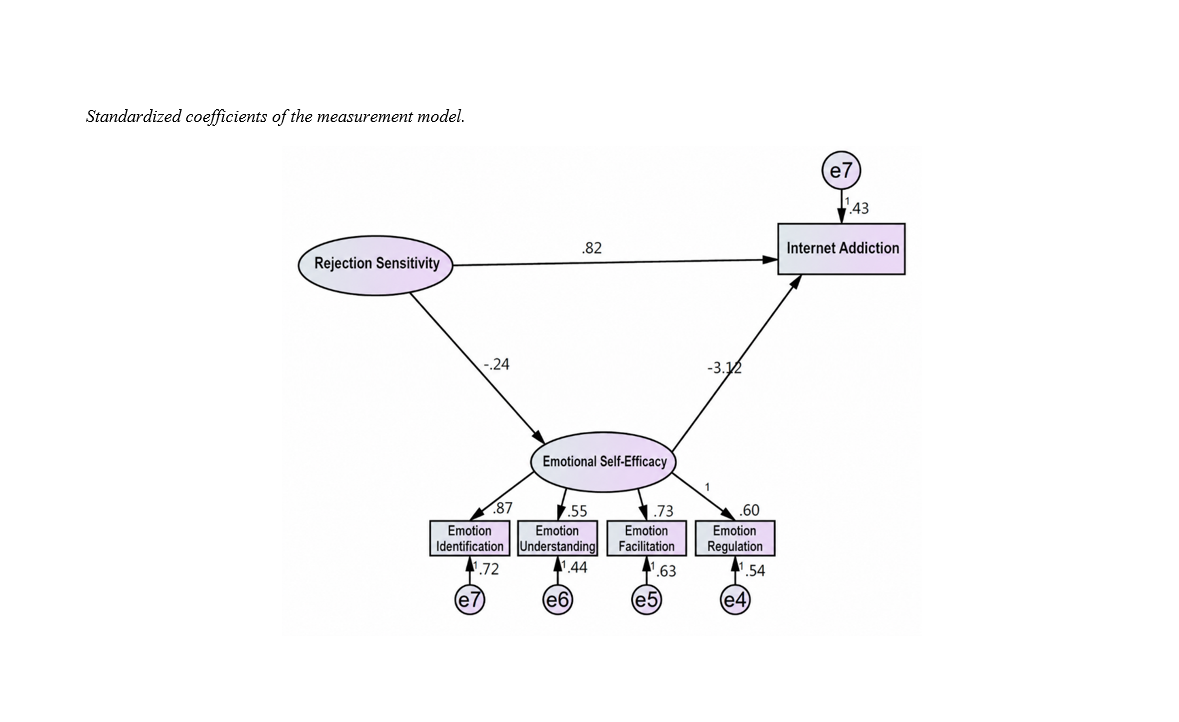
The present study aimed to examine the structural relationship between rejection sensitivity and cyberspace addiction, with an emphasis on the mediating role of emotional self-efficacy. In terms of purpose, this was a basic research study, and in terms of methodology, it employed a descriptive-correlational design. The statistical population consisted of students at the University of Mohaghegh Ardabili during the 2024–2025 academic year. Based on the number of parameters in the hypothesized model, 300 students were selected through cluster random sampling. Data were collected using the Internet Addiction Test (Young, 1998), the Emotional Self-Efficacy Scale (Beverley et al., 1997), the Depression Anxiety Stress Scales (Lovibond & Lovibond, 1995), and the Rejection Sensitivity Questionnaire (Downey & Feldman, 1996). Structural equation modeling was performed using SPSS version 24 and AMOS version 24. The results showed that rejection sensitivity had a significant positive direct effect on internet addiction. Emotional self-efficacy also had a negative direct effect on internet addiction and partially mediated the relationship between rejection sensitivity and internet addiction. The model fit indices (GFI = .96, RMSEA = .075) indicated that the proposed model had an acceptable fit to the data.
Downloads
References
Beirami, M., Hashemi Nosratabad, T., Esmailpour, K., & Shiri, A. (2021). Effectiveness of emotion efficacy therapy on reducing internet dependency and psychological vulnerability in students with internet addiction. Clinical Psychology Studies, 12(44), 23-43. https://doi.org/10.22054/jcps.2021.56400.2459
Cai, Z., Zhou, Y., & Wang, Y. (2023). Associations between problematic internet use and mental health outcomes: A systematic review and meta-analysis. International journal of environmental research and public health, 20, Article. https://www.ncbi.nlm.nih.gov/pmc/articles/PMC9883821/
Caprara, M., Gerbino, M., Mebane, M. E., & Ramirez-Ucles, I. M. (2022). Self-efficacy beliefs in managing positive emotions: Associations with positive affect, negative affect, and life satisfaction across gender and ages. Frontiers in human neuroscience, 16, 927648. https://doi.org/10.3389/fnhum.2022.927648
Celikkaleli, O., & Ata, R. (2025). The mediating role of regulatory emotional self-efficacy in the relationship between basic psychological need dissatisfaction, insufficient social support, and problematic Internet use in emerging adults. Acta Psychologica, 254, 104857. https://doi.org/10.1016/j.actpsy.2025.104857
Fan, Z., Chen, M., & Lin, Y. (2022). Self-control and problematic internet use in college students: The chain mediating effect of rejection sensitivity and loneliness. Psychology research and behavior management, 15, 459-470. https://doi.org/10.2147/PRBM.S352060
Fontana, A., Callea, A., Casini, E., & Curti, V. (2018). Rejection sensitivity and internet addiction in adolescence: Exploring the mediating role of emerging personality disorders. Clinical Neuropsychiatry, 15(4), 206-214. https://psycnet.apa.org/record/2018-59965-003
Ghadampour, E., Mahdiani, Z., Padarvand, H., Amraei, B., & Souri, H. (2019). Predicting addiction to cyberspace and tendency toward high-risk behaviors based on emotional self-regulation among high-school students in Tehran. Educational Psychology Quarterly, 15. https://doi.org/10.22054/jep.2020.35879.2406
Hasani, B., Khodabakhsh Pirklani, R., & Ahadi, B. (2022). Attachment style and smartphone addiction: The mediating role of self-esteem and rejection sensitivity. Journal of Psychological Science, 21(113), 971-986. http://psychologicalscience.ir/article-1-1499-fa.html
Keles, B., McCrae, N., & Grealish, A. (2020). A systematic review: The influence of social media on depression, anxiety and psychological distress in adolescents. International Journal of Adolescence and Youth, 25(1), 79-93. https://doi.org/10.1080/02673843.2019.1590851
Kheiripour, F., Bahrami Hidaji, M., Mohammadi Shirmahaleh, F., Rafezi, Z., & Asgharpour, M. (2023). Designing an emotion-regulation training protocol and examining its effectiveness on internet addiction in female students. Journal of Adolescent and Youth Psychological Studies, 5(2), 84-93. https://doi.org/10.61838/kman.jayps.5.2.10
Liu, W., Huang, J., Li, Y. L., Gao, X., Xu, Z. Y., & Li, Y. H. (2025). The impact of emotional abuse on Internet addiction in Chinese children: The sequential mediation roles of emotional dysregulation and regulatory emotional self-efficacy. Frontiers in psychology, 16, 1517489. https://doi.org/10.3389/fpsyg.2025.1517489
Molavi, P., Mikaeili, N., Ghaseminejad, M. A., Kazemi, Z., & Pournia, M. (2018). Social anxiety and benign and toxic online self-disclosures: Examining the role of rejection sensitivity, self-regulation, and internet addiction in students. Journal of Nervous and Mental Disease, 206(8), 598-605. https://pubmed.ncbi.nlm.nih.gov/30020206/
Morelli, M., Cattelino, E., Baiocco, R., Trumello, C., Babore, A., Candelori, C., & Chirumbolo, A. (2020). Parents and children during the COVID-19 lockdown: The influence of parenting distress and parenting self-efficacy on children's emotional well-being. Frontiers in psychology, 11, 584645. https://doi.org/10.3389/fpsyg.2020.584645
Panova, T., & Carbonell, X. (2018). Is smartphone addiction really an addiction? Journal of Behavioral Addictions, 7(2), 252-259. https://pubmed.ncbi.nlm.nih.gov/29895183/
Qarahkhani, Z., Bahrami, E., & Ahmadi, A. (2023). Internet addiction in students: Predictive role of academic alienation and psychological distress. 10th National Conference on New Findings in Positive Psychology, Bandar Abbas, Iran.
Quaglieri, A., Biondi, S., Roma, P., Varchetta, M., Fraschetti, A., Burrai, J., Lausi, G., Marti-Vilar, M., Gonzalez-Sala, F., Di Domenico, A., Giannini, A. M., & Mari, E. (2022). From emotional (dys)regulation to internet addiction: A mediation model of problematic social media use among Italian young adults. Journal of clinical medicine, 11(1), 188. https://doi.org/10.3390/jcm11010188
Ramadas, L., Wawrziczny, E., & Nandrino, J. L. (2025). Adult Rejection Sensitivity Questionnaire: Psychometric properties and factor structure of the French version. Journal of psychopathology and behavioral assessment, 47, 40. https://doi.org/10.1007/s10862-025-10215-x
Sadeghzadeh, R., Ahadi, H., Dortaj, F., & Manshei, G. (2019). Effectiveness of an integrated cognitive-behavioral therapy and metacognition-based training package in reducing dependency on virtual social networks. Journal of Psychological Science, 18(78), 659-666. http://psychologicalscience.ir/article-1-445-fa.html
Shao, Y., Wu, J., Xu, W., & Zhang, C. (2024). The impact of digital technology use on adolescents' subjective well-being: The serial mediating role of flow and learning engagement. Medicine, 103(43), e40123. https://doi.org/10.1097/MD.0000000000040123
Shin, J., Han, K. S., & Shin, H. J. (2024). Title not provided in source list. Journal of Korean Academy of Psychiatric and Mental Health Nursing, 33(3), 253-261. https://doi.org/10.12934/jkpmhn.2024.33.3.253
Tao, Z., Zhao, X., Wang, Z., Yu, C., & Zhang, W. (2020). Rejection sensitivity mediates the interparental conflict and adolescent internet addiction: School connectedness as a moderator. Frontiers in psychology, 11, 1038470. https://doi.org/10.3389/fpsyg.2022.1038470
Tsai, H. F., Cheng, S. H., Yeh, T. L., Shih, C. C., Chen, K. C., Yang, Y. C., & Yang, Y. K. (2020). The risk factors of internet addiction: A survey of university freshmen. Psychiatry research, 287, 112983. https://doi.org/10.1016/j.psychres.2008.01.015
Wu, Q., Ran, G., & Zhang, Q. (2020). Rejection sensitivity and trait anxiety: The indirect effects of regulatory emotional self-efficacy and shyness. Current Psychology, 39(6), 1965-1974. https://doi.org/10.1007/s12144-020-01070-y
Yang, X., Yip, B. H. K., Lee, E. K. P., Zhang, D., & Wong, S. Y. S. (2021). The relationship between technology use and problem technology use and potential psychosocial mechanisms: Population-based telephone survey in community adults during COVID-19. Frontiers in psychology. https://doi.org/10.3389/fpsyg.2021.696271
Young, K. S., Sandman, C. F., & Craske, M. G. (2019). Positive and negative emotion regulation in adolescence: Links to anxiety and depression. Brain Sciences, 9(4), 76. https://doi.org/10.3390/brainsci9040076
Zhao, J., Yang, Y., Wu, X., Zhao, F., & Huang, Y. (2024). How is rejection sensitivity linked to non-suicidal self-injury? Exploring social anxiety and regulatory emotional self-efficacy as explanatory processes in a longitudinal study of Chinese adolescents. Behavioral Sciences, 14(10), 943. https://doi.org/10.3390/bs14100943
Downloads
Additional Files
Publication Timeline
- Submitted
- Revised
- Accepted