Comparison of Parent–Child Relationships, Sense of Coherence, and Psychological Capital among First-Cycle Secondary School Female Students from Only-Child and Multi-Child Families in Khomam
Keywords:
parent–child relationships, Sense of coherence, psychological capital, only-child and multi-child familiesAbstract
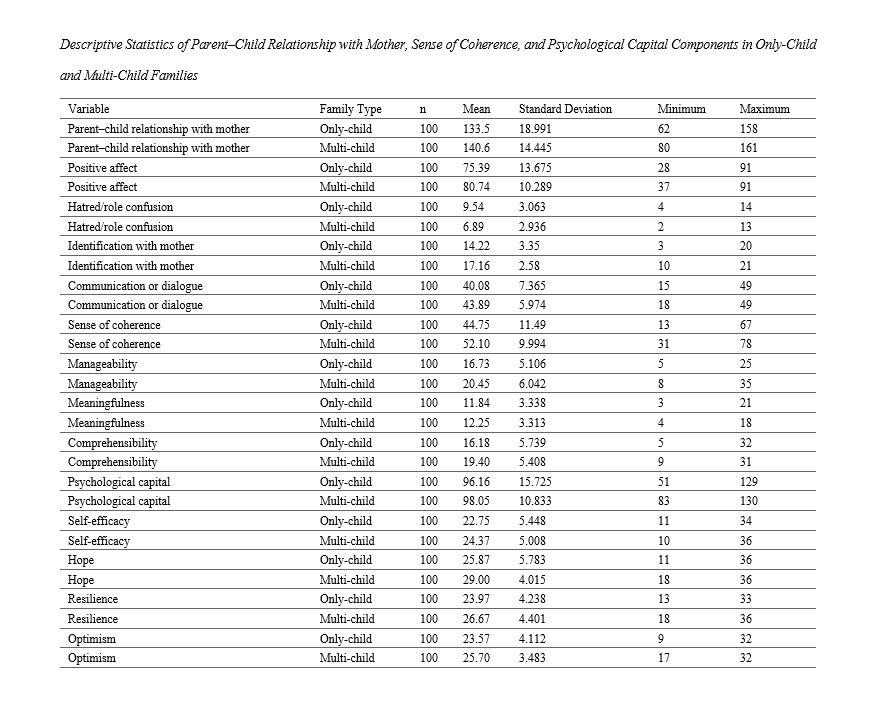
The present study examined differences in parent–child relationships, sense of coherence, and psychological capital among first-cycle secondary school female students from only-child and multi-child families in Khomam. In terms of purpose, this study was applied research, and in terms of method, it was causal-comparative (ex post facto). The statistical population consisted of 200 first-cycle secondary school female students, including 100 only-child students and 100 students from multi-child families, in the 2024–2025 academic year. Data were collected using the Fine Parent–Child Relationship Scale (PCRS), Antonovsky’s Sense of Coherence Scale (SOC-13), and the Psychological Capital Questionnaire (Luthans, 2007). Data analysis was performed using descriptive indices and inferential statistics, including the t-test and multivariate analysis of variance. The data were analyzed using SPSS version 23. The findings showed that the mean score of parent–child relationships in the multi-child group was significantly higher than that of the only-child group (p < 0.05). Moreover, the mean score of sense of coherence in the multi-child group was significantly higher than that of the only-child group (p < 0.001). In addition, a significant difference was observed between the two groups in psychological capital, including hope, resilience, and optimism, and the mean scores of psychological capital and its components were higher in the multi-child group than in the only-child group (p < 0.001). The analysis of variance indicated that family type had a significant effect on all dependent variables, namely parent–child relationships, sense of coherence, and psychological capital (p < 0.001). Overall, multi-child families had better parent–child relationships, which positively affected children’s sense of coherence and psychological capital. These results indicated a significant difference between the two groups in all three variables, namely parent–child relationships, sense of coherence, and psychological capital, and students from multi-child families performed better on these variables than only-child students. Therefore, it can be concluded that having multiple children has a positive effect on parent–child relationships, sense of coherence, and psychological capital.
Downloads
References
Ahunovna, M. D. (2021). Important aspects of the psychological characteristics of adolescence. JournalNX, 7(02), 59-61.
Aliyev, R., & Karakus, M. (2015). The effects of positive psychological capital and negative feelings on students' violence tendency. Procedia - Social and Behavioral Sciences, 190, 69-76. https://doi.org/10.1016/j.sbspro.2015.04.918
Amera, F. B. (2025). The Impact of Psychological Capital on University Students’ Academic Achievement Mediated Through Academic Engagement. Bje, 25(2), 139-160. https://doi.org/10.4314/10.4314/bdje.v25i2.9
Bahadori Khosroshahi, J., Hashemi Nosratabad, T., & Babapour Kheiraldin, J. (2012). The relationship between psychological capital and social capital among students of the University of Tabriz. Journal of Research and Health, 2(1), 63-71.
Berk, L. E. (2018). Development Through the Lifespan (7th ed.). Pearson.
Del-Pino-Casado, R., Espinosa-Medina, A., López-Martínez, C., & Orgeta, V. (2019). Sense of coherence, burden, and mental health in caregiving: A systematic review and meta-analysis. Journal of affective disorders, 242, 14-21. https://doi.org/10.1016/j.jad.2018.08.002
Etesamipour, R., Bagheri, F., & Zare Bahramabadi, M. (2020). Examining the parent-child relationship pattern with communication skills and the mediating role of students' self-esteem. Scientific Quarterly of Islamic Education, 15(31), 109-125.
Gebriné, K. É., Lampek, K., Sárváry, A., Sárváry, A., Takács, P., & Zrínyi, M. (2019). Impact of sense of coherence and work values perception on stress and self-reported health of midwives. Midwifery, 77, 9-15. https://doi.org/10.1016/j.midw.2019.06.006
Gohanj, A., & Ghazanfari. (2025). Modeling marriage orientation based on psychological capital and attitudes toward relationships before marriage, with the mediating role of family ties among single students. Journal of Psychological Sciences, 23(144), 195-214. https://doi.org/10.61186/jps.23.144.11
Hu, Y., Weng, Y., Ning, P., Han, L., & Zhang, Y. (2025). The Relationship Between Psychological Capital and Subjective Academic Achievement Among Middle School Students: The Chain Mediating Role of Adolescent Internalizing Problems and Life Attitude. BMC psychology, 13(1). https://doi.org/10.1186/s40359-025-03495-1
Jasem, R. A., Torkan, H., Jabr, A. M., & Mahdad, A. (2025). The Mediating Role of Psychological Capital in the Relationship Between Academic Self-Efficacy, Academic Engagement, and Academic Meaningfulness With Academic Achievement Among Students in Wasit, Iraq. Jayps, 6(3), 1-11. https://doi.org/10.61838/kman.jayps.6.3.1
Kaur, J., & Amin, S. (2017). Psychological capital and stress among school students. Indian Journal of Positive Psychology, 8(4).
Mehdizadeh Hassanabadi, F., & Salehi, I. (2022). Comparison of psychological sense of coherence, self-regulation, and hardiness among only-child and multi-child final-year high school students in Rasht. New Strategies in Psychology and Educational Sciences, 4(13), 200-213.
Mortazavi, M., Hosseinian, S., Rasouli, R., & Zarei Hassanabadi, M. (2018). The lived experience of only children in interaction with parents. Family Research, 15(2), 251-266.
Sharifian Motlaq, A., & Mohammadi, T. (2025). The effectiveness of mindfulness training on psychological capital and emotional regulation in gifted students. Journal of Psychology Growth, 14(1), 94-85. http://frooyesh.ir/browse.php?a_id=4708&sid=1&slc_lang=fa
Shek, D. T., & Dou, D. (2020). Perceived parenting and parent-child relational qualities in fathers and mothers: Longitudinal findings based on Hong Kong adolescents. International journal of environmental research and public health, 17(11), 4083. https://doi.org/10.3390/ijerph17114083
Shereda, H. M. A., Alhazmi, R., Kasemy, Z. A., Dawood, E., Singh, E. S. J., Alkhalaf, I., Alshehri, B., & Alanazi, T. D. M. (2025). Life Satisfaction and Psychological Wellbeing Among Medical Students: The Mediating Role of Psychological Capital. Frontiers in psychology, 16. https://doi.org/10.3389/fpsyg.2025.1614803
Shi, Z. (2024). Research on the Relationship Between Family Economic Capital and Students Psychological Development. Communications in Humanities Research, 64(1), 1-5. https://doi.org/10.54254/2753-7064/2024.18274
Soomro, B. A., & Shah, N. (2019). Determining the impact of entrepreneurial orientation and organizational culture on job satisfaction, organizational commitment, and employee performance. South Asian Journal of Business Studies, 8(3), 266-282. https://doi.org/10.1108/SAJBS-12-2018-0142
Souri Nejad, H., Raeisi Dehkordi, Z., Kohan, S., Shams, M., & Adib Moghaddam, E. (2020). Comparison of parenting style and mental health in mothers with one child and mothers with two or more children in Isfahan. Quarterly Journal of Nursing, Midwifery and Paramedical Sciences, 4(5), 71-76.
Yin, H., Qian, S., Huang, F., Zeng, H., Zhang, C. J., & Ming, W. K. (2021). Parent-child attachment and social adaptation behavior in Chinese college students: The mediating role of school bonding. Frontiers in psychology, 12, 711669. https://doi.org/10.3389/fpsyg.2021.711669
Yuan, H., Yan, Z., Yue, Y., Zhao, Y., & Lei, J. (2025). The Relationship Between Family Socio‐Economic Status and Preschool Children Parents' Parenting Sense of Competence: The Chain Mediating Role of Social Support and Psychological Capital. Child & Family Social Work. https://doi.org/10.1111/cfs.13263
Zoromba, M. A., Atta, M. H. R., Ali, A. S., El‐Gazar, H. E., & Amin, S. M. (2024). The Mediating Role of Psychological Capital in the Relationship Between Family Sense of Coherence and Caregiver Stress Among Parents of Children With Autism Spectrum Disorder. International journal of mental health nursing, 33(6), 2157-2169. https://doi.org/10.1111/inm.13383