Identifying and Ranking Core Elements of Counseling-Based Interventions that Enhance Student Self-Belief and Motivation
Keywords:
Counseling-based interventions, student motivation, self-belief, academic engagement, cognitive empowerment, emotional regulation, mixed-methods researchAbstract
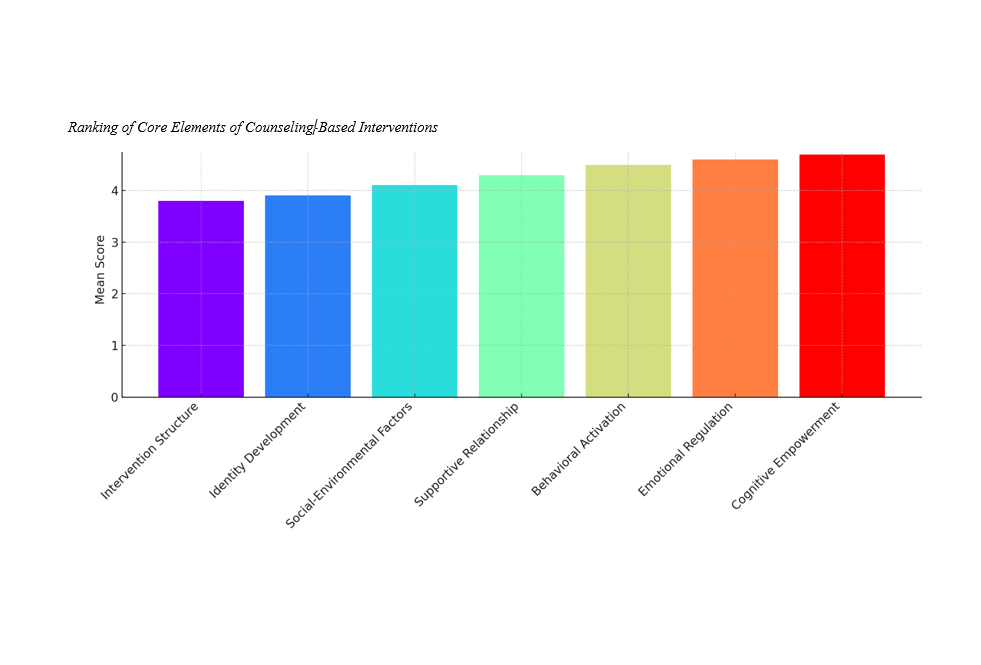
The objective of this study was to identify and rank the core elements of counseling-based interventions that effectively enhance student self-belief and academic motivation. This study employed a sequential exploratory mixed-methods design. In the qualitative phase, an extensive literature review was conducted until theoretical saturation was reached, and findings were analyzed using NVivo 14 to identify core components of counseling-based interventions. Seven main themes were extracted and used to construct the quantitative instrument. In the quantitative phase, a structured survey was administered to 260 university students in Morocco, who rated each identified element on a five-point Likert scale. Descriptive statistics and ranking analyses were conducted using SPSS-26 to determine the relative importance of each intervention component. Statistical analysis revealed significant differences in the perceived importance of counseling components, with cognitive empowerment strategies receiving the highest mean ranking (M = 4.70), followed by emotional regulation and support (M = 4.60), behavioral activation (M = 4.50), and supportive counseling relationship (M = 4.30). Social and environmental influences demonstrated moderate importance (M = 4.10), while identity and self-concept development (M = 3.90) and intervention structure and delivery quality (M = 3.80) ranked lower but remained positively evaluated. The ascending ranking pattern indicated that internal psychological processes were prioritized above structural or contextual supports. The study concludes that cognitive and emotional components form the strongest foundation for effective counseling-based interventions aimed at enhancing student motivation and self-belief, while relational, social, identity-related, and structural elements play complementary but essential supporting roles. The results provide a practical, evidence-based hierarchy to guide the development and refinement of counseling programs in educational settings.
Downloads
References
Ajuwon, O. A., Animashaun, E. S., & Chiekezie, N. R. (2024). Crisis Intervention, Mediation, Counseling, and Mentoring in Schools: Building Resilient Educational Communities. International Journal of Applied Research in Social Sciences, 6(8), 1593-1611. https://doi.org/10.51594/ijarss.v6i8.1372
Anindita, T., Febriyanti, S., Filhal, N. H., & Kuswardani, H. P. (2025). TERANG : Discover Your Passion, Ignite Your Academic Enthusiasm Through Group Counseling. Epj, 14(1), 33-39. https://doi.org/10.15294/epj.v14i1.32680
Annisa, D. F., Erwinda, L., & Syahputra, Y. (2024). The Effectiveness of Group Counseling Using Self-Talk Techniques to Reduce Procrastination in Students Experiencing Post-Earthquake Trauma. Indones. J. Guid. Couns. Stud., 1(2), 65-74. https://doi.org/10.64420/ijgcs.v1i2.227
Asadi, A., & Mede, E. (2024). Improving Student Performance and Personal Growth: A Review of Group Counseling in High Schools. Jayps, 5(1), 53-58. https://doi.org/10.61838/kman.jayps.5.1.7
Bahauddin, A., Hamidah, H., & Hamzah, H. (2025). Peran Layanan Konseling Dalam Menangani Dan Mencegah Kasus Bullying Di Sekolah. An Namatul Ausath, 3(1), 1-7. https://doi.org/10.64431/annamatulausath.v3i1.301
Enwere, C. A., & Chijioke, A. A. (2025). Influence of Career Counselling in Shaping Career Awareness and Academic Motivation of Students in Anambra State. Changethinkjournal, 4(1), 1-14. https://doi.org/10.47453/changethinkjournal.v4i1.3199
Fatmala, E. D. (2025). Learning Motivation and Self-Regulation Linked to Academic Procrastination. Indonesian Journal of Education Methods Development, 20(2). https://doi.org/10.21070/ijemd.v20i2.885
Hamzah, R. M. (2025). Marriage Readiness Education Among University Students: Analysis of Self-Preparation for Marriage and Family Life. Edu, 280-286. https://doi.org/10.59397/edu.v3i2.96
katas, K. U., Nwankwo, E. I., Igwama, G. T., Olaboye, J. A., & Anyanwu, E. C. (2023). The Role of Peer Counselling in Addressing Substance Abuse and Addiction in High School Students. International Journal of Management & Entrepreneurship Research, 5(12), 1221-1238. https://doi.org/10.51594/ijmer.v5i12.1534
Kim, J., Gu, B., & Cho, Y. (2025). Effects of Self-Regulation Strategy-Based Interventions for Elementary Students With Learning Difficulties: A Meta-Analysis of Experimental Studies in Korea. Korean J Special Edu, 60(2), 151-181. https://doi.org/10.15861/kjse.2025.60.2.151
Lin, H., Wang, Y., He, G., Li, J., & Zheng, H. (2025). The Effect of School-Based Group Counseling on Chinese Mainland Adolescents’ Mental Health and Academic Functioning: A Meta-Analysis of Controlled Studies. Journal of counseling psychology, 72(4), 416-431. https://doi.org/10.1037/cou0000789
Mahaly, S., Hariko, R., Syawaluddin, S., & Makatita, T. (2025). Unveiling Misconceptions in School Counseling: Exploring Student Perceptions and Challenges in Guidance Services Implementation. Edu, 8-14. https://doi.org/10.59397/edu.v3i1.48
Mahmood, S., & Kaló, Z. (2024). “ Virtual Counseling Was a Lifeline”- Lived Experiences of Adolescent Cyberbullying Victims on Counselling Intervention During the COVID-19 Pandemic: An Interpretative Phenomenological Analysis. https://doi.org/10.21203/rs.3.rs-4921549/v1
Nashwa, M., & Zuhara, E. (2025). The Effectiveness of Group Counseling in Improving the Self-Esteem of Junior High School Students Experiencing Body Shaming. QUANTA J. Kaji. Bimbing. Dan Konseling Dalam Pendidik., 9(3), 298-307. https://doi.org/10.22460/quanta.v9i3.6352
Prasetyaningrum, P. T., Ibrahim, N., Aryani, E., Ningsih, R., & Subagyo, I. R. (2025). Enhancing Accessibility, Engagement, and Motivation in Counseling Services for Secondary Schools Through Gamified Blended Mobile and Virtual Reality Therapy. Intensif Jurnal Ilmiah Penelitian Dan Penerapan Teknologi Sistem Informasi, 9(2), 211-234. https://doi.org/10.29407/intensif.v9i2.24814
Pratiwi, A. S., & Rahmawati, S. (2025). Intensity of Social Media Use in Adolescent Students and Preventive Efforts in Guidance and Counseling Services at School. Psychosocia, 3(1), 1-15. https://doi.org/10.61978/psychosocia.v3i1.503
Qodaria, R. L., & Harsiwi, N. E. (2024). Pengaruh Konseling Pendidikan Terhadap Peningkatan Prestasi Akademik Siswa Slow Learner. Khatulistiwa Jurnal Pendidikan Dan Sosial Humaniora, 4(3), 14-23. https://doi.org/10.55606/khatulistiwa.v4i3.3813
Rathore, U. (2024). Counselling Interventions for Children With Learning Disabilities: A Systematic Review. Research Review International Journal of Multidisciplinary, 9(10), 22-33. https://doi.org/10.31305/rrijm.2024.v09.n10.004
Revielyn, L., Rodalyn, F., Lester, S. J., Enrico, W., & G, L. B. L. (2025). From Whole to Broken: An Analysis on the Impact of Broken Families to Students’ Academic Engagement. Ijamrs, 5(2), 1473-1476. https://doi.org/10.62225/2583049x.2025.5.2.4005
Robinson, K., Atkinson, M., Kylišová, K., Egan, S. J., Shafran, R., & Wade, T. (2024). Pilot Implementation of an Evidence‐based Online Cognitive Behavioural Therapy for Perfectionism in University Students: Lessons Learnt. Stress and Health, 40(5). https://doi.org/10.1002/smi.3444
Simbolon, R., & Purba, W. (2022). Evaluating the Impact of School Counseling Programs on Student Well-Being and Academic Performance in the Educational Environment. Jiph, 11(2), 118-137. https://doi.org/10.35335/jiph.v11i2.19
Suhertina, S. (2024). The Relationship Between Self-Esteem and Achievement From the Perspective of Islamic Counseling: A Literature Analysis of 2024. Al-Ittizaan Jurnal Bimbingan Konseling Islam, 7(2), 135. https://doi.org/10.24014/ittizaan.v7i2.34262
Susilowati, S., & Suryadi, A. (2025). Strategic Guidance and Counseling Interventions to Overcome Learning Barriers, a Case Study at SMP Negeri 178 Jakarta. Mrscholar, 1(1), 18-29. https://doi.org/10.71312/mrscholar.v1i1.334
Swargiary, K. (2023). Assessing the Need for Values Counselling Among Higher Education Students in India: A Survey Study. https://doi.org/10.21203/rs.3.rs-3464746/v1
Veryanto, S., Noviyanti, A. I., & Masyitoh, D. (2025). Sociodrama-Based Education: Improving Students’ Positive Self-Concepts in Indonesian Secondary Schools. Edu, 342-350. https://doi.org/10.59397/edu.v3i2.108
Wahyudi, W., Maghfiroh, N. H., & Sukmawati, B. (2025). Healing Words With Meaning: The Impact of Existential–humanistic Group Counseling on Verbal Bullying Survivors. Edu, 11-17. https://doi.org/10.59397/edu.v4i1.132
Yuniarti, F. A., Huriah, T., Sofiana, L., & Satria, F. E. (2023). Social Modelling by Cadres Elevates Self Efficacy of Children About Tuberculosis. Jurnal Kesehatan Pasak Bumi Kalimantan, 5(2), 144. https://doi.org/10.30872/j.kes.pasmi.kal.v5i2.8509
Yuningdartie, Y. (2023). Efektivitas Konseling Rasional Emotif Behavioral Dalam Meningkatkan Self-Regulated Learning Siswa Sekolah Menengah Kejuruan. Jurnal Bimbingan Dan Konseling Borneo, 4(2). https://doi.org/10.35334/jbkb.v4i2.3256
Yunita, Y., & Uda, P. A. S. (2025). The Role of Peer Counseling Services in Addressing Juvenile Delinquency Among High School Students. Int. J. Couns. Psychother., 2(1), 9-18. https://doi.org/10.64420/ijcp.v2i1.186
Zeng, H., & Ka, C. M. H. (2025). Assessing Career Decision‐Making Interventions: Effects of Career Courses and Group Counseling on High School Students. The Career Development Quarterly, 73(1), 68-78. https://doi.org/10.1002/cdq.12371
Downloads
Additional Files
Publication Timeline
- Submitted
- Revised
- Accepted