Identifying and Ranking Core Components of Organizational Wellness Systems Improving Productivity
Keywords:
Organizational wellness, employee productivity, occupational health, mental health, workplace environment, leadership, organizational culture, wellness systems, workplace stress, employee wellbeingAbstract
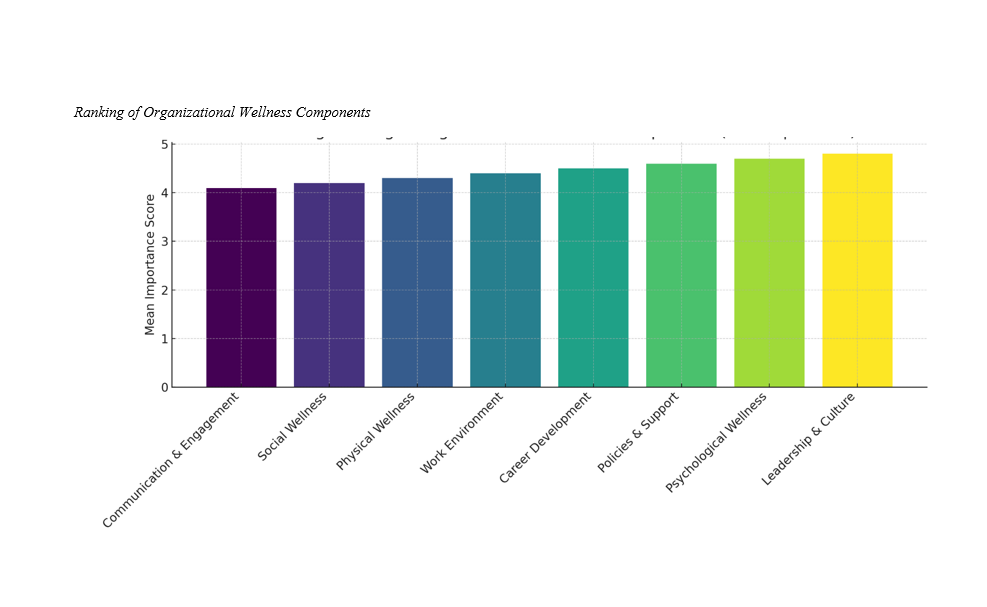
This study aimed to identify and rank the core components of organizational wellness systems that most effectively enhance employee productivity. This research followed a mixed-methods sequential design. In the first phase, a qualitative literature review was conducted until theoretical saturation was achieved, and all extracted data were coded and analyzed using NVivo 14 to identify wellness components. In the second phase, these components were operationalized into a structured questionnaire and distributed to 240 employees from various organizational sectors in Malaysia. Data from the quantitative phase were analyzed using SPSS-26 through descriptive statistics, reliability testing, and ranking procedures to determine the relative importance of each wellness component. Quantitative rankings revealed eight major components with varying levels of influence on productivity. Leadership and Organizational Culture received the highest mean importance score (M = 4.80), followed by Psychological and Emotional Wellness (M = 4.70) and Organizational Policies and Support Systems (M = 4.60). Mid-range rankings included Career Growth and Professional Development (M = 4.50) and Work Environment and Organizational Design (M = 4.40). Lower-ranked but still important dimensions included Employee Physical Wellness (M = 4.30), Social and Interpersonal Wellness (M = 4.20), and Organizational Communication and Engagement (M = 4.10). All components demonstrated strong relevance to productivity enhancement. The study confirms that organizational wellness is a multidimensional construct in which leadership quality, psychological support, and institutional policies form the most significant pillars of productivity. The findings emphasize the need for integrated wellness systems that balance mental, physical, structural, social, and developmental components. Organizations seeking to improve productivity should prioritize leadership development, psychological wellness programs, and comprehensive support policies while maintaining systemic attention to all dimensions of wellness.
Downloads
References
Abu Khaled Rony Syeedul, A.-A. (2025). Enhancing Organizational Productivity Through Effective Occupational Health and Safety Practices: Insights From the Beverage Manufacturing Unit of Abdul Monem Ltd. PST, 49(1), 179-192. https://doi.org/10.52783/pst.1459
Ansari, M., Tasleem, N., Afrin, F., & Mahapatra, T. (2023). Leadership Development Pathways in Public Health Through HR Initiatives. International Journal of Multidisciplinary Research and Growth Evaluation, 4(5), 1160-1169. https://doi.org/10.54660/.ijmrge.2023.4.5.1160-1169
Behera, S. K. (2025). From Pressure to Performance: An Analytical Approach to the Impact of Workplace Stressors on Employee Health and Productivity. Jier, 5(1). https://doi.org/10.52783/jier.v5i1.2165
Bhattacharjee, K. (2025). Cultivating Well-Being: HRM's Role in Mental Health in Workplace. Interantional Journal of Scientific Research in Engineering and Management, 09(03), 1-9. https://doi.org/10.55041/ijsrem43019
Bravo, C. N. B. (2025). Salud Mental Y Discriminación en Entornos Laborales: Un Abordaje Integrador Desde La ACT Y La Terapia Sistémica. Iberociencias, 4(3), 2262-2281. https://doi.org/10.63371/ic.v4.n3.a222
D’Ornay, A., A.Rm, S., & Natsir, U. (2025). Strategies for Sustainable Employee Performance in the Post-Pandemic Era: A Qualitative Approach. Jurnal Ilmiah Manajemen Kesatuan, 13(2), 1239-1252. https://doi.org/10.37641/jimkes.v13i2.3361
Elliason, E. K. (2025). Occupational Mental Health and Organizational Development: A Global South Perspective. Ijaara, 1(3). https://doi.org/10.64261/ijaarai.v1n3.001
Etezad, S., Fiset, J., & Hajj, R. A. (2025). Digital Self-Guided Mental Health Interventions to Prevent Workplace Burnout &Amp; Enhance Psychological Wellness: Protocol for a Systematic Review (Preprint). https://doi.org/10.2196/preprints.80417
Ezeh, F. E. (2025). Evaluating the Efficacy of Biometric-Enabled Digital Health Platforms in Employee Well-Being Programs: A Review of Predictive Mental Health Analytics in Workplace Settings. International Journal of Multidisciplinary Evolutionary Research, 6(2), 75-83. https://doi.org/10.54660/ijmer.2025.6.2.75-83
Fang, S., Yinhang, W., Liao, Z., Yang, X., Peyrodie, L., Niang, J., & Wang, Z. (2024). Application of Exercise Prescription in Corporate Health Management. 1(4), 41-54. https://doi.org/10.62517/jmpe.202418407
Firescu, V. (2024). The Impact of Occupational Health and Safety on Company Performance. 148-165. https://doi.org/10.2174/9789815165524124010011
Halliday, B., Laan, L. v. d., & Raineri, A. (2023). Prioritizing Work Health, Safety, and Wellbeing in Corporate Strategy: An Indicative Framework. https://doi.org/10.20944/preprints202310.1246.v1
Hapsari, G. K. (2025). Synergizing Individual and Organizational Approaches to Combat Work Stress. SHR, 1(1), 16-28. https://doi.org/10.61978/shr.v1i1.522
Hasin, H., Jamil, A., Sari, V. F., & Johari, Y. C. (2024). Evaluating the Impact of Workplace Interventions on Employee Stress Management: Insights From Health Awareness Programs, Job Redesign and Recreation Centre Access. Information Management and Business Review, 16(3(I)), 509-518. https://doi.org/10.22610/imbr.v16i3(i).3997
Hochi, Y., & Mizuno, M. (2024). The Impact of Exercise and Health Management on Workplace Creativity. Juntendo Medical Journal, 70(1), 44-53. https://doi.org/10.14789/jmj.jmj23-0030-oa
Jing, Z. (2025). Workplace Mental Health Management and Its Influence on Staff Engagement. Journal of Business and Economic Research, 1(6). https://doi.org/10.63887/jber.2025.1.6.24
Kechagias, E. P., Papadopoulos, G. A., & Rokai, I. (2024). Evaluating the Impact of Digital Health Interventions on Workplace Health Outcomes: A Systematic Review. Administrative Sciences, 14(6), 131. https://doi.org/10.3390/admsci14060131
Lomotey, S. A. A. (2025). The Impact of Workplace Bullying in Employee Well-Being: Investigating the Effects of Workplace Bullying on Employees Mental Health, Job Satisfaction and Productivity. (Ijhrsss), 02(09). https://doi.org/10.55677/ijhrsss/01-2025-vol02i9
Mappangile, A. S., & Ramdhan, D. H. (2022). Literature Review: Relating Factors to the Effectiveness of Occupational Health and Safety Program Performance. Open Access Macedonian Journal of Medical Sciences, 10(F), 420-426. https://doi.org/10.3889/oamjms.2022.9127
Montolalu, I. A., Andayani, H., Renaldi, T., & Sinurat, Y. Y. G. (2025). Implementation of Occupational Health Management to Improve Employee Well-Being and Productivity. Journal of Health Medicine and Nursing, 2(2), 43-52. https://doi.org/10.59613/jhmn.v2i2.5
Ozobu, C. O., Onyekwe, F. O., Adikwu, F. E., Odujobi, O., & Nwulu, E. O. (2023). Developing a National Strategy for Integrating Wellness Programs Into Occupational Safety and Health Management Systems in Nigeria: A Conceptual Framework. International Journal of Multidisciplinary Research and Growth Evaluation, 4(1), 914-927. https://doi.org/10.54660/.ijmrge.2023.4.1.914-927
R., A. H. (2024). The Impact of Poor Mental Health on Productivity and Suitable Remedies. International Journal for Multidisciplinary Research, 6(4). https://doi.org/10.36948/ijfmr.2024.v06i04.25410
Ramesh, S. (2024). The Economic Impact of Workplace Mental Health Initiatives: A Comprehensive Analysis of Return on Investment and Organizational Performance. Journal of Mental Health Issues and Behavior(46), 1-11. https://doi.org/10.55529/jmhib.46.1.11
Sundram, B. M., & Kusumareswaran, S. (2024). Developing a Conceptual Framework for Burnout Intervention Program in the Workplace. Zinc Supplementation Improves Heme Biosynthesis in Rats Exposed to Lead, 43(1), 88-101. https://doi.org/10.18051/univmed.2024.v43.88-101
Tiwari, N., & Sharma, A. (2025). Mental Health Audits in the Workplace: A Key to Supporting Employee Well-Being. Ijarcmss, 08(03(I)), 223-230. https://doi.org/10.62823/ijarcmss/8.3(i).8029
Velásquez, N. R. P. (2024). Exploring Psychological Violence in the Workplace: Implications for Mental Health and Organizational Well-Being. Nusantara. J. Behav. And. Soc. Sci, 3(4), 177-184. https://doi.org/10.47679/njbss.202465
Wijaya, D. O. P., Ahmad, Y., Gumilar, R., & Efendi, U. (2025). Workplace Well-Being and Climate Resilience Through Green HRM Strategies. Icsema, 1, 2986-2992. https://doi.org/10.32424/icsema.1.1.141
Zahid Husain Ibne Hasan, A. (2025). Challenges and Impact of Workplace Stress on Employee Health and Productivity. Jier, 5(1). https://doi.org/10.52783/jier.v5i1.2071
Živković, S., & Veljković, M. (2025). Psychosocial Risk Management and Stress Control. 8-15. https://doi.org/10.46793/hse25.008z
Downloads
Additional Files
Publication Timeline
- Submitted
- Revised
- Accepted