The Effectiveness of Assertiveness Skills Training on Emotional Self-Awareness and Interpersonal Difficulties among Male High School Students
Keywords:
Assertiveness Skills, Interpersonal Difficulties, Self-Awareness, StudentsAbstract
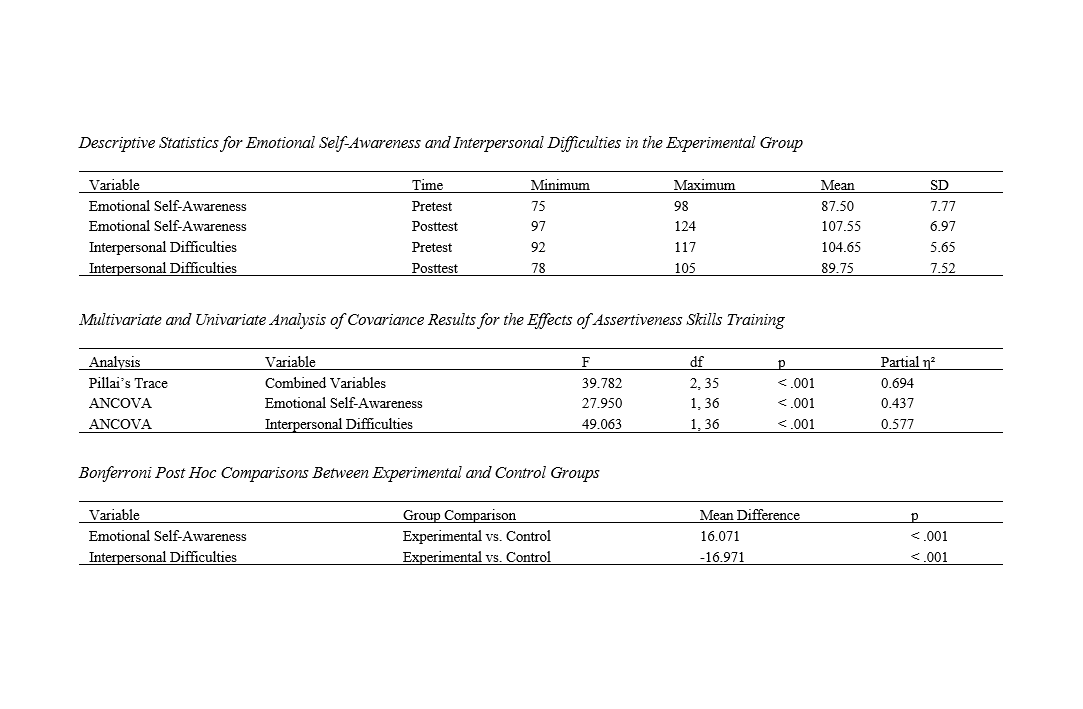
The present study was conducted to investigate the effectiveness of assertiveness skills training on emotional self-awareness and interpersonal difficulties among male high school students in Babol County. This study employed a quasi-experimental design using a pretest–posttest control group framework. The statistical population consisted of male students enrolled in the second cycle of secondary education (high school) in Babol County. A total of 40 students were randomly assigned to either an experimental group (n = 20) or a control group (n = 20). Participants completed the Emotional Self-Awareness Questionnaire developed by Grant et al. and the Interpersonal Difficulties Questionnaire developed by Engels (2005). The experimental group received assertiveness skills training, while the control group received no intervention. At the end of the intervention, both groups completed the questionnaires again as a posttest measure. The data were analyzed using multivariate and univariate analyses of covariance (MANCOVA and ANCOVA). The findings indicated that assertiveness skills training had a statistically significant effect on both emotional self-awareness and interpersonal difficulties. Based on the eta-squared values, the strongest effect was observed for interpersonal difficulties, accounting for approximately 58% of the variance, followed by emotional self-awareness, accounting for approximately 44% of the variance. The results suggest that assertiveness skills training increased emotional self-awareness and reduced interpersonal difficulties among male high school students in Babol County.
Downloads
References
Aftab, R. (2016). The Mediating Role of Interpersonal Difficulties in the Relationship between Experiential Avoidance and Depression and Anxiety. Applied Psychology Quarterly, 4(40), 523-542.
Bartholomew, M. E., Smith, B., & Johnson, S. L. (2019). Explaining Interpersonal Difficulty via Implicit and Explicit Personality Correlates of Mania Risk. Journal of affective disorders, 246, 248-251. https://doi.org/10.1016/j.jad.2018.12.036
Deep, P. D., Ghosh, N., & Natoli, A. P. (2026). Artificial Intelligence for Supporting College Students with Attention-Deficit/Hyperactivity Disorder: Cognitive, Emotional, and Ethical Perspectives. International Journal on Social and Education Sciences, 8(1), 1-17. https://doi.org/10.46328/ijonses.5915
Haroon Rashidi, H., & Abdehpour Sabzeghabaei, E. (2020). The Effectiveness of Problem-Solving Skills Training on Assertiveness and Shyness in Students with Learning Disorders. Journal of Learning Disabilities, 1(4), 133-152.
Lawlor, C., Vitoratou, S., Hepworth, C., & Jolley, S. (2021). Self-Reported Emotion Regulation Difficulties in Psychosis: Psychometric Properties of the Difficulties in Emotion Regulation Scale. Journal of Clinical Psychology, 77(10), 2323-2340. https://doi.org/10.1002/jclp.23164
Margherio, S. M., Brickner, M. A., Evans, S. W., Sarno Owens, J., DuPaul, G. J., & Allan, N. P. (2020). The Role of Emotion Regulation in Alcohol Use among Adolescents with Attention-Deficit/Hyperactivity Disorder. Psychology of Addictive Behaviors, 34(7), 772-782. https://doi.org/10.1037/adb0000582
Mohammad Hosseini, M. (2023). Examining the Effectiveness of Assertiveness Skills on Mental Health and Self-Efficacy. Third International Conference on Health, Educational Sciences, and Psychology,
Mousavizadeh. (2017). Psychology of Assertiveness: The Key to Success through Assertiveness. Jahan Danesh.
Nazarali, S., Navabinejad, S., & Ahghar, G. (2020). Examining and Comparing the Effect of Assertiveness Training through Group Counseling on Increasing Social Skills among Students of Shahid Beheshti University of Medical Sciences. Seventh International Conference on Psychology, Counseling, and Educational Sciences,
Norberg, M. M., Kwok, C., Crone, C., David, J., Kakar, V., & Grisham, J. R. (2020). Greater Interpersonal Problems Differentiate Those Who Excessively Acquire and Save from Those Who Only Excessively Acquire Possessions. Journal of Obsessive-Compulsive and Related Disorders, 27, 100571. https://doi.org/10.1016/j.jocrd.2020.100571
Prima, A. P. T., Asbani, A., Fibriyanti, D., Hartati, M. S., & Fitriani, A. (2026). Analysis of the Learning Motivation of Students at SD Integral Hidayatullah Putri Hijau Towards Emotional and Social Learning. Journal Transnational Universal Studies, 4(1), 1-7. https://doi.org/10.58631/jtus.v4i1.216
Salehi, H. (2022). The Effectiveness of Self-Awareness Skills Training on Critical Thinking and Positive Emotion Regulation in Male Lower-Secondary Students in Chadegan. Philosophy Approach in Schools and Organizations, 1(2), 1-14.
Shamsizadeh, E., Eftekharsaadi, Z., Jayervand, H., Bakhtiarpour, S., & Makvandi, B. (2022). Examining Social Well-Being and Emotional Self-Awareness Based on Quality of Relationship with Parents through Smartphone Addiction in Gifted Students. Journal of Pediatric Nursing, 8(3), 16-26.
Smithe, P. (2015). The Effect of Life Skills Training on Increasing Assertive Behavior in Third-Grade Female Students. Journal of Clinical Psychology, 53, 56-64.
Tandon, A., Dhir, A., Almugren, I., AlNemer, G. N., & Mäntymäki, M. (2021). Fear of Missing Out (FoMO) among Social Media Users: A Systematic Literature Review, Synthesis and Framework for Future Research. Internet Research, 31(3), 782-821. https://doi.org/10.1108/INTR-11-2019-0455
Wang, G. (2026). How Exercise Adherence Affects Emotion Regulation in Chinese College Students: The Chain Mediating Effect of Sleep Quality and Self-Efficacy. PLoS One, 21(1), e0338572. https://doi.org/10.1371/journal.pone.0338572
Zhu, B., Gao, X., Zhou, M., & Wang, H. (2025). The Mediating Roles of Cognitive Emotion Regulation and Resilience in the Association Between Life Events and Sleep Quality Among Medical Students. Frontiers in Psychiatry, 16. https://doi.org/10.3389/fpsyt.2025.1466138
Zong, Y., & Yang, L. (2025). How AI ‐Enhanced Social–Emotional Learning Framework Transforms EFL Students' Engagement and Emotional Well‐Being. European Journal of Education, 60(1). https://doi.org/10.1111/ejed.12925
Downloads
Additional Files
Publication Timeline
- Submitted
- Revised
- Accepted