
Factors Shaping Patients’ Engagement in Digital Health Self-Management Tools
Keywords:
Digital health, self-management, patient engagement, mHealth, eHealth, qualitative research, chronic disease managementAbstract
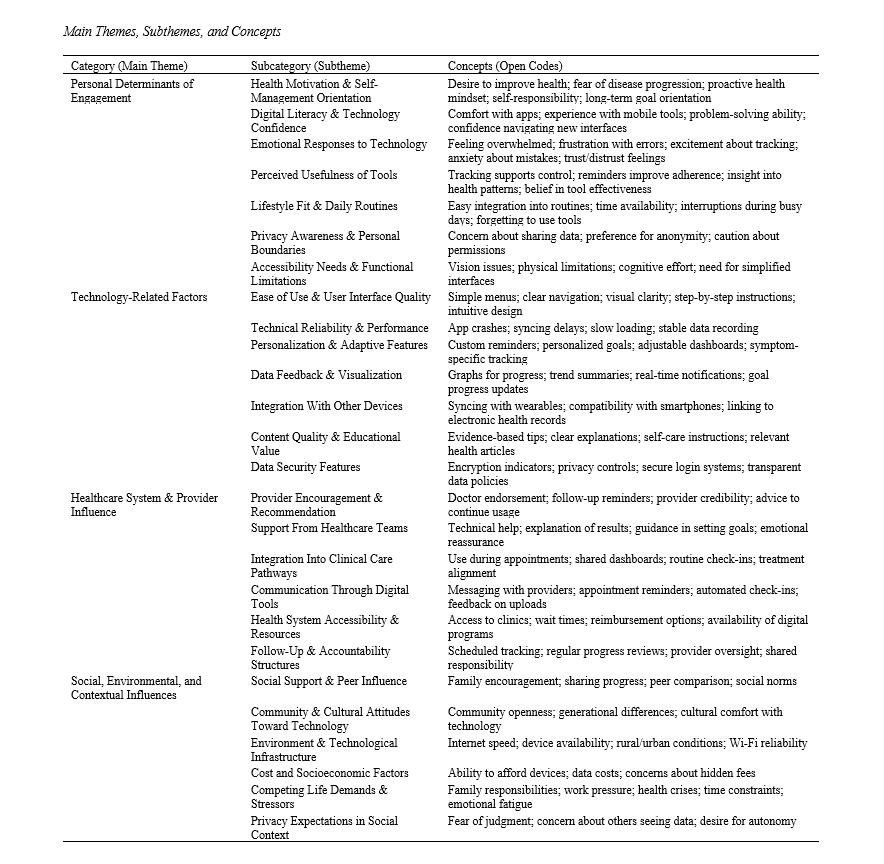
This study aimed to identify and understand the factors that influence patients’ engagement with digital health self-management tools. This qualitative study used a phenomenological–interpretive design to explore patients’ lived experiences with digital self-management technologies. Twenty-one adult participants residing in Canada were recruited through purposive sampling. Data were collected using in-depth semi-structured interviews conducted via telephone or videoconferencing. Interviews were audio-recorded, transcribed verbatim, anonymized, and analyzed using thematic analysis supported by NVivo software. Coding proceeded iteratively until theoretical saturation was reached. Trustworthiness was strengthened through reflexive memoing, researcher triangulation, and detailed documentation of analytic procedures. Four overarching themes and multiple subthemes emerged from the data. Personal determinants—including health motivation, digital literacy, emotional responses, perceived usefulness, privacy boundaries, and lifestyle fit—significantly shaped engagement. Technology-related factors such as usability, interface clarity, personalization features, technical reliability, meaningful data visualization, interoperability, and perceived data security influenced tool adoption and sustained use. Healthcare system and provider influences—particularly provider endorsement, integration of digital data into consultations, and ongoing support—reinforced accountability and strengthened engagement. Social and contextual factors, including family encouragement, cultural attitudes, socioeconomic constraints, environmental infrastructure, competing life demands, and privacy expectations, further moderated participants’ engagement patterns. Collectively, the results indicate that engagement emerges from the interaction of individual, technological, clinical, and contextual dynamics rather than from any single factor. Patients’ engagement with digital health self-management tools is shaped by a complex interplay of personal motivations, technological design, provider involvement, and socio-environmental contexts. Findings highlight the need for user-centered, context-responsive, and clinically integrated digital solutions that address both individual preferences and broader structural realities.
Downloads
References
Alshehri, F., & Alshaikh, F. (2021). Exploring the Constituent Elements of a Successful Mobile Health Intervention for Prediabetic Patients in King Saud University Medical City Hospitals in Saudi Arabia: Cross-Sectional Study. Jmir Formative Research, 5(7), e22968. https://doi.org/10.2196/22968
Anwar, N., Shanableh, S., & Alomar, M. J. (2025). Revolutionizing Chronic Disease Care With Intelligent Mobile Health Solutions: A Comprehensive Literature Review (Preprint). https://doi.org/10.2196/preprints.79483
Bendtsen, M., Schönwandt, B. M. T., Rubæk, M., & Hitz, M. F. (2024). Evaluation of an mHealth App on Self-Management of Osteoporosis: Prospective Survey Study. Interactive Journal of Medical Research, 13, e53995. https://doi.org/10.2196/53995
Braake, E. t., Vaseur, R. M. E., Grünloh, C., & Tabak, M. (2024). The State-of-the-Art of eHealth Self-Management Interventions for People With Chronic Obstructive Pulmonary Disease: A Scoping Review. https://doi.org/10.21203/rs.3.rs-3787842/v1
Breil, B., Salewski, C., & Apolinário-Hagen, J. (2021). Comparing the Acceptance of Mobile Hypertension Apps for Disease Management Among Patients Versus Clinical Use Among Physicians: Cross-Sectional Survey (Preprint). https://doi.org/10.2196/preprints.31617
Cao, W., Milks, M. W., Liu, X., Gregory, M. E., Addison, D., Zhang, P., & Li, L. (2021). mHealth Interventions for Self-Management of Hypertension: Framework and Systematic Review on Engagement, Interactivity, and Tailoring (Preprint). https://doi.org/10.2196/preprints.29415
Cao, W., Milks, M. W., Liu, X., Gregory, M. E., Addison, D., Zhang, P., & Li, L. (2022). mHealth Interventions for Self-Management of Hypertension: Framework and Systematic Review on Engagement, Interactivity, and Tailoring. Jmir Mhealth and Uhealth, 10(3), e29415. https://doi.org/10.2196/29415
Chioléro, A. (2023). eHealth for Chronic Diseases Management: Challenges and Opportunities. European journal of public health, 33(Supplement_2). https://doi.org/10.1093/eurpub/ckad160.103
Delva, S., Mendez, K. J. W., Cajita, M., Koirala, B., Shan, R., Wongvibulsin, S., Vilariño, V., Gilmore, D. R., & Han, H. R. (2020). Efficacy of Mobile Health for Self-Management of Cardiometabolic Risk Factors. The Journal of Cardiovascular Nursing, 36(1), 34-55. https://doi.org/10.1097/jcn.0000000000000659
Dsouza, S. M., Venne, J., Shetty, S., & Brand, H. (2024). Identification of Challenges and Leveraging mHealth Technology, With Need-Based Solutions to Empower Self-Management in Type 2 Diabetes: A Qualitative Study. Diabetology & Metabolic Syndrome, 16(1). https://doi.org/10.1186/s13098-024-01414-9
Duckworth, C., Cliffe, B., Pickering, B., Ainsworth, B., Blythin, A., Kirk, A., Wilkinson, T., & Boniface, M. (2024). Characterising User Engagement With mHealth for Chronic Disease Self-Management and Impact on Machine Learning Performance. NPJ Digital Medicine, 7(1). https://doi.org/10.1038/s41746-024-01063-2
Hägglund, M., Cajander, Å., Rexhepi, H., & Kane, B. (2022). Editorial: Personalized Digital Health and Patient-Centric Services. Frontiers in Computer Science, 4. https://doi.org/10.3389/fcomp.2022.862358
Jendly, M., Santschi, V., Tancredi, S., Konzelmann, I., Raboud, L., & Chioléro, A. (2023). eHealth Profile of Patients With Diabetes. Frontiers in Public Health, 11. https://doi.org/10.3389/fpubh.2023.1240879
Leach, C. R., Hudson, S. V., Diefenbach, M. A., Wiseman, K. P., Sanders, A. E., Coa, K., Chantaprasopsuk, S., Stephens, R. L., & Alfano, C. M. (2021). Cancer Health Self‐efficacy Improvement in a Randomized Controlled Trial. Cancer, 128(3), 597-605. https://doi.org/10.1002/cncr.33947
Li, Z., Lu, F., Wu, J., Bao, R., Rao, Y., Yang, Y. J., & Wang, H. (2024). Usability and Effectiveness of eHealth and mHealth Interventions That Support Self-Management and Health Care Transition in Adolescents and Young Adults With Chronic Disease: Systematic Review. Journal of medical Internet research, 26, e56556. https://doi.org/10.2196/56556
Lucia, A. D., Donisi, V., Pasini, I., Polati, E., Piccolo, L. D., Schweiger, V., & Perlini, C. (2024). Perspectives and Experiences on eHealth Solutions for Coping With Chronic Pain: Qualitative Study Among Older People Living With Chronic Pain. Jmir Aging, 7, e57196. https://doi.org/10.2196/57196
Marini, C., Cruz, J., Payano, L., Flores, R. P., Arena, G.-M., Mandal, S., Leven, E., Mann, D., & Schoenthaler, A. (2023a). Opening the Black Box of an mHealth Patient-Reported Outcome Tool for Diabetes Self-Management: Interview Study Among Patients With Type 2 Diabetes. Jmir Formative Research, 7, e47811. https://doi.org/10.2196/47811
Marini, C., Cruz, J., Payano, L., Flores, R. P., Arena, G.-M., Mandal, S., Leven, E., Mann, D., & Schoenthaler, A. (2023b). Opening the Black Box of an mHealth Patient-Reported Outcome Tool for Diabetes Self-Management: Interview Study Among Patients With Type 2 Diabetes (Preprint). https://doi.org/10.2196/preprints.47811
Nalini, R., Alamelu, R., & Dinesh, S. (2024). Fusion of Social Responsibility and Digital Health. 139-168. https://doi.org/10.4018/979-8-3693-5991-4.ch006
Osokpo, O. (2025). Electronic Health Literacy Influences Chronic Disease Self-Management Among Adults. Circulation, 152(Suppl_3). https://doi.org/10.1161/circ.152.suppl_3.4364099
Ouédraogo, I., Somé, B. M. J., Benedikter, R., & Diallo, G. (2023). Health and E-Health Literacy Among Diabetic Patients in Low-Income Countries: An Evaluation Study in Guinea and Burkina Faso (Preprint). https://doi.org/10.2196/preprints.55677
Ouédraogo, I., Somé, B. M. J., Benedikter, R., & Diallo, G. (2024). Health and eHealth Literacy of Patients With Diabetes in Low-Income Countries: Perspective From Guinea and Burkina Faso. Jmir Diabetes, 9, e55677-e55677. https://doi.org/10.2196/55677
Schmaderer, M., Miller, J. N., & Mollard, E. (2021). Experiences of Using a Self-Management Mobile App Among Individuals With Heart Failure: Qualitative Study. Jmir Nursing, 4(3), e28139. https://doi.org/10.2196/28139
Schmaderer, M., Struwe, L., Loecker, C., Lier, L., Lundgren, S., Pozehl, B., & Zimmerman, L. (2022). Feasibility, Acceptability, and Intervention Description of a Mobile Health Intervention in Patients With Heart Failure. The Journal of Cardiovascular Nursing, 38(5), 481-491. https://doi.org/10.1097/jcn.0000000000000955
Shah, J. R., Wilson, S., Wang, K., Thomas, S., Pathuri, S., Zheng, J., Acar, I. F., Kohilakis, E., Boyapalli, S., Kim, V., Berlot, A., Mowrey, W., Kaur, S., Mahali, L. P., Gonzalez, J. S., Wylie‐Rosett, J., & Jariwala, S. (2025). The Impact of Mobile Health Literacy, Socioeconomic Factors, and Engagement Patterns on DiabetesXcel App Usage in Adults. Journal of Diabetes & Metabolic Disorders, 24(2). https://doi.org/10.1007/s40200-025-01725-2
Shaw, R. J., Barnes, A., Steinberg, D., Vaughn, J., Diane, A., Levine, E., Vorderstrasse, A., Crowley, M. J., Wood, E., Hatch, D., Lewinski, A. A., Jiang, M., Stevenson, J., & Yang, Q. (2019). Enhancing Diabetes Self-Management Through Collection and Visualization of Data From Multiple Mobile Health Technologies: Protocol for a Development and Feasibility Trial. Jmir Research Protocols, 8(6), e13517. https://doi.org/10.2196/13517
Sibuyi, I.-N., Harpe, R. d. l., & Nyasulu, P. (2020). A Stakeholder-Centered mHealth Implementation Inquiry Within the Digital Health Innovation Ecosystem in South Africa: MomConnect as a Demonstration Case (Preprint). https://doi.org/10.2196/preprints.18188
Sibuyi, I.-N., Harpe, R. d. l., & Nyasulu, P. S. (2022). A Stakeholder-Centered mHealth Implementation Inquiry Within the Digital Health Innovation Ecosystem in South Africa: MomConnect as a Demonstration Case. Jmir Mhealth and Uhealth, 10(6), e18188. https://doi.org/10.2196/18188
Sirohi, D., Ng, C., Bidargaddi, N., Slater, H., Parker, M., Hull, M. L., & O’Hara, R. (2025). Good-Quality mHealth Apps for Endometriosis Care: Systematic Search. Journal of medical Internet research, 27, e49654. https://doi.org/10.2196/49654
Sneha, S., Thalla, S., Rischie, I., & Shahriar, H. (2021). Health Internet Technology for Chronic Conditions: Review of Diabetes Management Apps. Jmir Diabetes, 6(3), e17431. https://doi.org/10.2196/17431
Sze, W. T., & Kow, S. G. (2022). Perspectives and Needs of Malaysian Patients With Diabetes for a Mobile Health App Support on Self-Management of Diabetes: Qualitative Study (Preprint). https://doi.org/10.2196/preprints.40968
Sze, W. T., & Kow, S. G. (2023). Perspectives and Needs of Malaysian Patients With Diabetes for a Mobile Health App Support on Self-Management of Diabetes: Qualitative Study. Jmir Diabetes, 8, e40968. https://doi.org/10.2196/40968
Varsi, C., Solem, I. K. L., Eide, H., Børøsund, E., Kristjánsdóttir, Ó. B., Heldal, K., Waxenberg, L. B., Weiss, K. E., Schreurs, K. M. G., Morrison, E. J. P., Stubhaug, A., & Nes, L. S. (2021). Health Care Providers’ Experiences of Pain Management and Attitudes Towards Digitally Supported Self-Management Interventions for Chronic Pain: A Qualitative Study. BMC Health Services Research, 21(1). https://doi.org/10.1186/s12913-021-06278-7
Wang, H., Horeczko, T., Wiener, R. C., & Sambamoorthi, U. (2021). The Association of Mobile Health Applications With Self-Management Behaviors Among Adults With Chronic Conditions in the United States. International journal of environmental research and public health, 18(19), 10351. https://doi.org/10.3390/ijerph181910351
Wannheden, C., & Revenäs, Å. (2020). How People With Parkinson's Disease and Health Care Professionals Wish to Partner in Care Using eHealth: Co-Design Study (Preprint). https://doi.org/10.2196/preprints.19195
Yang, Q., Hatch, D., Crowley, M. J., Lewinski, A. A., Vaughn, J., Steinberg, D., Vorderstrasse, A., Jiang, M., & Shaw, R. J. (2020a). Digital Phenotyping Self-Monitoring Behaviors for Individuals With Type 2 Diabetes Mellitus: Observational Study Using Latent Class Growth Analysis. Jmir Mhealth and Uhealth, 8(6), e17730. https://doi.org/10.2196/17730
Yang, Q., Hatch, D., Crowley, M. J., Lewinski, A. A., Vaughn, J., Steinberg, D., Vorderstrasse, A., Jiang, M., & Shaw, R. J. (2020b). Digital Phenotyping Self-Monitoring Behaviors for Individuals With Type 2 Diabetes Mellitus: Observational Study Using Latent Class Growth Analysis (Preprint). https://doi.org/10.2196/preprints.17730
Zhao, J., Chen, P., & Wan, G. (2020). Measuring Patient Engagement Among Cancer Patients in eHealth and mHealth Interventions on Symptom Management: An Integrated Review (Preprint). https://doi.org/10.2196/preprints.17966
Zhong, C. C., Huang, J., Cheung, C. S., Wong, W. N., Cheung, N. T., & Wong, M. C. S. (2025). Patient Perspectives on an Ehealth App and Health Management Module in Hong Kong: A Qualitative Study. Health and Technology, 15(4), 717-724. https://doi.org/10.1007/s12553-025-00977-5
Downloads
Additional Files
Publication Timeline
- Submitted
- Revised
- Accepted