The Impact of Job Flexibility, Workload, and Self-Efficacy on Work–Life Balance: The Mediating Role of Technology Effectiveness and Organizational Support, and the Moderating Role of Leadership Style among Remote Knowledge Workers
DOI:
https://doi.org/10.61838/kman.ooc.psynexus.3.11Keywords:
job flexibility, workload, self-efficacy, information technologyAbstract
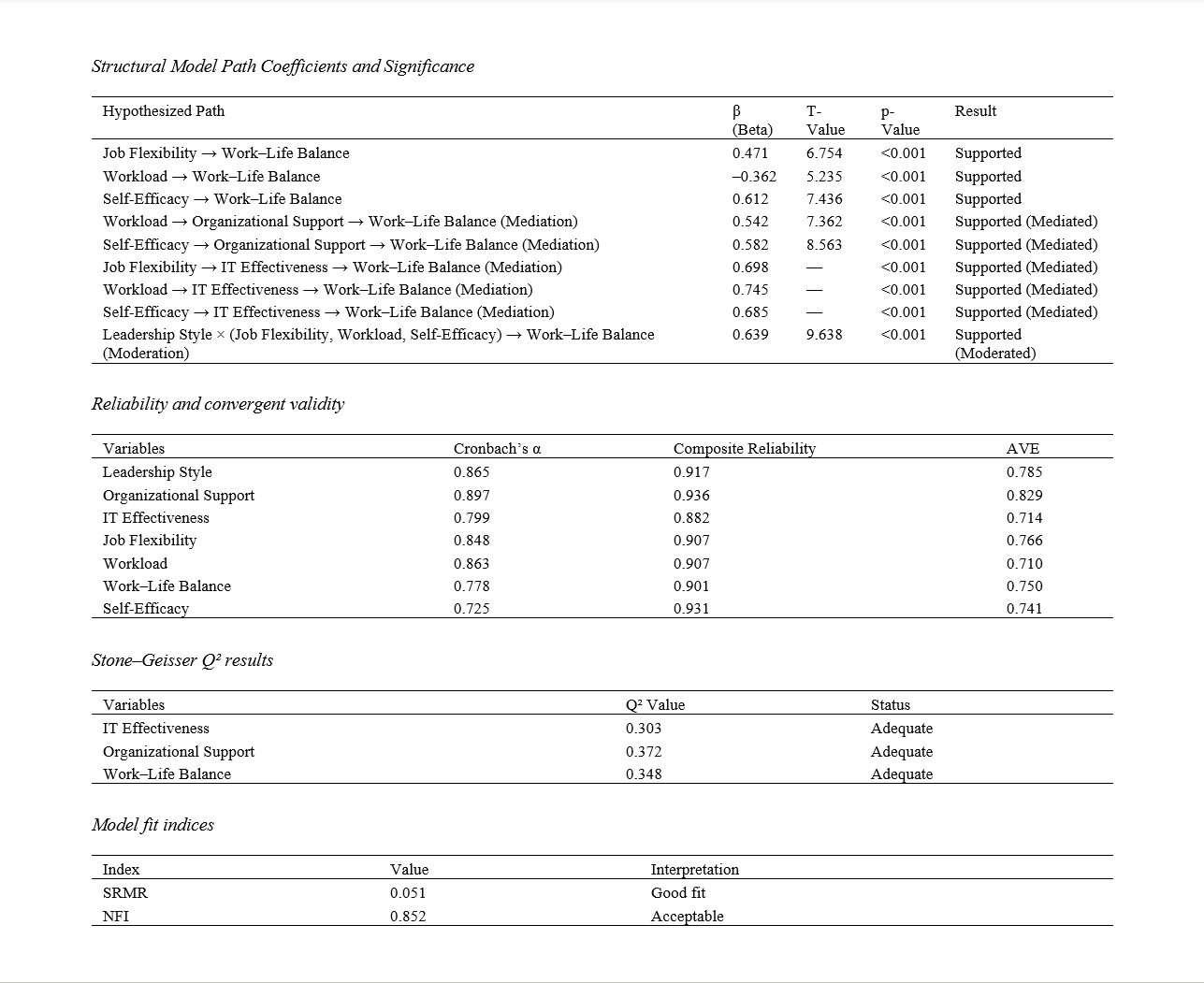
The purpose of this study is to examine the impact of job flexibility, workload, and individual self-efficacy on work–life balance, considering the mediating role of technology effectiveness and organizational support, as well as the moderating role of leadership style among remote knowledge workers. This research is applied in nature and adopts a descriptive–correlational method. The statistical population consisted of 196 remote employees working in startup companies in Tehran. Using convenience sampling and G*Power software, a sample size of 111 was determined. Data were collected through a questionnaire, and path analysis was conducted using PLS version 3 software. The results indicated that organizational support mediates the relationship between workload and work–life balance (R²=0.542, p=0.000), as well as between individual self-efficacy and work–life balance (R²=0.582, p=0.000). Furthermore, technology effectiveness mediates the relationships between job flexibility (R²=0.698), workload (R²=0.745), and self-efficacy (R²=0.685) with work–life balance (all with p=0.000). The moderating role of leadership style was also confirmed (R²=0.639, p=0.000). Based on the findings, it is recommended that training programs be designed and implemented to enhance self-efficacy and increase job flexibility for remote employees.
Downloads
References
Badri, S. K. Z. (2019). Affective well-being in the higher education sector: Connecting of work-life balance with mental health, job satisfaction and turnover issues inside the academic setting. International Journal of Happiness and Development, 5(3), 225-241. https://doi.org/10.1504/IJHD.2019.103382
Baillien, E., Cuyper, N. D., & De Witte, H. (2011). Job autonomy and workload as antecedents of workplace bullying: A two-wave test of Karasek's Job Demand Control Model for targets and perpetrators. Journal of Occupational and Organizational Psychology, 84, 191-208. https://doi.org/10.1348/096317910X508371
Ballout, H. I. (2009). Career commitment and career success: Moderating role of self-efficacy. Career Development International, 14(7), 655-670. https://doi.org/10.1108/13620430911005708
Bhuyan, S. (2025). Effect of Work-Life Balance on Employee Well-Being. 131-154. https://doi.org/10.4018/979-8-3693-7132-9.ch005
Carlson, D. S., Kacmar, K. M., Wayne, J. H., & Grzywacz, J. G. (2006). Measuring the positive side of the work-family interface: Development and validation of a work-family enrichment scale. Journal of Vocational Behavior, 68(1), 131-164. https://doi.org/10.1016/j.jvb.2005.02.002
Clarke, M., Kenny, A., & Loxley, A. (2015). Creating a supportive working environment for academics in higher education. https://papers.ssrn.com/sol3/papers.cfm?abstract_id=2623658
Crompton, R., & Lyonette, C. (2006). Work-life "balance" in Europe. Acta Sociologica, 49(4), 379-393. https://doi.org/10.1177/0001699306071680
Dorta-Afonso, D., Cuéllar-Molina, D., Rodríguez-Robaina, C., & De Saá-Pérez, P. (2025). Servant leadership and HPWS for work-life balance and job satisfaction in the hotel industry: perspectives from conservation of resources theory. Journal of Hospitality and Tourism Insights, 8(5), 2011-2030. https://doi.org/10.1108/JHTI-06-2024-0631
Faryad, L., Khorakian, A., & Nazemi, S. (2016). Examining the effect of psychological empowerment on employees' innovative behavior with regard to job engagement. Journal of Management Development and Transformation, 25, 17-26.
Frederick, P. M., Delaney-Klinger, K., & Hemingway, M. A. (2005). The importance of job autonomy, cognitive ability and job-related skill for predicting role breadth and job performance. Journal of Applied Psychology, 90(2), 399-406. https://doi.org/10.1037/0021-9010.90.2.399
Ganjinia, H., Jalal-Jabbari, S., Fallah, M. A., & Raeof-Shenas-Yeganeh, A. (2019). Evaluating and ranking antecedents of work-life balance in a governmental organization. Human Resource Studies, 9(1), 25-48. https://doi.org/10.22034/jhrs.2019.95937
Greenhaus, J. H., & Powell, G. N. (2006). When work and family are allies: A theory of work-family enrichment. The Academy of Management Review, 31(1), 72-92. https://doi.org/10.5465/amr.2006.19379625
Grotto, A. R., & Lyness, K. S. (2010). The costs of today's jobs: Job characteristics and organizational supports as antecedents of negative spillover. Journal of Vocational Behavior, 76, 395-405. https://doi.org/10.1016/j.jvb.2009.09.004
Guarnaccia, C., Scrima, F., Civilleri, A., & Salerno, L. (2018). The role of occupational self-efficacy in mediating the effect of job insecurity on work engagement, satisfaction and general health. Current Psychology, 37(3), 488-497. https://doi.org/10.1007/s12144-016-9525-0
Haar, R., Russo, M., Sune, A., & Ollier-Malaterre, A. (2014). Outcomes of work-life balance on job satisfaction, life satisfaction and mental health: A study across seven cultures. Journal of Vocational Behavior, 85(3), 361-373. https://doi.org/10.1016/j.jvb.2014.08.010
Hair, J. F., Black, B., Babin, B., Anderson, R. E., & Tatham, R. L. (2010). Multivariate data analysis. https://www.google.com/url?sa=t&source=web&rct=j&opi=89978449&url=https://www.drnishikantjha.com/papersCollection/Multivariate%2520Data%2520Analysis.pdf&ved=2ahUKEwiivpuS2f-PAxXj_7sIHX3GNPsQFnoECAoQAQ&usg=AOvVaw1t3EvI9WnTXycCdakigXHg
Hashemi, Z., Aini, S., & Taghavi, R. (2020). Examining the moderating role of spiritual intelligence in the relationship between HEXACO personality traits and academic stress among students. Psychological Sciences, 19(88), 451-461.
Hobfoll, S. E., Halbesleben, J., Neveu, J. P., & Westman, M. (2018). Conservation of resources in the organizational context: The reality of resources and their consequences. Annual Review of Organizational Psychology and Organizational Behavior, 5, 103-128. https://doi.org/10.1146/annurev-orgpsych-032117-104640
Hotama, V. A. (2025). The Effect of Work-Life Balance, Self-Esteem, and Work Motivation, on Organizational Commitment of Gen Z Employees. International Journal of Research and Innovation in Social Science, IX(IV), 738-750. https://doi.org/10.47772/ijriss.2025.90400055
Husin, N. A., Ghazali, A. S. M., Abudullah, N., & Hadi, I. A. (2018). Work-life balance of Malaysian lecturers. Australian Academy of Business and Economics Reviews, 4(1), 43-49. https://www.academia.edu/download/63157062/WLB_Lecturers20200501-103118-1yzm638.pdf
Kinman, G., & Jones, F. (2008). A life beyond work Job demands, work-life balance, and well-being in UK Academics. Journal of Human Behavior in the Social Environment, 17(1-2), 41-60. https://doi.org/10.1080/10911350802165478
Kubicek, B., Paskvan, M., & Bunner, J. (2017). The bright and dark sides of job autonomy Job demands in a changing world of work. https://doi.org/10.1007/978-3-319-54678-0_4
Le, H., Newman, A., Menzies, J., Zheng, C., & Fermelis, J. (2020). Work-life balance in Asia: A systematic review. Human Resource Management Review, 30(4), 100766. https://doi.org/10.1016/j.hrmr.2020.100766
Li, H., Li, F., & Chen, T. (2018). A motivational-cognitive model of creativity and the role of autonomy. Journal of Business Research, 92, 179-188. https://doi.org/10.1016/j.jbusres.2018.07.025
Lingard, H., Brown, K., Bradley, L., Bailey, C., & Townsend, K. (2007). Improving employees' work-life balance in construction industry: Project alliance case study. Journal of Construction Engineering and Management, 133(10), 807-815. https://doi.org/10.1061/(ASCE)0733-9364(2007)133:10(807)
Marais, E., De Klerk, M., Nel, J. A., & De Beer, L. (2014). The antecedents and outcomes of work-family enrichment amongst female workers. Sa Journal of Industrial Psychology, 40(1), 1. https://doi.org/10.4102/sajip.v40i1.1186
Mellner, C., Aronsson, G., & Kecklund, G. (2015). Boundary management preferences, boundary control, and work-life balance among full-time employed professionals in knowledge-intensive, Flexible work. Nordic Journal of Working Life Studies, 4(4), 7-23. https://doi.org/10.19154/njwls.v4i4.4705
Mirespasi, N., Ghorbani, M., & Roshadat-Jo, H. (2022). The effect of overtime and teleworking on work-life balance (Case study: National Gas Company of Gilan Province, Rasht, Iran). National Conference on Organizational and Management Research. https://sid.ir/paper/902088/fa
Morgeson, F. P., Delaney-Klinger, K., & Hemingway, M. A. (2005). The importance of job autonomy, cognitive ability and job-related skill for predicting role breadth and job performance. Journal of Applied Psychology, 90(2), 399-406. https://doi.org/10.1037/0021-9010.90.2.399
Neeta, B. (2025). A Study Related to Corporate Wellness Programs: Improve and Regulate Work-Life Balance. Ijsat, 16(2). https://doi.org/10.71097/ijsat.v16.i2.3319
Noor, K. M. (2011). Work-life balance and intention to leave among academics in Malaysian public Higher education institutions. International Journal of Business and Social Sciences, 2(11), 240-248. https://www.academia.edu/download/30909401/34.pdf
Panatik, S. A., Rajab, A., Shah, M. D., Rahman, H. A., Yusoff, R. M., & Badri, S. K. Z. (2012). Work-family conflict, stress and psychological strain in higher education. [Journal Title Not Provided]. https://www.academia.edu/download/31234356/14-ICEMI_2012-M00022.pdf
Rahimi-Moghadam, S., & Namvar, H. (2023). Predicting work-life balance among employees based on perceived social support and job preference with the mediating role of spiritual intelligence. Social Psychological Research, 13(52), 53-68. https://doi.org/10.22034/spr.2024.347240.1759
Richman, A. L., Civian, J. T., Shannon, L. L., Hill, E. J., & Brennan, R. T. (2008). The role of work-life conflict in predicting job satisfaction and turnover. [Journal Title Not Provided].
Salehabadi, S. (2021). The relationship between emotional intelligence and spiritual intelligence with employees' performance. First National Conference on Organizational and Management Research. https://sid.ir/paper/902088/fa
Tavaehteh, R. (2020). Predicting organizational commitment based on job preference and job security among employees of the traction department of the Islamic Republic of Iran Railways Islamic Azad University, Science and Research Branch, Faculty of Humanities and Social Sciences].
Downloads
Additional Files
Publication Timeline
- Submitted
- Revised
- Accepted
Issue
Section
Categories
License
Copyright (c) 2025 Mansour Ghalbi (Author); Alireza Zolfaghari (Corresponding Author); Zabih Pirani (Author)

This work is licensed under a Creative Commons Attribution-NonCommercial 4.0 International License.