The Mediating Role of Academic Buoyancy and Academic Achievement Motivation in the Relationship between Basic Psychological Needs and Psychological Well-being at Al-Qadisiyah University, Iraq
DOI:
https://doi.org/10.61838/kman.ec.psynexus.3.13Keywords:
Basic psychological needs, academic buoyancy, achievement motivation, psychological well-beingAbstract
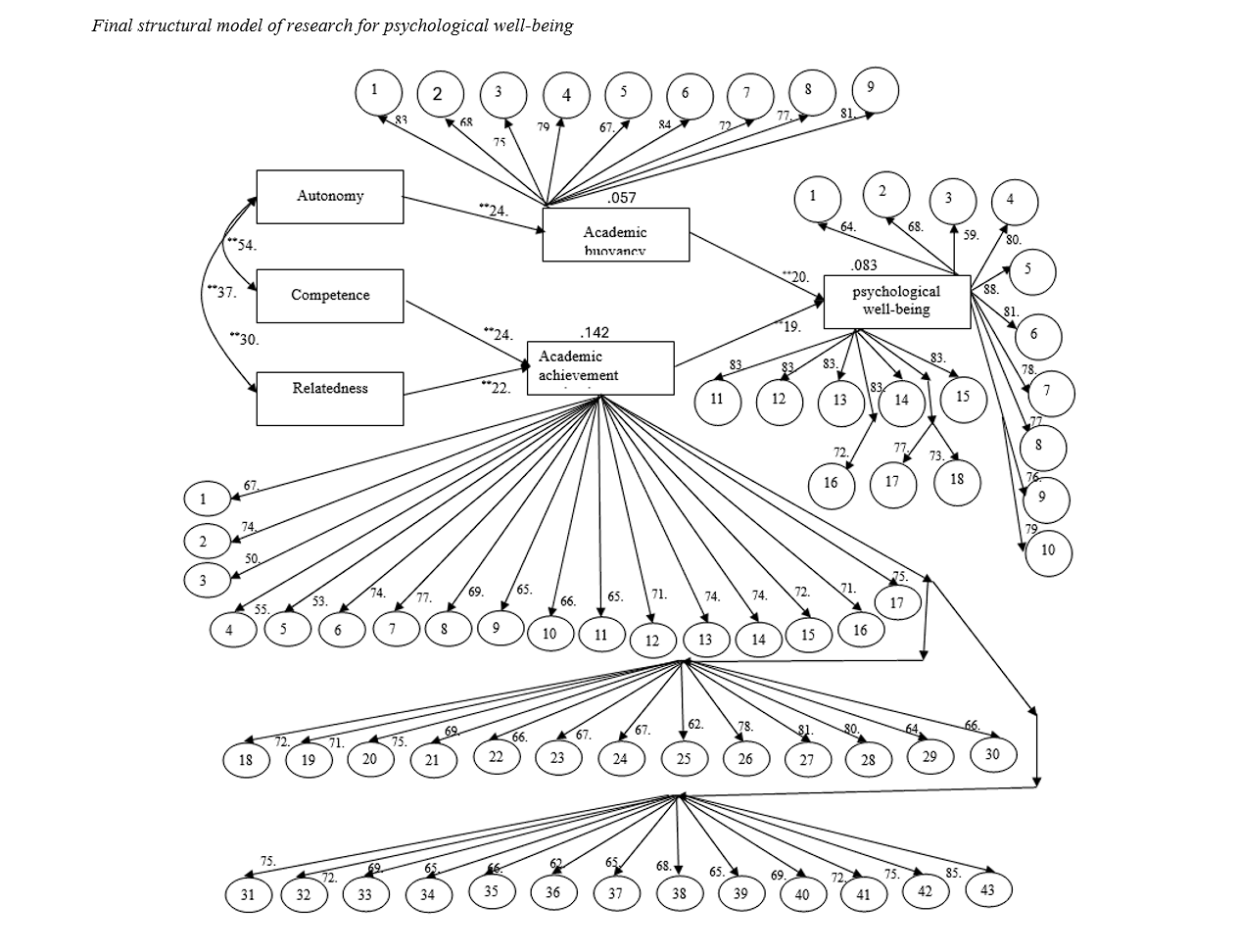
Psychological well-being is one of the most influential factors affecting students' efforts and performance. Hence, this study aimed to determine the mediating role of academic buoyancy and academic achievement motivation in the relationship between basic psychological needs and psychological well-being among students at Al-Qadisiyah University in Iraq. This research follows a correlational method. The statistical population comprised students at Al-Qadisiyah University in Iraq during the spring of 2024. From this population, 239 students were selected through convenience sampling and responded to Psychological Well-being (Ryff & Keyes, 1995), Academic Buoyancy (Hossein Chari & Dehghani Zadeh, 2012), Academic Achievement Motivation (McInerney & Sinclair, 1991) Basic Psychological Needs (Gagné, 2003) questionnaires. The data were analyzed using Pearson correlation coefficients and structural equation modeling (SEM) through SPSS version 26 and AMOS version 26. The results showed a significant relationship between basic psychological needs and psychological well-being, academic buoyancy, and academic achievement motivation (p < 0.05). The results of Structural equation modeling revealed that academic buoyancy and academic achievement motivation act as complete mediators in the relationship between basic psychological needs and psychological well-being. Based on the findings of this study, the role of basic psychological needs, academic buoyancy, and academic achievement motivation should be emphasized in academic setting to foster greater student psychological well-being.
Downloads
References
Asfa, A., & Abolmaali Alhosseini, K. (2022). Prediction of academic procrastination based on basic psychological needs with mediation of psychological wellbeing in undergraduate students. Educational Psychology, 18(65), 23-42. https://doi.org/10.22054/jep.2023.53037.3034
Azadikhah, M., Talepasand, S., & Kianersi, F. (2018). Testing Multidimensional And Hierarchical Model Of School Motivation Questionnaire. Training & Learning Researches (Daneshvar Raftar), 15(1 (27)), 11-22. https://www.sid.ir/paper/236026/en
Besharat, M. A. (2013). The Basic Needs Satisfaction in General Scale: Reliability, validity, and factorial analysis. Quarterly of Educational Measurement, 4(14), 147-168. https://jem.atu.ac.ir/article_90_en.html
Collie, R. J., Martin, A. J., Malmberg, L. E., Hall, J., & Ginns, P. (2015). Academic buoyancy, student's achievement, and the linking role of control: A cross-lagged analysis of high school students. The British Journal of Educational Psychology, 85(1), 113-130. https://doi.org/10.1111/bjep.12066
Derakhshan, M., Yousefi, S., & Najarpourian, A. (2012). The relationship between family emotional climate and academic vitality with regard to the mediating role of academic self-concept: Structural equation modeling. Teaching and Learning Research, 16(66), 56-37.
Fadiji, A. W., Khumalo, I. P., Wissing, M. P., & Appiah, R. (2024). A bibliometric review of positive psychology and well-being research in Africa. Frontiers in psychology, 15, 1384362. https://doi.org/10.3389/fpsyg.2024.1384362
Fakharian, J., Yaghoobi, A., Zargham, H., & Mohagheghi, H. (2020). Predicting Academic Buoyancy based on Family Emotional Climate, Academic Engagement, and Academic Self-Efficacy. medical journal of mashhad university of medical sciences, 63(2), 2391-2401. https://sid.ir/paper/950405/en
Fazli, A. (2019). Academic Vitality. First edition, Tehran: Norouzi Publications.
Gholamali Lavasani, M., Khezri Azar, H., Amani, J., & Alizadeh, S. (2011). Academic Achievement: The Role of Basic Psychological Needs And Identity Styles. Training & Learning Researches (Daneshvar Raftar), 18(1), 25-38. https://sid.ir/paper/236022/en
Hejazi, E., Salehnajafi, M., & Amani, J. (2015). The Mediating Role Of Intrinsic Motivation On The Relationship Between Basic Psychological Needs And Life Satisfaction. Contemporary psychology, 9(2), 77-88. https://sid.ir/paper/120129/en
Hossein Mardi, A. A., Ghorban Shiroodi, S., Zarbakhsh Bahri, M. R., & Tizdast, T. (2022). The Relationship of Academic Engagement, School Engagement and School Belonging with Academic Achievement by Mediated the Academic Achievement Motivation in Male Students. Journal of Sociology of Education, 7(2), 178-189. https://sid.ir/paper/1062646/en
Hutomo, B. A., & Kurniawati, F. (2024). Importance of basic psychological needs satisfaction in higher education: A systematic literature review. G-Couns: Jurnal Bimbingan Dan Konseling, 9(1), 233-246. https://doi.org/10.31316/gcouns.v9i1.6326
Kermavnar, T., Avsec, A., Huang, S., & Desmet, P. M. A. (2024). Assessing basic/fundamental psychological need fulfillment: systematic mapping and review of existing scales to foster cumulative science. Frontiers in psychology, 15, 1427478. https://doi.org/10.3389/fpsyg.2024.1427478
Khodashahi, F. (2025). The Relationship Between Basic Psychological Needs and Goal Orientation with Pupils' Academic Buoyancy. Recent Innovations in Psychology, 2(1), -. https://doi.org/10.22034/rip.2024.464404.1040
Kordloo, A., & Behrangi, M. R. (2020). The effect of intellectual scaffolding on educational management in the application of new educational technologies on academic motivation and academic achievement in science courses for female students in the fifth grade of elementary school. Management and Educational Perspective, 2(1), 19-33. https://doi.org/10.22034/jmep.2020.231073.1012
Lanza, S. T., Whetzel, C., & Bhandari, S. (2024). Health and Well-Being Among College Students in the United States During the COVID-19 Pandemic: Daily Diary Study. Interactive Journal of Medical Research, 13, e45689. https://doi.org/10.2196/45689
Mahmoudi, A., Ensafdaran, F., & Kakaieh, H. (2022). Investigating the Effects of Satisfaction of Basic Psychological Needs on the Identity Crisis of Students. Iranian Journal of Culture and Health Promotion, 6(2), 315-322. http://ijhp.ir/article-1-515-fa.html
Nafar, Z., Mazoosaz, A., Bagheri, H., & Shojaei, M. (2023). Investigating the role of self-acceptance and mental vitality in relation to psychological needs on optimism and psychological well-being of students in Tehran. A New Approach to Children's Education Quarterly, 5(1), 128-139. https://doi.org/10.22034/naes.2022.375057.1284
Nejati-Garae, E. (2023). Educational Motivation. First edition, Tehran: Farnam Publications.
Nemati, S., Badri-Gargari, R., & Katourani, A. (2022). The relationship between psychological well-being and academic vitality with students' perceptions of the classroom environment. Journal of School Psychology, 11(1), 117-131. https://doi.org/10.22098/jsp.2022.1508
Pakdaman Savoji, A., Ganji, K., & Ahmadzadeh, M. (2013). The Effect of Life Skills Training (LST) on Achievement Motivation and Academic Achievement of Students. Refah Journal, 12(47), 245-265. http://refahj.uswr.ac.ir/article-1-1131-fa.html
Parchami Khoram, M., Imani, S., & Ansari, D. (2022). Predicting Psychological Well-Being Based on Basic Psychological Needs: The Mediating Role of Social Networks Addiction. RBS, 20(2), 317-328. https://doi.org/10.52547/rbs.20.2.317
Ryff, C. D., & Keyes, C. L. M. (1995). The structure of psychological well-being revisited. Journal of Personality and Social Psychology, 69, 716-727. https://doi.org/10.1037/0022-3514.69.4.719
Saleem, M., Javaid, H., & Nisar, T. (2023). Basic psychological need satisfaction and students' well-being: the mediating role of subjective vitality. Iranian Rehabilitation Journal, 21(3), 543-552. https://doi.org/10.32598/irj.21.3.1920.1
Sheikholeslami, R., Yazdani, F., & Razavi Estahbanati, Z. (2019). Psychometric Properties Of Basic Psychological Needs Satisfaction And Frustration Scale. Journal of Psychology, 23(1 (89)), 66-82. https://sid.ir/paper/54551/en
Slemp, G. R., Field, J. G., Ryan, R. M., Forner, V. W., Van den Broeck, A., & Lewis, K. J. (2024). Interpersonal supports for basic psychological needs and their relations with motivation, well-being, and performance: A meta-analysis. Journal of personality and social psychology, 127(5), 1012-1037. https://doi.org/10.1037/pspi0000459
Veiskarami, H. A., Mir Drikvand, F., Ghara Veysi, S., & Soleymani, M. (2019). On the Relationship Of Academic Self-Efficacy With Academic Buoyancy: The Mediating Role Of Basic Psychological Needs. Journal of Educational Sciences, 12(47), 141-158. https://sid.ir/paper/183617/en
Wang, J., & Wang, X. (2012). Structural Equation Modeling: Applications using Mplus. Chichester: John Wiley & Sons. https://doi.org/10.1002/9781118356258
Weiner, B. (2010). An attributional theory of motivation and emotion. Psychological review, 92(4), 244-256. https://doi.org/10.1037//0033-295X.92.4.548
Yarmohammadi, M., Mohamadi, A., & Noghabi, R. (2019). Comparison the Effect of Teaching Based on Individual and Group Concept Mapping on Educational Motivation and Achievement. Biquarterly Journal of Cognitive Strategies in Learning, 7(12), 189-211. https://doi.org/10.22084/j.psychogy.2019.16773.1796
Yasami Nejad, P., Taheri, M., Golmohammadian, M., & Ahadi, H. (2014). The relationship between self-regulation, achievement motivation and academic achievement of female high school students in Tehran. Research on Education and Learning, 10(2), 325-338.
Yiğit, B., & Çakmak, B. Y. (2024). Discovering Psychological Well-Being: A Bibliometric Review. Journal of Happiness Studies, 25(5), 1-24. https://doi.org/10.1007/s10902-024-00754-7
Zebing, W. (2019). Academic motivation, engagement, and achievement among college students. College Student Journal, 53, 99-112. https://www.ingentaconnect.com/content/prin/csj/2019/00000053/00000001/art00011
Zhong, T. (2024). Physical activity motivations and psychological well-being among university students: a canonical correlation analysis. Frontiers in Public Health, 12, 1442632. https://doi.org/10.3389/fpubh.2024.1442632
Downloads
Additional Files
Publication Timeline
- Submitted
- Revised
- Accepted