
Sensory Processing Sensitivity and Migraine-Related Disability: A Longitudinal Mediation Model Through Body Vigilance and Sleep Disturbance
Keywords:
sensory processing sensitivity, migraine, migraine-related disability, body vigilance, sleep disturbance, longitudinal mediationAbstract
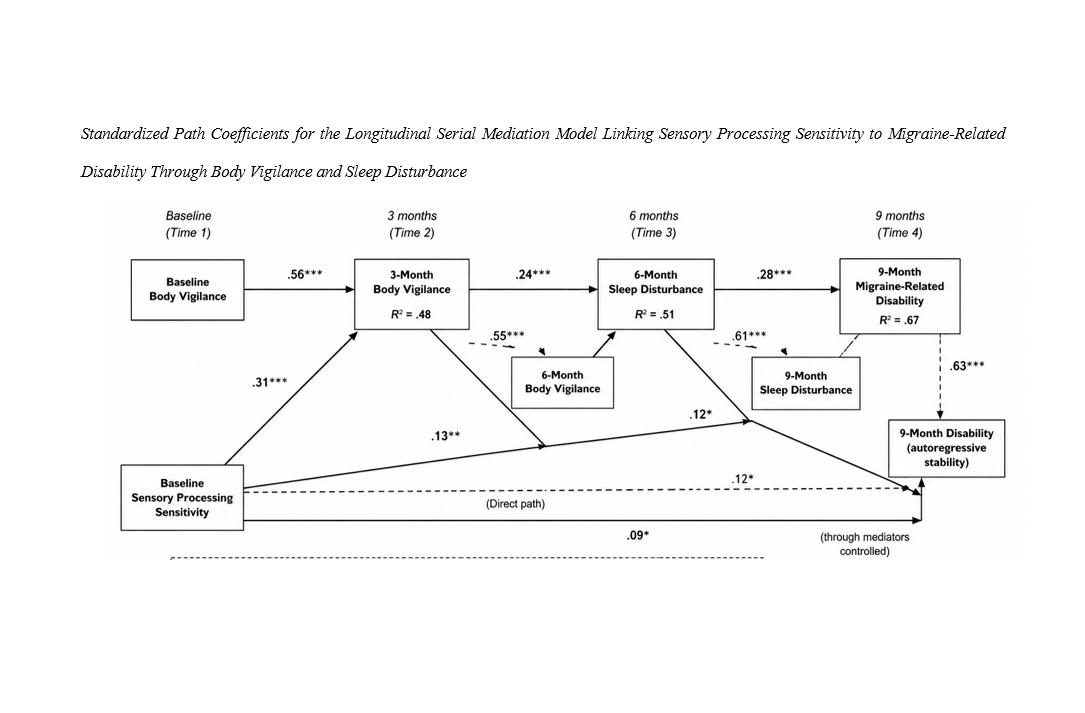
This study aimed to examine the longitudinal association between sensory processing sensitivity and migraine-related disability and to determine whether body vigilance and sleep disturbance sequentially mediated this relationship among Canadian adults with migraine. A prospective four-wave longitudinal study was conducted with 352 Canadian adults diagnosed with migraine. Data were collected at baseline and at three-, six-, and nine-month follow-ups. Sensory processing sensitivity was assessed using the Highly Sensitive Person Scale, body vigilance was measured with the Body Vigilance Scale, sleep disturbance was evaluated using the PROMIS Sleep Disturbance Short Form, and migraine-related disability was assessed with the Migraine Disability Assessment questionnaire. The hypothesized serial mediation model specified baseline sensory processing sensitivity as the predictor, three-month body vigilance as the first mediator, six-month sleep disturbance as the second mediator, and nine-month migraine-related disability as the outcome. Longitudinal structural equation modeling with robust maximum likelihood estimation and full-information maximum likelihood was used. Earlier levels of the mediators and outcome, age, gender, migraine duration, monthly migraine days, migraine chronicity, and preventive medication use were controlled. The hypothesized serial mediation model demonstrated good fit, χ²(44) = 68.21, p = .011, CFI = .976, TLI = .958, RMSEA = .040, and SRMR = .035. Sensory processing sensitivity significantly predicted three-month body vigilance, β = .310, p < .001; body vigilance predicted six-month sleep disturbance, β = .240, p < .001; and sleep disturbance predicted nine-month migraine-related disability, β = .280, p < .001. The serial indirect effect was significant, β = .021, 95% CI [.010, .038], p = .002. The total indirect effect was also significant, β = .094, 95% CI [.049, .151], p < .001, while the remaining direct effect indicated partial mediation. Greater sensory processing sensitivity may contribute to subsequent migraine-related disability partly through increased monitoring of bodily sensations and later sleep disturbance, highlighting body vigilance and sleep as potentially modifiable intervention targets.
Downloads
References
Abbattista, L., Wacquier, B., & Strauss, MR. (2026). Distinct Hypervigilance Profiles in Sleep-Onset Insomnia With and Without Psychiatric Comorbidity. https://doi.org/10.64898/2026.05.05.722943
Al-Beltagi, MR. (2026). Pediatric Migraine: Neurodevelopmental Mechanisms, Clinical Phenotypes, and Modern Therapeutics. World Journal of Clinical Pediatrics, 15(2). https://doi.org/10.5409/wjcp.v15.i2.119843
Antunes, L. G., Bataglion, C., Fernandes, M. H., Melchior, M. d. O., & Magri, L. V. (2025). Cognitive Domain Impairments in Chronic Painful Temporomandibular Disorders: Associations With Pain Intensity, Hypervigilance and Catastrophising: A Cross‐Sectional Analysis. Journal of Oral Rehabilitation, 53(1), 76-88. https://doi.org/10.1111/joor.70064
Chahine, A., Hemade, A., Zouki, C.-J. E., Obeïd, S., Lahoud, J.-C., Fekih‐Romdhane, F., & Hallit, S. (2025). Examination of the Psychometric Properties of Arabic Version of the Body Vigilance Scale. PLoS One, 20(5), e0324610. https://doi.org/10.1371/journal.pone.0324610
Cigarán‐Méndez, M., Tejera-Alonso, Á., Gómez‐Calero, C., Fernández‐de‐las‐Peñas, C., López-Redondo, M., Valera‐Calero, J. A., Fernández-Palacios, F. G., & Pacho-Hernández, J. C. (2025). Can Clinical, Psychological, and Cognitive Patient-Reported Outcome Measures (PROMs) Help to Discriminate Women With Fibromyalgia From Those With Other Localized/Regional Pain Conditions? A Diagnostic Accuracy Study. Medicina, 61(2), 359. https://doi.org/10.3390/medicina61020359
Crouch, T. B., Chelimsky, G., Boylan, L., Maxwell, M., Westcott, G., Chase, S. O., Redman, T., Burch, J., Gharbo, R., Wells, M., Redmer, W., Kinser, P., & Chelimsky, TR. (2026). The Body and the Brain Keep the Score: A Data-Driven Conceptual Model Linking Trauma and Postural Tachycardia Syndrome. Frontiers in psychology, 17. https://doi.org/10.3389/fpsyg.2026.1829434
Fernández‐de‐las‐Peñas, C., Cigarán‐Méndez, M., Ambite‐Quesada, S., Gómez‐Calero, C., Fernández-Palacios, F. G., Pacho-Hernández, J. C., Tejera-Alonso, Á., Plaza‐Manzano, G., Valera‐Calero, J. A., Álvarez-Mariño, B., Ordás-Bandera, C., Arendt‐Nielsen, L., & de‐la‐Llave‐Rincón, A. I. (2025). Association of Nociceptive, Neurocognitive, Psychological and Genetic Profile on Conditioned Pain Modulation in Women With Migraine: Protocol for a Case–control Study. BMJ open, 15(8), e103305. https://doi.org/10.1136/bmjopen-2025-103305
Hamamra, B., & Mahamid, FR. (2026). Sleepless in Gaza: War-Related Trauma and the Neurobiological Toll on Sleep. Cambridge Prisms Global Mental Health, 13. https://doi.org/10.1017/gmh.2026.10164
Hui, I. T. K., Cheung, S.-H., Biabani, N., Drakatos, P., Bucks, R. S., Naismith, S. L., O'Regan, D., Kumari, V., Riemann, D., Wise, T., Li, S. X., & Rosenzweig, IR. (2026). Sleep‐Related Attentional Bias in Insomnia: A Drift Diffusion Model Approach. Journal of Sleep Research, 35(4). https://doi.org/10.1111/jsr.70315
Kizilhan, J. I., Ag, Z., Ahmed, Q. T., & Avidan, A. YR. (2026). Sleep Disturbances Among Yazidi Survivors of the ISIS Genocide: Epidemiology, Neuropsychology, and Culturally Sensitive Interventions. Brain and Behavior, 16(6). https://doi.org/10.1002/brb3.71523
Korn, T. F., & Bernstein, C. AR. (2026). Migraine Across the Menopausal Transition and Beyond: A Narrative Review. Headache the Journal of Head and Face Pain, 66(6), 1390-1404. https://doi.org/10.1111/head.70071
Magri, L. V., Melchior, M. d. O., Silva, G. V. d., Edilaine Cristina da Silva, G. D., & Leite‐Panissi, C. R. A. (2025). Phenotypes of Painful TMD in Discordant Monozygotic Twins According to a Cognitive-Behavioral-Emotional Model: A Case-Control Study. PLoS One, 20(4), e0320515. https://doi.org/10.1371/journal.pone.0320515
Mavroudis, I., Petridis, F., Karantali, E., Ciobîcă, A., Papagiannopoulos, S., & Kazis, D. (2025). Post-Concussion Syndrome and Functional Neurological Disorder: Diagnostic Interfaces, Risk Mechanisms, and the Functional Overlay Model. Brain Sciences, 15(7), 755. https://doi.org/10.3390/brainsci15070755
McCloy, K., Babiloni, A. H., & Bj, S. (2024). Sleep Disorders and Orofacial Pain: Insights for Dental Practice. Australian Dental Journal, 69(S1). https://doi.org/10.1111/adj.13037
Melamed, E., Rydberg, L., Ambrose, A. F., Bhavaraju‐Sanka, R., Fine, J. S., Fleming, T. K., Herman, E., Johnson, J. L. P., Kucera, J. R., Longo, M., Niehaus, W., Oleson, C. V., Sampsel, S., Silver, J. K., Smith, M. M., & Verduzco‐Gutierrez, M. (2023). Multidisciplinary Collaborative Consensus Guidance Statement on the Assessment and Treatment of Neurologic Sequelae in Patients With Post‐acute Sequelae of SARS‐CoV‐2 Infection (PASC). Pm&r, 15(5), 640-662. https://doi.org/10.1002/pmrj.12976
Meshkin, D., McGillen, P., Martin, M. J., & Burruss, S. (2025). Great Debates—Shift Work Versus One Day at a Time: 12- Versus 24-Hour Call Duration in Acute Care Surgery. The American Surgeon, 91(10), 1598-1602. https://doi.org/10.1177/00031348251341955
Mollica, A., DeDominicis, M., Silverberg, N. D., & Burke, M. J. (2025). Persisting Symptoms After Concussion and Functional Neurological Disorder: Points of Intersection. Seminars in Neurology, 46(02), 196-205. https://doi.org/10.1055/a-2752-8940
Ngarka, L., Fodjo, J. N. S., Aly, E., Masocha, W., & Njamnshi, A. K. (2022). The Interplay Between Neuroinfections, the Immune System and Neurological Disorders: A Focus on Africa. Frontiers in Immunology, 12. https://doi.org/10.3389/fimmu.2021.803475
Omland, P. M., Hansen, J. O., Neverdahl, J. P., Mykland, M. S., Matre, D., Uglem, M., & Sand, T. (2025). Migraine and Insufficient Sleep: The Effect of Sleep Restriction on Nociceptive Evoked Potentials in Migraine. Cephalalgia, 45(3). https://doi.org/10.1177/03331024251329400
Otani, KR. (2026). Headache Psychiatry: A Structured Narrative Review and Integrative Framework. Psychiatry and Clinical Neurosciences Reports, 5(2). https://doi.org/10.1002/pcn5.70347
Özdemir, H. N., Charlton, J., Cortese, E., Stadio, A. D., Herdman, D., & Kaski, DR. (2026). Persistent Postural‐Perceptual Dizziness: A Practical Approach to Diagnosis and Patient Communication. European Journal of Neurology, 33(2). https://doi.org/10.1111/ene.70494
Patrick Emanuell Mesquita Sousa, S., & Peres, M. F. P. (2025). Practical Issues in the Management of Sleep, Anxiety, and Mood Disorders in Primary Headaches. Arquivos de Neuro-psiquiatria, 83(07), 001-008. https://doi.org/10.1055/s-0045-1809881
Pearson, N., Baker, P., & Bradshaw, JR. (2026). Investigation of the Lived Experience of Family Members of a Person With Intellectual Disabilities Who Presents With Pica. Journal of Applied Research in Intellectual Disabilities, 39(3). https://doi.org/10.1111/jar.70268
Ratu, A. N. Y., & Murni, A. W. (2024). Risk Factors for Sleep Disorders in Patients With Chronic Pain: A Meta-Analysis. Bioscientia Medicina Journal of Biomedicine and Translational Research, 8(10), 5172-5184. https://doi.org/10.37275/bsm.v8i10.1100
Scholfield, D. W., Chandrasekharan, D., Bahra, A., Williams, M. V., & Patel, N. V. (2022). Functional Ear Symptoms Referred to an Otology Clinic: Incidence, Co-Morbidity, Aetiological Factors and a New Experience-Driven Clinical Model. The Journal of Laryngology & Otology, 137(2), 143-150. https://doi.org/10.1017/s0022215122001530
Spiegel, B. (2022). Gravity and the Gut: A Hypothesis of Irritable Bowel Syndrome. The American Journal of Gastroenterology, 117(12), 1933-1947. https://doi.org/10.14309/ajg.0000000000002066
Tao, H., Zeng, X., Hou, M., Chen, S., Shen, J., Liao, X., & Zou, C. (2023). Association of Adverse Childhood Experiences and Depression Among Medical Students: The Role of Family Functioning and Insomnia. Frontiers in psychology, 14. https://doi.org/10.3389/fpsyg.2023.1134631
Valera‐Calero, J. A., Arendt‐Nielsen, L., Cigarán‐Méndez, M., Fernández‐de‐las‐Peñas, C., & Varol, U. (2022). Network Analysis for Better Understanding the Complex Psycho-Biological Mechanisms Behind Fibromyalgia Syndrome. Diagnostics, 12(8), 1845. https://doi.org/10.3390/diagnostics12081845
Wei, H. L., Yu, Y. S., Wang, M., Zhou, G. P., Li, J., Zhang, H., & Zhou, Z. (2024). Exploring Potential Neuroimaging Biomarkers for the Response to Non-Steroidal Anti-Inflammatory Drugs in Episodic Migraine. The Journal of Headache and Pain, 25(1). https://doi.org/10.1186/s10194-024-01812-4
Westerman, M., Kafkas, A., Parry‐Jones, A., Strong, S., Retzler, C., & Hallam, G. (2025). Neurobiological and Neuropsychological Disturbance in EDS. Frontiers in Neurology, 16. https://doi.org/10.3389/fneur.2025.1648702
Xue, QR. (2026). Association Between Temporomandibular Disorders and Somatization: A Narrative Review. Journal of Oral & Facial Pain and Headache, 42. https://doi.org/10.22514/jofph.2026.004
Downloads
Additional Files
Publication Timeline
- Submitted
- Revised
- Accepted