Impact of Virtual Reality Relaxation Training on Somatic Anxiety and Coping Strategies
DOI:
https://doi.org/10.61838/kman.jppr.3.3.4Keywords:
Virtual reality, somatic anxiety, coping strategies, relaxation trainingAbstract
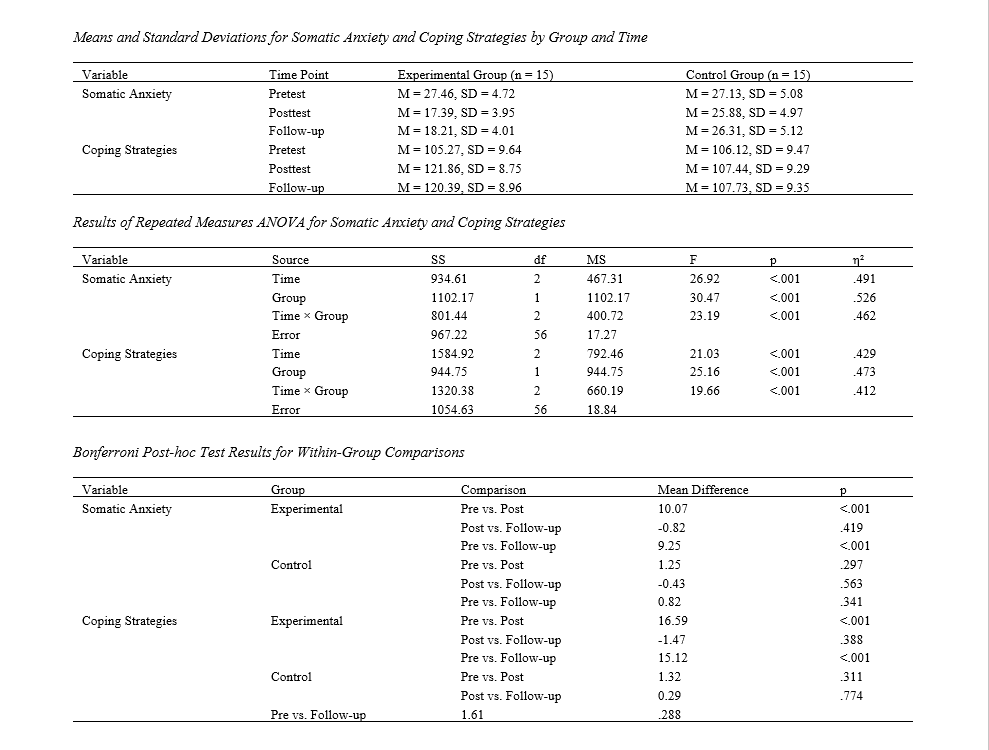
This study aimed to evaluate the effectiveness of an eight-session Virtual Reality Relaxation Training (VRRT) program on reducing somatic anxiety and improving coping strategies in young adults. A randomized controlled trial was conducted with 30 participants from Armenia, randomly assigned to either an experimental group (n = 15) receiving VRRT or a control group (n = 15) placed on a waitlist. The intervention consisted of weekly 60-minute sessions over eight weeks, involving immersive virtual environments integrated with guided breathing, progressive muscle relaxation, mindfulness, and visualization. Somatic anxiety was measured using the Beck Anxiety Inventory (BAI), and coping strategies were assessed with the Coping Inventory for Stressful Situations (CISS). Assessments were conducted at three time points: pretest, posttest, and five-month follow-up. Data were analyzed using repeated measures ANOVA and Bonferroni post-hoc tests via SPSS-27. Repeated measures ANOVA revealed significant group × time interaction effects for both somatic anxiety (F = 23.19, p < .001, η² = .462) and coping strategies (F = 19.66, p < .001, η² = .412). Bonferroni post-hoc tests indicated that the experimental group showed a significant reduction in somatic anxiety from pretest to posttest (p < .001), which was sustained at follow-up. Likewise, significant improvements in coping strategies were observed in the experimental group (p < .001), with no significant change in the control group across time. The findings support the effectiveness of Virtual Reality Relaxation Training in reducing somatic anxiety and enhancing coping strategies, with sustained benefits observed up to five months post-intervention. VRRT offers a promising, immersive approach for anxiety management and resilience training among young adults.
Downloads
References
Amiri, A., Jalali, R., & Salari, N. (2023). The Effect of Using Virtual Reality Technology on Anxiety and Vital Signs Before Surgery in Patients Undergoing Open Heart Surgery. Perioperative Medicine, 12(1). https://doi.org/10.1186/s13741-023-00354-8
Arnfred, B., Svendsen, J. K., Adjourlu, A., & Horthøj, C. (2023). Scoping Review of the Hardware and Software Features of Virtual Reality Exposure Therapy for Social Anxiety Disorder, Agoraphobia, and Specific Phobia. Frontiers in Virtual Reality, 4. https://doi.org/10.3389/frvir.2023.952741
Caltabiano, A. (2025). Virtual Reality Delivered Exposure for Fear of Needles: A Small-Scale Pilot. https://doi.org/10.31234/osf.io/nfvjq_v1
Chen, Y., Chen, X., Li, L., Li, Y., Yan, Q., & Hu, X. (2024). The Efficacy of Virtual Reality–Based Interventions on Pain, Anxiety, Depression, and Quality of Life Among Patients With Cancer: A Meta-Analysis of Randomized Controlled Trials. Cancer Nursing. https://doi.org/10.1097/ncc.0000000000001430
Gungor, A., Avraamidou, L., Kool, D., Lee, M., Niek, N. H. M. E., Albada, B., Kolk, K. v. d., Tromp, M., & Bitter, J. H. (2022). The Use of Virtual Reality in a Chemistry Lab and Its Impact on Students’ Self-Efficacy, Interest, Self-Concept and Laboratory Anxiety. Eurasia Journal of Mathematics Science and Technology Education, 18(3), em2090. https://doi.org/10.29333/ejmste/11814
Hosseini, T., Hooshmandja, M., Noaparast, M., Mojtahedzadeh, R., & Mohammadi, A. (2024). Virtual Reality Exposure Therapy to Decrease Anxiety Before Surgical Invasive Procedures in Hemodialysis Patients: An Interventional Study. BMC Nephrology, 25(1). https://doi.org/10.1186/s12882-024-03461-w
Huang, Z., Choi, D., Lai, B., Lü, Z., & Tian, H. (2022). Metaverse-Based Virtual Reality Experience and Endurance Performance in Sports Economy: Mediating Role of Mental Health and Performance Anxiety. Frontiers in Public Health, 10. https://doi.org/10.3389/fpubh.2022.991489
Huy, B. (2023). Impact of Virtual Reality Therapy on Social Anxiety. Journal Educational Verkenning, 4(3), 1-7. https://doi.org/10.48173/jev.v4i3.213
Jamal, N. A., Herawati, T., & Amelia, A. (2024). Utilization of Virtual Reality to Diminish Preprocedural Anxiety in Patients Undergoing Cardiac Interventions: A Systematic Review. Malahayati International Journal of Nursing and Health Science, 7(3), 329-339. https://doi.org/10.33024/minh.v7i3.174
Kumar, A. (2023). To What Extent Is Virtual Reality Therapy Efficient as a Treatment of Social Anxiety Disorder? British Journal of Multidisciplinary and Advanced Studies, 4(6), 18-31. https://doi.org/10.37745/bjmas.2022.0362
Leopardi, A. C., Velasco, A. A., Mayor, M. E., & Miegimolle, M. (2023). Effectiveness of Virtual Reality Goggles as Distraction for Children in Dental Care—A Narrative Review. Applied Sciences, 13(3), 1307. https://doi.org/10.3390/app13031307
Lepilkina, T. A., Бениашвили, А. Г., Cheremin, R. A., Malyukova, N. G., Ma, M., Bogdanov, M. A., Burminsky, D. S., Потанин, С. С., Rodkina, S. V., Rupchev, G., & Eip, M. N. (2023). Efficacy of a Relaxation Scenario in Virtual Reality for the Comorbid Symptoms of Anxiety and Asthenia in a General Hospital Setting: A Pilot Comparative Randomized Open-Label Study. Consortium Psychiatricum, 4(1), 38-51. https://doi.org/10.17816/cp221
MacDonald, C. (2024). Improving Virtual Reality Exposure Therapy With Open Access and Overexposure: A Single 30-Minute Session of Overexposure Therapy Reduces Public Speaking Anxiety. Frontiers in Virtual Reality, 5. https://doi.org/10.3389/frvir.2024.1506938
Mao, W., Chen, W., & Wang, Y. (2024). Effect of Virtual Reality-Based Mindfulness Training Model on Anxiety, Depression, and Cancer-Related Fatigue in Ovarian Cancer Patients During Chemotherapy. Technology and Health Care, 32(2), 1135-1148. https://doi.org/10.3233/thc-230735
Massov, L., Robinson, B., Rodriguez-Ramirez, E., & Maude, R. (2024). ‘Giving Birth on a Beach’: Women’s Experiences of Using Virtual Reality in Labour. PLoS One, 19(6), e0304349. https://doi.org/10.1371/journal.pone.0304349
Meneses-Claudio, B., & Auccacusi-Kañahuire, M. (2023). Virtual Reality for Physical and Psychological Improvement During the Treatment of Patients With Breast Cancer: Systematic Review. Eai Endorsed Transactions on Pervasive Health and Technology, 9. https://doi.org/10.4108/eetpht.9.4275
Natali, L., Meregalli, V., Rowlands, K., Pietro, J. D., Treasure, J., Collantoni, E., Meneguzzo, P., Tenconi, E., Favaro, A., Fontana, F. A., Ceccato, E., Sala, A., Valmaggia, L., & Cardi, V. (2024). Virtual Food Exposure With Positive Mood Induction or Social Support to Reduce Food Anxiety in Anorexia Nervosa: A Feasibility Study. International Journal of Eating Disorders, 57(3), 703-715. https://doi.org/10.1002/eat.24155
Rişvan, M., & Sü, S. (2024). The Impact of Two Methods on Pain and Anxiety During Short Peripheral Cannula Placement: A Randomized Controlled Trial. The Journal of Vascular Access. https://doi.org/10.1177/11297298241278787
Rougereau, G., Sandiford, M. H., Lévêque, R., Ménigaux, C., Bauer, T., & Hardy, A. (2023). Management of Anxiety for Ambulatory Hallux Valgus Surgery With a Virtual Reality Hypnosis Mask: Randomized Controlled Trial. Foot & Ankle International, 44(6), 539-544. https://doi.org/10.1177/10711007231162816
Smith, K. L., Wang, Y., & Colloca, L. (2022). Corrigendum: Impact of Virtual Reality Technology on Pain and Anxiety in Pediatric Burn Patients: A Systematic Review and Meta-Analysis. Frontiers in Virtual Reality, 3. https://doi.org/10.3389/frvir.2022.1016417
Tesfaye, E. M., Garito, I. P., Lewis-Fung, S., Calabia, D., Schlosser, R., & Appel, L. (2024). Using Virtual Reality to Manage Pain and Anxiety During Dental Treatments in Patients With Stroke: A Case Series. SAGE Open Medical Case Reports, 12. https://doi.org/10.1177/2050313x241249910
Wang, L., Liu, J., Xie, W. P., Chen, Q., & Cao, H. (2022). Condition Notification Assisted by Virtual Reality Technology Reduces the Anxiety Levels of Parents of Children With Simple CHD: A Prospective Randomised Controlled Study. Cardiology in the Young, 32(11), 1801-1806. https://doi.org/10.1017/s104795112100500x
Woods, A., Whittaker, L., Verhulst, I., Bennett, J., & Dalton, P. (2022). The Impact of an Audience on the Appeal of Virtual Reality. Frontiers in Virtual Reality, 2. https://doi.org/10.3389/frvir.2021.807910
Zaki, M., Airlangga, P. S., Sumartono, C., Putri, H. S., Fitriani, M., & Wirabuana, B. (2024). Comparison of Cortisol Levels in Subarachnoid Block Anesthesia Patients With and Without Immersive Virtual Reality: A Study Protocol. Bali Medical Journal, 13(3), 991-995. https://doi.org/10.15562/bmj.v13i3.5278
Вакуленко, Д. В., Vakulenko, L., & Hevko, O. (2024). Arterial Oscillography: New Capabilities of the Blood Pressure Monitor With the Oranta-Ao Information System. https://doi.org/10.52305/xffr7057
Іванова, Є. (2023). Використання Віртуальної Реальності В Психоконсультуванні Для Пацієнтів Із Тривожними Розладами. Наукові Інновації Та Передові Технології(13(27)). https://doi.org/10.52058/2786-5274-2023-13(27)-965-976
Downloads
Additional Files
Publication Timeline
- Submitted
- Revised
- Accepted
Issue
Section
License

This work is licensed under a Creative Commons Attribution-NonCommercial 4.0 International License.