The Link Between Emotional Awareness and Interpersonal Sensitivity: The Mediating Role of Alexithymia
DOI:
https://doi.org/10.61838/kman.jppr.3.3.2Keywords:
Emotional Awareness, Interpersonal Sensitivity, Alexithymia, Structural Equation Modeling, Emotional IntelligenceAbstract
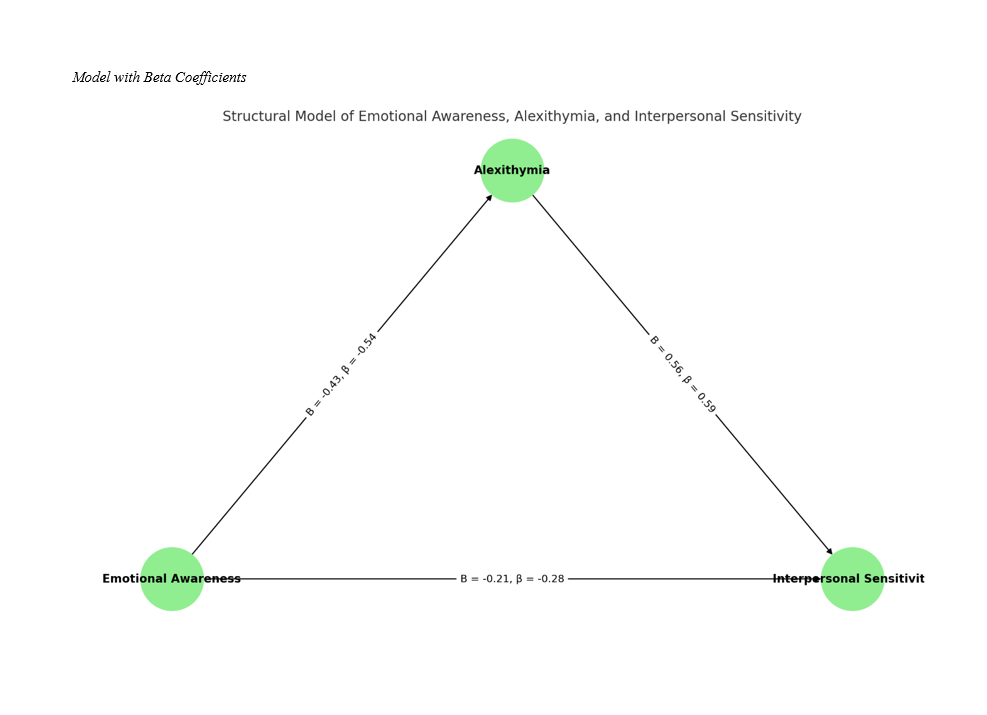
This study aimed to investigate the relationship between emotional awareness and interpersonal sensitivity, focusing on the mediating role of alexithymia among adults in Egypt. The research employed a descriptive correlational design with a sample of 390 adult participants selected based on Morgan and Krejcie’s sample size table. Participants were recruited from various Egyptian communities and completed standardized questionnaires measuring emotional awareness, alexithymia, and interpersonal sensitivity. Data analysis was conducted using SPSS-27 for Pearson correlation analysis and AMOS-21 for Structural Equation Modeling (SEM) to examine the proposed mediation model. Model fit was assessed using key indices including Chi-square/df, CFI, TLI, GFI, and RMSEA. Results indicated a significant negative correlation between emotional awareness and interpersonal sensitivity (r = –.47, p < .01), and a significant positive correlation between alexithymia and interpersonal sensitivity (r = .59, p < .01). Emotional awareness also showed a significant negative correlation with alexithymia (r = –.54, p < .01). SEM results confirmed that emotional awareness significantly predicted lower alexithymia (β = –.54, p < .001), which in turn significantly predicted higher interpersonal sensitivity (β = .59, p < .001). The direct path from emotional awareness to interpersonal sensitivity remained significant (β = –.28, p = .002), and the indirect effect through alexithymia was also significant (β = –.32, p < .001), indicating partial mediation. The overall model demonstrated good fit (χ²/df = 2.34, CFI = 0.97, RMSEA = 0.058). The findings underscore the critical role of emotional awareness in reducing interpersonal sensitivity, both directly and through the mediating influence of alexithymia. Enhancing emotional processing skills may serve as an effective target for interventions aimed at improving social functioning and emotional well-being.
Downloads
References
Amarat, M., Deniz, S., Akbolat, M., & Çimen, M. (2023). Examining the Effect of Situational Awareness and Health Protection Behaviour on Loneliness and Hopelessness in COVID-19 Process. Journal of Health Management, 25(2), 172-178. https://doi.org/10.1177/09720634231175740
Ding, X., Zhao, T. C., Li, X., Yang, Z., & Tang, Y. Y. (2020). Trait Mindfulness and College Student Interpersonal Sensitivity: The Mediating Role of Negative Emotions and the Moderating Role of Effectiveness/Authenticity. https://doi.org/10.21203/rs.3.rs-83562/v1
Ding, X., Zhao, T. C., Li, X., Yang, Z., & Tang, Y. Y. (2021). Exploring the Relationship Between Trait Mindfulness and Interpersonal Sensitivity for Chinese College Students: The Mediating Role of Negative Emotions and Moderating Role of Effectiveness/Authenticity. Frontiers in psychology, 12. https://doi.org/10.3389/fpsyg.2021.624340
Du, J., Li, Z., Jia, G., Zhang, Q., & Chen, W. (2019). Relationship Between Mental Health and Awareness of the Knowledge on Mental Health in Left-Behind Middle School Students. Medicine, 98(11), e14476. https://doi.org/10.1097/md.0000000000014476
Ekaterina, P., & M, B. V. (2019). Identifying Emotional Intelligence and Metacognitive Awareness Among University Students. https://doi.org/10.33422/icrpconf.2019.03.137
Fadahunsi, J. A., Abdullahi, A. H., Sunday, A. O., & Stephen, M. (2025). Effect of Emotional Intelligence on Academic Achievement of Senior Secondary School Students in Biology in Wukari Metropolis. International. J. Of. Educ. Manag. Technol., 3(2), 592-610. https://doi.org/10.58578/ijemt.v3i2.5940
Feng, H., Wang, Y., & Wu, J. (2024). A Study on Emotional Control Ability and Interpersonal Relationships of Urban College Students. Advances in Education Humanities and Social Science Research, 12(1), 330. https://doi.org/10.56028/aehssr.12.1.330.2024
Kumar, S., Agrawal, U., & Jha, M. (2025). Gender Differences in Emotional Intelligence and Its Impact on Interpersonal Relationships Among College Students. Ijira, 05(01(II)), 122-129. https://doi.org/10.62823/ijira/5.1(ii).7295
Laurensius, Lisa, Y., & Setyawan, A. E. (2023). Analysis of Interpersonal and Emotional Intelligence Students in Informatics Learning in TJKT Department at SMK Negeri 1 Sintang. Regy, 2(1), 33-42. https://doi.org/10.62590/regy.v2i1.92
Lee, Y. M., & Joeng, J. R. (2020). The Mediating Effects of Rejection Sensitivity and Emotion Dysregulation on the Relation Between Adult Attachment Anxiety and Interpersonal Problems. Asian Journal of Education, 21(1), 101-124. https://doi.org/10.15753/aje.2020.03.21.1.101
Maitrianti, C. (2022). Strategi Pengembangan Kecerdasan Intrapersonal Dalam Mengenali Bakat Siswa. Jurnal Mudarrisuna Media Kajian Pendidikan Agama Islam, 12(1), 160. https://doi.org/10.22373/jm.v12i1.13300
Mandloi, S., & Pandey, D. K. (2025). A Comparative Study of Dimensions of Emotional Intelligence of Higher Secondary School Students With Respect to Gender and Locality. Gimrj. https://doi.org/10.69758/gimrj/2412iv02v12p0013
Melenets, L., Матвійчук, О., Savchenko, S., Сherpak, Y., & Petroshchuk, N. (2022). The Impact of Using Humour on the Improvement of Teachers’ Emotional Intelligence During Advanced Training Courses. Jett, 13(3). https://doi.org/10.47750/jett.2022.13.03.022
Noor, H., & Rehman, S. (2023). Emotion Regulation and Self-Concept as Predictors of Interpersonal Problems in Transgender Population of Pakistan. Clinical and Counselling Psychology Review, 5(2), 78-93. https://doi.org/10.32350/ccpr.52.05
Ramón-Ramón, C. A., Aguilar, C. E. V., & Rosales-Guichay, B. A. (2024). Sensibilidad Emocional Y Resiliencia en Operadores De Emergencia De La Provincia De El Oro-Ecuador. Fides Et Ratio, 27(27). https://doi.org/10.55739/bfwr1y48
Razvaliaeva, A. Y., & Polskaya, N. A. (2023). The Relationship Between Interpersonal Sensitivity and Emotion Regulation in Youths. European Journal of Psychology Open, 82(4), 171-179. https://doi.org/10.1024/2673-8627/a000051
Roy, A. (2023). Interpersonal Emotion Regulation and Emotional Intelligence: A Review. International Journal of Research Publication and Reviews, 04(02), 623-627. https://doi.org/10.55248/gengpi.2023.42002
SalehiT, S., & Davarani, F. F. (2025). Investigating the Effectiveness of Emotionally-Focused Approach Training on Improving Interpersonal Sensitivity in Couples on the Verge of Divorce. Journal of counseling research. https://doi.org/10.18502/qjcr.v23i92.17848
Sharma, A., & Singh, A. (2024). A Study of Emotional Intelligence of Adolescents in Relation to Modernization. Shodhkosh Journal of Visual and Performing Arts, 5(4). https://doi.org/10.29121/shodhkosh.v5.i4.2024.3463
Tajigharajeh, S., Safari, M., Abadi, T. S. H., Abadi, S. S. H., Kargar, M., Panahi, M., Hasani, M., & Ghaedchukamei, Z. (2021). Determining the Relationship Between Emotional Intelligence and Interpersonal Sensitivity With Quality of Work Life in Nurses. Journal of education and health promotion, 10(1), 174. https://doi.org/10.4103/jehp.jehp_612_20
Topalalioğlu, S. (2025). Role of Interpersonal Sensitivity and Cognitive Distortions in the Development of Psychopathologies. Psikiyatride Guncel Yaklasimlar - Current Approaches in Psychiatry, 17(2), 261-271. https://doi.org/10.18863/pgy.1484640
Wang, H., Zhu, L., Cao, Y., Han, F., & Yao, Q. (2023). Development and Validation of the Emotional Awareness Questionnaire for Teachers in China. Social Behavior and Personality an International Journal, 51(9), 1-13. https://doi.org/10.2224/sbp.12599
Wang, Y., & Zhang, M. (2024). Social Emotional Learning Modeling for Enhancement in Preschool Education. Applied Mathematics and Nonlinear Sciences, 9(1). https://doi.org/10.2478/amns-2024-1404
Zaheer, S., Mehmood, A., Bukhari, N., Saleem, A., Ansar, M., & Usman, F. (2024). Assessing Interpersonal and Intrapersonal Emotional Insights in Undergraduate Medical Students. Pakistan Journal of Health Sciences, 209-214. https://doi.org/10.54393/pjhs.v5i08.1633
Zhang, J. (2023). Mindfulness and Negative Emotions: Chain Mediation Effect of Perceived Social Support and Interpersonal Sensitivity. SHS Web of Conferences, 171, 01004. https://doi.org/10.1051/shsconf/202317101004
Фещенко, Г. (2024). Емоційна Культура Та Емоційний Інтелект У Розвитку Менеджерів Соціокультурної Діяльності. Сні(7(7)). https://doi.org/10.52058/3041-1572-2024-7(7)-412-422
Downloads
Additional Files
Publication Timeline
- Submitted
- Revised
- Accepted
Issue
Section
License

This work is licensed under a Creative Commons Attribution-NonCommercial 4.0 International License.