The Influence of Agreeableness on Perceived Social Support: The Mediating Role of Empathy
DOI:
https://doi.org/10.61838/kman.jppr.3.3.1Keywords:
Agreeableness, Empathy, Perceived Social Support, Personality TraitsAbstract
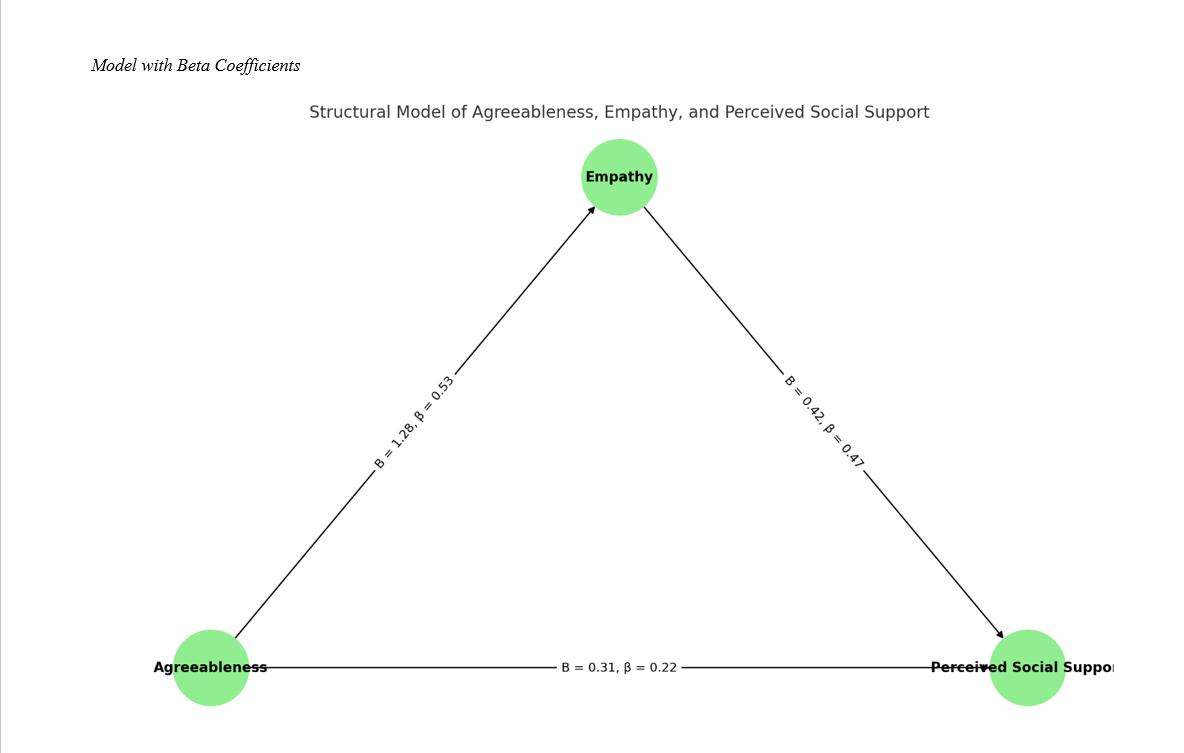
This study aimed to investigate the influence of agreeableness on perceived social support, with a specific focus on the mediating role of empathy among Indonesian adults. A descriptive correlational research design was used, involving 400 participants selected through stratified random sampling based on Krejcie and Morgan's sample size determination table. Participants completed standardized self-report instruments: the NEO Five-Factor Inventory (Agreeableness), the Interpersonal Reactivity Index (Empathy), and the Multidimensional Scale of Perceived Social Support. Pearson correlation analysis was performed using SPSS-27 to examine bivariate relationships among the variables. Structural Equation Modeling (SEM) was conducted using AMOS-21 to assess the hypothesized mediational model, with model fit indices evaluated and path coefficients estimated for both direct and indirect effects. Pearson correlations indicated that agreeableness was significantly associated with both empathy (r = .53, p < .01) and perceived social support (r = .41, p < .01), while empathy was also significantly correlated with perceived social support (r = .59, p < .01). The SEM analysis demonstrated good model fit (χ²/df = 2.04, GFI = 0.94, CFI = 0.96, RMSEA = 0.051). Direct effects were significant from agreeableness to empathy (β = .53, p < .001), empathy to perceived social support (β = .47, p < .001), and agreeableness to perceived social support (β = .22, p < .001). The indirect effect of agreeableness on perceived social support via empathy was also significant (β = .25, p < .001), confirming the mediation model. Empathy plays a critical mediating role in the relationship between agreeableness and perceived social support. These findings highlight the importance of both personality traits and socio-emotional competencies in shaping individuals’ perceptions of their social networks, especially in collectivist cultures like Indonesia.
Downloads
References
Abdullah, A. A., Hamsan, H. H., & Ma’rof, A. A. (2020). How Do Personality Factors Associate With Prosocial Behavior? The Mediating Role of Empathy. International Journal of Academic Research in Business and Social Sciences, 10(16). https://doi.org/10.6007/ijarbss/v10-i16/8303
Ayhan, D., & Tatar, A. (2024). Psychosocial Risk Factors in Employees as Predictors of Mobbing. Yönetim Ve Ekonomi Araştırmaları Dergisi, 21(4), 133-151. https://doi.org/10.11611/yead.1360828
Bamford, J. S., & Davidson, J. W. (2017). Trait Empathy Associated With Agreeableness and Rhythmic Entrainment in a Spontaneous Movement to Music Task: Preliminary Exploratory Investigations. Musicae Scientiae, 23(1), 5-24. https://doi.org/10.1177/1029864917701536
Bętkowska-Korpała, B., Epa, R., Sikora-Zych, K., Olszewska-Turek, K., Pastuszak-Draxler, A., Rajtar-Zembaty, A., & Starowicz–Filip, A. (2021). Differences in Personality Related Determinants of Empathetic Sensibility in Female and Male Students of Medicine. PLoS One, 16(7), e0254458. https://doi.org/10.1371/journal.pone.0254458
Bętkowska-Korpała, B., Pastuszak-Draxler, A., Olszewska-Turek, K., Sikora-Zych, K., Epa, R., & Starowicz–Filip, A. (2022). Personality Characteristics of Empathy Profiles – Practical Implications for Education of Medicine Students. BMC Medical Education, 22(1). https://doi.org/10.1186/s12909-022-03432-5
Buljan, T., & Mlačić, B. (2024). Relationship Between Personality Traits, Reading Tendencies, and Empathy. International Journal of Personality Psychology, 10, 41-48. https://doi.org/10.21827/ijpp.10.41425
Fido, D., & Richardson, M. (2018). Empathy Mediates the Relationship Between Nature Connectedness and Both Callous and Uncaring Traits. https://doi.org/10.31234/osf.io/dtc42
Fuente, C. B. l., Núñez-Rodríguez, S., Raquel de la Fuente, A., & González‐Bernal, J. J. (2025). Relationship Between Leadership, Personality, and the Dark Triad in Workplace: A Systematic Review. Behavioral Sciences, 15(3), 297. https://doi.org/10.3390/bs15030297
Hudson, S. k. T. J., & Uenal, F. (2022). The Connections Between Personality, Ideology and (Counter-)Empathic Emotions Depend on the Target. https://doi.org/10.31234/osf.io/t2wnp
Hudson, S. k. T. J., & Uenal, F. (2023). The Connections Between Personality, Ideology and (Counter‐)empathic Emotions Depend on the Target. Journal of personality, 92(3), 883-906. https://doi.org/10.1111/jopy.12860
Jones, C. (2022). Five Factor Model: Insights Into a College Population. Curr Res Psychol Behav Sc, 3(6), 1-6. https://doi.org/10.54026/crpbs/1062
Jugović, I., Petrović, D., & Marušić, I. (2023). The Mediating Role of Personality and Gender Roles on the Relationship Between Gender and Empathy: A Study on Preservice Teachers. Sociologija I Prostor. https://doi.org/10.5673/sip.61.1.3
Kallianou, M. N. (2024). Agreeableness and Conflict Management in Daily Life: The Impact of Prosocial Traits on Psychological Adaptation. Studies in Psychological Science, 2(3), 56-65. https://doi.org/10.56397/sps.2024.09.06
Kearns, P. O., Tyler, J., & Graziano, W. G. (2020). More Than Fantasy: Prosocial Daydreams Relate to Prosocial Dispositions and Behaviour. International journal of psychology, 56(1), 85-94. https://doi.org/10.1002/ijop.12673
Lachance, V., Laverdière, O., Kealy, D., & Ogrodniczuk, J. S. (2024). Dispositional Empathy Among Psychotherapists: A Latent Profile Analysis. Clinical Psychology & Psychotherapy, 31(3). https://doi.org/10.1002/cpp.3016
Ling, G., Li, X., & Wang, X. (2023). Agreeableness and Adolescents' Cyberbullying Perpetration: A Longitudinal Moderated Mediation Model of Moral Disengagement and Empathy. Journal of personality, 91(6), 1461-1477. https://doi.org/10.1111/jopy.12823
Melchers, M., Li, M., Haas, B. W., Reuter, M., Bischoff, L., & Montag, C. (2016). Similar Personality Patterns Are Associated With Empathy in Four Different Countries. Frontiers in psychology, 7. https://doi.org/10.3389/fpsyg.2016.00290
Men, L. R., & Sung, Y. (2019). Shaping Corporate Character Through Symmetrical Communication: The Effects on Employee-Organization Relationships. International Journal of Business Communication, 59(3), 427-449. https://doi.org/10.1177/2329488418824989
Pal, R. (2024). To Explore the Associations Between Different Personality Pattern and Empathy Among Adults: A Correlational Study. https://doi.org/10.31234/osf.io/k6fjv
Simon, P., & Nader‐Grosbois, N. (2021). Preschoolers' Empathy Profiles and Their Social Adjustment. Frontiers in psychology, 12. https://doi.org/10.3389/fpsyg.2021.782500
Suciu, N., Meliţ, L. E., & Mărginean, C. O. (2021). A Holistic Approach of Personality Traits in Medical Students: An Integrative Review. International journal of environmental research and public health, 18(23), 12822. https://doi.org/10.3390/ijerph182312822
Sun, Y., Chen, S., Miao, L., Chen, S., Piao, Z., & Tong, C. (2024). The Relationship Between Personality, Resilience, and Empathy in Dental Students: A Cross-Sectional Study (Preprint). https://doi.org/10.2196/preprints.56133
Syrnyk, C., & McArthur, A. D. (2021). The Characteristics and Motivations of Human Volunteers of Animal-Assisted Interventions. Human-Animal Interaction Bulletin. https://doi.org/10.1079/hai.2021.0017
Topić, M. K. (2021). Emotional Engagement, but Not Transportation Leads to Higher Empathy After Reading a Fictional Story, in More Agreeable Participants. Primenjena Psihologija, 14(2), 211-227. https://doi.org/10.19090/pp.2021.2.211-227
Yang, D., & Tu, C. C. (2020). Influence of College Students’ Agreeableness on Interpersonal Relationships: Moderating Role of Empathy. Education and Urban Society, 53(4), 383-401. https://doi.org/10.1177/0013124520928609
Yasien, S., & Almuzaini, F. (2022). The Relationship Between Empathy and Personality Traits in Saudi Medical Students. Journal of education and health promotion, 11(1), 150. https://doi.org/10.4103/jehp.jehp_851_21
Yeganeh, N. (2022). Structural Relationships of Big Five Personality Factors With Symptoms of Sadistic Personality Due to the Role of Schadenfreude in Students. Journal of Applied Psychology, 16(1), 159-135. https://doi.org/10.52547/apsy.2021.223890.1161
Downloads
Additional Files
Publication Timeline
- Submitted
- Revised
- Accepted
Issue
Section
License

This work is licensed under a Creative Commons Attribution-NonCommercial 4.0 International License.