Self-Compassion as a Mediator Between Self-Criticism and Physical Symptom Reporting
DOI:
https://doi.org/10.61838/kman.jppr.3.2.6Keywords:
Self-criticism, Self-compassion, Physical symptom reportingAbstract
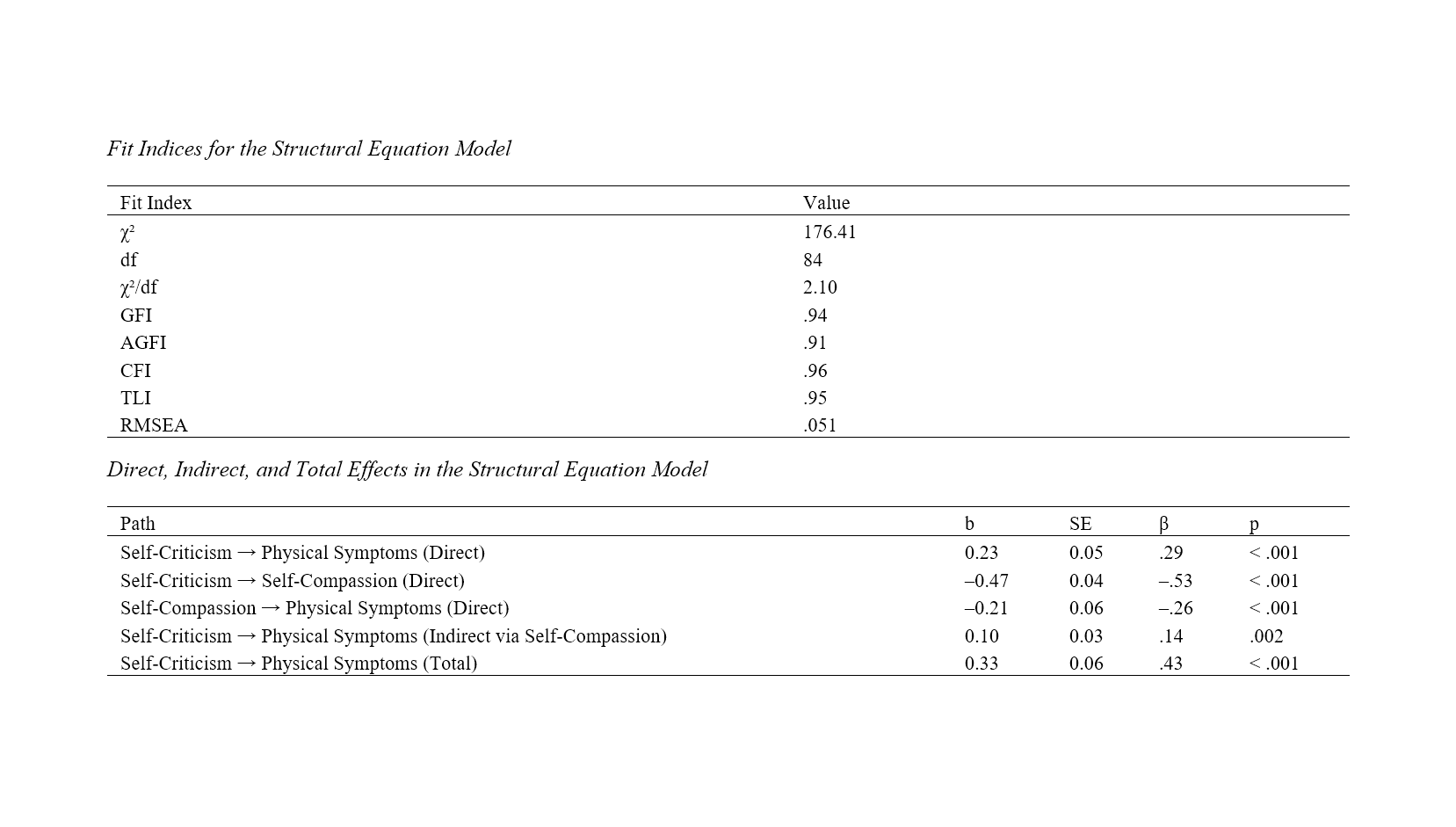
This study aimed to investigate whether self-compassion mediates the relationship between self-criticism and physical symptom reporting in a sample of Iranian adults. A descriptive correlational research design was employed with a sample of 435 participants selected based on the Morgan and Krejcie sample size table. Participants completed three standardized self-report instruments: the Levels of Self-Criticism Scale (LOSC), the Self-Compassion Scale (SCS), and the Patient Health Questionnaire-15 (PHQ-15) for physical symptom reporting. Data were analyzed using SPSS-27 for descriptive statistics and Pearson correlation analysis, and AMOS-21 was used to conduct Structural Equation Modeling (SEM) to evaluate the mediation model. The results revealed significant correlations between all study variables. Self-criticism was positively correlated with physical symptom reporting (r = .47, p < .001) and negatively correlated with self-compassion (r = –.53, p < .001). Self-compassion was also negatively associated with physical symptom reporting (r = –.45, p < .001). SEM analysis indicated that the model demonstrated good fit (χ²/df = 2.10, CFI = .96, RMSEA = .051). Direct effects were significant from self-criticism to physical symptom reporting (β = .29, p < .001), from self-criticism to self-compassion (β = –.53, p < .001), and from self-compassion to physical symptom reporting (β = –.26, p < .001). The indirect effect of self-criticism on physical symptoms through self-compassion was also significant (β = .14, p = .002), confirming partial mediation. The findings suggest that self-compassion serves as a psychological buffer that partially mediates the impact of self-criticism on physical symptom reporting. Enhancing self-compassion may reduce the somatic burden of individuals prone to self-critical thinking, offering valuable implications for psychological interventions and health promotion.
Downloads
References
Bodok-Mulderij, I., Schaap‐Jonker, H., Klaassen-Dekker, A., Boselie, J. J., & Jacobs, N. (2023). The Relation Between Religion/Spirituality and Mental Health Is Mediated by Self-Compassion: Evidence From Two Longitudinal Studies in the Dutch-Speaking General Population. Psychology of Religion and Spirituality, 15(3), 407-417. https://doi.org/10.1037/rel0000501
Carvalho, M. M. d. (2025). Hope and Self-Compassion Mediate the Relationship Between Mental Health Literacy and Mental Health. Journal of Prevention and Health Promotion. https://doi.org/10.1177/26320770241280575
Casto, K. V., & Lecci, L. (2012). Experimentally Manipulated Somatic Information and Somatization Tendencies and Their Impact on Physical Symptom Reporting and Performance in a Physically Strenuous Task. Int J Exerc Sci, 5(1), 60-71. https://doi.org/10.70252/bowj3449
Cutajar, K., & Bates, G. (2024). Australian Women in the Perinatal Period During COVID-19: The Influence of Self-Compassion and Emotion Regulation on Anxiety, Depression, and Social Anxiety. https://doi.org/10.20944/preprints202412.0990.v1
Cutajar, K., & Bates, G. (2025). Australian Women in the Perinatal Period During COVID-19: The Influence of Self-Compassion and Emotional Regulation on Anxiety, Depression, and Social Anxiety. Healthcare, 13(2), 120. https://doi.org/10.3390/healthcare13020120
Garnsey, C. L. (2025). Self‐compassion and Mental Health: Examining the Mediational Role of Health Behaviour Engagement in Emerging Adults. British Journal of Health Psychology, 30(2). https://doi.org/10.1111/bjhp.12791
Hong, S., & Wang, Z. (2024). Understanding the Impact of Expertise on Compassion Fatigue in Counseling via Core Self-Evaluation and Resilience. Scientific reports, 14(1). https://doi.org/10.1038/s41598-024-73666-4
Howren, M. B., Suls, J., & Martin, R. (2009). Depressive Symptomatology, Rather Than Neuroticism, Predicts Inflated Physical Symptom Reports in Community-Residing Women. Psychosomatic Medicine, 71(9), 951-957. https://doi.org/10.1097/psy.0b013e3181b9b2d7
Kim, H. Y., & Jun, W. H. (2024). The Mediating Effect of Professional Values on the Relationship Between Self-Leadership and Compassion Competence of Community Mental Health Nurses. Western Journal of Nursing Research, 46(7), 501-508. https://doi.org/10.1177/01939459241253535
Kotera, Y., Young, H., Maybury, S., & Aledeh, M. (2022). Mediation of Self-Compassion on Pathways From Stress to Psychopathologies Among Japanese Workers. International journal of environmental research and public health, 19(19), 12423. https://doi.org/10.3390/ijerph191912423
Liu, C., Lin, P. T., & Xiong, Z. (2024). Self-Compassion and Psychological Flourishing Among College Students: The Mediating Role of Hope and the Moderating Role of Emotion Regulation. Behavioral Sciences, 14(12), 1149. https://doi.org/10.3390/bs14121149
Liu, X., Fang, H., Tian, T., Zhang, J., Ji, Y., & Zhong, Y. (2025). Self-Compassion and Work Engagement Among Clinical Nurses: The Mediating Role of Moral Resilience. Frontiers in Public Health, 13. https://doi.org/10.3389/fpubh.2025.1507539
Marzi, S., & Seadatee Shamir, A. (2019). The Role of Self-efficacy and Seadat in Predicting Self-criticism/reassurance among Teachers. frooyesh, 8(5), 153-162.
Min, L., Ni, J., & Mengyuan, L. (2022). The Influence of Self-Compassion on Mental Health of Postgraduates: Mediating Role of Help-Seeking Behavior. Frontiers in psychology, 13. https://doi.org/10.3389/fpsyg.2022.915190
Mistretta, E. G., Davis, M. C., Bartsch, E. M., & Olah, M. S. (2023). Self-Compassion and Pain Disability in Adults With Chronic Pain: The Mediating Role of Future Self-Identification and Self-Efficacy. Journal of Health Psychology, 28(11), 1044-1056. https://doi.org/10.1177/13591053231167275
Mohamadi, M., & Jabalameli, s. (2024). The Effectiveness of Group Schema Therapy on Self-Criticism and Distress Tolerance in Women with Substance-Dependent Spouses. etiadpajohi, 17(70), 221-244. https://doi.org/10.61186/etiadpajohi.17.70.221
Pastore, O. L., & Fortier, M. (2023). The Mediating Role of Self-Compassion in Positive Education for Student Mental Health During COVID-19. Health Promotion International, 38(5). https://doi.org/10.1093/heapro/daad107
Polat, K. (2025). Relationships Between Health Anxiety, Intolerance of Uncertainty, Rumination and Self-Compassion: A Structural Equation and Latent Profile Analysis. International Journal of Eurasia Social Sciences, 16(59), 290-313. https://doi.org/10.70736/ijoess.552
Rezagholiyan, M., Nemati, F., & Hashemi, T. (2025). Development of a Model of Students' Subjective Well-Being Based on Attachment Styles, Self-Compassion, and Emotion Regulation Styles with the Mediating Role of Quality of Life. Journal of Adolescent and Youth Psychological Studies (JAYPS), 6(1), 21-33. https://doi.org/10.61838/
Santos, F., & Cassidy, T. (2024). Materialistic Values, Health and Wellbeing: The Role of Self-Compassion. Journal of Psychology & Clinical Psychiatry, 15(1), 1-7. https://doi.org/10.15406/jpcpy.2024.15.00753
Syafitri, N., Lubis, R., Indrawan, Y. F., & Choong, T. C. (2024). Self-Compassion: Unveiling Mental Health Through Emotion Regulation in High-School Students. Tazkiya Journal of Psychology, 12(1), 1-16. https://doi.org/10.15408/tazkiya.v12i1.37794
Tapeinos, A., Karakasidou, E., & Stalikas, A. (2024). The Mediating Role of Self-Compassion Between Suicidal Ideation and Gender Role in Adolescents. The European Journal of Counselling Psychology. https://doi.org/10.46853/001c.120186
Tofangchi, M., Raeisi, Z., Ghamrani, A., & Rezaei Jamalouei, H. (2021). The causal relationship between self-compassion and self-criticism in female patients with tension headaches using the structural equation model. Anesthesia and Pain, 12(2), 62-77.
Tran, M. A. Q., Khoury, B., Chau, N. N. T., Pham, M. V., Dang, A. T. N., Ngo, T. V., Ngo, T. T., Truong, T. M., & Lê, Đ. A. K. (2022). The Role of Self-Compassion on Psychological Well-Being and Life Satisfaction of Vietnamese Undergraduate Students During the COVID-19 Pandemic: Hope as a Mediator. Journal of Rational-Emotive & Cognitive-Behavior Therapy, 42(1), 35-53. https://doi.org/10.1007/s10942-022-00487-7
Vidal, J., Ciudad-Fernández, V., Navarrete, J., Soler, J., Schmidt, C., Molinari, G., & Cebolla, A. (2024). From Self-Criticism to Self-Compassion: Exploring the Mediating Role of Two Emotion Dysregulation Variables in Their Relationship to Depressive Symptoms. Current Psychology. https://doi.org/10.1007/s12144-024-06325-6
Walton, C. C. (2025). A Preliminary Investigation Into Self-Compassion and Compassion-Based Intervention for Mental Health in the Performing Arts. Frontiers in psychology, 16. https://doi.org/10.3389/fpsyg.2025.1512114
Werner, A. M., Tibubos, A. N., Rohrmann, S., & Reiss, N. (2019). The clinical trait self-criticism and its relation to psychopathology: A systematic review – Update. Journal of affective disorders, 246, 530-547. https://doi.org/10.1016/j.jad.2018.12.069
Williams, P., & Wiebe, D. J. (2000). Individual Differences in Self-Assessed Health: Gender, Neuroticism and Physical Symptom Reports. Personality and individual differences, 28(5), 823-835. https://doi.org/10.1016/s0191-8869(99)00140-3
Xie, Q. (2023). Coping Style as a Mediator in the Associations Between Dispositional Mindfulness, Self-Compassion, and Loneliness. https://doi.org/10.31234/osf.io/5u7g6
Zhang, D., & Shen, J. (2023). Dispositional Mindfulness and Mental Health Among Chinese College Students During the COVID-19 Lockdown: The Mediating Role of Self-Compassion and the Moderating Role of Gender. Frontiers in psychology, 13. https://doi.org/10.3389/fpsyg.2022.1072548
Downloads
Publication Timeline
- Submitted
- Revised
- Accepted
Issue
Section
License

This work is licensed under a Creative Commons Attribution-NonCommercial 4.0 International License.