Fairness-Aware Machine Learning for Predicting Diabetes Distress from Conscientiousness, Self-Efficacy, Medication Adherence, and Glycemic Control
Keywords:
diabetes distress, fairness-aware machine learning, conscientiousness, self-efficacy, medication adherence, glycated hemoglobin, type 2 diabetesAbstract
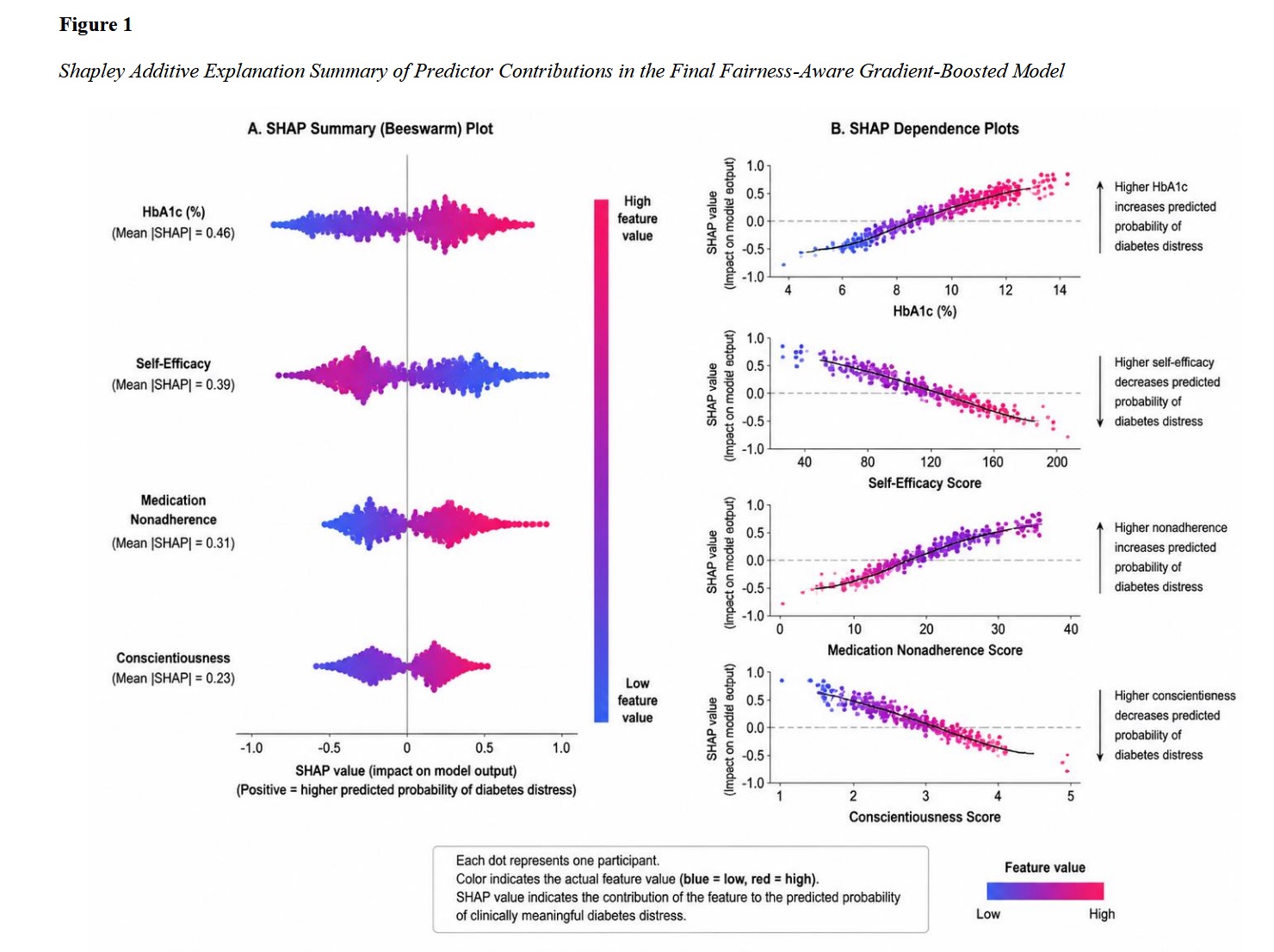
This study aimed to develop, compare, interpret, and assess the fairness of machine-learning models for predicting clinically meaningful diabetes distress from conscientiousness, diabetes management self-efficacy, medication adherence, and glycemic control among adults with type 2 diabetes in Kenya. This multicenter analytical cross-sectional study included 684 adults with type 2 diabetes recruited from four outpatient diabetes clinics in Kenya. Diabetes distress, conscientiousness, diabetes management self-efficacy, and medication adherence were assessed using standardized instruments, while glycated hemoglobin was extracted from clinical records. Clinically meaningful diabetes distress was defined as a mean Diabetes Distress Scale score of 2.0 or higher. Penalized logistic regression, support vector machine, random forest, and gradient-boosted decision-tree models were developed using a stratified 70:30 development-test split and repeated ten-fold cross-validation. Model performance was evaluated using discrimination, calibration, and classification metrics. Fairness was assessed across sex, age, and residence using differences in true-positive and false-positive rates, equalized odds, average odds, and selection-rate ratios. Shapley additive explanations were used to interpret predictor contributions. Participants with clinically meaningful distress had significantly lower conscientiousness, t(682) = 15.48, p < .001, and self-efficacy, t(682) = 22.79, p < .001, as well as significantly greater medication nonadherence, t(682) = −13.89, p < .001, and higher HbA1c, t(682) = −11.11, p < .001. Conventional gradient boosting achieved the highest AUROC of .842, sensitivity of .824, and specificity of .774. After fairness mitigation, AUROC remained .833 and sensitivity remained .824, while equalized-odds differences declined to .034 for sex, .018 for age, and .021 for residence. HbA1c had the greatest predictive contribution, followed by self-efficacy, medication nonadherence, and conscientiousness. Fairness-aware gradient boosting predicted diabetes distress with good accuracy while substantially reducing demographic disparities, indicating that combining psychological, behavioral, and metabolic variables may support equitable and timely psychosocial screening in diabetes care.
Downloads
References
Abdulhamza, K. L., & Majeed, H. M. (2026). Self-Management Behaviors and Its Correlation With Maintenance Blood Glucose Level Control Among Diabetes Mellitus Patients: A Longitudinal Design Study. Journal of education and health promotion, 15(1). https://doi.org/10.4103/jehp.jehp_10_26
Al-Slail, F. Y. (2026). The Effect of Motivational Interviewing on Glycemic Control Among Saudi Persons With Type 2 Diabetes: A Feasibility Study. Saudi medical journal, 47(2), 273-282. https://doi.org/10.15537/1658-3175.1008
Babaita, A. O., Ademuyiwa, I. Y., & Moriyama, M. (2026). Glycemic Control and Association With Diabetes-Related Distress, Self-Management Behavior, Financial Toxicity, and Cost-Related Non-Adherence: A Mixed-Methods Study. Frontiers in Endocrinology, 17. https://doi.org/10.3389/fendo.2026.1857675
Bassi, G., Mancinelli, E., Dell’Arciprete, G., Rizzi, S., Gabrielli, S., & Salcuni, S. (2021). Efficacy of eHealth Interventions for Adults With Diabetes: A Systematic Review and Meta-Analysis. International journal of environmental research and public health, 18(17), 8982. https://doi.org/10.3390/ijerph18178982
Belhaj, H., Barouaca, H., Oudghiri, D. E., Lamiri, A., Mostakim, M., Timihiri, A., Ahyayauch, H., & Younes, S. (2024). The Influence of Therapeutic Education on Diabetes-Related Distress and Therapeutic Adherence Among Patients With Type 2 Diabetes in Tetouan, Morocco. European Journal of Clinical and Experimental Medicine, 22(1), 140-146. https://doi.org/10.15584/ejcem.2024.1.28
Carreira, M., Ma Soledad Ruiz de, A., Pinzón, J. L., & Anarte-Ortiz, M. T. (2023). Internet-Based Cognitive-Behavioral Therapy Is Effective in Reducing Depressive Symptomatology in Type 1 Diabetes: Results of a Randomized Controlled Trial. Frontiers in Clinical Diabetes and Healthcare, 4. https://doi.org/10.3389/fcdhc.2023.1209236
Derese, A., Sirgu, S., Egziabhere, Y. G., & Hanlon, C. (2025). Mechanisms and Pathways Linking Depression and Type 2 Diabetes Outcomes: A Scoping Review. https://doi.org/10.1101/2025.02.21.25322657
Dimou, K., Dragioti, E., Tsitsas, G., Mantzoukas, S., & Gouva, M. (2023). Association of Personality Traits and Self-Care Behaviors in People With Type 2 Diabetes Mellitus: A Systematic Review and Meta-Analysis. Cureus. https://doi.org/10.7759/cureus.50714
Duarte‐Díaz, A., Perestelo‐Pérez, L., Rivero‐Santana, A., Peñate, W., Álvarez‐Pérez, Y., Ramos‐García, V., González‐Pacheco, H., Goya-Arteaga, L., Bonis-Braun, M. d., González-Martín, S., Ramallo‐Fariña, Y., Carrión, C., & Serrano‐Aguilar, P. (2023). The Relationship Between Patient Empowerment and Related Constructs, Affective Symptoms and Quality of Life in Patients With Type 2 Diabetes: A Systematic Review and Meta-Analysis. Frontiers in Public Health, 11. https://doi.org/10.3389/fpubh.2023.1118324
Fadli, F., Nursalam, N., Sjattar, E. L., & Uly, N. (2025). An Integrative Model of Self-Regulation in Type 2 Diabetes Self-Management: A Systematic Review of Individual and Family-Based Interventions. Healthcare, 13(24), 3230. https://doi.org/10.3390/healthcare13243230
Hagiwara, Y., Adachi, T., Kanai, M., & Miki, T. (2025). Impact of Personality Prototypes on App Engagement and Weight Loss in a Mobile App-Based Lifestyle Modification Support Program for Individuals With Obesity and Non-Communicable Diseases. Digital Health, 11. https://doi.org/10.1177/20552076251347891
Huang, L. C., Lin, C. L., Chang, Y.-T., Chen, R. Y., & Bai, C. H. (2022). Gender Impact on Diabetes Distress Focus at Medical Communication Concerns, Life and Interpersonal Stress. International journal of environmental research and public health, 19(23), 15678. https://doi.org/10.3390/ijerph192315678
Jacob, R., Biju, B., & Sharma, R. K. (2024). Psychologic Distress in Diabetic Patients. Journal of Drug Delivery and Therapeutics, 14(6), 247-250. https://doi.org/10.22270/jddt.v14i6.6663
Jafari, M., Shahverdian, A., Sadigh, G., & Etten, R. A. V. (2024). Impact of Patient Personality on Adherence to Oral Anticancer Medications: An Opportunity? (Preprint). https://doi.org/10.2196/preprints.57199
Jerawatana, R., Weinstein, B., Phattanasri, C. N., Saetung, S., Sahakitrungruang, T., Tachanivate, P., Saibuathong, N., Hathaidechadusadee, A., Deeampai, C., Sakmanarit, J., Korpaisarn, S., Numsriskulrat, N., Anothaisintawee, T., & Reutrakul, S. (2025). The Effects of Self-Compassion in Adolescents and Young Adults With Type 1 Diabetes: A Pilot Randomized Controlled Trial. Annals of Pediatric Endocrinology & Metabolism, 30(4), 190-200. https://doi.org/10.6065/apem.2448224.112
Lin, P.-Y., Lee, T. Y., Liu, C. Y., & Lee, Y. J. (2021). The Effect of Self-Efficacy in Self-Management on Diabetes Distress in Young People With Type 2 Diabetes. Healthcare, 9(12), 1736. https://doi.org/10.3390/healthcare9121736
Liu, S., Chen, F., Tang, F., Wang, W., Yuan, X., Cheng, D., & Wang, Y. (2026). Bridging Minds and Behaviours: Patient Empowerment Mediates Psychological Factors and Diabetes Self‐Management. Endocrinology Diabetes & Metabolism, 9(2). https://doi.org/10.1002/edm2.70183
Lupini, F., Moore, H., Basch, M., Vagadori, J., Cooke, F., Kelly, K. P., Streisand, R., Shomaker, L. B., Dagnachew, M., Cooper, D. K., & Mackey, E. R. (2025). Mindfulness-Based Intervention for Adolescents With Type 1 Diabetes: A Case Series. Clinical Practice in Pediatric Psychology, 13(2), 189-198. https://doi.org/10.1177/21694826251319328
Matejko, B., Morawska-Tota, M., Tota, Ł., Flakus, M., Cyranka, K., Kieć‐Wilk, B., Lushchyk, M., Małecki, M. T., & Klupa, T. (2023). Association of Short- And Long-Term Metabolic Control Parameters With Personality Traits in Adult Type 1 Diabetes Treated With Personal Insulin Pumps. Psychiatria Polska, 57(2), 431-442. https://doi.org/10.12740/pp/onlinefirst/145647
Milani, I., Cipponeri, E., Ripa, P., Magon, A., Terzoni, S., Cilluffo, S., Lusignani, M., & Caruso, R. (2025). Health Literacy in People With Type 1 Diabetes: A Scoping Review. International journal of environmental research and public health, 22(6), 869. https://doi.org/10.3390/ijerph22060869
Miller, R. O. (2021). Personality as a Predictor of HbA1c Level in Patients With Type 2 Diabetes Mellitus. Medicine, 100(27), e26590. https://doi.org/10.1097/md.0000000000026590
Nas, N., & Saglam, F. (2026). Personality Traits, Psychiatric Symptoms, and Glycemic Control in Patients With Type 2 Diabetes Mellitus: A Cross-Sectional Study. Healthcare, 14(10), 1274. https://doi.org/10.3390/healthcare14101274
Şahiner, A., Güven, A. G., Şıklar, Z., Berberoğlu, M., Özsu, E., & Aycan, Z. (2025). The Impact of an Adolescent-Friendly Approach on Metabolic Control in Adolescents With Type 1 Diabetes in Türkiye. Journal of clinical medicine, 14(20), 7377. https://doi.org/10.3390/jcm14207377
Sánchez-Urbano, C., Osuna, M. a. J. P., & Herruzo, C. (2021). Personality Prototypes in People With Type 1 Diabetes and Their Relationship With Adherence. International journal of environmental research and public health, 18(9), 4818. https://doi.org/10.3390/ijerph18094818
Sendekie, A. K., Limenh, L. W., Bizuneh, G. K., Kasahun, A. E., Wondm, S. A., Tamene, F. B., Dagnew, E. M., Gete, K. Y., Kassaw, A. T., Dagnaw, A. D., Tadesse, Y. B., & Abate, B. B. (2025). Psychological Distress and Its Impact on Glycemic Control in Patients With Diabetes, Northwest Ethiopia. Frontiers in Medicine, 12. https://doi.org/10.3389/fmed.2025.1488023
Soufi, A., Mok, É., Henderson, M., Dasgupta, K., Rahme, E., & Nakhla, M. (2023). Association of Stigma, Diabetes Distress and Self‐efficacy With Quality of Life in Adolescents With Type 1 Diabetes Preparing to Transition to Adult Care. Diabetic Medicine, 41(1). https://doi.org/10.1111/dme.15159
Spaggiari, S., Bassi, G., Salcuni, S., & Riso, D. D. (2025). Evaluating the Impact of eHealth Interventions on Adolescents With Diabetes: A Systematic Review and Meta-Analysis. Frontiers in Clinical Diabetes and Healthcare, 6. https://doi.org/10.3389/fcdhc.2025.1659146
Stéphan, Y., Sutin, A. R., Luchetti, M., Canada, B., & Terracciano, A. (2020). Personality and HbA1c: Findings From Six Samples. Psychoneuroendocrinology, 120, 104782. https://doi.org/10.1016/j.psyneuen.2020.104782
Tunsuchart, K., Lerttrakarnnon, P., Srithanaviboonchai, K., Likhitsathian, S., & Skulphan, S. (2020). Type 2 Diabetes Mellitus Related Distress in Thailand. International journal of environmental research and public health, 17(7), 2329. https://doi.org/10.3390/ijerph17072329
Wagner, G., Zeiler, M. D., Karwautz, A., Schneider, A., Rami‐Merhar, B., & Berger, G. (2022). Personality, Coping and Developmental Conditions in Female Adolescents and Young Adults With Type 1 Diabetes: Influence on Metabolic Control and Quality of Life. Frontiers in Psychiatry, 12. https://doi.org/10.3389/fpsyt.2021.809015
Wibowo, Z. K., Mudjanarko, S. W., & Khairina, K. (2022). The Relationship Between Diabetes Distress and HbA1C Level in Type 2 Diabetes Mellitus Therapy Patients: A Systematic Review. Bali Medical Journal, 11(1), 476-484. https://doi.org/10.15562/bmj.v11i1.2986
Woodard, L., Amspoker, A. B., Hundt, N. E., Gordon, H. S., Hertz, B., Odom, E., Utech, A., Razjouyan, J., Rajan, S. S., Kamdar, N., Lindo, J., Kiefer, L., Mehta, P., & Naik, A. D. (2022). Comparison of Collaborative Goal Setting With Enhanced Education for Managing Diabetes-Associated Distress and Hemoglobin A1c Levels. JAMA Network Open, 5(5), e229975. https://doi.org/10.1001/jamanetworkopen.2022.9975
Yasui‐Furukori, N., Murakami, H., Otaka, H., Tanabe, J., Yanagimachi, M., Murabayashi, M., Matsumura, K., Matsuhashi, Y., Nakayama, H., Mizushiri, S., Sugawara, N., Daimon, M., & Shimoda, K. (2020). Personality Traits Do Not Have Influence on Glycemic Control in Outpatients With Type 2 Diabetes Mellitus. Psychiatry Investigation, 17(1), 78-84. https://doi.org/10.30773/pi.2019.0210
Zeng, T., Zhang, K., Ding, W., & Li, W. (2026). Association Between Exposure to a PERMA Model-Based Positive Psychology Intervention and Levels of Psychological Distress and Compliance Behaviors in Patients With Type 2 Diabetes Mellitus: A Quasi-Experimental Study. Frontiers in psychology, 17. https://doi.org/10.3389/fpsyg.2026.1808234
Zhao, X., Liu, Q., Guo, X., Hu, X., & Li, C. (2023). Serial Mediation Roles of Empowerment and Self‐care Activities Connecting Health Literacy, Quality of Life, and Glycemic Control in People With Type 2 Diabetes. Worldviews on Evidence-Based Nursing, 21(3), 330-337. https://doi.org/10.1111/wvn.12684
Downloads
Additional Files
Publication Timeline
- Submitted
- Revised
- Accepted