Unsupervised Machine Learning–Based Identification of Psychosomatic Susceptibility Profiles Using Big Five Personality Traits, Alexithymia, Coping Flexibility, Sleep Disturbance, and Somatic Symptom Severity
Keywords:
psychosomatic susceptibility, unsupervised machine learning, ig Five personality traits, alexithymia, coping flexibility, sleep disturbance, somatic symptomsAbstract
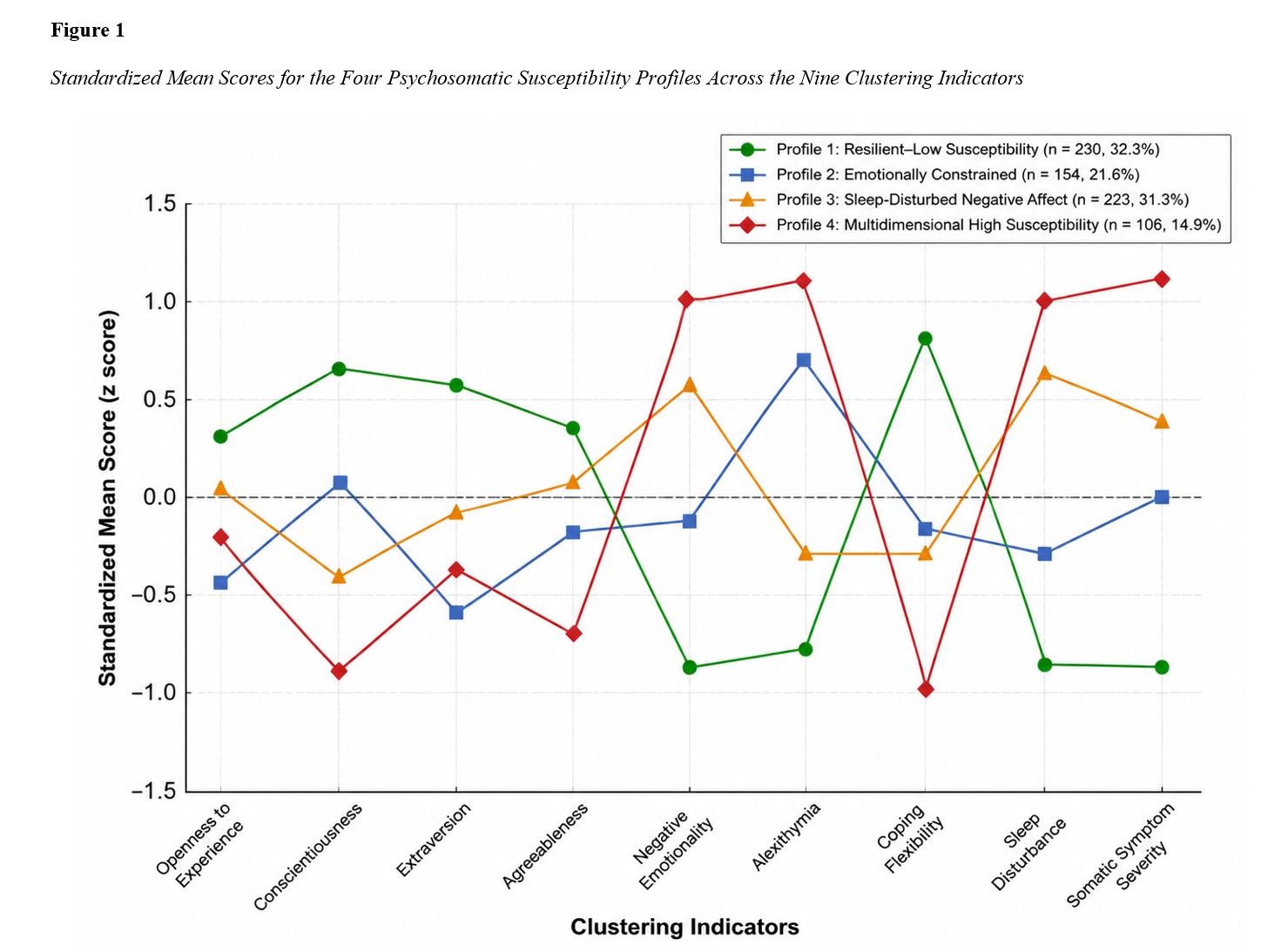
This study aimed to identify psychosomatic susceptibility profiles among adults in Ireland using unsupervised machine learning based on Big Five personality traits, alexithymia, coping flexibility, sleep disturbance, and somatic symptom severity. A cross-sectional, person-centered study included 713 adults residing in the Republic of Ireland. Participants completed the Big Five Inventory–2 Short Form, Toronto Alexithymia Scale, Coping Flexibility Scale, Pittsburgh Sleep Quality Index, and Patient Health Questionnaire–15. Standardized scores were analyzed using k-means clustering, partitioning around medoids, Gaussian mixture modeling, and hierarchical clustering. Solutions containing two to six profiles were compared using silhouette width, the Calinski–Harabasz index, the Davies–Bouldin index, the gap statistic, bootstrap Jaccard coefficients, and holdout adjusted Rand indices. Profile differences were examined using omnibus tests, adjusted pairwise comparisons, and effect sizes. A four-profile solution provided the strongest and most stable fit, comprising resilient–low susceptibility, emotionally constrained, sleep-disturbed negative affect, and multidimensional high susceptibility profiles. Significant between-profile differences were found for all clustering indicators (all p < .001). The largest effects emerged for somatic symptom severity, F(3, 709) = 344.79, partial η² = .593; negative emotionality, F(3, 709) = 318.57, partial η² = .574; sleep disturbance, F(3, 709) = 301.66, partial η² = .561; alexithymia, F(3, 709) = 283.12, partial η² = .545; and coping flexibility, F(3, 709) = 271.40, partial η² = .535. Profile membership was significantly associated with chronic physical illness, diagnosed mental health conditions, and psychotropic medication use. Psychosomatic susceptibility is best understood as a heterogeneous configuration of personality, emotional processing, coping adaptability, sleep impairment, and somatic burden, supporting profile-based assessment and targeted interventions.
Downloads
References
Akram, U., Stevenson, J. C., Gardani, M., Allen, S., & Johann, A. F. (2023). Personality and Insomnia: A Systematic Review and Narrative Synthesis. Journal of Sleep Research, 32(6). https://doi.org/10.1111/jsr.14031
Berger, K., Schiefner, F., Rudolf, M. P., Awiszus, F., Junne, F., Vogel, M., & Lohmann, C. H. (2024). Long-Term Effects of Doping With Anabolic Steroids During Adolescence on Physical and Mental Health. Die Orthopädie, 53(8), 608-616. https://doi.org/10.1007/s00132-024-04498-3
Bottiroli, S., Renzi, A., Ballante, E., Icco, R. D., Sances, G., Tanzilli, A., Vecchi, T., Tassorelli, C., & Galli, F. (2023). Personality in Chronic Headache: A Systematic Review With Meta-Analysis. Pain Research and Management, 2023, 1-19. https://doi.org/10.1155/2023/6685372
Castellà, J., & Muro, A. (2022). How Time Perspective, Personality, and Morningness Contributed to Psychological Well-Being During the Coronavirus Lockdown. Quaderns de Psicologia, 24(1), e1752. https://doi.org/10.5565/rev/qpsicologia.1752
Chang, R. S., Lee, M., Im, J. J., Choi, K. H., Kim, J., Chey, J., Shin, S.-H., & Ahn, W. Y. (2023). Biopsychosocial Factors of Gaming Disorder: A Systematic Review Employing Screening Tools With Well-Defined Psychometric Properties. Frontiers in Psychiatry, 14. https://doi.org/10.3389/fpsyt.2023.1200230
Chauhan, A., & Kumar, S. (2022). Stress-Personality Relationship During Covid-19 Restrictions: A Review. International Journal of Management Public Policy and Research, 1(4), 57-63. https://doi.org/10.55829/ijmpr.v1i4.99
Chen, J., & Huang, H. (2024). The Influence of Big Five Personality Traits on Depression and Suicidal Behavior. https://doi.org/10.5772/intechopen.1006564
Conway, B. A., Marwin Machay Indio do Brasil do, C., Helder Sergio Lira Soares, F., Toscanini, A. C., Hasan, R., Mansur‐Alves, M., & Rafihi‐Ferreira, R. E. (2025). Personality Traits and Insomnia: Direct and Anxiety‐mediated Associations. Journal of Sleep Research, 34(6). https://doi.org/10.1111/jsr.70003
Ecker, A., Jarvers, I., Kandsperger, S., Brunner, R., & Schleicher, D. (2025). Temperament and Personality: Preliminary Evidence of Possible Relationships With Multifactorial Stress Reactivity in Healthy Adolescents. Frontiers in psychology, 16. https://doi.org/10.3389/fpsyg.2025.1613000
Elagouz, M., Nabih, M. H., ElKaffas, M. E., Hafiz, M., & Ibrahim, I. (2025). Resilience and Its Relation to Alexithymia and Personality Traits in Egyptian Medical Students: A Cross-Sectional Study. https://doi.org/10.21203/rs.3.rs-5510628/v1
Esther, B., & Obosi, A. C. (2023). Influence of Occupational Stress, Personality and Job Demand on Mental Health of Police Officers in Nigeria. https://doi.org/10.21203/rs.3.rs-3263840/v1
Fabbri, M., Beracci, A., & Martoni, M. (2022). Insomnia, Time Perspective, and Personality Traits: A Cross-Sectional Study in a Non-Clinical Population. International journal of environmental research and public health, 19(17), 11018. https://doi.org/10.3390/ijerph191711018
Fukuti, P., Santi, T. D., Nascimento, A. G., Oliveira, L. C. d., Garcia, L. A. Z., Konieczniak, E. M. M., Cabrelon, V., Carrijo, L. D. F., Oliveira, M. C. d., Brañas, M. J., Croci, M. S., Aguiar-Borges, S., Santos, J. M., Sousa, N., Humes, E. C., Menezes, P. R., Miguel, E. C., & Caye, A. (2026). Big Five Personality Traits and Lifestyle: A Cross-Sectional Study in Brazilian Undergraduate Students. https://doi.org/10.21203/rs.3.rs-9622599/v1
Gaggero, G., Dellantonio, S., Pastore, L., Leng, K. S. H., & Esposito, G. (2022). Shared and Unique Interoceptive Deficits in High Alexithymia and Neuroticism. PLoS One, 17(8), e0273922. https://doi.org/10.1371/journal.pone.0273922
Ho, C. S. H., Chua, J. J. E., & Tay, G. W. N. (2022). The Diagnostic and Predictive Potential of Personality Traits and Coping Styles in Major Depressive Disorder. BMC psychiatry, 22(1). https://doi.org/10.1186/s12888-022-03942-y
Holzinger, B., Mayer, L., & Klösch, G. (2021). Personality Traits and Insomnia Symptoms in Shift Workers. Frontiers in psychology, 12. https://doi.org/10.3389/fpsyg.2021.689741
Kulshreshtha, P. (2023). Personality Construct as a Biomarker in Fibromyalgia: A Narrative Review From an Autonomic Rehabilitation Perspective. Journal of Back and Musculoskeletal Rehabilitation, 36(6), 1251-1260. https://doi.org/10.3233/bmr-220353
Listopad, I. W., Michaelsen, M. M., Werdecker, L., & Esch, T. (2021). Bio-Psycho-Socio-Spirito-Cultural Factors of Burnout: A Systematic Narrative Review of the Literature. Frontiers in psychology, 12. https://doi.org/10.3389/fpsyg.2021.722862
Lu, C., Yin, S., Tian, T., Zhao, Z., Wang, L., Zhang, X., Zeng, M., Liu, T., & Wang, L. (2024). Gender-Specific Associations Between Personality Traits and Mental Health Status of Intensive Care Unit Patients’ Family Members. https://doi.org/10.21203/rs.3.rs-4454661/v1
Luo, W., & Zhong, B. L. (2025). The Relationship Between Childhood Abuse, Personality, and Depression: A Narrative Review. Alpha Psychiatry, 26(4). https://doi.org/10.31083/ap45405
Min, W., Zhou, B., Li, Z., Tang, N., Zhang, X., Wang, J., Chen, Y., Zhou, Y., Ru‐Han, A., Tang, L., Li, G., & Sun, X. (2022). Re-Interpretation of the Mechanism of Type 2 Diabetes Mellitus Based on a Framework of Psychosomatic Medicine: A Real-World Study. BMC psychiatry, 22(1). https://doi.org/10.1186/s12888-022-04315-1
Orrù, G., Piarulli, A., Conversano, C., Grenno, G., & Gemignani, A. (2025). The Interplay of Personality Traits and Psychological Well-Being: Insights From a Study of Italian Undergraduates. International journal of environmental research and public health, 22(2), 132. https://doi.org/10.3390/ijerph22020132
Orzeszek, S., Martynowicz, H., Smardz, J., Wojakowska, A., Bombała, W., Jenča, A., & Więckiewicz, M. (2025). Relationship Between Pain, Quality of Sleep, Sleep Bruxism and Patients’ Personality Among Individuals With Reported Orofacial Pain. Scientific reports, 15(1). https://doi.org/10.1038/s41598-025-09978-w
Osimo, S. A., Aiello, M., Gentili, C., Ionta, S., & Cecchetto, C. (2021). The Influence of Personality, Resilience, and Alexithymia on Mental Health During COVID-19 Pandemic. Frontiers in psychology, 12. https://doi.org/10.3389/fpsyg.2021.630751
Parent‐Lamarche, A., Marchand, A., & Saade, S. (2021). A Multilevel Analysis of the Role Personality Play Between Work Organization Conditions and Psychological Distress. BMC psychology, 9(1). https://doi.org/10.1186/s40359-021-00703-6
Pilafas, G., & Lyrakos, G. (2021). Psychosomatic Health and Sympathetic Nervous Adaptation of Health Professionals and the General Population During the Second Covid-19 Wave in Greece. Between-Group Comparisons and Regression Analysis. Health & Research Journal, 7(4), 160. https://doi.org/10.12681/healthresj.28160
Rahimi, M. K. A., Zarimeidani, F., Bahreini, H. S., Rahmati, R., & Shahraki, H. R. (2025). Personality Traits and Alexithymia: A Closer Look at University Students in a Cross-Sectional Study. Medicine, 104(10), e41765. https://doi.org/10.1097/md.0000000000041765
Ranjbari, H. T. (2021). Role of Learning Positive Personality Traits in the Promotion of Generational Resilience and Health. Journal of Rescue and Relief, 141-148. https://doi.org/10.32592/jorar.2021.13.2.6
Sołtys, A., & Wnuk, M. (2025). Types of Caregivers for People With Alzheimer's Disease in the Context of Their Value System and Personality Traits. Journal of Alzheimer’s Disease, 109(3), 1331-1345. https://doi.org/10.1177/13872877251406616
Tu, T. T. H., Watanabe, M., Suga, T., Hong, C., Takao, C., Takenoshita, M., Motomura, H., & Toyofuku, A. (2021). Personality Traits in Burning Mouth Syndrome Patients With and Without a History of Depression. Frontiers in Psychiatry, 12. https://doi.org/10.3389/fpsyt.2021.659245
Wickord, L.-C., & Quaiser‐Pohl, C. (2022). Psychopathological Symptoms and Personality Traits as Predictors of Problematic Smartphone Use in Different Age Groups. Behavioral Sciences, 12(2), 20. https://doi.org/10.3390/bs12020020
Williams, P., & Carlson, S. E. (2025). Personality and Emotional Adjustment in Health Risk and Resilience. 431-463. https://doi.org/10.1037/0000394-020
Zhao, Y., Guo, J., Liu, S., Aizezi, M., Zeng, Q., Sidike, A., Abliz, R., Kudireti, A., Xie, Y., Taineikuli, A., & Zhang, B. (2021). Prevalence and Related Factors of Depression, Anxiety, Acute Stress, and Insomnia Symptoms Among Medical Staffs Experiencing the Second Wave of COVID-19 Pandemic in Xinjiang, China. Frontiers in Public Health, 9. https://doi.org/10.3389/fpubh.2021.671400
Downloads
Additional Files
Publication Timeline
- Submitted
- Revised
- Accepted