Modeling the Dark Triad of Personality (Machiavellianism, Psychopathy, and Narcissism) Based on Feelings of Inferiority, Anxiety, and Social Rejection with the Mediating Role of Impulse Control in Adolescents with a History of Running Away from Home
DOI:
https://doi.org/10.61838/kman.jayps.4397Keywords:
Dark Triad, Machiavellianism, psychopathy, narcissism, feelings of inferiority, social anxiety, social rejection, impulse control, adolescents, runaway youthAbstract
Objective: This study aimed to model the Dark Triad of personality (Machiavellianism, psychopathy, and narcissism) based on feelings of inferiority, social anxiety, and social rejection with the mediating role of impulse control in adolescents with a history of running away from home.
Methods and Materials: The research employed an applied and correlational design. The statistical population consisted of adolescents (girls and boys) aged 14–18 years attending drop-in harm reduction centers and night shelters in Tehran during the first half of 2023 (N = 2400). Using purposive sampling and Krejcie and Morgan’s table, 331 participants were selected. Data were collected through validated instruments, including the Short Dark Triad Questionnaire (SD3), the Feelings of Inferiority Questionnaire, the Liebowitz Social Anxiety Scale (LSAS-SR), the Social Isolation Questionnaire, and the Barratt Impulsiveness Scale (BIS-11). Structural equation modeling (SEM) was conducted using AMOS software to test the hypothesized model.
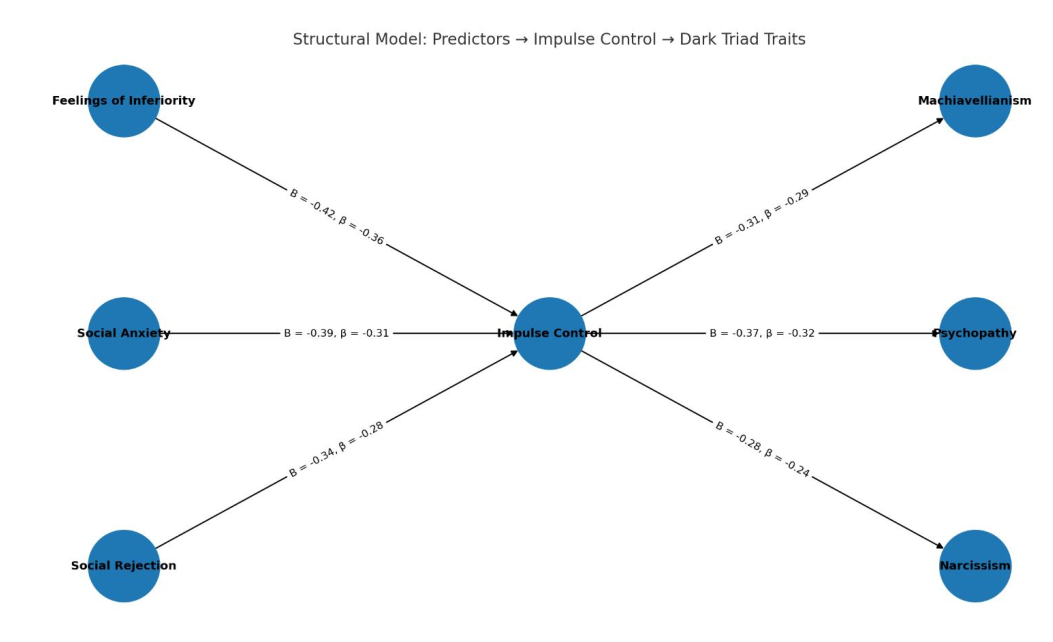
Findings: Results demonstrated that feelings of inferiority (B = –0.42, β = –.36, p = .001), social anxiety (B = –0.39, β = –.31, p = .001), and social rejection (B = –0.34, β = –.28, p = .002) significantly predicted lower impulse control. In turn, impulse control significantly predicted Machiavellianism (B = –0.31, β = –.29, p = .001), psychopathy (B = –0.37, β = –.32, p = .001), and narcissism (B = –0.28, β = –.24, p = .003). Indirect effects confirmed mediation, for example, the effect of feelings of inferiority on Machiavellianism (β = –.11, p = .004). Model fit indices indicated acceptable fit (χ²/df = 2.23, CFI = .95, RMSEA = .062).
Conclusion: Findings suggest that emotional vulnerabilities such as inferiority, anxiety, and rejection influence the development of Dark Triad traits primarily through impaired impulse control. These results emphasize the role of self-regulation as a protective factor and highlight the importance of preventive interventions targeting impulse control among vulnerable adolescents.
Downloads
References
Arvan, M. (2013). Bad News for Conservatives? Moral Judgments and the Dark Triad Personality Traits: A Correlational Study. Neuroethics, 6(2), 307-318. https://doi.org/10.1007/s12152-011-9140-6
Bradshaw, E. L., Conigrave, J. H., Steward, B. A., Ferber, K. A., Parker, P. D., & Ryan, R. M. (2023). A meta-analysis of the dark side of the American dream: Evidence for the universal wellness costs of prioritizing extrinsic over intrinsic goals. Journal of personality and social psychology, 124(4), 873.
Crysel, L. C., Crosier, B. S., & Webster, G. D. (2013). The Dark Triad and risk behavior. Personality and individual differences, 54(1), 35-40. https://doi.org/10.1016/j.paid.2012.07.029
Enayati, M., Khanzadeh, M., Raeisi, Z., & Dehghani, A. (2025). The mediating role of authoritative parenting style in predicting risky behaviors based on the dark triad of personality with the mediating of distress tolerance in adolescents. Journal of Psychological Science, 24(151), 223-244. http://dorl.net/dor/10.52547/JPS.24.151.223
Hartung, J., Bader, M., Moshagen, M., & Wilhelm, O. (2022). Age and gender differences in socially aversive ("dark") personality traits. European Journal of Personality, 36(1), 3-23. https://doi.org/10.1177/0890207020988435
He, Q., Wang, Y., Xing, Y., & Yu, Y. (2018). Dark personality, interpersonal rejection, and marital stability of Chinese couples: An actor–partner interdependence mediation model. Personality and individual differences, 134, 232-238. https://doi.org/10.1016/j.paid.2018.06.003
Jonason, P. K., & Sherman, R. A. (2020). Personality and the perception of situations: The Big Five and Dark Triad traits. Personality and individual differences, 163, 110081. https://doi.org/10.1016/j.paid.2020.110081
Jones, D. N. (2016). The nature of Machiavellianism: Distinct patterns of misbehavior. In The dark side of personality: Science and practice in social, personality, and clinical psychology. (pp. 87-107). American Psychological Association. https://doi.org/10.1037/14854-005
Jozi, H., Ramadanpour, F., & Begian Koulemarz, M. J. (2023). A structural model of attachment styles, the Dark Triad of personality, rejection sensitivity, and social media addiction with the mediating role of communication skills in students. Social Psychology Research, 12(48), 1-20. https://www.socialpsychology.ir/article_169380.html?lang=en
Kesebir, P. (2014). A quiet ego quiets death anxiety: Humility as an existential anxiety buffer. Journal of personality and social psychology, 106(4), 610-623. https://doi.org/10.1037/a0035814
Mahmodfakhe, H. (2022). Prediction of moral disengagement based on dark triad of personality and belief in a just world among the Marketers of Urmia city during Corona. Social Psychology Research, 12(47), 98-114. https://www.socialpsychology.ir
Nafisi, N., Vaziri, A., Ghorashi, G., & Nematzaheh, S. (2019). Type D Personality Elements (Negative Emotion and Social Inhibition) in Perception of Cancer Patients Disease. Thought and Behavior in Clinical Psychology, 13(52), 77-86. https://www.magiran.com/paper/2028151
Ramadanpour, F., Jozi, H., & Begian Kolemarzi, M. J. (2022). Structural model of attachment styles, dark triad of personality, rejection sensitivity with social media addiction with the mediation of communication skills in students. Social Psychology Research, 12(48), 1-20. https://www.socialpsychology.ir/article_169380.html?lang=en
Sadeghi, M. (2021a). The effect of the dark dimensions of personality on the behavior of bad-guy employees (research case: administrative employees of the Education and Training Organization of Chaharmahal and Bakhtiari Province) Master's thesis in the field of management of humanities and social sciences campus of Yazd University].
Sadeghi, M. (2021b). The impact of dark personality traits on the misbehavior of employees (Case study: Administrative staff of the Education Organization of Chaharmahal and Bakhtiari Province)
Turan, M. E., Adam, F., Kaya, A., & Yıldırım, M. (2023). The mediating role of the dark personality triad in the relationship between ostracism and social media addiction in adolescents. Education and Information Technologies, 1-17. https://doi.org/10.1007/s10639-023-12002-1
Turan, M. E., Adam, Firdevs, Kaya, Alican, Yıldırım, Murat. (2024). The mediating role of the dark personality triad in the relationship between ostracism and social media addiction in adolescents. Education and Information Technologies, 29(4), 3885-3901. https://doi.org/10.1007/s10639-023-12002-1
Wai, M., & Tiliopoulos, N. (2012). The affective and cognitive empathic nature of the dark triad of personality. Personality and individual differences, 52(7), 794-799. https://doi.org/10.1016/j.paid.2012.01.008
Zeigler-Hill, V. E., & Marcus, D. K. (2016). The dark side of personality: Science and practice in social, personality, and clinical psychology. American Psychological Association. https://doi.org/10.1037/14854-000
Downloads
Additional Files
Publication Timeline
- Submitted
- Revised
- Accepted
Issue
Section
License
Copyright (c) 2025 Aida Ebadpoor (Author); Maryam Nikooy (Corresponding Author); Parvaneh mohammadkhani (Author)

This work is licensed under a Creative Commons Attribution-NonCommercial 4.0 International License.