Social Support as a Mediator Between Cyberbullying Victimization and Psychological Distress in Adolescents
DOI:
https://doi.org/10.61838/kman.jayps.6.6.12Keywords:
Cyberbullying, Psychological Distress, Social Support, Adolescents, Structural Equation Modeling, IraqAbstract
Objective: This study aimed to investigate the mediating role of social support in the relationship between cyberbullying victimization and psychological distress among adolescents in Iraq.
Methods and Materials: A descriptive correlational research design was employed with a sample of 395 adolescents selected based on the Krejcie and Morgan sampling table. Participants were recruited from various high schools in Iraq using stratified random sampling. Standardized tools were utilized to measure cyberbullying victimization (Cyberbullying and Online Aggression Survey Instrument), social support (Multidimensional Scale of Perceived Social Support), and psychological distress (Kessler Psychological Distress Scale, K10). Data were analyzed using SPSS version 27 and AMOS version 21. Pearson correlation coefficients were computed to examine bivariate relationships, and Structural Equation Modeling (SEM) was performed to test the mediation model and model fit.
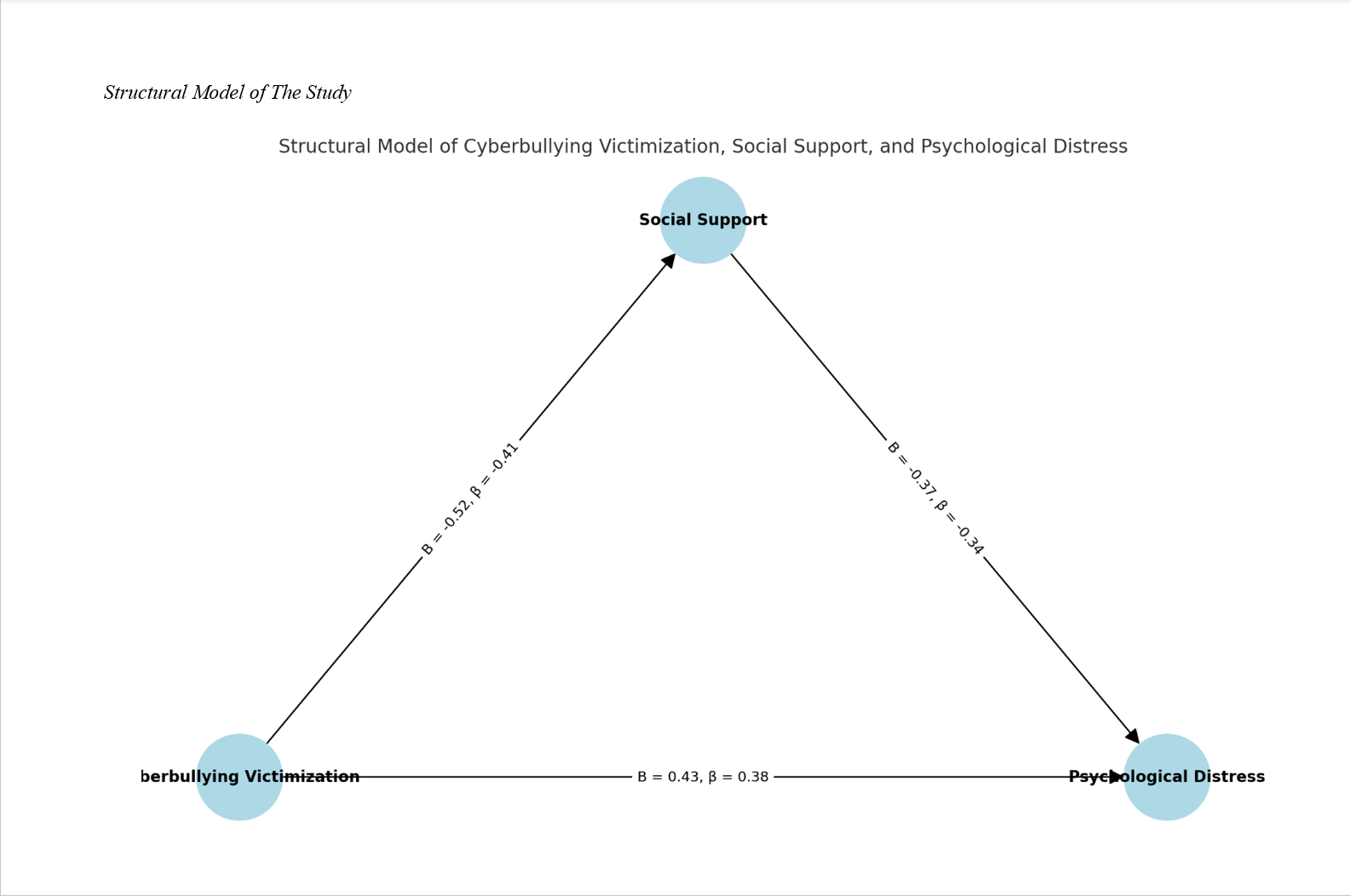
Findings: Results showed that cyberbullying victimization was positively associated with psychological distress (r = .53, p < .001), while social support was negatively associated with both cyberbullying (r = −.41, p < .001) and psychological distress (r = −.46, p < .001). The SEM analysis revealed good model fit (χ²/df = 2.08, CFI = 0.97, RMSEA = 0.052) and supported partial mediation. Cyberbullying had a significant direct effect on psychological distress (B = 0.43, β = 0.38, p < .001), while social support significantly mediated this relationship (indirect effect = −0.19, p < .001).
Conclusion: These findings underscore the critical role of perceived social support in mitigating the psychological consequences of cyberbullying victimization among adolescents. Promoting supportive social environments within families, peer groups, and schools may serve as a protective factor against mental health issues in digitally active youth populations.
Downloads
References
Adam, N. M., & Alwi, M. A. (2023). Hubungan Antara Harga Diri Dengan Perilaku Cyberbullying Pada Remaja. Jurnal Psikologi Talenta, 8(2), 47. https://doi.org/10.26858/talenta.v8i2.44841
Aledeh, M., Sokan–Adeaga, A. A., Adam, H., Aledeh, S., & Kotera, Y. (2024). Suggesting Self-Compassion Training in Schools to Stop Cyberbullying: A Narrative Review. Discover Psychology, 4(1). https://doi.org/10.1007/s44202-023-00110-5
Barlett, C. P. (2024). Social Learning of Cyberbullying Perpetration: The Interactive Role of Parent and Peer Cyberbullying and Cyberbullying Reinforcement in a Sample of U.S. Adolescents: A Brief Report. Technology Mind and Behavior, 5(2). https://doi.org/10.1037/tmb0000126
Chen, X., & Liu, X. (2024). Research on the Issue of Cyberbullying in the Cross-Cultural Communication of Adolescents in Social Media. Journal of Education Humanities and Social Sciences, 45, 411-417. https://doi.org/10.54097/kx41ha22
Ferrer, R., Ali, K., & Hughes, C. E. (2024). Using AI-Based Virtual Companions to Assist Adolescents With Autism in Recognizing and Addressing Cyberbullying. Sensors, 24(12), 3875. https://doi.org/10.3390/s24123875
Hidayati, L., & Kumalasari, A. S. (2021). Adolescents’ Involvement in Cyberbullying: The Importance of Peer Social Interaction. https://doi.org/10.2991/ahsr.k.210127.036
Hidayati, L., & Oktafianti, R. A. (2021). The Relationship Between Family’s Affective Functions and Cyberbullying in Adolescents. https://doi.org/10.2991/ahsr.k.210115.087
Hsieh, Y. C., Jain, P., Veluri, N., Bhela, J., Sheikh, B., Bangash, F., Gude, J., Subhedar, R., Zhang, M., Shah, M., Mansuri, Z., Patel, U., Aedma, K. K., & Parikh, T. (2021). Mood and Suicidality Among Cyberbullied Adolescents: A Cross-Sectional Study From Youth Risk Behavior Survey. Adolescents, 1(4), 412-420. https://doi.org/10.3390/adolescents1040031
Jung, Y.-H. (2023). A Study on ‘Media Helden’, an Adolescent Cyberbullying Prevention Program in Germany: Focusing on Empathy Improvement Program. Korean Soc Cult Converg, 45(7), 365-378. https://doi.org/10.33645/cnc.2023.07.45.07.365
Kim, D. H. (2022). A Study on the Perpetrators of Cyberbullying in Adults: Focusing on the Moderating Effect of Cyberbullying Awareness. The Korean Society of Private Security, 21(4), 1-31. https://doi.org/10.56603/jksps.2022.21.4.1
Kim, J. H., Song, H. Y., & Jung, G. H. (2023). Relationships Parental Positive Parenting and Cyberbullying Perpetration Among Adolescents: Role of Self-Esteem and Smartphone Addiction. https://doi.org/10.21203/rs.3.rs-3292745/v1
Lekatompessy, R., Dewi, N. S., & Andriany, M. (2022). Respons Psikologis Remaja Korban Cyberbullying: Studi Kasus Pada Remaja. Jurnal Surya Muda, 4(1), 16-26. https://doi.org/10.38102/jsm.v4i1.112
Liang, H., Jiang, H., Zhang, C., Zhou, H., Zhang, B., & Tuo, A. (2022). How Does Parent-Adolescent Conflict and Deviant Peer Affiliation Affect Cyberbullying: Examining the Roles of Moral Disengagement and Gender. Psychology research and behavior management, Volume 15, 2259-2269. https://doi.org/10.2147/prbm.s371254
Perwitasari, D. R., & Wuryaningsih, E. W. (2022). Why Did You Do That to Me?: A Systematic Review of Cyberbullying Impact on Mental Health and Suicide Among Adolescents. NurseLine Journal, 7(1), 35. https://doi.org/10.19184/nlj.v7i1.27311
Rachmania, N. O. N., Ahyani, L. N., & Pramono, R. B. (2021). The Difference in Aggression and Emotion Regulation on Adolescent Cyberbullying Perpetrators. Kne Social Sciences. https://doi.org/10.18502/kss.v5i7.9322
Rahmaputri, A. Y., Setiasih, S., & Kesumaningsari, N. P. A. (2022). Parental Psychological Control and Cyberbullying Tendency in Adolescents From the Perpetrator Side. Jurnal Ilmiah Psikologi Terapan, 10(2), 149-155. https://doi.org/10.22219/jipt.v10i2.21370
Ramadhani, S. P. D., & Prastyanti, R. A. (2024). Protection Against Cyberbullying for Teens in the United States. The Easta Journal Law and Human Rights, 2(03), 147-156. https://doi.org/10.58812/eslhr.v2i03.232
Santre, S. (2022). Cyberbullying in Adolescents: A Literature Review. International Journal of Adolescent Medicine and Health, 35(1), 1-7. https://doi.org/10.1515/ijamh-2021-0133
Wang, X., Qiao, Y., Li, W., & Dong, W. (2021). How Is Online Disinhibition Related to Adolescents’ Cyberbullying Perpetration? Empathy and Gender as Moderators. The Journal of Early Adolescence, 42(5), 704-732. https://doi.org/10.1177/02724316211064515
Wang, X., Wang, S., & Zeng, X. (2023). Does Deviant Peer Affiliation Accelerate Adolescents' Cyberbullying Perpetration? Roles of Moral Disengagement and Self‐control. Psychology in the Schools, 60(12), 5025-5040. https://doi.org/10.1002/pits.23037
Widijowati, R. D. (2023). An Effective Legal Implementation Against Cyberbullying Perpetrators Among Adolescents. Jurnal Pembaharuan Hukum, 10(3), 410. https://doi.org/10.26532/jph.v10i3.34351
Yang, J., Li, W., Dong, W., Gao, L., & Wang, X. (2023). The Moderating Roles of Peer Pressure and Family Economic Stress in the Longitudinal Links Between Adolescent Trait Anger and Cyberbullying Perpetration. School Psychology, 38(2), 79-87. https://doi.org/10.1037/spq0000514
Yurdakul, Y., & Ayhan, A. B. (2022). The Effect of the Cyberbullying Awareness Program on Adolescents’ Awareness of Cyberbullying and Their Coping Skills. Current Psychology, 42(28), 24208-24222. https://doi.org/10.1007/s12144-022-03483-3
Zhang, Y., Ding, M., & Zhou, P. (2024). The Last Straw: Exploring COVID‐19 Anxiety, Bullying Victimization, and Teacher Emotional Violence in Chinese Adolescents' Perpetrators Cyberbullying. Journal of Community & Applied Social Psychology, 34(4). https://doi.org/10.1002/casp.2828
Zhang, Y., Xu, C., Dai, H., & Jia, X. (2021). Psychological Distress and Adolescents’ Cyberbullying Under Floods and the COVID-19 Pandemic: Parent–Child Relationships and Negotiable Fate as Moderators. International journal of environmental research and public health, 18(23), 12279. https://doi.org/10.3390/ijerph182312279
Zhao, F., Zhang, H., Li, S., Wu, H., & Hou, J. (2024). Exploring the Relationship Between Paternal Co‐parenting Behaviors and Cyberbullying Perpetration in Chinese Adolescents: The Moderating Roles of Psychological Entitlement and Gender. Psychology in the Schools, 61(8), 3193-3211. https://doi.org/10.1002/pits.23210
Downloads
Additional Files
Publication Timeline
- Submitted
- Revised
- Accepted
Issue
Section
License

This work is licensed under a Creative Commons Attribution-NonCommercial 4.0 International License.