Personality, Attachment, and Help-Seeking as Predictors of Attitudes Toward AI in Psychotherapy
Keywords:
Artificial Intelligence, Help-Seeking Behavior, Object Attachment, Patient Acceptance of Health Care, Personality Disorders, PsychotherapyAbstract
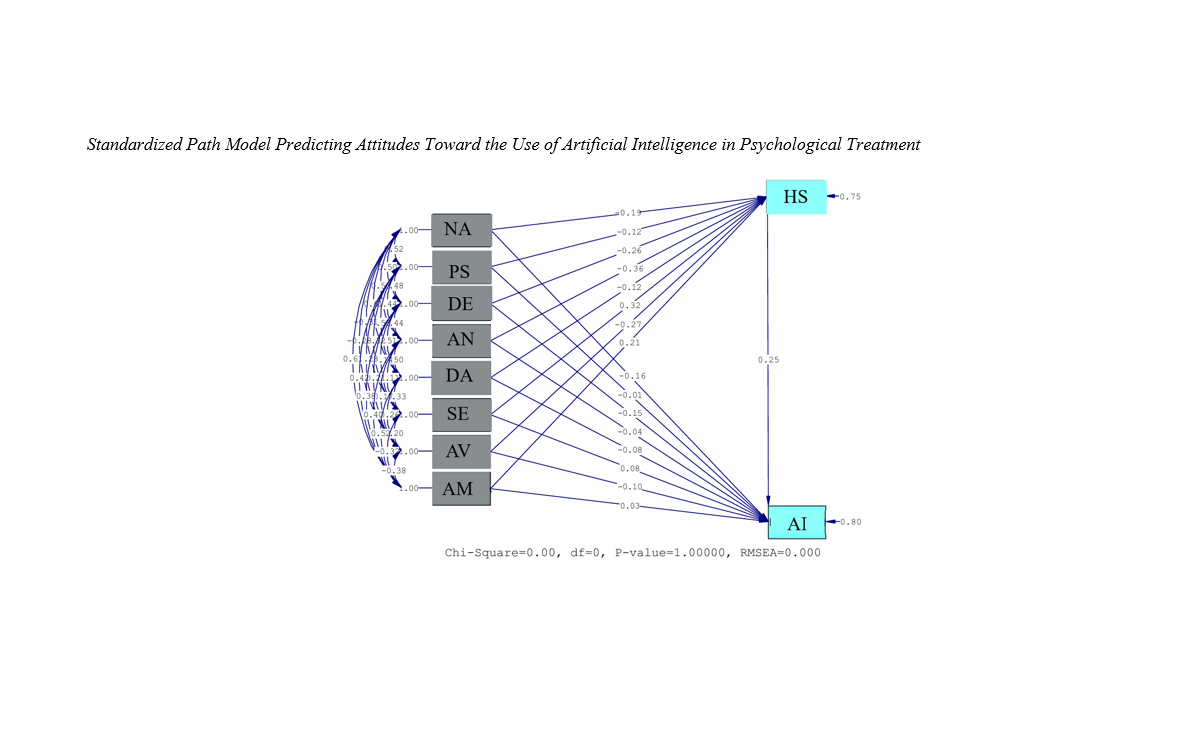
Objective: The present study aimed to predict attitudes toward the use of artificial intelligence in psychological treatment based on maladaptive personality traits and attachment styles, with the mediating role of attitudes toward professional psychological help-seeking.
Methods and Materials: This descriptive-correlational study employed a path modeling approach. The statistical population consisted of students from the Islamic Azad University, Science and Research Branch, aged 18 to 35, selected through convenience sampling. The research instruments included the Attitudes toward the Use of Artificial Intelligence in Therapy Scale, attachment styles and the short form of the Personality Inventory for DSM-5–Brief Form (PID-5-BF), and the Professional Psychological Help-Seeking Attitude Scale.
Findings: The results of the structural model analysis indicated that certain personality traits, such as negative affect, were significantly associated with attitudes toward the use of artificial intelligence. Additionally, complex and significant relationships between attachment styles and attitudes toward AI in therapy were revealed. Moreover, the mediating role of attitudes toward professional help-seeking revealed an interesting pattern in explaining these relationships.
Conclusion: The findings suggested that individuals’ psychological characteristics played a crucial role in shaping their attitudes toward emerging therapeutic technologies. These insights can guide future research aimed at designing interventions that are better suited to individuals’ psychological needs.
Downloads
References
Abbasi, M., & Beiranvand, K. (2020). Personality Traits (Extraversion and Neuroticism) as Moderators of the Association between Stigma and Psychological Help-Seeking amongst University Students. Clin Psychol Pers, 17(1), 79-88. https://doi.org/10.22070/cpap.2020.2886
Aktan, M. E., Turhan, Z., & Dolu, I. (2022). Attitudes and Perspectives towards the Preferences for Artificial Intelligence in Psychotherapy. Comput Human Behav, 133, 107273. https://doi.org/10.1016/j.chb.2022.107273
Albikawi, Z., Abuadas, M., & Rayani, A. M. (2025). Nursing Students’ Perceptions of AI-Driven Mental Health Support and Its Relationship with Anxiety, Depression, and Seeking Professional Psychological Help: Transitioning from Traditional Counseling to Digital Support. Healthcare (Basel), 13(9), 1089. https://doi.org/10.3390/healthcare13091089
Bayrami, A., & Yekita, B. (2024). Prioritization of Components of Attitude toward the Use of Artificial Intelligence in Psychological Treatments.
Benda, N., Desai, P., Reza, Z., Zheng, A., Kumar, S., & Harkins, S. (2024). Patient Perspectives on AI for Mental Health Care: Cross-Sectional Survey Study. JMIR Ment Health, 11, e58462. https://doi.org/10.2196/58462
Fiske, A., Henningsen, P., & Buyx, A. (2019). Your Robot Therapist Will See You Now: Ethical Implications of Embodied Artificial Intelligence in Psychiatry, Psychology, and Psychotherapy. J Med Internet Res, 21(5), e13216. https://doi.org/10.2196/13216
Gillath, O., Ai, T., Branicky, M. S., Keshmiri, S., Davison, R. B., & Spaulding, R. (2021). Attachment and Trust in Artificial Intelligence. Comput Human Behav, 115, 106607. https://doi.org/10.1016/j.chb.2020.106607
Hoffman, B. D., Oppert, M. L., & Owen, M. (2024). Understanding Young Adults’ Attitudes towards Using AI Chatbots for Psychotherapy: The Role of Self-Stigma. Comput Human Behav Artif Hum, 2(2), 100086. https://doi.org/10.1016/j.chbah.2024.100086
Joy, D., & Venkatachalam, J. (2024). Big-Five Personality Factors and Technology Acceptance among University Students. J Appl Sch Psychol, 5(2), 309-315.
Kaya, F., Aydin, F., Schepman, A., Rodway, P., Yetişensoy, O., & Demir Kaya, M. (2024). The Roles of Personality Traits, AI Anxiety, and Demographic Factors in Attitudes toward Artificial Intelligence. Int J Hum Comput Interact, 40(2), 497-514. https://doi.org/10.1080/10447318.2022.2151730
Knes, A. S., Carlisle, H., Thai, M. L., Jadidi, V., & Lowder, E. M. (2026). From Jury to Judge: Effects of Changing the Default Sentencing Agent on Sentence Length in Virginia. Journal of Criminal Justice, 104, 102652.
Kolhe, D. (2024). Exploring Attachment Styles in the Era of Digital Connectivity: A Narrative Review of Detox Behaviours. Int J Indian Psychol, 12(1). https://doi.org/10.25215/1201.072
Park, J., & Woo, S. E. (2022). Who Likes Artificial Intelligence? Personality Predictors of Attitudes toward Artificial Intelligence. J Psychol, 156(1), 68-94. https://doi.org/10.1080/00223980.2021.2012109
Sindermann, C., Yang, H., Elhai, J. D., Yang, S., Quan, L., & Li, M. (2022). Acceptance and Fear of Artificial Intelligence: Associations with Personality in a German and a Chinese Sample. Discov Psychol, 2(1), 8. https://doi.org/10.1007/s44202-022-00020-y
Stănescu, D. F., & Romașcanu, M. C. (2024). The Influence of AI Anxiety and Neuroticism in Attitudes toward Artificial Intelligence. Eur J Sustain Dev, 13(4), 191-201. https://doi.org/10.14207/ejsd.2024.v13n4p191
Stein, J. P., Messingschlager, T., Gnambs, T., Hutmacher, F., & Appel, M. (2024). Attitudes towards AI: Measurement and Associations with Personality. Sci Rep, 14(1), 2909. https://doi.org/10.1038/s41598-024-53335-2
Temple, S., Rowbottom, C., & Simpson, J. (2023). Patient Views on the Implementation of Artificial Intelligence in Radiotherapy. Radiography (Lond), 29(Suppl 1), S112-S116. https://doi.org/10.1016/j.radi.2023.03.006
Topchi, Y., Roshan Chesli, R., & Jan Bozorgi, M. (2023). Predicting the Strength of Myself and Its Features Based on Attachment Styles. Clin Psychol Pers, 21(2), 13-26. https://doi.org/10.22070/cpap.2023.407855.1250
Wu, X., Liew, K., & Dorahy, M. J. (2025). Trust, Anxious Attachment, and Conversational AI Adoption Intentions in Digital Counseling: A Preliminary Cross-Sectional Questionnaire Study. Jmir Ai, 4(1), e68960. https://doi.org/10.2196/68960
Xolmuxamatovich, Y. A., Ravshanovna, K. L., & Xasanovich, X. R. (2025). Digital Technologies in Modern Education and Their Functions.
Yang, F., & Oshio, A. (2025). Using Attachment Theory to Conceptualize and Measure the Experiences in Human-AI Relationships. Curr Psychol, 1(12).
Zabel, S., Pensini, P., & Otto, S. (2025). Unveiling the Role of Honesty-Humility in Shaping Attitudes towards Artificial Intelligence. Pers Individ Dif, 238, 113072. https://doi.org/10.1016/j.paid.2025.113072
Downloads
Additional Files
Publication Timeline
- Submitted
- Revised
- Accepted