LightGBM Prediction of Digital Self-Harm from Self-Criticism, Emotion Dysregulation, and Online Disinhibition
Keywords:
Digital self-harm, LightGBM, self-criticism, emotion dysregulation, online disinhibition, machine learning, ChileAbstract
Objective: This study aimed to predict digital self-harm severity among young adults in Chile using a LightGBM model based on self-criticism, emotion dysregulation, and online disinhibition.
Methods and Materials: The study used a cross-sectional, correlational, and predictive design. The statistical population consisted of young adults living in Chile who were active users of digital communication platforms. The final sample included 512 participants aged 18 to 29 years. Data were collected using a Digital Self-Harm Behavior Checklist, the Forms of Self-Criticizing/Attacking and Self-Reassuring Scale, the Difficulties in Emotion Regulation Scale, the Online Disinhibition Scale, and a demographic and digital behavior questionnaire. Data analysis included descriptive statistics, reliability assessment, Pearson correlation coefficients, and predictive modeling using Light Gradient Boosting Machine. The dataset was divided into training and test sets, and model performance was evaluated using cross-validation, root mean square error, mean absolute error, and coefficient of determination. SHAP values were used to interpret the relative contribution of predictors.
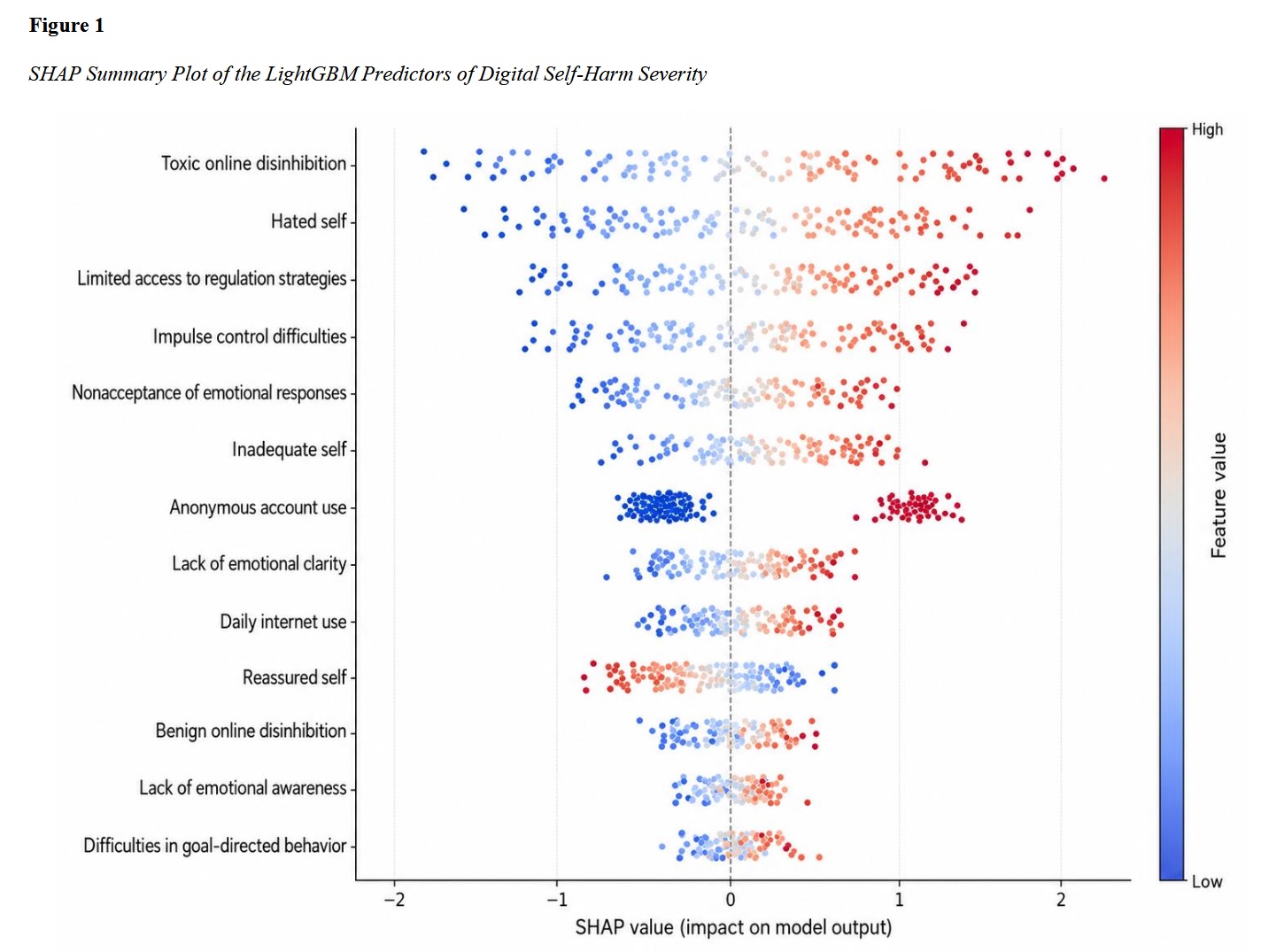
Findings: Digital self-harm was positively correlated with inadequate self (r = 0.43, p < 0.01), hated self (r = 0.57, p < 0.01), emotion dysregulation total score (r = 0.52, p < 0.01), benign online disinhibition (r = 0.21, p < 0.01), and toxic online disinhibition (r = 0.61, p < 0.01), and negatively correlated with reassured self (r = -0.32, p < 0.01). The LightGBM model showed the strongest predictive performance, with test RMSE = 3.96, MAE = 2.98, and R² = 0.59. SHAP analysis identified toxic online disinhibition, hated self, limited access to emotion regulation strategies, impulse control difficulties, and nonacceptance of emotional responses as the most important predictors of digital self-harm severity.
Conclusion: The findings indicate that digital self-harm is best understood as a multidimensional phenomenon shaped by hostile self-criticism, impaired emotion regulation, and toxic online disinhibition.
Downloads
References
Achab, S., Rothen, S., Giustiniani, J., Nicolier, M., Franc, E., Zullino, D., Mauny, F., & Haffen, É. (2022). Predictors of Gaming Disorder or Protective From It, in a French Sample: A Symptomatic Approach to Self-Regulation and Pursued Rewards, Providing Insights for Clinical Practice. International journal of environmental research and public health, 19(15), 9476. https://doi.org/10.3390/ijerph19159476
Agathokleous, G., & Taiwo, A. O. (2022). How Online Counselling Is Utilised, Evaluated, and Received. 251-277. https://doi.org/10.4018/978-1-7998-7991-6.ch011
Bant, L., Bogaerts, S., Howard, R., Mazzeschi, C., & Garofalo, C. (2025). The Quadripartite Violence Typology: Further Validation of the Angry Aggression Scale in a Dutch Community Sample. Psychology of violence, 15(6), 712-729. https://doi.org/10.1037/vio0000594
Booth, N., Derefaka, G., Khan, R., & Brewer, G. (2023). Cyber Intimate Partner Aggression in Adulthood: The Role of Insecure Attachment and Self-Control. Journal of Criminal Psychology, 13(4), 367-380. https://doi.org/10.1108/jcp-03-2023-0015
Carmichael, J., Ponsford, J., Gould, K. R., Forbes, M. K., Kotov, R., Fornito, A., & Spitz, G. (2023). A Transdiagnostic, Hierarchical Taxonomy of Psychopathology Following Traumatic Brain Injury (HiTOP-TBI). https://doi.org/10.31234/osf.io/vxtqk
Ding, J., Lin, Y., & Chen, I. H. (2025). Why Individuals With Trait Anger and Revenge Motivation Are More Likely to Engage in Cyberbullying Perpetration? The Online Disinhibition Effect. Frontiers in Public Health, 13. https://doi.org/10.3389/fpubh.2025.1496965
Gan, W., Chen, Z., Wu, Z., Huang, X., & Wang, F. (2024). Aggression in Online Gaming: The Role of Online Disinhibition, Social Dominance Orientation, Moral Disengagement and Gender Traits Among Chinese University Students. Frontiers in Public Health, 12. https://doi.org/10.3389/fpubh.2024.1459696
Giannakopoulos, G., & Prassou, A. (2025). Mediating and Moderating Mechanisms in the Relationship Between Social Media Use and Adolescent Aggression: A Scoping Review of Quantitative Evidence. European Journal of Investigation in Health Psychology and Education, 15(6), 98. https://doi.org/10.3390/ejihpe15060098
Hudon, A., Harvey, E., Nicolas, S., Dufour, M., Guérin-Thériault, C., Bérubé-Fortin, J., Combey, I., Yue, Y. C., Perreault, A., Pagé, S. B., & MacDermott, V. (2025). Cyberpsychopathy: A Multidimensional Framework for Understanding Psychopathic Traits in Digital Environments. European Journal of Investigation in Health Psychology and Education, 15(6), 107. https://doi.org/10.3390/ejihpe15060107
Lai, M. H. C. (2024). The Psychological Boomerang: Investigating the Mental Health Impacts of Spreading Anti-Lgbtq+ Misinformation and Hate Speech Online. Communications in Humanities Research, 63(1), 77-82. https://doi.org/10.54254/2753-7064/2024.17703
Lee, N. (2026). Understanding Bystander Responses to Virtual Sexual Assault: Predictors of Intervention and Self-Protection in Virtual Environments. International Journal of Police Science & Management, 28(2), 159-170. https://doi.org/10.1177/14613557261447745
Looi, J. C., Allison, S., & Bastiampillai, T. (2023). Remaining on Course, Online: Reflections and Recommendations on More Effective Psychiatrist Participation in Online Chat Forums in the Context of Social Media Dynamics. Australasian Psychiatry, 31(5), 652-655. https://doi.org/10.1177/10398562231186244
Maftei, A., Opariuc‐Dan, C., & Grigore, A.-N. (2023). Toxic Sensation Seeking? Psychological Distress, Cyberbullying, and the Moderating Effect of Online Disinhibition Among Adults. Scandinavian journal of psychology, 65(1), 61-69. https://doi.org/10.1111/sjop.12956
Mantara, A. Y., Sa’id, M., Zahra, G. A., Rizkina, A. T., & Febriyanti, L. (2023). Adaptation of the Online Disinhibition Effect Scale. Kne Social Sciences. https://doi.org/10.18502/kss.v8i19.14381
Mao, Y., & Hu, B. (2024). From Trolling Victimization to Reactive Trolling: Moderated Mediation Effects of Online Disinhibition and Motivations. Social Science Computer Review, 43(1), 27-47. https://doi.org/10.1177/08944393241250013
Morelli, M., Pazzagli, C., Sciabica, G. M., Chirumbolo, A., & Andreassi, S. (2025). The Association Between Pathological Personality Domains and Aggravated and Risky Sexting in a Sample of Emerging Adults. Scandinavian journal of psychology, 67(1), 147-157. https://doi.org/10.1111/sjop.70021
Nazari, A., Mafakheri, N., Shafiei, R., Nargesi, F., Sharp, C., & Komasi, S. (2025). Decoding Personality Functioning: The Impact of DSM-5 Pathological Traits Mediated by Emotion Dysregulation and Metacognition. Borderline personality disorder and emotion dysregulation, 12(1). https://doi.org/10.1186/s40479-025-00315-1
Nocera, T. R., Dahlen, E. R., Mohn, R. S., Leuty, M. E., & Batastini, A. B. (2022). Dark Personality Traits and Anger in Cyber Aggression Perpetration: Is Moral Disengagement to Blame? Psychology of Popular Media, 11(1), 24-34. https://doi.org/10.1037/ppm0000295
Pan, Y., Chen, G., Liu, Q., & Shi, Y. (2022). Research on the Governance Dilemma and Countermeasures of Cyber Violence. 1409-1421. https://doi.org/10.2991/978-2-494069-89-3_162
Ramadhani, A. Z., & Merida, S. C. (2024). Self-Control and the Phenomenon of Toxic Online Disinhibition in Teenagers Who Have Twitter. Nusantara Journal of Behavioral and Social Sciences, 3(2), 45-52. https://doi.org/10.47679/202454
Rehman, T. U. (2024). Workplace Cyberbullying: Nature, Characteristics, and Implications. Evaluation Review, 49(4), 625-654. https://doi.org/10.1177/0193841x241304293
Rose, L., Phillips, N. L., Lynam, D. R., Bauer, B. W., & Miller, J. D. (2025). Associations Between Psychopathy and Suicide: A Meta-Analytic Review. Personality Disorders Theory Research and Treatment, 16(6), 562-576. https://doi.org/10.1037/per0000743
Sánchez-Hernández, M. D., Herrera, M. C., & Expósito, F. (2024). Is Online Disinhibition Related to Cyberdating Abuse Perpetration Through Moral Disengagement? The Moderating Role of Gender, Sexism, and Cybervictimization. Sex Roles, 90(7), 938-959. https://doi.org/10.1007/s11199-024-01480-3
Scott, J. E., & Barlett, C. P. (2023). Understanding Cyber-Racism Perpetration Within the Broader Context of Cyberbullying Theory: A Theoretical Integration. Children, 10(7), 1156. https://doi.org/10.3390/children10071156
Sharma, M. K., Anand, N., Srivastava, K., & Sunil, S. (2021). Internet Regression and the Meaning of Self. Medico-Legal Journal, 89(2), 122-124. https://doi.org/10.1177/0025817220984014
Soares, F. B., Gruzd, A., Jacobson, J., & Hodson, J. (2023). To Troll or Not to Troll: Young Adults’ Anti-Social Behaviour on Social Media. PLoS One, 18(5), e0284374. https://doi.org/10.1371/journal.pone.0284374
Vale, M., & Matos, M. (2023). How Can Cyberhate Victimization and Perpetration Be Understood? , 130-150. https://doi.org/10.4018/979-8-3693-1528-6.ch008
Wang, L., & Ngai, S. S. (2021). Understanding the Effects of Personal Factors and Situational Factors for Adolescent Cyberbullying Perpetration: The Roles of Internal States and Parental Mediation. Journal of adolescence, 89(1), 28-40. https://doi.org/10.1016/j.adolescence.2021.03.006
Wanjiku, E. (2022). Revenge Pornography on the Internet. Communicare Journal for Communication Studies in Africa, 40(1), 151-170. https://doi.org/10.36615/jcsa.v40i1.1515
You, L. (2023). The Bystander Effect: Why Do Witnesses Refrain From Acting in Cyberbullying Cases? https://doi.org/10.31219/osf.io/zrqp6
Zhang, Q., Chen, Q., & Gu, X. (2024). Trolling, Cyberstalking, Body-Shaming, Slut-Shaming a Study on Online Abuses of Social Media. Communications in Humanities Research, 28(1), 232-241. https://doi.org/10.54254/2753-7064/28/20230304
Zhao, Z. (2023). The Causes and Measures of Online Deviance. Journal of Education Humanities and Social Sciences, 22, 415-420. https://doi.org/10.54097/ehss.v22i.12491
Zheng, G., Huang, J., Lan, J., & Wang, Y. (2025). Parenting in Context: A Systematic Review of Family Factors and Cyberbullying Perpetration Among Adolescents. Child & Family Social Work, 31(1), 420-446. https://doi.org/10.1111/cfs.13281
Downloads
Additional Files
Publication Timeline
- Submitted
- Revised
- Accepted