Social Media Doomscrolling and Anxiety: Psychological Resilience as a Moderator
DOI:
https://doi.org/10.61838/kman.jarac.4776Keywords:
doomscrolling, social media, anxiety, psychological resilience, Egypt, structural equation modelingAbstract
Objective: This study aimed to examine the relationship between social media doomscrolling and anxiety among Egyptian adults and to test whether psychological resilience moderates this association, potentially buffering individuals against the anxiety-provoking effects of doomscrolling.
Methods and Materials: A descriptive correlational design was used with a sample of 399 adult social media users recruited from diverse Egyptian online communities. Sample size was determined based on the Morgan and Krejcie table to ensure adequate statistical power. Data were collected using validated instruments: the Social Media Disorder Scale adapted for doomscrolling, the Generalized Anxiety Disorder Scale-7 (GAD-7) for anxiety, and the Connor–Davidson Resilience Scale (CD-RISC-25) for psychological resilience. Analyses were conducted using IBM SPSS 27 for descriptive and bivariate statistics and AMOS 21 for structural equation modeling (SEM). Model fit was evaluated using χ²/df, GFI, AGFI, CFI, TLI, and RMSEA indices.
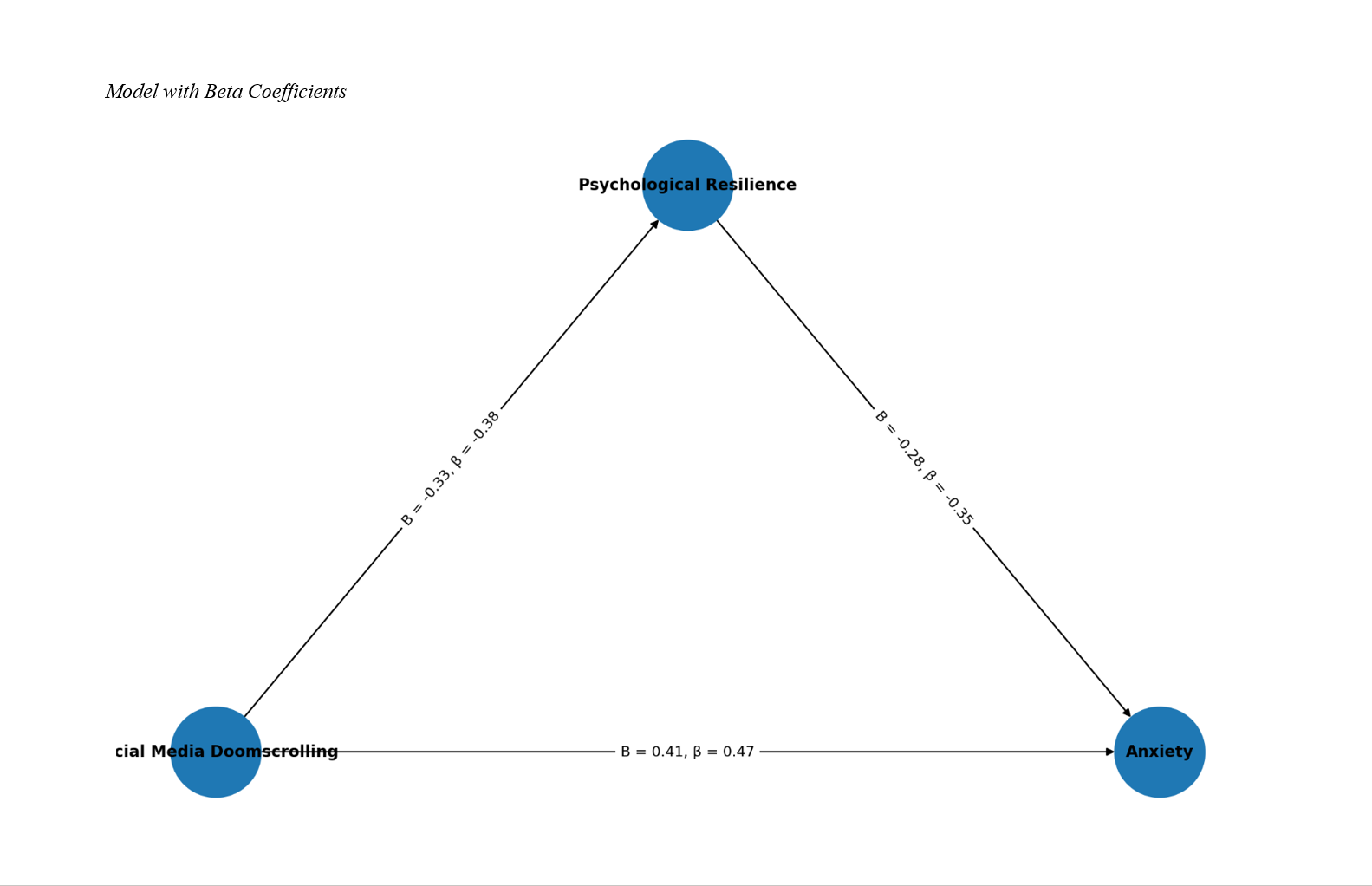
Findings: Results showed that doomscrolling was significantly and positively correlated with anxiety (r = .58, p < .001), while resilience was negatively associated with both doomscrolling (r = –.46, p < .001) and anxiety (r = –.52, p < .001). SEM demonstrated an excellent fit (χ²/df = 2.10, GFI = .93, CFI = .96, RMSEA = .053). Doomscrolling had a significant direct effect on anxiety (β = 0.47, p < .001) and a significant indirect effect via reduced resilience (β = –0.11, p < .001). Resilience strongly predicted lower anxiety (β = –0.35, p < .001) and significantly buffered the relationship between doomscrolling and anxiety.
Conclusion: Excessive exposure to negatively oriented social media content is associated with heightened anxiety, but psychological resilience serves as a protective factor, weakening this link.
Downloads
References
Abbouyi, S., Bouazza, S., Kinany, S. E., Rhazi, K. E., & Zarrouq, B. (2024). Depression and Anxiety and Its Association With Problematic Social Media Use in the MENA Region: A Systematic Review. The Egyptian Journal of Neurology Psychiatry and Neurosurgery, 60(1). https://doi.org/10.1186/s41983-024-00793-0
Alhomaidan, H. T., Alqossayir, F., Colle Mansour MathnaDepartment of, P., & Al-Mohaimeed, A. (2023). Reported Depression and Anxiety Symptoms Among Social Media Users in the General Population of Saudi Arabia: A Cross-Sectional Survey. American Journal of Health Behavior, 47(5), 1035-1044. https://doi.org/10.5993/ajhb.47.5.16
Alzamel, L. (2025). Stress, Social Anxiety, and Problematic Social Media Use: The Role of Coping Styles. Carleton Undergrad. J. Sci., 5(1). https://doi.org/10.22215/cujs.v5i1.5290
Brailovskaia, J., Krasavtseva, Y., Kochetkov, Y., Tour, P., & Margraf, J. (2022). Social Media Use, Mental Health, and Suicide-Related Outcomes in Russian Women: A Cross-Sectional Comparison Between Two Age Groups. Women S Health, 18. https://doi.org/10.1177/17455057221141292
Chen, Z., Tian, F., & Wang, C. (2023). Social Media Usage and Anxiety: An Overview of Intermediary Factors. Lecture Notes in Education Psychology and Public Media, 12(1), 263-269. https://doi.org/10.54254/2753-7048/12/20230826
Çınaroğlu, M., & Yılmazer, E. (2025). Problematic Social Media Use, Self-Objectification, and Body Image Disturbance: The Moderating Roles of Physical Activity and Diet Intensity. Psychology research and behavior management, Volume 18, 931-952. https://doi.org/10.2147/prbm.s517193
Cui, J., Wang, Y., Liu, D., & Yang, H. (2023). Depression and Stress Are Associated With Latent Profiles of Problematic Social Media Use Among College Students. Frontiers in Psychiatry, 14. https://doi.org/10.3389/fpsyt.2023.1306152
Dagher, M., Farchakh, Y., Barbar, S., Haddad, C., Akel, M., Hallit, S., & Obeïd, S. (2021). Association Between Problematic Social Media Use and Memory Performance in a Sample of Lebanese Adults: The Mediating Effect of Anxiety, Depression, Stress and Insomnia. Head & Face Medicine, 17(1). https://doi.org/10.1186/s13005-021-00260-8
Gong, Z., Lv, Y., Jiao, X., Liu, J., Sun, Y., & Qun-zhen, Q. U. (2022). The Relationship Between COVID-19-related Restrictions and Fear of Missing Out, Problematic Smartphone Use, and Mental Health in College Students: The Moderated Moderation Effect of Resilience and Social Support. Frontiers in Public Health, 10. https://doi.org/10.3389/fpubh.2022.986498
Gul, I., Amir, N., & Khan, A. (2022). Indeed Death Is Nearer; Moderating Role of Resilience in the Relationship Between Fear of COVID-19 and Death Anxiety. American Journal of Psychology, 4(1), 38-52. https://doi.org/10.47672/ajp.1185
Hao, Z., Jin, L., Huang, J., Lyu, R., & Cui, Q. (2021). Academic Burnout and Problematic Smartphone Use During the COVID-19 Pandemic: The Effects of Anxiety and Resilience. Frontiers in Psychiatry, 12. https://doi.org/10.3389/fpsyt.2021.725740
Ji, F., Sun, Q., Han, W., Li, Y., & Xia, X. (2024). How Physical Exercise Reduces Problematic Mobile Phone Use in Adolescents: The Roles of Expression Suppression, Depression, Anxiety, and Resilience. Psychology research and behavior management, Volume 17, 4369-4382. https://doi.org/10.2147/prbm.s484089
Jiang, Y. (2021). Problematic Social Media Usage and Anxiety Among University Students During the COVID-19 Pandemic: The Mediating Role of Psychological Capital and the Moderating Role of Academic Burnout. Frontiers in psychology, 12. https://doi.org/10.3389/fpsyg.2021.612007
Jolliff, A., D’Angelo, J., Jenkins, M. C., & Moreno, M. A. (2021). The Mediating Role of Anxiety Symptoms in the Link Between Chronic Illness and Problematic Social Media Use in Young Adults: A Cross-Sectional Study (Preprint). https://doi.org/10.2196/preprints.27143
Luo, X. (2023). Effects of Social Anxiety and Subjective Well-Being on Problematic Mobile Social Media Use in First-Year University Students: The Mediating Role of Self-Esteem. Psychological Reports, 128(4), 2463-2483. https://doi.org/10.1177/00332941231190326
Martínez-Monteagudo, M. C., Delgado, B., Aparisi, D., Torrecillas, M., & Navarro, I. (2025). La Ansiedad, Depresión Y Estrés Como Factores Explicativos Del Uso Problemático De Las Redes Sociales en Estudiantes De Educación Secundaria. International Journal of Developmental and Educational Psychology Revista Infad De Psicología, 1(1), 645-654. https://doi.org/10.17060/ijodaep.2025.n1.v1.2857
ÖZok, H. İ., Kaya, A., Dinçer, R. E., & Yıldırım, M. (2025). Associations Between Social Appearance Anxiety, Problematic Social Media Use, Selfitis Behavior, and Adaptable Self: A Moderated-Mediation Model. Psihologija(00), 14-14. https://doi.org/10.2298/psi231025014o
Schmelzer, N., Westphal, T., Pichardo, A., Buckner, D., Smith, N., Shaaban, N., Johnson, M., Bennett, J., & Estep, J. (2022). The Relationship Between Problematic Social Media Use and Time Spent on Social Media: Exploring Neuroticism as a Moderator. PBRJ, 2(1), 29-35. https://doi.org/10.54581/jwjb5363
Shannon, H., Bush, K., Shvetz, C., Paquin, V., Morency, J., Hellemans, K. G. C., & Guimond, S. (2024). Longitudinal Problematic Social Media Use in Students and Its Association With Negative Mental Health Outcomes. Psychology research and behavior management, Volume 17, 1551-1560. https://doi.org/10.2147/prbm.s450217
Shannon, H., Bush, K., Villeneuve, P. J., Hellemans, K. G. C., & Guimond, S. (2021). Problematic Social Media Use in Adolescents and Young Adults: Systematic Review and Meta-Analysis (Preprint). https://doi.org/10.2196/preprints.33450
Shannon, H., Bush, K., Villeneuve, P. J., Hellemans, K. G. C., & Guimond, S. (2022). Problematic Social Media Use in Adolescents and Young Adults: Systematic Review and Meta-Analysis. Jmir Mental Health, 9(4), e33450. https://doi.org/10.2196/33450
Singh, S., & Kaurav, R. P. S. (2022). Is Fear of COVID-19 Leading to Future Career Anxiety and Turnover Intentions? Problematic Social Media Use and Confidence in the Vaccine as a Mediator. Vision the Journal of Business Perspective. https://doi.org/10.1177/09722629221130831
Song, Y., Zhang, G., Liu, N., Zhang, Y., Zhai, J.-h., Niu, X., & Liu, Y. (2024). Influence of Physical Activity on Problematic Smartphone Use in Medical Students: Mediating Effects of Social Anxiety and the Moderating Role of Gender. Frontiers in psychology, 15. https://doi.org/10.3389/fpsyg.2024.1445847
Srivastava, S., Rishi, B., & Belwal, R. (2024). Linking Fear of Missing Out and Psychological Well-Being: A Multi-Country Study. Journal of Consumer Marketing, 41(4), 391-405. https://doi.org/10.1108/jcm-02-2023-5837
Tosun, H. (2025). Problematic Social Media Use and Its Relationship With Breastfeeding Behaviors and Anxiety in Social Media-Native Mothers: A Mixed-Methods Study. Healthcare, 13(17), 2216. https://doi.org/10.3390/healthcare13172216
Wallinheimo, A.-S. (2025). Mechanisms That Link Circadian Preference to Problematic Smartphone and Social Media Use in Young Adults. PLoS One, 20(9), e0331961. https://doi.org/10.1371/journal.pone.0331961
Weng, C. A., Bulgin, J., Diaz, S., Zhang, J. F., Tan, R., Li, L., & Armstrong-Hough, M. (2024). Communication Attributes Modify the Anxiety Risk Associated With Social Media Addiction: A Prospective Diary Method Study (Preprint). https://doi.org/10.2196/preprints.64850
Yaqoob, A., Hafeez, R., Khan, R. N., & Khan, M. A. (2025). Navigating the Digital Self: Social Media Addiction and Its Effect on Social Comparison and Internalizing Symptoms. SocSciSpec, 4(3), 197-215. https://doi.org/10.71085/sss.04.03.329
Μangoulia, P., Katsiroumpa, A., Katsiroumpa, Z., Koukia, E., Gallos, P., Moisoglou, I., & Galanis, P. (2025). A Link Between Problematic Social Media Use and Mental Health in Greece: Sex and Generation Differences. https://doi.org/10.20944/preprints202508.0319.v1
Downloads
Additional Files
Publication Timeline
- Submitted
- Revised
- Accepted