Mechanisms of Self-Concept Coherence in Late Adolescence Under Academic Pressure
DOI:
https://doi.org/10.61838/kman.jarac.4632Keywords:
self-concept coherence, academic stress, adolescence, resilience, qualitative study, BrazilAbstract
Objective: This study aimed to explore and conceptualize the psychological and contextual mechanisms through which late adolescents maintain a coherent self-concept while navigating intense academic demands in the Brazilian educational context.
Methods and Materials: A qualitative research design was employed using semi-structured, in-depth interviews with 18 late adolescents (10 females and 8 males, aged 17–21) from Brazil who were experiencing significant academic pressure. Participants were recruited through purposive sampling to ensure diversity in gender, academic stage, and performance levels. Data collection continued until theoretical saturation was reached. All interviews were conducted in Portuguese, lasted between 60 and 90 minutes, and were audio-recorded and transcribed verbatim. Thematic analysis was applied with support from NVivo software version 14, following iterative coding, category refinement, and constant comparison to ensure depth and consistency. Credibility was enhanced through peer debriefing and member checking.
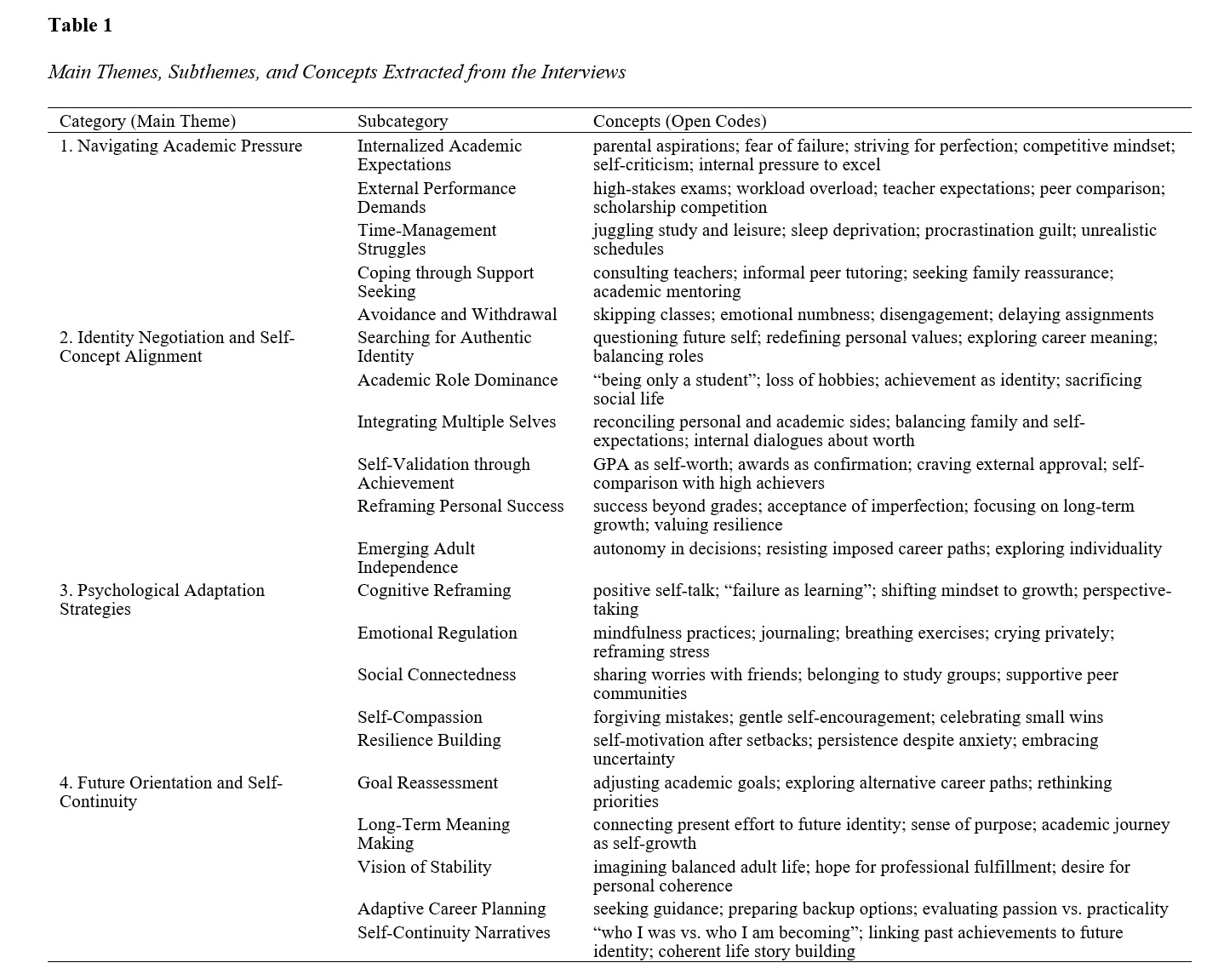
Findings: Four overarching thematic categories were identified: navigating academic pressure, identity negotiation and self-concept alignment, psychological adaptation strategies, and future orientation with self-continuity. Adolescents reported internalizing family and cultural expectations while simultaneously striving for authenticity, often reframing success to protect identity stability. Cognitive reframing, emotional regulation, and self-compassion emerged as key strategies to mitigate stress and preserve self-concept clarity. Social support from peers and family played a dual role, sometimes buffering stress but occasionally intensifying pressure. Future-oriented thinking, including goal reappraisal and constructing life narratives linking past, present, and envisioned adult selves, contributed to resilience and a coherent sense of self despite academic adversity.
Conclusion: Maintaining self-concept coherence in late adolescence is a dynamic, context-sensitive process involving adaptive psychological strategies and relational negotiation. These insights provide a foundation for designing culturally responsive educational and mental health interventions to help adolescents sustain identity stability under academic stress.
Downloads
References
Astuti, K., & Waseso, A. P. (2023). Smoking in Adolescents: The Effect of Academic Stress and Smoking Self-Efficacy. Insight Jurnal Ilmiah Psikologi, 25(2), 120-130. https://doi.org/10.26486/psikologi.v25i2.3530
Buritica, J. M. R., Berboth, S., Hoferichter, F., & Raufelder, D. (2024). Neural and Behavioural Correlates of Adolescents Changing Academic Self‐concept. British Journal of Educational Psychology, 95(2), 234-248. https://doi.org/10.1111/bjep.12667
Cruijsen, R. v. d., Begeer, S., & Crone, E. A. (2024). The Role of Autism and Alexithymia Traits in Behavioral and Neural Indicators of Self-Concept and Self-Esteem in Adolescence. Autism, 28(9), 2346-2361. https://doi.org/10.1177/13623613241232860
Cruijsen, R. v. d., Blankenstein, N. E., Spaans, J., Peters, S., & Crone, E. A. (2023). Longitudinal Self-Concept Development in Adolescence. Social Cognitive and Affective Neuroscience, 18(1). https://doi.org/10.1093/scan/nsac062
Högberg, B. (2024). Education Systems and Academic Stress—A Comparative Perspective. British Educational Research Journal, 50(3), 1002-1021. https://doi.org/10.1002/berj.3964
Hur, Y. J. (2023). The Influence of Other’s Emotional Perception Competencies of Teenager on Academic Helplessness Mediated by Academic Achievement Self-Concept: Based on Influenced by Parents’ Emotional Perception Competencies and Achievement Evaluation. The Korea Association for Care Competency Education, 8(2), 179-198. https://doi.org/10.52616/jccer.2023.8.2.179
Jin, G., Wang, Q., Lei, J., Chen, Y., & Liu, S. (2024). The Relationship Between Effort–Reward Imbalance and Learning Engagement: The Chain‐Mediating Role of Academic Self‐Concept and Academic Burnout. Psychology in the Schools, 62(3), 899-907. https://doi.org/10.1002/pits.23363
kang, m.-g., & Kim, S. (2025). Effects of Adolescent Grit, Parental Supervision, and Academic Stress on Self-Regulated Learning. K Assoc Edu Res, 10(2), 741-754. https://doi.org/10.48033/jss.10.2.36
Kim, E. J., & Kim, Y. J. (2024). Effect of Academic Stress on Depression in Adolescents: Mediating Effect of Self-Esteem and Moderated Mediating Effect of Parental Monitoring. Asia-pacific Journal of Convergent Research Interchange, 10(3), 359-370. https://doi.org/10.47116/apjcri.2024.03.25
Kim, J. A., Choi, J. I., Lee, S. J., & Jeong, E. J. (2025). The Influence of Negative Emotions on Adolescents' Pathological Gaming: The Role of Self-Control in the Associations With Aggression, Academic Stress, and Pathological Gaming. Frontiers in psychology, 16. https://doi.org/10.3389/fpsyg.2025.1539162
Kwon, S., & Shin, S. (2023). Analyzing the Structural Relationships Between Stress Factors and Stress, Health Perceptions, and Life Satisfaction in Multicultural Adolescents. Korean Soc Cult Converg, 45(12), 501-515. https://doi.org/10.33645/cnc.2023.12.45.12.501
Leng, H., Xiang, X., & Li, S. (2025). The Chain Mediation Effects of General Self-Efficacy and Psychological Resilience Between Physical Activity and Academic Stress Among Chinese Adolescents. Frontiers in psychology, 16. https://doi.org/10.3389/fpsyg.2025.1626157
Liu, F., Li, H. C., Sun, H.-M., Wang, P., & Qin, M. (2025). Adolescents’ Academic Achievement and Meaning in Life: The Role of Self-Concept Clarity. Frontiers in psychology, 16. https://doi.org/10.3389/fpsyg.2025.1596061
Mistry, S., Mukherjee, S., & Adhikari, S. (2023). Effect of Self-Concept and Academic Life Satisfaction on Achievement Motivation of School-Going Adolescents. Kuey. https://doi.org/10.53555/kuey.v29i4.7348
Núñez‐Regueiro, F., Jamain, L., Laurent-Chevalier, M., & Nakhili, N. (2022). School Engagement in Times of Confinement: A Stress Process Approach. Journal of youth and adolescence, 51(7), 1257-1272. https://doi.org/10.1007/s10964-022-01621-5
Oh, S. (2024). Unintentional Nonsuicidal Self-Injury in an Adolescent With Perfectionism. Precision and Future Medicine, 8(3), 112-115. https://doi.org/10.23838/pfm.2024.00114
Pontes, A., Coelho, V., Peixoto, C., Meira, L., & Azevedo, H. (2024). Academic Stress and Anxiety Among Portuguese Students: The Role of Perceived Social Support and Self-Management. Education Sciences, 14(2), 119. https://doi.org/10.3390/educsci14020119
Saini, J., & Devi, M. (2022). Study of Academic Stress and Academic Achievement Among Rural Adolesecents Learners During Online Teaching in Covid – 19 Times. Scholarly Research Journal for Humanity Science & English Language, 10(52). https://doi.org/10.21922/srjhsel.v10i52.11512
Shalu, S. S., Mathew, E. M., Preethi, P., Reshma, R., Mallikarjun, M., Nitin, N., Jat, M. C., & Natekar, D. S. (2025). A Correlational Study to Assess the Academic Stress and Self Esteem Among School Going Adolescents in Bagalkot. Scholars Journal of Applied Medical Sciences, 13(02), 483-487. https://doi.org/10.36347/sjams.2025.v13i02.032
Shikari, N. (2025). A Probe Into the Effect of Self-Concept on the Development of Academic Motivation of the School-Going Adolescents of Nadia District. International Journal of Research and Innovation in Social Science, IX(XVII), 585-599. https://doi.org/10.47772/ijriss.2025.917psy0053
Wang, Z., Li, C., Xie, Z., & Hong, O. T. (2024). Grit Difference in the Association Between Academic Stress and Adolescents' Meaning in Life: The Roles of School Burnout and Self‐Compassion. Child Care Health and Development, 50(6). https://doi.org/10.1111/cch.70005
Xing, H., Zhang, Y., Yao, M., Zhu, W., & Liu, H. (2024). How Perceived Parenting Qualities Link to the Reciprocal Relationship Between Adolescents’ Self-Concept and Life Satisfaction. Journal of Social and Personal Relationships, 41(11), 3480-3502. https://doi.org/10.1177/02654075241268780
Downloads
Additional Files
Publication Timeline
- Submitted
- Revised
- Accepted