Mechanisms of Rumination Deactivation: An Interpretive Phenomenological Study in Young Adults with Anxiety
DOI:
https://doi.org/10.61838/kman.jarac.7.3.25Keywords:
Rumination, Anxiety, Young adults, Interpretive phenomenological analysis, Emotional regulation, Cognitive flexibility, Coping mechanismsAbstract
Objective: This study aimed to explore the lived experiences and underlying psychological and contextual mechanisms by which young adults with anxiety naturally deactivate rumination.
Methods and Materials: A qualitative research design based on interpretive phenomenological analysis (IPA) was employed to gain an in-depth understanding of participants’ experiences. The study involved 21 Indonesian young adults (aged 18–30) who self-identified as experiencing recurrent anxiety and ruminative thought patterns. Participants were recruited through purposeful sampling from mental health support networks and university counseling centers. Data were collected through in-depth semi-structured interviews conducted in Bahasa Indonesia and analyzed using NVivo 14 software. Interviews continued until theoretical saturation was reached. Analysis followed iterative coding, theme development, and integration processes, with peer debriefing and member checking to ensure credibility and confirmability.
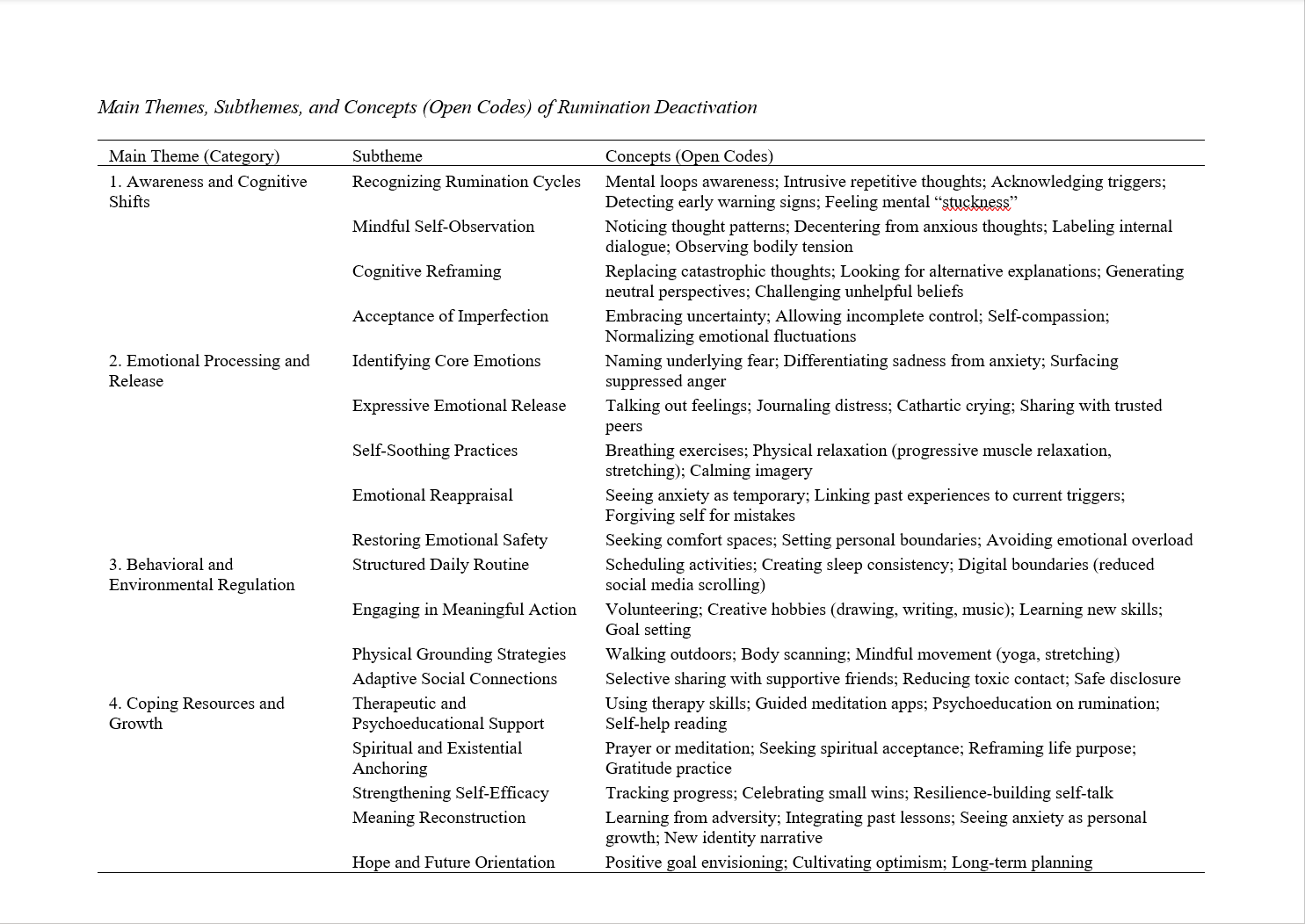
Findings: Four overarching themes emerged: (1) awareness and cognitive shifts, including recognition of mental loops, decentering, cognitive reframing, and acceptance of imperfection; (2) emotional processing and release, such as naming core emotions, expressive disclosure, self-soothing practices, and emotional reappraisal; (3) behavioral and environmental regulation, encompassing structured routines, purposeful engagement, digital boundaries, and adaptive social connection; and (4) coping resources and growth, involving self-directed use of therapy-informed tools, spirituality and existential meaning-making, strengthening self-efficacy, and future-oriented hope. These mechanisms revealed a layered, dynamic process of disengaging from repetitive negative thinking in everyday contexts.
Conclusion: Rumination deactivation among young adults with anxiety involves a synergistic interplay of metacognitive awareness, emotional regulation, behavioral structuring, and personal growth resources. Understanding these naturalistic strategies can inform culturally sensitive interventions, prevention programs, and self-help tools to support mental well-being in emerging adulthood.
Downloads
References
Altena, E., Ellis, J., Camart, N., Guichard, K., & Bastien, C. (2023). Mechanisms of Cognitive Behavioural Therapy for Insomnia. Journal of Sleep Research, 32(6). https://doi.org/10.1111/jsr.13860
Birditt, K. S., Newton, N. J., Turkelson, A., Polenick, C. A., Zhou, Z., & Fingerman, K. L. (2024). Daily Rumination Among Older Men and Women: The Role of Perceived Family and Nonfamily Social Partner Life Stress. The Journals of Gerontology Series B, 79(5). https://doi.org/10.1093/geronb/gbae027
Carlson, S. A., & Williams, P. (2024). 0107 Bedtime Procrastination Mediates the Association Between Repetitive Negative Thoughts and Insomnia Symptoms. Sleep, 47(Supplement_1), A47-A48. https://doi.org/10.1093/sleep/zsae067.0107
Eckland, N. S., Sperry, S. H., Castro, A. A., & Berenbaum, H. (2022). Intensity, Frequency, and Differentiation of Discrete Emotion Categories in Daily Life and Their Associations With Depression, Worry, and Rumination. Emotion, 22(2), 305-317. https://doi.org/10.1037/emo0001038
Edge, D., Newbold, A., Ehring, T., Rosenkranz, T., Frost, M., & Watkins, E. (2021). Reducing Worry and Rumination in Young Adults via a Mobile Phone App: Study Protocol of the ECoWeB (Emotional Competence for Well-Being in Young Adults) Randomised Controlled Trial Focused on Repetitive Negative Thinking. BMC psychiatry, 21(1). https://doi.org/10.1186/s12888-021-03536-0
Edge, D., Watkins, E., Newbold, A., Ehring, T., Frost, M., & Rosenkranz, T. (2023). Evaluating the Effects of a Self-Help Mobile Phone App on Worry and Rumination Experienced by Young Adults: Randomized Controlled Trial (Preprint). https://doi.org/10.2196/preprints.51932
Edge, D., Watkins, E., Newbold, A., Ehring, T., Frost, M., & Rosenkranz, T. (2024). Evaluating the Effects of a Self-Help Mobile Phone App on Worry and Rumination Experienced by Young Adults: Randomized Controlled Trial. Jmir Mhealth and Uhealth, 12, e51932. https://doi.org/10.2196/51932
Eisma, M. C., Lang, T. A. d., & Boelen, P. A. (2020). How Thinking Hurts: Rumination, Worry, and Avoidance Processes in Adjustment to Bereavement. Clinical Psychology & Psychotherapy, 27(4), 548-558. https://doi.org/10.1002/cpp.2440
Glenn, T., Smith, C., Miller, V. A., Wolfe, J., Blume, E. D., Lumeng, J. C., Schumacher, K. R., & Cousino, M. K. (2024). From Worries to Resilience: A Qualitative Study of the Psychosocial Experiences of Diverse Adolescents and Young Adults With Heart Failure and Their Caregivers. Cardiology in the Young, 35(1), 136-143. https://doi.org/10.1017/s1047951124026660
González-Palau, F., María de la Paz Scribano, P., Veas, B. L. A., & Medrano, L. A. (2024). Mindfulness Program for Cognitive Errors of Workers: Role of Consciousness, Worry and Rumination. Revista Neurociências, 32, 1-19. https://doi.org/10.34024/rnc.2024.v32.19065
Hawley, L. L., Lisi, D., Richter, M. A., Selchen, S., & Rector, N. A. (2024). The Relationship of Rumination, Worry and OCD Symptoms During Technology Supported Mindfulness Therapy for OCD. Clinical Psychology & Psychotherapy, 31(4). https://doi.org/10.1002/cpp.3018
Hirsch, C. R., Krahé, C., Whyte, J., Bridge, L., Loizou, S., Norton, S., & Mathews, A. (2020). Effects of Modifying Interpretation Bias on Transdiagnostic Repetitive Negative Thinking. Journal of consulting and clinical psychology, 88(3), 226-239. https://doi.org/10.1037/ccp0000455
Jansen, P., Hoja, S., & Meneghetti, C. (2021). Does Repetitive Thinking Mediate the Relationship Between Self-Compassion and Competition Anxiety in Athletes? Cogent Psychology, 8(1). https://doi.org/10.1080/23311908.2021.1909243
Joubert, A. E., Moulds, M. L., Werner‐Seidler, A., Sharrock, M. J., Popović, B., & Newby, J. M. (2022). Understanding the Experience of Rumination and Worry: A Descriptive Qualitative Survey Study. British Journal of Clinical Psychology, 61(4), 929-946. https://doi.org/10.1111/bjc.12367
Lau, P. (2023). Self-Focused Rumination as a Potential Cognitive Risk Factor in Stress-Related Disturbed Sleep. https://doi.org/10.32920/24194712
Li, A., Nie, Y., Chi, M., Wang, N., Ji, S., Zhu, Z., Li, S., & Hou, Y. (2024). The Content and Nature of Rumination in Chinese Young and Middle-Aged Patients With Acute Coronary Syndrome: A Qualitative Study. https://doi.org/10.20944/preprints202407.0126.v1
Mansueto, G., Cavallo, C., Palmieri, S., Ruggiero, G. M., Sassaroli, S., & Caselli, G. (2021). Adverse Childhood Experiences and Repetitive Negative Thinking in Adulthood: A Systematic Review. Clinical Psychology & Psychotherapy, 28(3), 557-568. https://doi.org/10.1002/cpp.2590
Misaki, M., Tsuchiyagaito, A., Guinjoan, S. M., & Paulus, M. P. (2024). Aging Increases the Distinctiveness of Emotional Brain States Across Rumination, Worry, and Positive Thinking. https://doi.org/10.1101/2024.10.29.620853
Mizuno, A., Karim, H. T., Newmark, J., Khan, F. R., Rosenblatt, M. J., Neppach, A. M., Lowe, M., Aizenstein, H., Mennin, D. S., & Andreescu, C. (2022). Thinking of Me or Thinking of You? Behavioral Correlates of Self vs. Other Centered Worry and Reappraisal in Late-Life. Frontiers in Psychiatry, 13. https://doi.org/10.3389/fpsyt.2022.780745
Morse, R. M., Koutsoubelis, F., Whitfield, T., Demnitz‐King, H., Ourry, V., Stott, J., Chocat, A., Devouge, E. F., Walker, Z., Klimecki, O., Collette, F., Chételat, G., Gonneaud, J., Poisnel, G., & Marchant, N. L. (2024). Worry and Ruminative Brooding: Associations With Cognitive and Physical Health in Older Adults. Frontiers in psychology, 15. https://doi.org/10.3389/fpsyg.2024.1332398
O’Connor, D. B., Wilding, S., Ferguson, E., Cleare, S., Wetherall, K., McClelland, H., Melson, A. J., Niedzwiedz, C. L., O’Carroll, R. E., Platt, S., Scowcroft, E., Watson, B., Zortea, T. C., Robb, K. A., & Connor, R. O. (2021). Effects of COVID-19-related Worry and Rumination on Mental Health and Loneliness During the Pandemic: Longitudinal Analyses of Adults in the UK COVID-19 Mental Health &Amp;amp; Wellbeing Study. https://doi.org/10.31234/osf.io/r8cdw
Puccetti, N. A., Stamatis, C. A., Timpano, K. R., & Heller, A. S. (2024). Worry and Rumination Elicit Similar Neural Representations: Neuroimaging Evidence for Repetitive Negative Thinking. Cognitive Affective & Behavioral Neuroscience, 25(2), 488-500. https://doi.org/10.3758/s13415-024-01239-z
Shahmoradi, M., & Mostafavi, S. (2022). Effectiveness of Rumination-Focused Cognitive Behavioral Therapy on Cognitive Functions in Adults With High Levels of Rumination. https://doi.org/10.31234/osf.io/p3bcn
Wu, Q., He, J., Chi, P., Lin, X., & Chen, C. (2025). Longitudinal Associations of Childhood Emotional Maltreatment With Disordered Eating Behaviors: Linking Mechanisms of Repetitive Negative Thinking And Body Dissatisfaction. International Journal of Eating Disorders. https://doi.org/10.1002/eat.24492
Yun, R. C., Fardghassemi, S., & Joffé, H. (2022). Thinking Too Much: How Young People Experience Rumination in the Context of Loneliness. Journal of Community & Applied Social Psychology, 33(1), 102-122. https://doi.org/10.1002/casp.2635
Zhou, Z., Birditt, K. S., Leger, K. A., & Fingerman, K. L. (2023). Daily Worry, Rumination, and Sleep in Late Life. Innovation in Aging, 7(Supplement_1), 588-589. https://doi.org/10.1093/geroni/igad104.1926
Downloads
Additional Files
Publication Timeline
- Submitted
- Revised
- Accepted