Exploring Motivational Structures Underlying Persistence in Individuals With ADHD
DOI:
https://doi.org/10.61838/kman.jarac.7.3.20Keywords:
ADHD, motivation, persistence, self-regulation, qualitative research, cultural context, resilience strategiesAbstract
Objective: This study aimed to explore the underlying motivational structures that enable individuals with Attention-Deficit/Hyperactivity Disorder (ADHD) to sustain persistence and long-term goal engagement despite attentional and emotional challenges.
Methods and Materials: A qualitative research design was employed to capture the lived experiences of adults and emerging adults with ADHD. Using purposive sampling, 25 participants (14 males, 11 females; aged 18–40) with a formal ADHD diagnosis were recruited from support groups, mental health clinics, and online communities in Thailand. Data were collected through in-depth, semi-structured interviews lasting 60–90 minutes. The interviews explored personal definitions of persistence, self-regulatory strategies, emotional experiences, and the role of social and cultural contexts. All sessions were audio-recorded, transcribed verbatim, and analyzed using thematic analysis in NVivo 14 software. Data collection continued until theoretical saturation was reached.
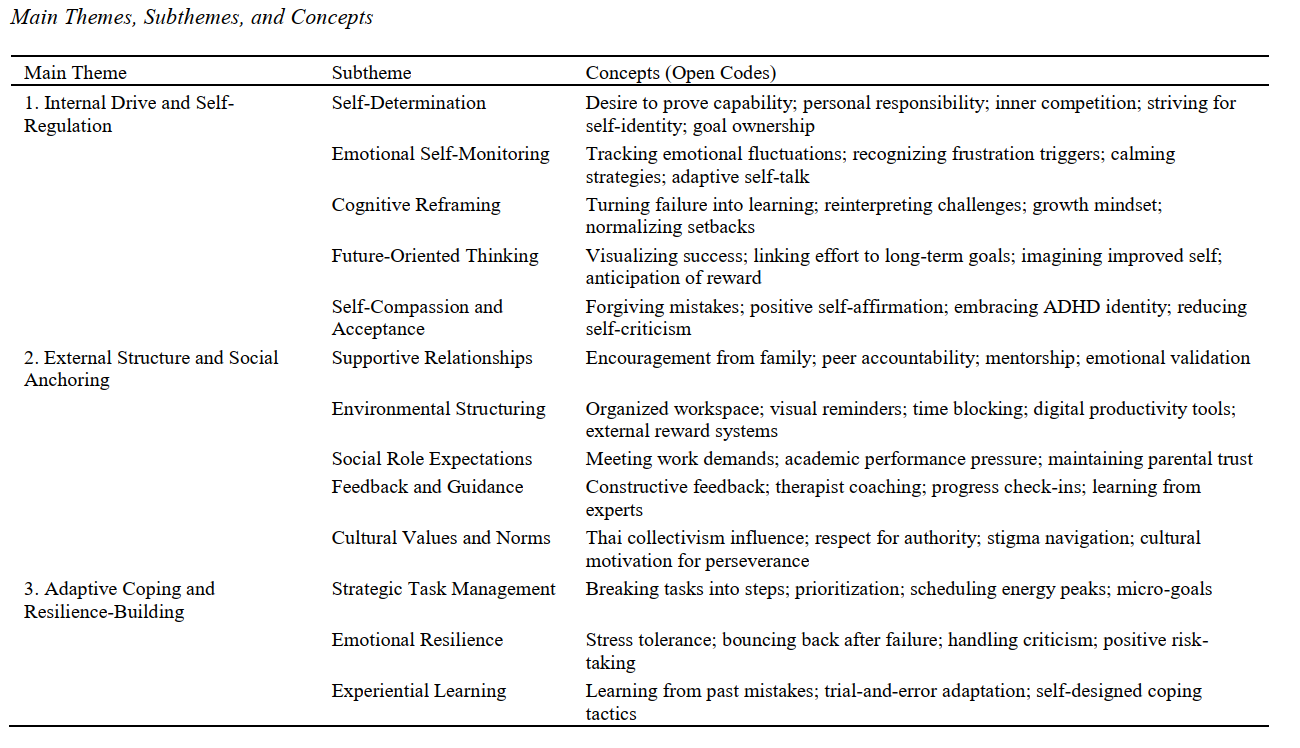
Findings: Analysis revealed three overarching motivational themes: internal drive and self-regulation, external structure and social anchoring, and adaptive coping and resilience-building. Internal processes such as self-determination, emotional self-monitoring, cognitive reframing, and future-oriented thinking enabled participants to stay engaged despite executive function challenges. External supports—including family and peer encouragement, structured environments, feedback from mentors, and cultural values—served as anchoring forces. Adaptive coping strategies, including breaking tasks into smaller steps, using mindfulness and body regulation, and creatively channeling reward sensitivity, further reinforced persistence. These interwoven systems formed a dynamic motivational architecture that participants developed to sustain long-term efforts.
Conclusion: Persistence in ADHD emerges from a complex interaction of personal agency, cultural and social scaffolds, and adaptive resilience strategies. Understanding these motivational systems can inform culturally sensitive interventions that strengthen self-regulation, leverage social support, and empower individuals with ADHD beyond symptom control.
Downloads
References
Afshadi, M. M. S., Amiri, S., & Talebi, H. (2023). Examining the Structural Equation Modeling Between Intrinsic-Motivation, Emotion Regulation and AHDH: The Mediating Role of Problem-Solving, Time-Management, and Behavioral-Inhibition. Current Psychology, 43(1), 885-899. https://doi.org/10.1007/s12144-023-04289-7
Barkley, R. A., & Benton, C. M. (2024a). Focus on Executive Functions. Part 2: Nonverbal and Verbal Working Memory. The ADHD Resource Hub, 2(5), 77-89. https://doi.org/10.1521/adhdhub.2024.2.5.1
Barkley, R. A., & Benton, C. M. (2024b). Focus on Executive Functions. Part 3: Emotion Regulation, Self-Motivation, and Planning/Problem-Solving. The ADHD Resource Hub, 2(6), 90-99. https://doi.org/10.1521/adhdhub.2024.2.6.1
Capodieci, A., Olla, V., Tonasso, C., Campana, M., Morsiani, A., Zambelli, A., & Guidetti, G. (2025). Tele-Assessment of Executive Functions in Young Adults With ADHD: A Pilot Study. Applied Sciences, 15(15), 8741. https://doi.org/10.3390/app15158741
Carreiro, L. R. R., Paes, I. T., Silva, M. M. M., & Seabra, A. G. (2023). Cluster Analysis of Attentional Performance and Behavioral Expressions in Adults With Adhd Symptoms. European Psychiatry, 66(S1), S981-S981. https://doi.org/10.1192/j.eurpsy.2023.2087
Chan, E., & Langberg, J. M. (2024). Predicting Occupational Outcomes for Individuals With ADHD: The Role of Hyperactivity/Impulsivity and Executive Functioning. Journal of Occupational Rehabilitation. https://doi.org/10.1007/s10926-024-10259-y
Childress, A., Sibley, M., Solanto, M. V., Wiznitzer, M., & Newcorn, J. H. (2023). Guidelines in the United States for the Diagnosis and Treatment of Attention-Deficit/Hyperactivity Disorder in Adults: Why They Are Needed. Psychiatric Annals, 53(10), 461-469. https://doi.org/10.3928/00485713-20230911-04
Collado-Valero, J., Sória, I. N., Delgado, B., Real-Fernández, M., Costa-López, B., Mazón-Esquiva, I., & Lavigne-Cerván, R. (2021). ADHD and Sluggish Cognitive Tempo: Comparing Executive Functioning Response Patterns. Sustainability, 13(19), 10506. https://doi.org/10.3390/su131910506
Gabrieli-Seri, O., Ert, E., & Pollak, Y. (2022). Symptoms of Attention Deficit/Hyperactivity Disorder Are Associated With Sub-Optimal and Inconsistent Temporal Decision Making. Brain Sciences, 12(10), 1312. https://doi.org/10.3390/brainsci12101312
Hardjasasmita, I. M., Ulitua, A. E., Soen, C. C., & Roswiyani, R. (2023). Do Cognitive Training Games Actually Work for Adhd? A Literature View. Ijassh, 1(2), 1381-1388. https://doi.org/10.24912/ijassh.v1i2.26390
Köder, F., Sharma, C., Cameron, S., & Garraffa, M. (2022). The Effects of Bilingualism on Cognition and Behaviour in Individuals With Attention Deficits: A Scoping Review. Frontiers in psychology, 13. https://doi.org/10.3389/fpsyg.2022.1057501
Makkar, T. K. (2025). Adult ADHD and Its Familial Associations: Neuropsychological Profiles and Psychiatric Comorbidities. Journal of Indian Association for Child and Adolescent Mental Health. https://doi.org/10.1177/09731342251375193
Miranda, A., Berenguer, C., Miranda, B. R., Martı́nez-Raga, J., & Mulas, F. (2021). Contribution of Family, Behavioral, and Neuropsychological Factors to Long-Term Functional Outcomes in Young Adults With ADHD: A 12-Year Follow-Up Study. Sustainability, 13(2), 814. https://doi.org/10.3390/su13020814
Miranda, B. R., Berenguer, C., Baixauli, I., Mira, Á., Martı́nez-Raga, J., & Miranda, A. (2020). Empirical Examination of Executive Functioning, ADHD Associated Behaviors, and Functional Impairments in Adults With Persistent ADHD, Remittent ADHD, and Without ADHD. BMC psychiatry, 20(1). https://doi.org/10.1186/s12888-020-02542-y
Noureddine, C., Salman, Y. B., Fletes, W., & Sherer, J. (2024). Ctrl+ADHD: Navigating the Mechanisms Tethering Internet Gaming Disorder and ADHD. CNS Spectrums, 29(5), 520-521. https://doi.org/10.1017/s1092852924001998
Ogrodnik, M., Karsan, S., Malamis, B., Kwan, M., Fenesi, B., & Heisz, J. J. (2023). Exploring Barriers and Facilitators to Physical Activity in Adults With ADHD: A Qualitative Investigation. Journal of Developmental and Physical Disabilities, 36(2), 307-327. https://doi.org/10.1007/s10882-023-09908-6
Pheh, K. S., Tan, K. A., Ibrahim, N., & Sidik, S. M. (2021). Effectiveness of Online Mindfulness-Based Intervention (iMBI) on Inattention, Hyperactivity–Impulsivity, and Executive Functioning in College Emerging Adults With Attention-Deficit/Hyperactivity Disorder: A Study Protocol. International journal of environmental research and public health, 18(3), 1257. https://doi.org/10.3390/ijerph18031257
Robledo-Castro, C., Bonilla-Santos, G., & Castaño, P. R. L. (2022). Computer-Based Cognitive Training Programs: Effects on Executive Functions in Children With Attention Deficit Hyperactivity Disorder (ADHD). https://doi.org/10.37766/inplasy2022.10.0046
Shuai, L., He, S., Zheng, H., Wang, Z., Qiu, M., Xia, W., Cao, X., Lu, L., & Zhang, J. (2021). Influences of Digital Media Use on Children and Adolescents With ADHD During COVID-19 Pandemic. Globalization and Health, 17(1). https://doi.org/10.1186/s12992-021-00699-z
Takamatsu, N., Nakashima, M., Matsuura, K., Umemoto, I., Ito, M., Kanazawa, J., Tomiyama, H., Kondo, M., Tachimori, H., Nakao, T., Horikoshi, M., & Kuga, H. (2024). A Multicenter, Single‐group, Open Feasibility Study of a New Individual Cognitive Behavioral Therapy Program for Adult Japanese Patients With Attention‐deficit/Hyperactivity Disorder: Study Protocol. Psychiatry and Clinical Neurosciences Reports, 3(4). https://doi.org/10.1002/pcn5.70036
Trinczer, I. L., & Shalev, L. (2024). Computerised Attention Functions Training Versus Computerised Executive Functions Training for Children With Attention Deficit/Hyperactivity Disorder: A Randomised Controlled Trial. Journal of clinical medicine, 13(23), 7239. https://doi.org/10.3390/jcm13237239
Wu, Y., Xu, L., Wu, Z.-M., Cao, X. L., Xue, G., Wang, Y., & Yang, B. (2022). Computer-Based Multiple Component Cognitive Training in Children With ADHD: A Pilot Study. https://doi.org/10.21203/rs.3.rs-2242958/v1
Zhang, J. (2025). The Role of Executive Function in the Co-Occurrence of ADHD and Developmental Dyscalculia in Chinese Children. Alpha Psychiatry, 26(3). https://doi.org/10.31083/ap42712
Downloads
Additional Files
Publication Timeline
- Submitted
- Revised
- Accepted
Issue
Section
License
Copyright (c) 2025 Sirinut Gunchai (Author); Thanaphat Kuntawong (Corresponding Author); Patcharee Sumethokul (Author)

This work is licensed under a Creative Commons Attribution-NonCommercial 4.0 International License.