Exploring the Dimensions of Self-Concept in Adolescents from Marginalized Communities
DOI:
https://doi.org/10.61838/kman.jarac.7.3.19Keywords:
Adolescents, Self-concept, Marginalized communities, Identity developmentAbstract
Objective: This study aimed to explore the multidimensional nature of self-concept among adolescents living in marginalized communities, focusing on personal, social, and coping dimensions that shape identity development.
Methods and Materials: A qualitative research design was employed using semi-structured interviews as the sole data collection method. Twenty-one adolescents aged 13 to 18 years from marginalized communities in Turkey were purposively selected to provide diverse perspectives. Interviews were conducted until theoretical saturation was reached, ensuring comprehensive exploration of emerging themes. All interviews were audio-recorded, transcribed verbatim, and analyzed using thematic analysis with the aid of NVivo 14 software. Rigorous procedures, including iterative coding, peer debriefing, and continuous comparison, were applied to ensure credibility and trustworthiness of the findings.
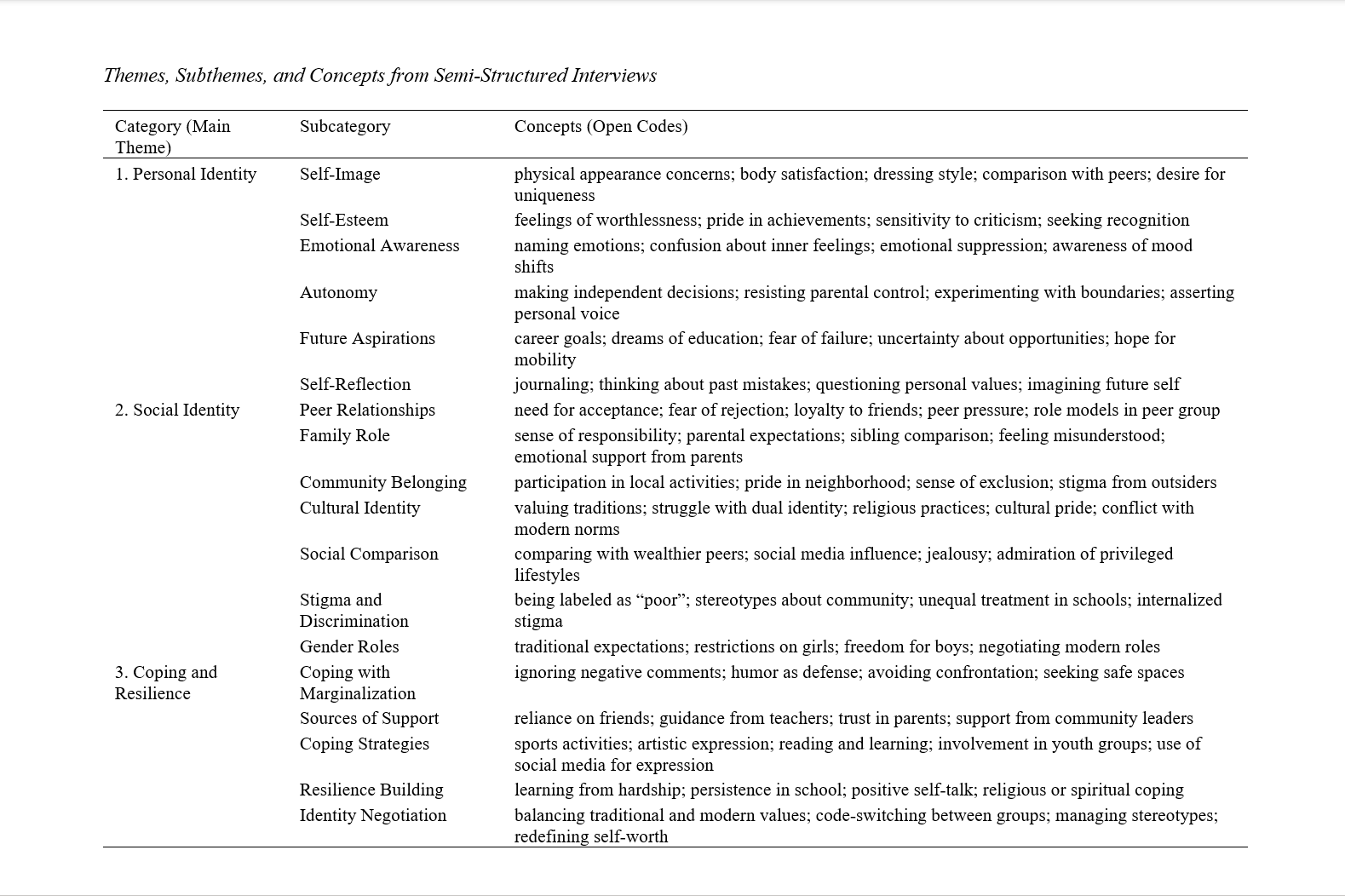
Findings: Three overarching categories of self-concept emerged: personal identity, social identity, and coping and resilience. Personal identity encompassed subthemes such as self-image, self-esteem, emotional awareness, autonomy, future aspirations, and self-reflection. Social identity included peer relationships, family roles, community belonging, cultural identity, social comparison, stigma and discrimination, and gender roles. Coping and resilience involved coping with marginalization, sources of support, coping strategies, resilience building, and identity negotiation. Participants described vulnerabilities including low self-esteem, stigma, and tension between traditional and modern cultural norms, alongside strengths such as supportive relationships, community pride, and resilience strategies. Illustrative quotations highlighted adolescents’ lived experiences and strategies for negotiating complex identities.
Conclusion: The study underscores the multifaceted and context-dependent nature of adolescent self-concept, shaped by family, peers, community, culture, and broader structural realities. Despite significant challenges, adolescents demonstrated resilience and agency in redefining self-worth and negotiating cultural boundaries. These findings highlight the need for supportive interventions in schools, families, and communities that address both vulnerabilities and strengths, empowering adolescents in marginalized settings to construct positive self-concepts.
Downloads
References
Agustina, M. W., & Auliya, E. (2024). The Influence of Father Involvement on Adolescent Sexual Self-Concept. Incoheliv, 1(1), 40-51. https://doi.org/10.24123/incoheliv.v1i1.6552
Bubnova, I. S., & Rerke, V. I. (2020). Influence of Positive and Negative Styles of Family Upbringing on the Formation of Self-Concept in Adolescents. Pedagogical Image, 14(3), 446-458. https://doi.org/10.32343/2409-5052-2020-14-3-446
Chen, W. W., Yuan, H.-L., Yang, X., & Lai, S. K. (2020). Parenting, Self‐concept, and Attitudes About Romantic Relationships. Journal of adolescence, 82(1), 41-49. https://doi.org/10.1016/j.adolescence.2020.06.003
Dirlam, J., & Merry, J. J. (2020). Challenges in Isolating the Effect of College Attainment and Debt Accumulation on Young Adult Self‐Concept. Sociological Forum, 36(1), 111-133. https://doi.org/10.1111/socf.12664
Ihsan, M., & Sabarudin, S. (2023). Understanding Normative and Historical Islamic Approaches in Islamic Studies: Islamic Religious Education Studies. Edumaspul - Jurnal Pendidikan, 7(2), 3360-3373. https://doi.org/10.33487/edumaspul.v7i2.6946
Isnaini, A., Wulandari, N., & Sera, D. C. (2021). Pengaruh Keterlibatan Ayah Dalam Pengasuhan (Father Involvement) Terhadap Konsep Diri Remaja. Jurnal Psikologi Tabularasa, 16(2), 77-82. https://doi.org/10.26905/jpt.v16i2.7686
Lbs, F. H., & Ichsan, I. (2023). Analisis Faktor-Faktor Yang Mempengaruhi Konsep Diri Dan Moralitas Remaja Dari Aspek Sosial-Religius. Jurnal Ilmiah Religiosity Entity Humanity (Jireh), 5(2), 175-182. https://doi.org/10.37364/jireh.v5i2.150
Levey, E. K. V., Garandeau, C. F., Meeus, W., & Branje, S. (2019). The Longitudinal Role of Self-Concept Clarity and Best Friend Delinquency in Adolescent Delinquent Behavior. Journal of youth and adolescence, 48(6), 1068-1081. https://doi.org/10.1007/s10964-019-00997-1
Purnama, H., & Fitriana, A. N. (2024). The Use of Social Media on Self-Concept in Adolescents: A Multiple Case Study. Jurnal Keperawatan Komprehensif, 10(4), 477-482. https://doi.org/10.33755/jkk.v10i4.739
Qadaruddin, M., Bakri, W., Shah, J. M., Cahyadi, I., & Sasriani, A. (2023). Determinism of Media Technology and Distortion of Siri’ Culture. Communicatus Jurnal Ilmu Komunikasi, 7(2), 163-184. https://doi.org/10.15575/cjik.v7i2.30458
Rao, M., & Wang, H. (2023). The Relationship Between Parenting Styles and Adolescents' Academic Achievement. Journal of Education Humanities and Social Sciences, 22, 753-757. https://doi.org/10.54097/ehss.v22i.13355
Ratnawati, D., & Rahmadani, V. G. (2020). Hubungan Perilaku Menonton Drama Korea Dengan Pembentukan Konsep Diri Pada Remaja Di SMPN 1 Cileungsi. Surya Medika Jurnal Ilmiah Ilmu Keperawatan Dan Ilmu Kesehatan Masyarakat, 16(1), 29-35. https://doi.org/10.32504/sm.v16i1.249
Tamaela, J. M., Amir, N., Sanggel, M. J., & Nompo, R. S. (2024). The Impact of Non-Physical Bullying on Adolescents' Self-Concept: An Observational Study in the Adolescent Community in Sausapor, Tambrauw Regency, West Papua, Indonesia. Scientia Psychiatrica, 5(3), 509-519. https://doi.org/10.37275/scipsy.v5i3.171
Wijayanto, G. A., & Hidayati, E. (2021). Konsep Diri Pada Remaja Yang Mengalami Bullying. Jurnal Keperawatan Silampari, 4(2), 503-509. https://doi.org/10.31539/jks.v4i2.1947
Xing, H., Zhang, Y., Yao, M., Zhu, W., & Liu, H. (2024). How Perceived Parenting Qualities Link to the Reciprocal Relationship Between Adolescents’ Self-Concept and Life Satisfaction. Journal of Social and Personal Relationships, 41(11), 3480-3502. https://doi.org/10.1177/02654075241268780
Yim, C., & McCann, C. (2024). Effects of Social Support on Adolescent Identity Development. J Emerg Invest. https://doi.org/10.59720/23-290
Zhang, H., & Zhang, B. (2024). The Relationship Between Adolescent Peer Attachment and Social Anxiety: The Mediating Role of Self-Concept and the Moderating Role of Physical Exercise. https://doi.org/10.21203/rs.3.rs-5435212/v1
Downloads
Additional Files
Publication Timeline
- Submitted
- Revised
- Accepted
Issue
Section
License
Copyright (c) 2025 Selva Turan (Author); Mehdi Rostami (Corresponding Author); Valerie Karstensen, Amna Arif (Author)

This work is licensed under a Creative Commons Attribution-NonCommercial 4.0 International License.