The Phenomenology of Self-Alienation in People With High Perfectionistic Traits
DOI:
https://doi.org/10.61838/kman.jarac.7.2.28Keywords:
Perfectionism, Self-alienation, Phenomenology, Emotional suppression, Perfectionistic self-presentation, Identity disconnectionAbstract
Objective: This study aimed to explore the lived experience of self-alienation among individuals with high perfectionistic traits.
Methods and Materials: A qualitative research design was employed using in-depth semi-structured interviews with 24 participants (13 females, 11 males) aged 21–39 from various regions in India. Participants were purposively sampled based on high perfectionistic tendencies, as determined through a brief screening using items adapted from the Frost Multidimensional Perfectionism Scale. Interviews focused on internal emotional processes, identity-related experiences, and interpersonal functioning. Data collection continued until theoretical saturation was achieved. All interviews were audio-recorded, transcribed verbatim, and analyzed thematically using NVivo software (Version 12) in accordance with a phenomenological approach. Open codes were systematically categorized into subthemes and overarching themes through iterative coding and peer debriefing.
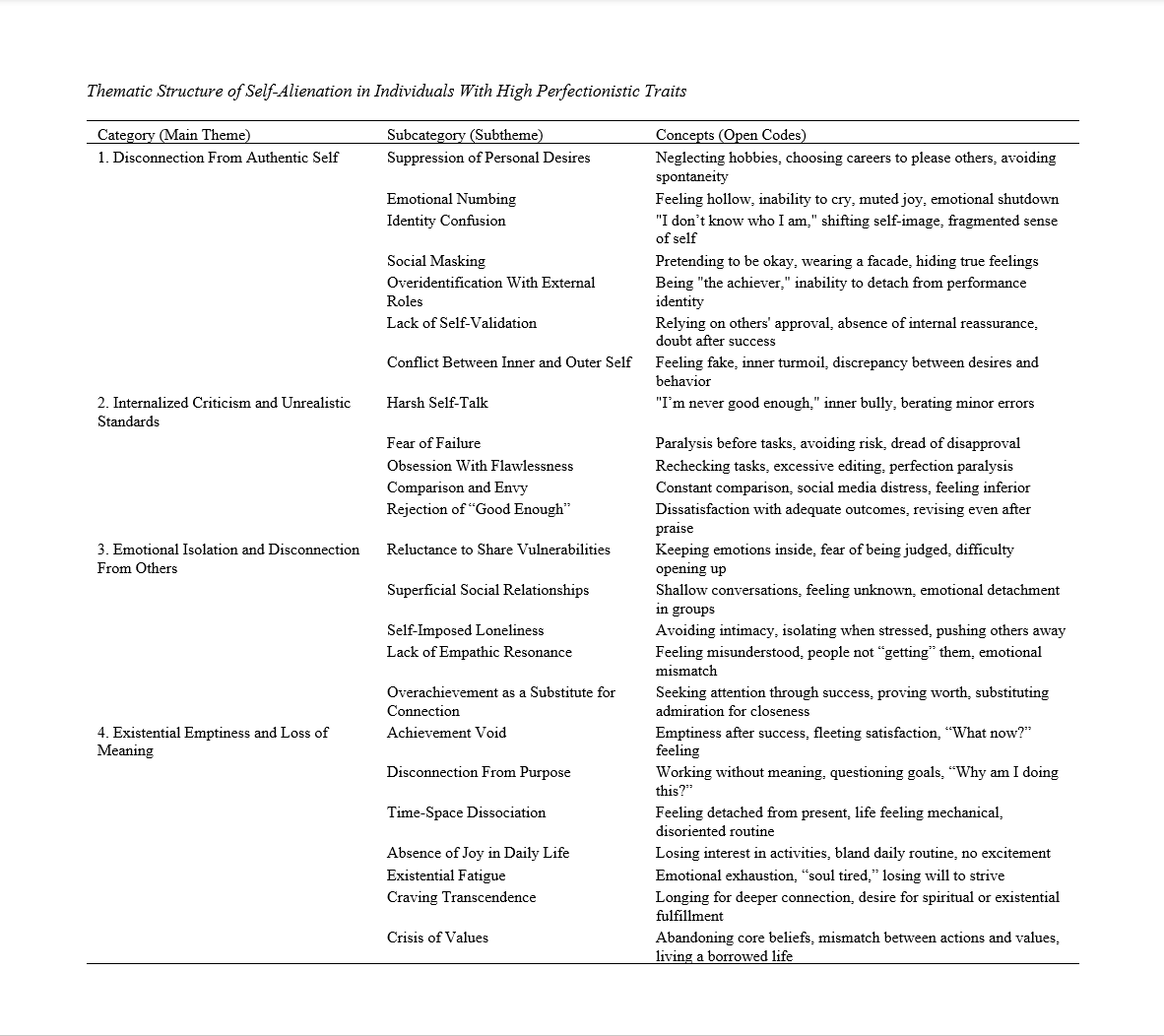
Findings: Four major themes were identified: (1) Disconnection From Authentic Self, characterized by emotional numbing, identity confusion, and suppression of personal desires; (2) Internalized Criticism and Unrealistic Standards, encompassing harsh self-talk, fear of failure, and obsession with flawlessness; (3) Emotional Isolation and Disconnection From Others, marked by relational avoidance, superficial connections, and loneliness; and (4) Existential Emptiness and Loss of Meaning, involving achievement void, value confusion, and lack of intrinsic purpose. Participant narratives revealed a cycle of emotional suppression and performative self-presentation that deepened their sense of alienation and inner fragmentation.
Conclusion: Self-alienation is a central psychological consequence of perfectionistic self-presentation, affecting identity, emotional regulation, and social connection.
Downloads
References
Altstötter–Gleich, C., Prestele, E., Grommisch, G., & Lischetzke, T. (2025). Multidimensional Perfectionism and Daily Self-Control Episodes. Personality Science, 6. https://doi.org/10.1177/27000710241310361
Besser, A., Flett, G. L., & Hewitt, P. L. (2010). Perfectionistic Self‐Presentation and Trait Perfectionism in Social Problem‐Solving Ability and Depressive Symptoms. Journal of Applied Social Psychology, 40(8), 2121-2154. https://doi.org/10.1111/j.1559-1816.2010.00653.x
Burkitt, W. T. (2024). Perfectionism and Self-Esteem: The Mediating Role of Basic Psychological Needs. Psychological Reports. https://doi.org/10.1177/00332941241303402
Choi, H., & Lee, H.-K. (2024). The Influence of Perfectionistic Self-Presentation on Loneliness of University Students: The Moderating Effect of Self-Concept Clarity. Korean Association for Learner-Centered Curriculum and Instruction, 24(2), 365-380. https://doi.org/10.22251/jlcci.2024.24.2.365
Elion, A. A., Wang, K. T., Slaney, R. B., & French, B. H. (2012). Perfectionism in African American Students: Relationship to Racial Identity, GPA, Self-Esteem, and Depression. Cultural Diversity and Ethnic Minority Psychology, 18(2), 118-127. https://doi.org/10.1037/a0026491
Grugan, M. C., & Wright, K. J. (2025). Trait Perfectionism, Perfectionistic Self-Presentation, and Muscle Dysmorphia in Male Exercisers: A Structural Equation Modeling Strategy. Journal of Clinical Sport Psychology, 19(1), 42-57. https://doi.org/10.1123/jcsp.2023-0006
Hashmi, Z. S., Ijaz, T., & Ijaz, S. (2022). Perfectionistic Self-Presentation and Body Dissatisfaction: The Role of Anxiety and Depression. Pakistan Journal of Psychological Research, 37(4), 515-532. https://doi.org/10.33824/pjpr.2022.37.4.31
Hassan, S., Flett, G. L., Ganguli, R., & Hewitt, P. L. (2014). Perfectionistic Self-Presentation and Suicide in a Young Woman With Major Depression and Psychotic Features. Case Reports in Psychiatry, 2014, 1-6. https://doi.org/10.1155/2014/901981
Hewitt, P. L., Blasberg, J. S., Flett, G. L., Besser, A., Sherry, S., Caelian, C., Papsdorf, M., Cassels, T. G., & Birch, S. (2011). Perfectionistic Self-Presentation in Children and Adolescents: Development and Validation of the Perfectionistic Self-Presentation Scale—Junior Form. Psychological assessment, 23(1), 125-142. https://doi.org/10.1037/a0021147
Javed, A., Yousaf, K., & Ghaffar, A. A. (2023). Machiavellianism, Perfectionistic Self-Presentation and Decision-Making in Leaders. Apr, 1(2). https://doi.org/10.32350/apr.12.04
Kawamoto, A., Sheth, R., Yang, M., Demps, L., & Sevig, T. (2022). The Role of Self-Compassion Among Adaptive and Maladaptive Perfectionists in University Students. The counseling psychologist, 51(1), 113-144. https://doi.org/10.1177/00110000221129606
Kehayes, I. L. L., & Mackinnon, S. P. (2019). Investigating the Relationship Between Perfectionistic Self-Presentation and Social Anxiety Using Daily Diary Methods: A Replication. Collabra Psychology, 5(1). https://doi.org/10.1525/collabra.257
Khossousi, V., Greene, D., Shafran, R., Callaghan, T., Dickinson, S. L., & Egan, S. J. (2024). The Relationship Between Perfectionism and Self-Esteem in Adults: A Systematic Review and Meta-Analysis. Behavioural and Cognitive Psychotherapy, 52(6), 646-665. https://doi.org/10.1017/s1352465824000249
Lee, E., & Kim, T. S. (2024). The Relationship Between Perfectionistic Self-Presentation and Loneliness of College Students: The Mediating Effect of Internalized Shame and Self-Silencing. Korean Association for Learner-Centered Curriculum and Instruction, 24(18), 391-406. https://doi.org/10.22251/jlcci.2024.24.18.391
Lo, A., & Abbott, M. J. (2019). Self-Concept Certainty in Adaptive and Maladaptive Perfectionists. Journal of Experimental Psychopathology, 10(2). https://doi.org/10.1177/2043808719843455
Lundqvist, C., Kolbeinsson, Ö., Asratian, A., & Wade, T. (2024). Untangling the Relationships Between Age, Gender, Type of Sport, Perfectionistic Self-Presentation and Motivation on Body Satisfaction: A Cross-Sectional Study on Aesthetic and Non-Aesthetic Female and Male Athletes Aged 10 to 22 Years. BMJ Open Sport & Exercise Medicine, 10(3), e001975. https://doi.org/10.1136/bmjsem-2024-001975
Nakano, K. (2009). Perfectionism, Self-Efficacy, and Depression: Preliminary Analysis of the Japanese Version of the Almost Perfect Scale–Revised. Psychological Reports, 104(3), 896-898. https://doi.org/10.2466/pr0.104.3.896-908
Nam, Y. J., & Lee, B. K. (2020). The Moderating Effects of Coping Style on the Relationship Between Perfectionistic Self- Presentation and Social Anxiety in College Students. Korean Journal of Stress Research, 28(1), 10-16. https://doi.org/10.17547/kjsr.2020.28.1.10
Park, Y. R., & La, S. H. (2024). The Effect of Shame Experience on Intimacy of University Students: Focusing on Moderating Effect of Perfectionistic Self-Presentation. Korean Association for Learner-Centered Curriculum and Instruction, 24(17), 741-751. https://doi.org/10.22251/jlcci.2024.24.17.741
Read, D. J., Hill, A. P., Jowett, G. E., & Astill, S. (2016). The Relationship Between Perfectionistic Self-Presentation and Reactions to Impairment and Disability Following Spinal Cord Injury. Journal of Health Psychology, 24(3), 362-375. https://doi.org/10.1177/1359105316674268
Sánchez‐Rodríguez, E., Ferreira-Valente, A., Pathak, A., Solé, E., Sharma, S., Jensen, M. P., & Miró, J. (2021). The Role of Perfectionistic Self-Presentation in Pediatric Pain. International journal of environmental research and public health, 18(2), 591. https://doi.org/10.3390/ijerph18020591
Stoeber, J., Madigan, D. J., Damian, L. E., Esposito, R. M., & Lombardo, C. (2016). Perfectionism and Eating Disorder Symptoms in Female University Students: The Central Role of Perfectionistic Self-Presentation. Eating and Weight Disorders - Studies on Anorexia Bulimia and Obesity, 22(4), 641-648. https://doi.org/10.1007/s40519-016-0297-1
Stoeber, J., & Roche, D. L. (2014). Affect Intensity Contributes to Perfectionistic Self-Presentation in Adolescents Beyond Perfectionism. Journal of Rational-Emotive & Cognitive-Behavior Therapy, 32(2), 164-180. https://doi.org/10.1007/s10942-013-0176-x
Ubaradka, A., Fathima, A., & Batra, S. D. (2023). Psychological Correlates of Perfectionistic Self-Presentation Among Social Media Users. International Journal of Cyber Behavior Psychology and Learning, 13(1), 1-13. https://doi.org/10.4018/ijcbpl.324089
Vicent, M., Sanmartín, R., Otáñez-Enríquez, N., & García-Fernández, J. M. (2022). Perfectionistic Self-Presentation Scale in Ecuador: Psychometric Properties and Latent Mean Differences Across Genders. Revista Latinoamericana de Psicología, 54. https://doi.org/10.14349/rlp.2022.v54.20
Downloads
Additional Files
Publication Timeline
- Submitted
- Revised
- Accepted
Issue
Section
License

This work is licensed under a Creative Commons Attribution-NonCommercial 4.0 International License.