Helplessness Beliefs and Social Withdrawal: The Mediating Role of Avoidant Coping
DOI:
https://doi.org/10.61838/kman.jarac.7.2.20Keywords:
Helplessness beliefs, social withdrawal, avoidant copingAbstract
Objective: This study aimed to examine the mediating role of avoidant coping in the relationship between helplessness beliefs and social withdrawal among Brazilian young adults.
Methods and Materials: A descriptive correlational design was employed with a sample of 418 participants aged 18–35 from Brazil, selected based on the Krejcie and Morgan sampling table. Standardized instruments were used to measure helplessness beliefs, avoidant coping, and social withdrawal. Data were analyzed using Pearson correlation via SPSS-27 to determine bivariate relationships and Structural Equation Modeling (SEM) via AMOS-21 to test the hypothesized mediation model. Assumptions of normality, linearity, and multicollinearity were assessed and confirmed prior to analysis.
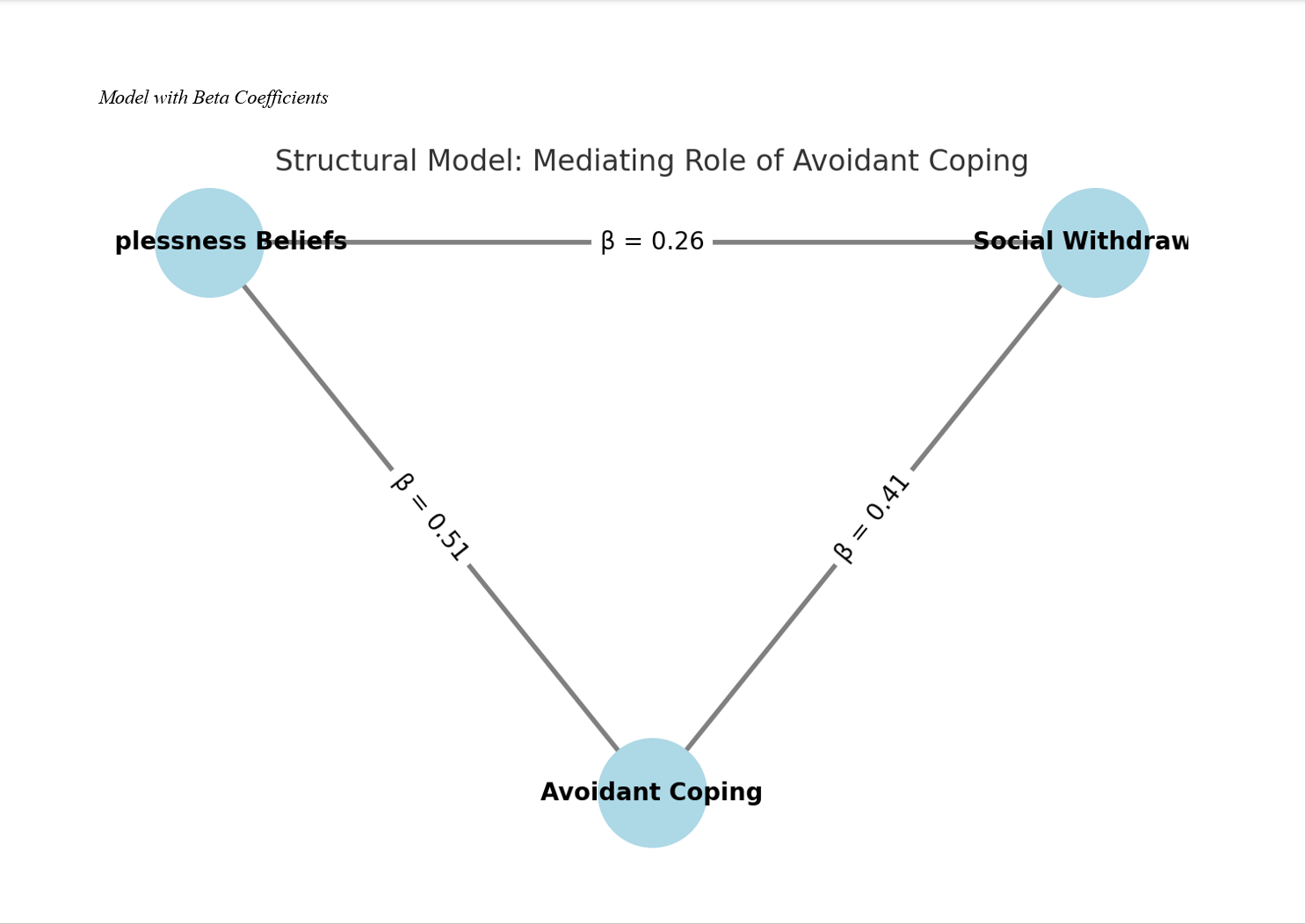
Findings: Results indicated significant positive correlations between helplessness beliefs and avoidant coping (r = .51, p < .001), helplessness beliefs and social withdrawal (r = .43, p < .001), and avoidant coping and social withdrawal (r = .48, p < .001). The SEM analysis demonstrated a good model fit (χ²/df = 2.05, CFI = .96, RMSEA = .049). Helplessness beliefs had a direct effect on avoidant coping (β = 0.51, p < .001) and social withdrawal (β = 0.26, p < .001). Avoidant coping had a significant direct effect on social withdrawal (β = 0.41, p < .001). The indirect effect of helplessness beliefs on social withdrawal via avoidant coping was also significant (β = 0.21, p < .001), confirming partial mediation. The total standardized effect from helplessness beliefs to social withdrawal was β = 0.47.
Conclusion: The findings highlight avoidant coping as a significant behavioral mechanism linking helplessness beliefs to social withdrawal. Interventions aimed at restructuring cognitive appraisals and promoting adaptive coping strategies may be effective in reducing withdrawal-related behaviors in at-risk populations.
Downloads
References
Akan, Ş., & BİRtek, D. (2023). The Role of Basic Personality Traits, Cognitive Coping Strategies in Social Anxiety Symptoms. Acibadem Universitesi Saglik Bilimleri Dergisi. https://doi.org/10.31067/acusaglik.1319964
Al-Saidi, F. H., & Aldhafri, S. (2020). The Effect of Parental Styles on Academic Achievement: The Mediating Role of Learned Helplessness Among 10th Grade Students in Al Batinah North Governorate From Sultanate of Oman. Journal of Educational & Psychological Sciences, 21(03), 41-71. https://doi.org/10.12785/jeps/210302
Bakracheva, M. (2025). Personality Predictors of Flourishing and Learning to Flourish. International Journal of Cognitive Research in Science Engineering and Education, 13(1), 141-156. https://doi.org/10.23947/2334-8496-2025-13-1-141-156
Buchmann, J., Baumann, N., Meng, K., Semrau, J., Kühl, J., Pfeifer, K., Vogel, H., & Faller, H. (2021). Volitional Action Control and Depression in Chronic Pain: Does Action Versus State Orientation Moderate the Relations of Pain-Related Cognitions to Depression? Current Psychology, 42(9), 7591-7608. https://doi.org/10.1007/s12144-021-01914-1
Carreiro, J. P., Cardoso, S., Teques, P., Teques, A. P., & Ribeiro, J. L. P. (2025). Satisfaction With Social Support and Quality of Life Among Portuguese Patients With Breast Cancer: Mediating Effects of Coping Styles—Cross-Sectional Study. Healthcare, 13(3), 297. https://doi.org/10.3390/healthcare13030297
Chwaszcz, J., Palacz-Chrisidis, A., Wiechetek, M., Bartczuk, R., Niewiadomska, I., Sławska, P., & Wośko, P. (2020). Quality of Life, Resources, and Coping During the First Weeks of the COVID-19 Pandemic by People Seeking Psychological Counselling Before the Pandemic. https://doi.org/10.31234/osf.io/ryv8g
Dohmen, M., Braat-Eggen, E., Kemperman, A., & Hornikx, M. (2022). The Effects of Noise on Cognitive Performance and Helplessness in Childhood: A Review. International journal of environmental research and public health, 20(1), 288. https://doi.org/10.3390/ijerph20010288
Fatima, T., & Arshad, E. (2024). Relationship of Locus of Control, Learned Helplessness and Coping Strategies Among Patients With Chronic Illness. International Journal of Multidisciplinary Research Updates, 8(2), 001-011. https://doi.org/10.53430/ijmru.2024.8.2.0048
Hawrot, A., & Zhou, J. (2023). Parent-Child School-Related Interactions and Helplessness in Maths: The Role of Maths Self-Efficacy. European Journal of Psychology of Education, 39(2), 1353-1370. https://doi.org/10.1007/s10212-023-00740-2
Lotfi, A. H., Monirpoor, N., & ZarghamHajebi, M. (2021). Providing a Structural Model of Early Helplessness in Cancer Patients Based on Early Maladaptive Schemas (EMSs) and Coping Strategies With the Mediating Role of Family Codependency. Aftj, 2(3), 511-534. https://doi.org/10.61838/kman.aftj.2.3.26
Onyedibe, M. C. C., Ugwu, L. E., Nnadozie, E. E., & Onu, D. U. (2021). Cancer Coping Self-Efficacy Mediates the Relationship Between Mental Adjustment to Cancer and Health-Related Quality of Life in Persons With Cancer. South African Journal of Psychology, 52(3), 325-337. https://doi.org/10.1177/00812463211061071
Panda, T. K., Swami, M. K., Suthar, N., Pareek, P., Vishnoi, J. R., & Singh, K. (2024). Relationship Between Perceived Social Support, Mental Adjustment to Cancer, and Depression Among Patients With Breast Cancer. Australasian Psychiatry. https://doi.org/10.1177/10398562241306950
Quchani, M. (2023). The Mediating Role of Coping Styles in the Association Between Perfectionism and Learned Helplessness in Students’ Population. Annales Médico-Psychologiques Revue Psychiatrique, 181(7), 619-627. https://doi.org/10.1016/j.amp.2022.07.010
Sergienko, E. A., Tsiring, D. А., Pakhomova, Y. N., & Пономарева, И. В. (2024). The Role of Subjective Age in the System of Psychological Factors in the Course of the Disease in Men With Prostate Cancer. Part II. Subjective Age and Other Psychological Factors in the Course of the Disease in Men With Prostate Cancer. Counseling Psychology and Psychotherapy, 32(4), 155-173. https://doi.org/10.17759/cpp.2024320408
Stańko-Kaczmarek, M., Kardasz, Ł., Koza, J., Piwońska, M., Siwińska, W., & Sokołowska, K. (2023). Uważność a Radzenie Sobie Ze Stresem U Kobiet I Mężczyzn. Człowiek I Społeczeństwo, 55, 141-162. https://doi.org/10.14746/cis.2023.55.8
Sun, Q., Ho, K. Y., Yue-e, W., Qin, S., Chen, S., Lin, Y., & Peng, J. (2025). Illness Cognitions and Psychological Distress Among Young and Middle-Aged Couples With Colorectal Cancer: A Dyadic Study. Journal of Health Psychology. https://doi.org/10.1177/13591053251325028
Sun, Q., Yue-e, W., Qin, S., Chen, S., Lin, Y., & Peng, J. (2024). Dyadic Effects of Illness Cognition and Psychological Distress Among Young and Middle-Aged Couples With Colorectal Cancer: The Mediating Role of Dyadic Coping. https://doi.org/10.21203/rs.3.rs-3916812/v1
Tomaszek, K., & Muchacka-Cymerman, A. (2021). The Mediating Effect of Student School Burnout On the Relationship Between Coping Strategies And Internet Addiction. Current Issues in Personality Psychology. https://doi.org/10.5114/cipp.2021.110085
Trejnowska, A., Goodall, K., Rush, R., Ellison, M., & McVittie, C. (2020). The Relationship Between Adult Attachment and Coping With Brain Tumour: The Mediating Role of Social Support. Psycho-Oncology, 29(4), 729-736. https://doi.org/10.1002/pon.5325
Wei, R.-j., & Chen, Y. (2022). The Associations of Family Functioning With Learned Helplessness: A Moderated Mediating Model. 1092-1104. https://doi.org/10.2991/978-94-6463-064-0_114
Wilson, M. J. A., & Sia, S. K. (2022). Buffering Role of Positive Religious Coping Against the Helplessness of Elderly People Under Covid Stress. Working With Older People, 27(1), 26-33. https://doi.org/10.1108/wwop-02-2022-0006
Wright, M. F., Wachs, S., Yanagida, T., Ševčíková, A., Dědková, L., Bayraktar, F., Aoyama, I., Kamble, S. V., Macháčková, H., Li, Z., Soudi, S., Lei, L., & Shu, C. (2022). Coping With Public and Private Face-to-Face and Cyber Victimization Among Adolescents in Six Countries: Roles of Severity and Country. International journal of environmental research and public health, 19(21), 14405. https://doi.org/10.3390/ijerph192114405
Yoo, H. J., & Marshall, D. T. (2024). Exploring Graduate Students’ Perceived Helplessness, Self-Efficacy, Social Support and Satisfaction. Studies in Graduate and Postdoctoral Education, 16(1), 73-89. https://doi.org/10.1108/sgpe-12-2023-0113
Downloads
Additional Files
Publication Timeline
- Submitted
- Revised
- Accepted
Issue
Section
License

This work is licensed under a Creative Commons Attribution-NonCommercial 4.0 International License.