Perceived Injustice and Low Resilience as Predictors of Passive Coping in Trauma Survivors
DOI:
https://doi.org/10.61838/kman.jarac.7.3.14Keywords:
Perceived injustice, resilience, passive coping, trauma survivorsAbstract
Objective: This study aimed to investigate the predictive roles of perceived injustice and resilience in explaining passive coping behaviors among trauma survivors.
Methods and Materials: A correlational descriptive design was employed with a sample of 409 trauma-exposed participants from Ecuador, selected based on the Krejcie and Morgan sample size determination table. Participants completed standardized self-report measures, including the Coping Strategies Inventory (CSI) for passive coping, the Injustice Experience Questionnaire (IEQ) for perceived injustice, and the Connor-Davidson Resilience Scale (CD-RISC) for resilience. Data were analyzed using SPSS-27. Pearson correlation coefficients were calculated to examine the bivariate relationships between variables, and a standard linear regression analysis was conducted to assess the combined predictive power of perceived injustice and resilience on passive coping.
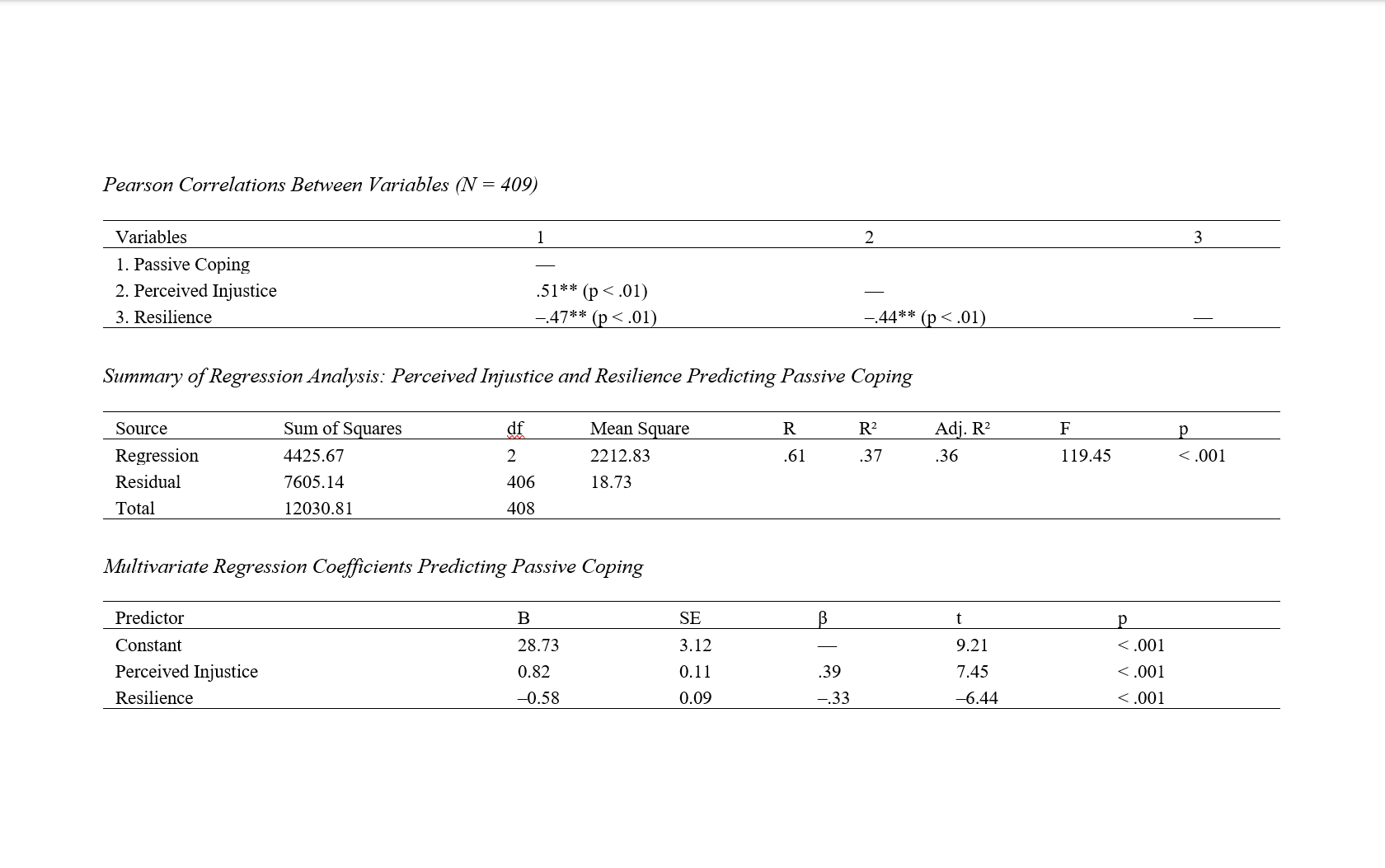
Findings: Perceived injustice was significantly and positively correlated with passive coping (r = .51, p < .01), while resilience was significantly and negatively correlated with passive coping (r = –.47, p < .01). A significant negative correlation was also found between perceived injustice and resilience (r = –.44, p < .01). Linear regression analysis showed that perceived injustice (B = 0.82, β = .39, p < .001) positively predicted passive coping, while resilience (B = –0.58, β = –.33, p < .001) negatively predicted passive coping. The overall model was significant (F(2, 406) = 119.45, p < .001) with an R² of .37, indicating that the two predictors explained 37% of the variance in passive coping.
Conclusion: These results highlight the importance of addressing injustice perceptions and enhancing resilience in trauma-informed interventions to promote adaptive coping among survivors.
Downloads
References
Arslan, K., & Tuncay, T. (2023). Examining the Factors Influencing the Stress Levels in Families of Children With Autism. Uluslararası İnsan Çalışmaları Dergisi, 6(12), 229-253. https://doi.org/10.35235/uicd.1318620
Baca, S. A., Fite, P. J., & Chang, C. N. (2022). Are Perceived Containment and Coping Styles Differentially Associated With Reactive and Proactive Aggression? Aggressive Behavior, 49(3), 236-248. https://doi.org/10.1002/ab.22065
Bucknell, K. J., Hoare, S., Kangas, M., Karin, E., & Crane, M. F. (2024). A Mixed-Methods Study Exploring Coping Self-Insights Associated With Resilience. Behavioral Sciences, 14(11), 1018. https://doi.org/10.3390/bs14111018
Chan, H. C., & Wong, D. S. W. (2017). Coping with cyberbullying victimization: An exploratory study of Chinese adolescents in Hong Kong. International Journal of Law, Crime and Justice, 50, 71-82. https://doi.org/10.1016/j.ijlcj.2017.04.003
Chen, M. (2025). Cross-Sectional Study of Workplace Violence on Work Engagement Among Chinese Nurses: The Mediating Role of Psychological Resilience. BMJ open, 15(1), e086006. https://doi.org/10.1136/bmjopen-2024-086006
Díaz-Morán, S., Palència, M., Mont-Cardona, C., Cañete, T., Blázquez, G., Martínez-Membrives, E., López-Aumatell, R., Tobeña, A., & Fernández-Teruel, A. (2012). Coping style and stress hormone responses in genetically heterogeneous rats: Comparison with the Roman rat strains. Behavioural Brain Research, 228(1), 203-210. https://doi.org/10.1016/j.bbr.2011.12.002
Geschke, K., Steinmetz, A., Fellgiebel, A., & Wuttke-Linnemann, A. (2024). The Influence of Resilience on Caregiver Burden, Depression, and Stress in the Course of the COVID-19 Lockdowns. Sage Open, 14(2). https://doi.org/10.1177/21582440241249273
Gregory, V. L., & Edmonds, J. L. T. (2023). The Racial Pandemic Experienced by Black American Men: Cognitive–behavioral and Structural Implications. American Journal of Orthopsychiatry, 93(1), 1-16. https://doi.org/10.1037/ort0000651
Hay, N., & Kalantidou, E. (2022). The Practice of Resilience Building in Urban and Regional Communities. 1-6. https://doi.org/10.1007/978-3-030-51812-7_296-1
Heloísa Monteiro do Amaral, P., Borghi, F., Tânia Maron Vichi Freire de, M., & Kassisse, D. M. G. (2020). The Impact of Confinement in the Psychosocial Behaviour Due COVID-19 Among Members of a Brazilian University. International Journal of Social Psychiatry, 67(6), 720-727. https://doi.org/10.1177/0020764020971318
Hou, Y., Zhang, Y., Cao, X., Lei, G., & Liu, G. H. (2023). The Association Between Perceived Social Support and Resilience Among Chinese University Students: A Moderated Mediation Model. Psychology in the Schools, 61(4), 1474-1490. https://doi.org/10.1002/pits.23122
Karaosman, H., Marshall, D., & Villena, V. H. (2023). Chrysalis of Crisis: Covid-19 As a catalyst for Awakening Power and Justice in a Luxury Fashion Supply Chain. International Journal of Operations & Production Management, 43(10), 1634-1666. https://doi.org/10.1108/ijopm-05-2022-0320
Kleinmann, B., & Wolter, T. (2022). Opioid Consumption in Chronic Pain Patients: Role of Perceived Injustice and Other Psychological and Socioeconomic Factors. Journal of clinical medicine, 11(3), 647. https://doi.org/10.3390/jcm11030647
Klingenberg, I., & Süß, S. (2022). Profiling Resilience: A Latent Profile Analysis of German Nurses' Coping and Resilience. Frontiers in Health Services, 2. https://doi.org/10.3389/frhs.2022.960100
Lee, S., Jeong, S., & Choi, Y.-S. (2019). The Effect of Stress Coping on Resilience of Firefighters. Biomedicalresearch, 30(2). https://doi.org/10.35841/biomedicalresearch.30-19-087
Lemèe, C., Fleury‐Bahi, G., & Navarro, Ó. (2019). Impact of Place Identity, Self-Efficacy and Anxiety State on the Relationship Between Coastal Flooding Risk Perception and the Willingness to Cope. Frontiers in psychology, 10. https://doi.org/10.3389/fpsyg.2019.00499
Lin, P. C., Yen, J. Y., Lin, H. C., Chou, W. P., Liu, T. L., & Ko, C. H. (2021). Coping, Resilience, and Perceived Stress in Individuals With Internet Gaming Disorder in Taiwan. International journal of environmental research and public health, 18(4), 1771. https://doi.org/10.3390/ijerph18041771
Mai, Y., Wu, Y. J., & Yan-ni, H. (2021). What Type of Social Support Is Important for Student Resilience During COVID-19? A Latent Profile Analysis. Frontiers in psychology, 12. https://doi.org/10.3389/fpsyg.2021.646145
Marta de las Heras, M., Jiménez, S. Y., Navarro, R., & Rubio, E. L. (2022). The Relationship Between Personal Variables and Perceived Appropriateness of Coping Strategies Against Cybervictimisation Among Pre-Service Teachers. Sustainability, 14(9), 5575. https://doi.org/10.3390/su14095575
Muniandy, M., Richdale, A. L., & Lawson, L. P. (2022). Coping‐resilience Profiles and Experiences of Stress in Autistic Adults. Autism Research, 15(11), 2149-2166. https://doi.org/10.1002/aur.2817
Namasaba, M., Kazembe, N., Seera, G., & Baguwemu, A. A. (2022). Broadening the Scope of Social Support, Coping Skills and Resilience Among Caretakers of Children With Disabilities in Uganda: A Sequential Explanatory Mixed-Methods Study. BMC public health, 22(1). https://doi.org/10.1186/s12889-022-13018-x
Nijs, J., Roose, E., Lahousse, A., Mostaqim, K., Reynebeau, I., Couck, M., Beckwée, D., Huysmans, E., Bults, R., Wilgen, C. P. V., & Leysen, L. (2021). Pain and Opioid Use in Cancer Survivors: A Practical Guide to Account for Perceived Injustice. Pain Physician, 309-317. https://doi.org/10.36076/ppj.2021.24.309
Pavilanis, A., Truchon, M., Achille, M., Côté, P., & Sullivan, M. (2022). Perceived Injustice as a Determinant of the Severity of Post-Traumatic Stress Symptoms Following Occupational Injury. Journal of Occupational Rehabilitation, 33(1), 134-144. https://doi.org/10.1007/s10926-022-10056-5
Pearson-Leary, J., Abramenko, A. P., Estela-Pro, V., Feindt-Scott, E., Yan, J., Vigderman, A., Luz, S., Bangasser, D. A., Ross, R., Kubin, L., & Bhatnagar, S. (2024). Differential Recruitment of Brain Circuits During Fear Extinction in Non-Stressed Compared to Stress Resilient Animals. Scientific reports, 14(1). https://doi.org/10.1038/s41598-023-50830-w
Pv, A. (2025). Impact of Family’s Emotional Involvement and Coping Strategies on Resilience Among Young Adults. World Journal of Advanced Research and Reviews, 25(3), 1994-2002. https://doi.org/10.30574/wjarr.2025.25.3.0848
Quyamuddin, M. (2025). Emotional Resilience and Psychological Well-Being in Junior Resident Doctor’s Professional Growth: A Conceptual Exploration Through the Lens of the “Triangular Theory of Love”. International Journal for Multidisciplinary Research, 7(2). https://doi.org/10.36948/ijfmr.2025.v07i02.39862
Roose, E. (2024). Effect of Perceived Injustice-Targeted Pain Neuroscience Education Compared With Biomedically Focused Education in Breast Cancer Survivors: A Study Protocol for a Multicentre Randomised Controlled Trial (BCS-PI Trial). BMJ open, 14(1), e075779. https://doi.org/10.1136/bmjopen-2023-075779
Scholten, E. W. M., Julia, D. H. P. S., Diemen, T. v., Hillebregt, C. F., Ketelaar, M., Woldendorp, K. H., Osterthun, R., Visser‐Meily, J. M. A., & Post, M. W. M. (2020). Appraisals and Coping Mediate the Relationship Between Resilience and Distress Among Significant Others of Persons With Spinal Cord Injury or Acquired Brain Injury: A Cross-Sectional Study. BMC psychology, 8(1). https://doi.org/10.1186/s40359-020-00419-z
Scott, P. D., Lockhart, J. S., Zoucha, R., Jakub, K., Szigethy, E., & Nguyen, G. C. (2020). Coping Behaviors of African Americans With Inflammatory Bowel Disease: A Focused Ethnography. Journal of Transcultural Nursing, 32(5), 466-473. https://doi.org/10.1177/1043659620967443
Tuason, M. T., Güss, C. D., & Boyd, L. (2021). Thriving during COVID-19: Predictors of psychological well-being and ways of coping. PLoS One, 16(3), e0248591. https://doi.org/10.1371/journal.pone.0248591
Zapater‐Fajarí, M., Crespo-Sanmiguel, I., Pulopulos, M. M., Hidalgo, V., & Salvador, A. (2021). Resilience and Psychobiological Response to Stress in Older People: The Mediating Role of Coping Strategies. Frontiers in Aging Neuroscience, 13. https://doi.org/10.3389/fnagi.2021.632141
Zheng, Y., Wang, X., Deng, Y., & Wang, J. (2024). Effect of Psychological Resilience on Posttraumatic Growth Among Midwives: The Mediating Roles of Perceived Stress and Positive Coping Strategies. Nursing Open, 11(11). https://doi.org/10.1002/nop2.70076
Zhou, K., Ning, F., Wang, W., & Li, X. (2022). The Mediator Role of Resilience Between Psychological Predictors and Health-Related Quality of Life in Breast Cancer Survivors: A Cross-Sectional Study. BMC Cancer, 22(1). https://doi.org/10.1186/s12885-022-09177-0
Downloads
Additional Files
Publication Timeline
- Submitted
- Revised
- Accepted
Issue
Section
License

This work is licensed under a Creative Commons Attribution-NonCommercial 4.0 International License.