Self-Reflection as a Mediator Between Solitude and Identity Development
DOI:
https://doi.org/10.61838/kman.jarac.6.4.27Keywords:
Solitude, Self-Reflection, Identity Development, AdolescentsAbstract
Objective: This study aimed to examine the mediating role of self-reflection in the relationship between solitude and identity development among Malaysian adolescents.
Methods and Materials: A descriptive correlational design was employed with a sample of 476 adolescents selected based on the Morgan and Krejcie table using stratified random sampling from various educational institutions in Malaysia. Participants completed three standardized instruments: the Preference for Solitude Scale (PSS), the Self-Reflection and Insight Scale (SRIS), and the Ego Identity Process Questionnaire (EIPQ). Data were analyzed using SPSS-27 for descriptive and Pearson correlation analyses, and AMOS-21 was used for Structural Equation Modeling (SEM) to examine direct and indirect paths and assess model fit through standard indices.
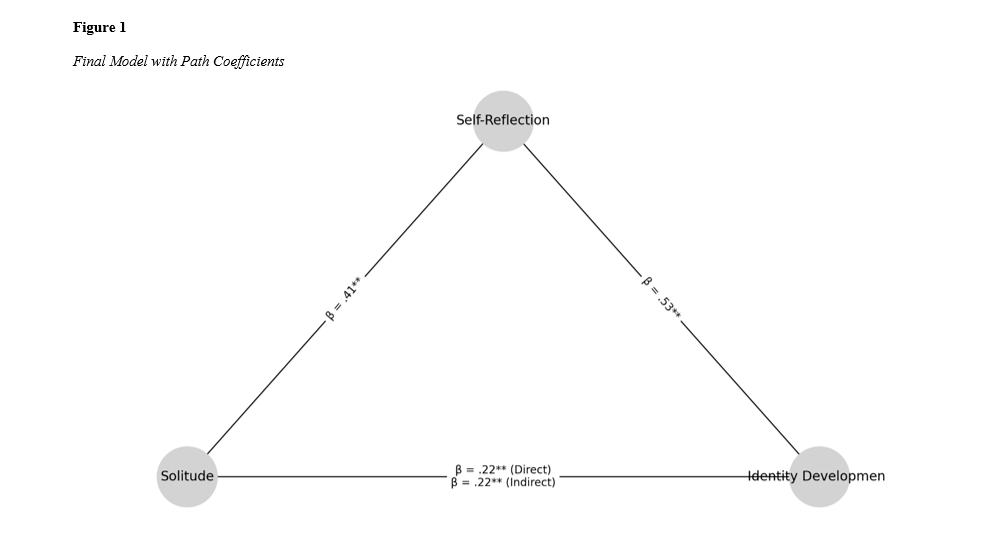
Findings: Descriptive results showed moderate to high levels of solitude (M = 35.42, SD = 5.76), self-reflection (M = 67.89, SD = 9.13), and identity development (M = 101.47, SD = 10.86). Pearson correlations revealed significant positive relationships among solitude, self-reflection, and identity development (p < .001). The SEM model indicated good fit (χ² = 142.36, df = 64, χ²/df = 2.22, GFI = 0.94, AGFI = 0.91, CFI = 0.96, TLI = 0.95, RMSEA = 0.051). Self-reflection significantly mediated the relationship between solitude and identity development. The indirect effect of solitude on identity development through self-reflection (β = 0.22, p < .001) complemented the direct effect (β = 0.22, p < .001), resulting in a total standardized effect of β = 0.44 (p < .001).
Conclusion: The findings highlight the essential role of self-reflection in enhancing the developmental impact of solitude on identity formation. Encouraging reflective practices among adolescents can optimize the psychological benefits of solitude and support more coherent identity development during formative years.
Downloads
References
Adamson, L., & Lyxell, B. (1996). Self-concept and questions of life: Identity development during late adolescence. Journal of adolescence, 19(6), 569-582. https://doi.org/10.1006/jado.1996.0055
Aldahadha Al-Khawaldeh, B., & Mohammed Al-Khawalde, M. A. (2023). The Predictive Power of Ego Identity with Situational Regret Among the Divorced Women in Tafila Governorate. Refereed Journal of Northern Europe Academy for Studies & Research (Denmark), 21. https://ebsco-openurl.publicaciones.saludcastillayleon.es/results?sid=ebsco:ocu:record&bquery=DE+%22DIVORCED%20women%22
Bermingham, L., Meehan, K., Wong, P., & Trub, L. (2021). Attachment anxiety and solitude in the age of smartphones. Psychoanalytic Psychology, 38(4), 311-318. https://doi.org/10.1037/pap0000372
Bosacki, S. (2024). Solitude, Silence and Loneliness in Adolescence. https://doi.org/10.5040/9781350345690
Champ, R. E., Adamou, M., & Tolchard, B. (2023). Seeking connection, autonomy, and emotional feedback: A self-determination theory of self-regulation in attention-deficit hyperactivity disorder. Psychological review, 130(3), 569-603. https://doi.org/10.1037/rev0000398
Coplan, R. J., Hipson, W. E., Archbell, K. A., Ooi, L. L., Baldwin, D., & Bowker, J. C. (2019). Seeking more solitude: Conceptualization, assessment, and implications of aloneliness. Personality and individual differences, 148, 17-26. https://doi.org/10.1016/j.paid.2019.05.020
Hofer, J., & Spengler, B. (2020). How negative parenting might hamper identity development: spontaneous aggressiveness and personal belief in a just world. Self and identity, 19(2), 117-139. https://doi.org/10.1080/15298868.2018.1541026
Javdan, M. (2014). The relationship between self-reflection, family emotional atmosphere, and life skills with aggression in adolescent boys. Journal of Personality and Individual Differences, 3(5), 125-142. https://www.magiran.com/p1353445
Kawamoto, T. (2021). Online self-presentation and identity development: The moderating effect of neuroticism. PsyCh Journal, 10(5), 816-833. https://doi.org/10.1002/pchj.470
Khoshnavay Fomani, F., Mirlashari, J., Sharif Nia, H., Begjani, J., Khoshakhlagh, F., Shiri, M., & Teymuri, E. (2022). Exploring the effects of self-reflection practice on cognitive emotion regulation and resilience among mothers of premature neonates. NPT, 9(3), 211-220. https://doi.org/10.18502/npt.v9i3.10223
Kim, Y.-H. (2023). A Method for Applying Questioning Strategies for Self-Reflection to Supplement Value Clarification Theory. Korea Association Yeolin Edu, 31(3), 199-223. https://doi.org/10.18230/tjye.2023.31.3.199
Kwon, J. (2024). Unravelling the Influence of Buddhist Liberal Arts Education on College Students’ Self-Reflection. Religions, 15(6), 647. https://doi.org/10.3390/rel15060647
MacIsaac, A., Mushquash, A. R., & Wekerle, C. (2022). Writing Yourself Well: Dispositional Self-Reflection Moderates the Effect of a Smartphone App-Based Journaling Intervention on Psychological Wellbeing Across Time. Behaviour Change, 40(4), 297-313. https://doi.org/10.1017/bec.2022.24
Manago, A. M., Graham, M. B., Greenfield, P. M., & Salimkhan, G. (2008). Self-presentation and gender on MySpace. Journal of Applied Developmental Psychology, 29(6), 446-458. https://doi.org/10.1016/j.appdev.2008.07.001
McLean, K. C., & Syed, M. (2016). Personal, Master, and Alternative Narratives: An Integrative Framework for Understanding Identity Development in Context. Human development, 58(6), 318-349. https://doi.org/10.1159/000445817
Naor, L., & Mayseless, O. (2020). The Wilderness Solo Experience: A Unique Practice of Silence and Solitude for Personal Growth. Frontiers in psychology, 11. https://doi.org/10.3389/fpsyg.2020.547067
Nazari, F., Nouhi, S., Jan Bozorgi, M., & Piadeh Kohsar, A. (2023). Effectiveness of Cognitive Behavioral Therapy on Ego Identity Status and Mental Well-Being in People Connected to Virtual Networks. MEJDS, 13(0), 58-58. http://jdisabilstud.org/article-1-3116-en.html
Paz, O. (2021). The Labyrinth of Solitude. Lohe Fekr.
Pedrosa, D., Fontes, M. M., Araújo, T. M. d., Morais, C. G. B., Bettencourt, T., Pestana, P. D., Morgado, L., & Cravino, J. (2021). Metacognitive Challenges to Support Self-Reflection of Students in Online Software Engineering Education. https://doi.org/10.1109/cispee47794.2021.9507230
Suryarini, D. Y., & Bahtiar, R. S. (2021). Exploring Self-Reflection Practice as a Means to Self-Development for Student Teacher of Elementary School Education Study Program. Primaryedu - Journal of Primary Education, 5(1), 88. https://doi.org/10.22460/pej.v5i1.2255
Thomas, V., Carr, B. B., Azmitia, M., & Whittaker, S. (2021). Alone and Online: Understanding the Relationships Between Social Media, Solitude, and Psychological Adjustment. Psychology of Popular Media, 10(2), 201-211. https://doi.org/10.1037/ppm0000287
Downloads
Additional Files
Publication Timeline
- Submitted
- Revised
- Accepted
Issue
Section
License

This work is licensed under a Creative Commons Attribution-NonCommercial 4.0 International License.