The Relationship Between Traumatic Life Events and Negative Symptoms of Schizophrenia: The Mediating Role of Cognitive Biases and Difficulty in Emotion Regulation
DOI:
https://doi.org/10.61838/kman.jarac.3501Keywords:
Schizophrenia, Emotion Regulation Difficulties, Traumatic Life Events, Cognitive Biases, Negative SymptomsAbstract
Objective: Negative symptoms significantly contribute to the burden of illness and reduced quality of life in individuals with schizophrenia. The primary aim of this study was to examine the mediating role of cognitive biases and difficulty in emotion regulation in the relationship between traumatic life events and negative symptoms of schizophrenia.
Methodology: This descriptive study employed a correlational design. The statistical population consisted of all individuals with schizophrenia hospitalized at Razi Psychiatric Hospital in 2023–2024. From this population, 200 participants were selected through convenience sampling. Data collection instruments included the Positive and Negative Syndrome Scale, the Trauma History Questionnaire, the Cognitive Bias Scale, and the Short Form of the Difficulties in Emotion Regulation Scale. Data were analyzed using SPSS and LISREL software, as well as Pearson correlation and structural equation modeling (SEM).
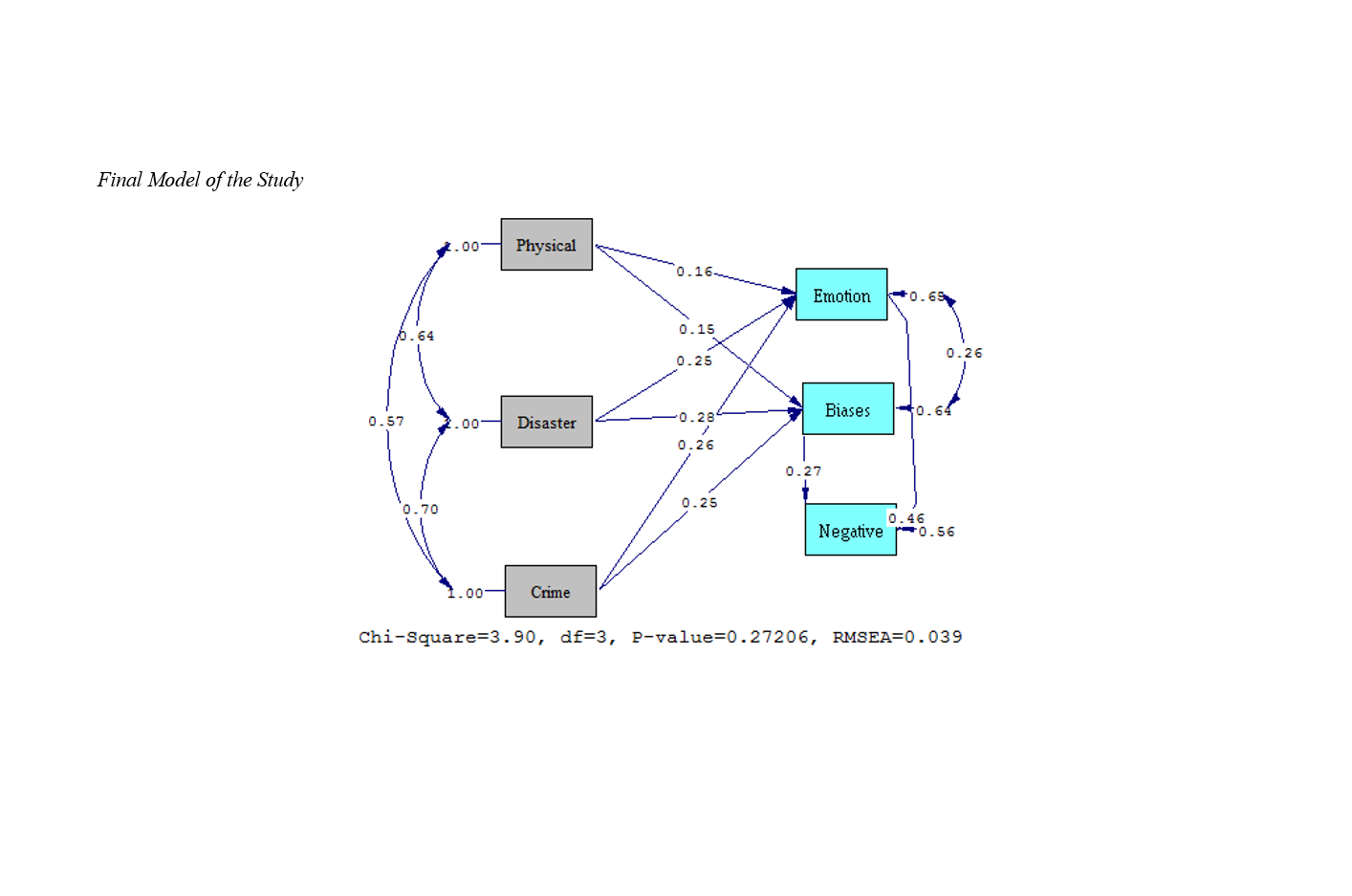
Results: The findings indicated that cognitive biases and difficulty in emotion regulation mediated the relationship between traumatic life events and negative symptoms of schizophrenia (CFI = 1, NNFI = 0.99, IFI = 1, GFI = 0.99, RMSEA = 0.039).
Conclusion: Individuals with schizophrenia who experience traumatic life events are likely to exhibit negative symptoms due to cognitive biases and difficulties in emotion regulation. Therefore, training in emotion regulation skills and enhancing cognitive biases may serve as a critical component in the challenging task of treating negative symptoms of schizophrenia.
Downloads
References
Bartolomeo, L. A., Chapman, H. C., Raugh, I. M., & Strauss, G. P. (2021). Delay discounting in youth at clinical high-risk for psychosis and adults with schizophrenia. Psychological medicine, 51(11), 1898-1905. https://doi.org/10.1017/S0033291720000677
Bartolomeo, L. A., Raugh, I. M., & Strauss, G. P. (2022). Deconstructing emotion regulation in schizophrenia: The nature and consequences of abnormalities in monitoring dynamics. Schizophrenia Research, 240, 135-142. https://doi.org/10.1016/j.schres.2021.12.043
Carbon, M., & Correll, C. U. (2022). Thinking and acting beyond the positive: the role of the cognitive and negative symptoms in schizophrenia. CNS Spectrums, 19(S1), 35-53. https://doi.org/10.1017/S1092852914000601
Chapman, H. C., Visser, K. F., Mittal, V. A., Gibb, B. E., Coles, M. E., & Strauss, G. P. (2020). Emotion regulation across the psychosis continuum. Development and Psychopathology, 32(1), 219-227. https://doi.org/10.1017/S0954579418001682
Correll, C. U., & Schooler, N. R. (2020). Negative symptoms in schizophrenia: a review and clinical guide for recognition, assessment, and treatment. Neuropsychiatric Disease and Treatment, 519-534. https://doi.org/10.2147/NDT.S225643
Dragan, M. (2020). Adverse experiences, emotional regulation difficulties and psychopathology in a sample of young women: Model of associations and results of cluster and discriminant function analysis. European Journal of Trauma & Dissociation, 4(1), 100091. https://doi.org/10.1016/j.ejtd.2018.12.001
Duru, E., & Balkıs, M. (2024). COVID-19 related negative life events and psychological distress: the role of emotion and cognitive emotion regulation strategies. Journal of Rational-Emotive & Cognitive-Behavior Therapy, 42(1), 69-91. https://doi.org/10.1007/s10942-022-00488-6
Galderisi, S., Mucci, A., Buchanan, R. W., & Arango, C. (2018). Negative symptoms of schizophrenia: new developments and unanswered research questions. The Lancet Psychiatry, 5(8), 664-677. https://doi.org/10.1016/S2215-0366(18)30050-6
Gawęda, Ł., Kowalski, J., Aleksandrowicz, A., Bagrowska, P., Dąbkowska, M., & Pionke-Ubych, R. (2024). A systematic review of performance-based assessment studies on cognitive biases in schizophrenia spectrum psychoses and clinical high-risk states: A summary of 40 years of research. Clinical psychology review, 102391. https://doi.org/10.1016/j.cpr.2024.102391
Gawęda, Ł., Prochwicz, K., & Cella, M. (2015). Cognitive biases mediate the relationship between temperament and character and psychotic-like experiences in healthy adults. Psychiatry research, 225(1-2), 50-57. https://doi.org/10.1016/j.psychres.2014.10.006
Ghamari Givi, H., Moulavi, P., & Heshmati, R. (2010). Exploration of the factor structure of positive and negative syndrome scale in schizophrenia spectrum disorder. Journal of Clinical Psychology, 2(2), 1-10. https://jcp.semnan.ac.ir/article_2018.html?lang=en
Gratz, K. L., & Roemer, L. (2004). Multidimensional assessment of emotion regulation and dysregulation: Development, factor structure, and initial validation of the difficulties in emotion regulation scale. Journal of psychopathology and behavioral assessment, 26, 41-54. https://doi.org/10.1023/B:JOBA.0000007455.08539.94
Green, B. L. (1996). Trauma History Questionnaire In - B. H. Stamm (Ed.), Measurement of stress, trauma, and adaptation. In (pp. 366-369). Sidran Press. https://www.researchgate.net/publication/318052047_Measurement_of_stress_trauma_and_adaptation
Isvoranu, A. M., van Borkulo, C. D., Boyette, L. L., Wigman, J. T., Vinkers, C. H., Borsboom, D., & Group, I. (2017). A network approach to psychosis: pathways between childhood trauma and psychotic symptoms. Schizophrenia Bulletin, 43(1), 187-196. https://doi.org/10.1093/schbul/sbw055
Kaufman, E. A., Xia, M., Fosco, G., Yaptangco, M., Skidmore, C. R., & Crowell, S. E. (2016). The Difficulties in Emotion Regulation Scale Short Form (DERS-SF): Validation and replication in adolescent and adult samples. Journal of psychopathology and behavioral assessment, 38(3), 443-455. https://doi.org/10.1007/s10862-015-9529-3
Kay, S. R., Fiszbein, A., & Opler, L. A. (1987). The positive and negative syndrome scale (PANSS) for schizophrenia. Schizophrenia Bulletin, 13(2), 261-276. https://doi.org/10.1093/schbul/13.2.261
Khoramimanesh, S., & Mansouri, A. (2019). The mediating role of cognitive emotion regulation and spiritual coping in the relationship between the history of trauma and symptoms of borderline personality. Journal of Research in Behavioural Sciences, 17(1), 1-11. https://doi.org/10.52547/rbs.17.1.1
Kimhy, D., Lister, A., Liu, Y., Vakhrusheva, J., Delespaul, P., Malaspina, D., & Wang, Y. (2020). The impact of emotion awareness and regulation on psychotic symptoms during daily functioning. npj Schizophrenia, 6(1), 7. https://doi.org/10.1038/s41537-020-0096-6
Krkovic, K., Krink, S., & Lincoln, T. M. (2018). Emotion regulation as a moderator of the interplay between self-reported and physiological stress and paranoia. European Psychiatry, 49, 43-49. https://doi.org/10.1016/j.eurpsy.2017.12.002
Livet, A., Navarri, X., Potvin, S., & Conrod, P. (2020). Cognitive biases in individuals with psychotic-like experiences: A systematic review and a meta-analysis. Schizophrenia Research, 222, 10-22. https://doi.org/10.1016/j.schres.2020.06.016
Ma, Y., Chiappelli, J., Kvarta, M. D., Bruce, H., van der Vaart, A., Goldwaser, E. L., & Hong, L. E. (2023). Effects of independent versus dependent stressful life events on major symptom domains of schizophrenia. Schizophrenia, 9(1), 84. https://doi.org/10.1038/s41537-023-00415-3
McCutcheon, R. A., Marques, T. R., & Howes, O. D. (2020). Schizophrenia-an overview. JAMA Psychiatry, 77(2), 201-210. https://doi.org/10.1001/jamapsychiatry.2019.3360
Menon, V. (2020). Brain networks and cognitive impairment in psychiatric disorders. World Psychiatry, 19(3), 309-310. https://doi.org/10.1002/wps.20799
Mętel, D., Arciszewska, A., Daren, A., Pionke, R., Cechnicki, A., Frydecka, D., & Gawęda, Ł. (2020). Mediating role of cognitive biases, resilience and depressive symptoms in the relationship between childhood trauma and psychotic‐like experiences in young adults. Early Intervention in Psychiatry, 14(1), 87-96. https://doi.org/10.1111/eip.12829
Morrison, A. P., French, P., & Wells, A. (2007). Metacognitive beliefs across the continuum of psychosis: Comparisons between patients with psychotic disorders, patients at ultra-high risk and non-patients. Behaviour Research and Therapy, 45(9), 2241-2246. https://doi.org/10.1016/j.brat.2007.01.002
Nabizadeh asl, D., Ahi, Q., Shahabizadeh, F., & Mansouri, A. (2020). The Mediating Role of Cognitive Emotion Regulation, Cognitive Biases, and Negative Schemas in the Relationship between Traumatic Childhood Experiences and Psychotic-Like Experiences. Journal of Research in Behavioural Sciences, 18(3), 320-335. https://doi.org/10.52547/rbs.18.3.320
Nuechterlein, K. H., Dawson, M. E., Gitlin, M., Ventura, J., Goldstein, M. J., Snyder, K. S., & Mintz, J. (1992). Developmental processes in schizophrenic disorders: longitudinal studies of vulnerability and stress. Schizophrenia Bulletin, 18(3), 387-425. https://doi.org/10.1093/schbul/18.3.387
Phiri, P., Rathod, S., Carr, H., & Kingdon, D. (2017). A brief review of key models in cognitive behaviour therapy for psychosis. Acta Psychopathol, 3(84), 10-4172. https://doi.org/10.4172/2469-6676.100156
Pionke-Ubych, R., Frydecka, D., Cechnicki, A., Nelson, B., & Gawęda, Ł. (2021). The Indirect Effect of Trauma via Cognitive Biases and Self-Disturbances on Psychotic-Like Experiences. Frontiers in Psychiatry, 12, 611069. https://doi.org/10.3389/fpsyt.2021.611069
Popovic, D., Schmitt, A., Kaurani, L., Senner, F., Papiol, S., Malchow, B., & Falkai, P. (2019). Childhood trauma in schizophrenia: current findings and research perspectives. Frontiers in Neuroscience, 13, 274. https://doi.org/10.3389/fnins.2019.00274
Shamsabadi, A., Ahi, Q., Bahreinian, S. A., Mansouri, A., & Shahabizadeh, F. (2023). The Mediating Role of Difficulties in Emotion Regulation and Personality Organization in the Relationship between Object Relations and Non-suicidal Self-injury. Rooyesh-e-Ravanshenasi Journal (RRJ), 12(6), 151-162. https://frooyesh.ir/article-1-4498-en.html
Underwood, R., Kumari, V., & Peters, E. (2016). Cognitive and neural models of threat appraisal in psychosis: a theoretical integration. Psychiatry research, 239, 131-138. https://doi.org/10.1016/j.psychres.2016.03.016
Uyan, T. T., Baltacioglu, M., & Hocaoglu, C. (2022). Relationships between childhood trauma and dissociative, psychotic symptoms in patients with schizophrenia: a case-control study. General Psychiatry, 35(1). https://doi.org/10.1136/gpsych-2021-100659
van der Gaag, M., Schütz, C., Ten Napel, A., Landa, Y., Delespaul, P., Bak, M., & De Hert, M. (2013). Development of the Davos assessment of cognitive biases scale (DACOBS). Schizophrenia Research, 144(1-3), 63-71. https://doi.org/10.1016/j.schres.2012.12.010
Zahid, A., & Best, M. W. (2023). Examining Cognitive Biases Uniquely Associated with Schizotypy. Psychopathology, 1-11. https://doi.org/10.1159/000529742
Downloads
Additional Files
Publication Timeline
- Submitted
- Revised
- Accepted
Issue
Section
License
Copyright (c) 2025 Hadi Razmyar (Author); Ahmad Mansouri (Corresponding Author); Qasem Ahi, Seyed Abdolmajid Bahreinian, Fahime Saied (Author)

This work is licensed under a Creative Commons Attribution-NonCommercial 4.0 International License.