The Effectiveness of Self-Talk Training on Craving, Mental Health, and Rejection Sensitivity in Individuals with Substance Dependence
DOI:
https://doi.org/10.61838/kman.jarac.3379Keywords:
Self-talk, Mental health, Sensitivity to rejection, CravingAbstract
Objective: This study aimed to determine the effectiveness of self-talk training on craving, mental health, and rejection sensitivity in individuals with substance use disorders.
Methods and Materials: The research utilized a quasi-experimental design with pre-test, post-test, and follow-up phases. The statistical population included all opioid substance abusers who referred to outpatient treatment centers in Nasim Shahr during 2021–2022, from which 60 participants were selected through purposive sampling based on the inclusion criteria. Data collection instruments included a demographic information checklist (researcher-developed form), the Craving Assessment Questionnaire for Substance Use after Abstinence (Salehi Fedardi et al., 2011), the Mental Health Continuum-Short Form (Keyes, 2002), and the Rejection Sensitivity Questionnaire (Downey & Feldman, 1996). The self-talk training program was conducted over 10 sessions for the experimental groups, while no interventions were implemented for the control group. Data were analyzed using statistical assumption tests and repeated measures analysis of variance with SPSS software version 26.
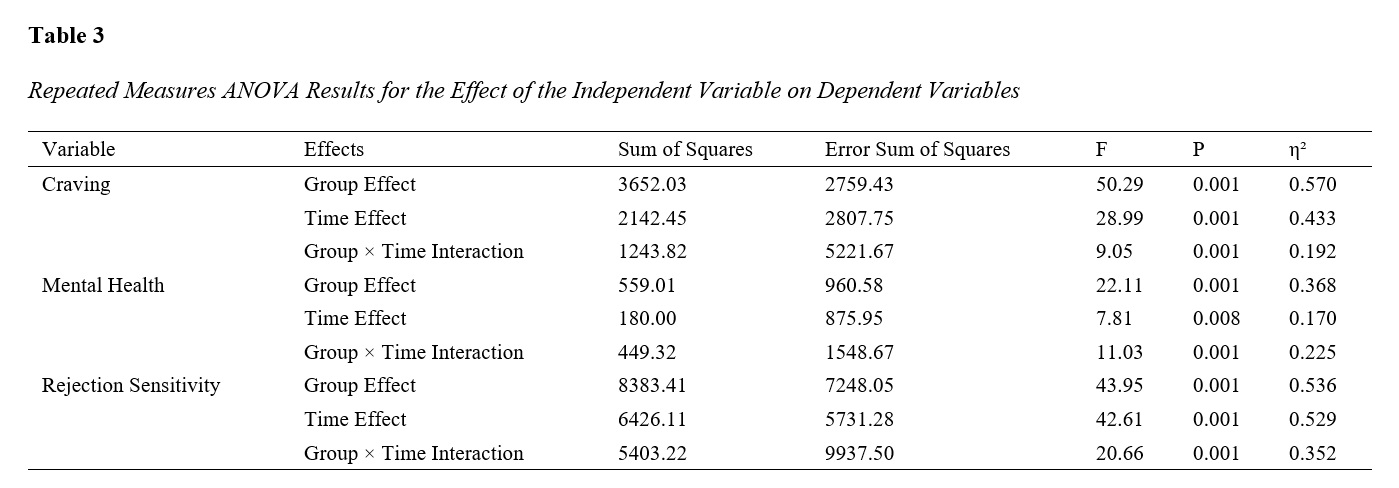
Findings: Results indicated a significant interaction effect between group membership and time across pre-test, post-test, and follow-up phases in the linear combination of craving, mental health, and rejection sensitivity variables (p < .05).
Conclusion: It can be concluded that self-talk training was effective in reducing craving and rejection sensitivity while improving mental health in individuals with substance use disorders.
Downloads
References
Asi Kooshsefahani, A., & Baradaran, M. (2022). The Effectiveness of Mindfulness Training on Cognitive-Emotional Regulation, Experiential Avoidance, and Methadone Dose Reduction in Patients Undergoing Methadone Treatment. Addiction Research Journal, 16(66), 291-310. https://doi.org/10.52547/etiadpajohi.16.66.291
Bahrami, B. (2019). The role of academic self-handicapping and rejection sensitivity in predicting aggressive behaviors in students with specific learning disabilities Shahid Madani University of Azerbaijan]. http://pajouhesh.azaruniv.ac.ir/_Pages/ResearchEN.aspx?ID=29943
Dahl-Leonard, K., Hall, C., Beegle, B., & Capin, P. (2022). Teaching Readers to Recognize Negative Thoughts and Use Positive Self-Talk. Intervention in School and Clinic. https://doi.org/10.1177/10534512221140537
Dyar, C., Feinstein, B. A., Bettin, E., & Davila, J. (2022). Bisexual+ visibility attempts: Associations with minority stress, affect, and substance use in a daily diary study. Psychology of Sexual Orientation and Gender Diversity, 9(2), 201. https://doi.org/10.1037/sgd0000469
Ghalami, Z. (2017). Comparing the Effectiveness of Two Methods of Positive Self-Talk and Self-Control Training on Academic Adjustment and Self-Efficacy of Female High School Students Faculty of Psychology and Educational Sciences, Allameh Tabataba'i University]. https://en.civilica.com/doc/1040546/
Golestaneh, A., Tajeri, B., Barj Ali, M., Sobhi Gharamaleki, N., & Sarrami Foroushani, G. (2021). Determining Drug Craving Based on Emotion Regulation Behavior, Psychological Capital, and Problem-Solving Style in Addicted Men Aged 20 to 45 Years. Journal of Disability Studies, 7(11), 1-12. https://jdisabilstud.org/browse.php?a_id=2167&slc_lang=en&sid=1&printcase=1&hbnr=1&hmb=1
Hoskote, A. R., Croce, E., & Johnson, K. E. (2023). The evolution of the role of US school nurses in adolescent mental health at the individual, community, and systems level: An integrative review. The Journal of School Nursing, 39(1), 51-71. https://doi.org/10.1177/10598405211068120
Kross, E., & Ayduk, O. (2017). Self-distancing: Theory, research, and current directions. In Advances in experimental social psychology (Vol. 55, pp. 81-136). Academic Press. https://doi.org/10.1016/bs.aesp.2016.10.002
Li, X., Laplante, D. P., Paquin, V., Lafortune, S., Elgbeili, G., & King, S. (2022). Effectiveness of cognitive behavioral therapy for perinatal maternal depression, anxiety and stress: A systematic review and meta-analysis of randomized controlled trials. Clinical psychology review, 92. https://doi.org/10.1016/j.cpr.2022.102129
Mark, T. L., Treiman, K., Padwa, H., Henretty, K., Tzeng, J., & Gilbert, M. (2022). Addiction treatment and telehealth: review of efficacy and provider insights during the COVID-19 pandemic. Psychiatric Services, 73(5), 484-491. https://doi.org/10.1176/appi.ps.202100088
Niu, G. F., Shi, X. H., Yao, L. S., Yang, W. C., Jin, S. Y., & Xu, L. (2022). Social Exclusion and Depression among undergraduate students: The mediating roles of rejection sensitivity and social self-efficacy. Current Psychology, 1-10. https://doi.org/10.1007/s12144-022-03318-1
Rizal, R. M., Asmawi, M., & Lubis, J. (2021). Effect of Self-Talk on Petanque Shooting Accuracy. International Journal of Human Movement and Sports Sciences, 9(4), 807-813. https://doi.org/10.13189/saj.2021.090427
Rohmah, P. Z., Hidayati, D. L., Aisha, M. N., & Purwandari, E. (2022). Positive Self-Talk Intervention to Decrease Stress in Parents of Children With Special Needs. Dimas Jurnal Pemikiran Agama Untuk Pemberdayaan, 22(2), 181-200. https://doi.org/10.21580/dms.2022.222.13270
Romm, K. F., Patterson, B., Crawford, N. D., Posner, H., West, C. D., Wedding, D., & Berg, C. J. (2022). Changes in young adult substance use during COVID-19 as a function of ACEs, depression, prior substance use and resilience. Substance Abuse, 43(1), 212-221. https://doi.org/10.1080/08897077.2021.1930629
Shariati, F. K., & Jamal. (2013). The Effect of Different Types of Self-Talk on Balance Performance in Healthy Elderly Individuals. Journal of Motor Development and Sports Learning, 5(13), 119-133. https://jsmdl.ut.ac.ir/article_32138.html?lang=en
Thomaes, S., Tjaarda, I. C., Brummelman, E., & Sedikides, C. (2020). Effort self‐talk benefits the mathematics performance of children with negative competence beliefs. Child development, 91(6), 2211-2220. https://doi.org/10.1111/cdev.13347
Downloads
Additional Files
Publication Timeline
- Submitted
- Revised
- Accepted
Issue
Section
License
Copyright (c) 2025 Maryam Beheshti (Author); Hossein Ebrahimi Moghadam (Corresponding Author); Nasrin Bagheri (Author)

This work is licensed under a Creative Commons Attribution-NonCommercial 4.0 International License.