Effectiveness of Play Therapy-Based Interventions and Their Impact on Improving Socio-Emotional Skills in Children with Speech Disorders
DOI:
https://doi.org/10.61838/kman.jarac.3373Keywords:
Play therapy, socio-emotional skills, speech disordersAbstract
Objective: This study aimed to determine the effectiveness of play therapy-based interventions and their impact on improving socio-emotional skills in children with speech disorders in Tehran.
Methods and Materials: This research method was a quasi-experimental design with a pre-test and post-test, along with a control group and a follow-up phase. The statistical population of this study included children with speech disorders who visited the Roozbeh Speech Therapy Center in Tehran in 2024. The research sample consisted of 32 boys aged 5 to 6 years, selected through purposive sampling. They were then divided into two groups of 16, comprising an experimental group and a control group. The experimental group received 12 sessions of play therapy. Data were collected using the Miller Socio-Emotional Skills Questionnaire (1997) and analyzed through mixed analysis of variance with repeated measures in SPSS22.
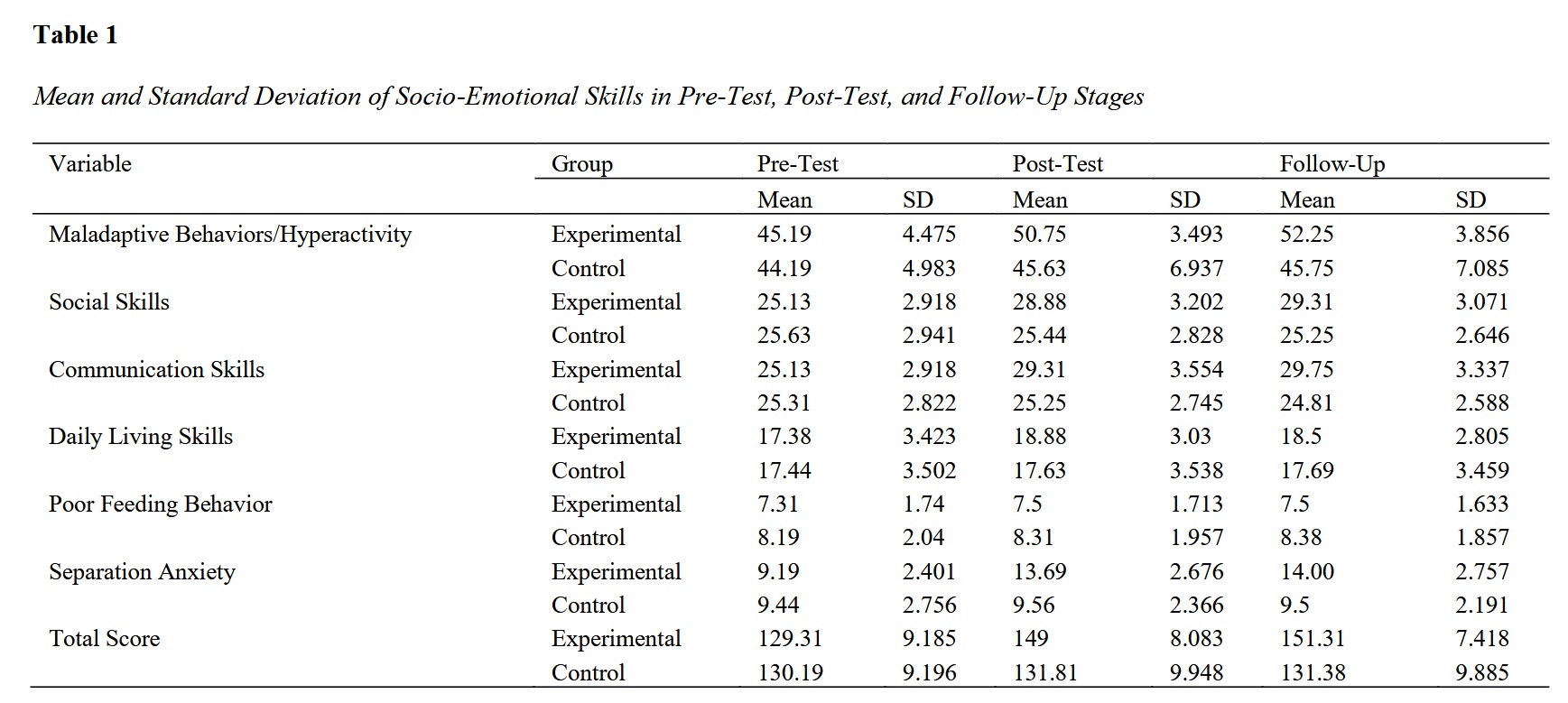
Findings: The results of this study indicated that the intervention was effective in changing the socio-emotional skill scores of children with speech disorders. The differences from the post-test to the follow-up phase were not statistically significant (p > .05). This indicates that the results were sustained over the follow-up phase, and the effectiveness of the play therapy-based interventions on improving socio-emotional skills in children with speech disorders remained stable.
Conclusion: The findings suggest that play therapy, as a multidimensional intervention, helps children with speech disorders enhance their socio-emotional skills across all dimensions.
Downloads
References
Abbasi, A., Aghaei Jeshvaghani, A., & Ebrahimi moghasam, H. (2020). Effectiveness of metacognition therapy on the anxiety and psychological wellbeing of the patients with generalized anxiety. medical journal of mashhad university of medical sciences, 63(5), 2745-2756. https://doi.org/10.22038/mjms.2021.17348
Anderson, K., Thomas, L., & Brown, T. (2019). A Review of Social-Emotional Development in Children with Speech Disorders. Journal of Speech-Language Pathology, 24(2), 150-165.
Ardestani Balaie, Z., Banisi, P., & Zomorodi, S. (2021). The effectiveness of emotion therapy on psychological well-being, social acceptance and social adequacy of teachers. Journal of Pouyesh in Education and Consultation (JPEC), 1400(14), 147-168. https://educationscience.cfu.ac.ir/article_1855.html
Barton, A. W., Lavner, J. A., Sutton, N. C., McNeil Smith, S., & Beach, S. R. (2022). African Americans’ relationship quality and depressive symptoms: A longitudinal investigation of the Marital Discord Model. Journal of Family Psychology. https://doi.org/10.1037/fam0000967
Beitchman, J. H., & Brownlie, E. B. (2014). Language disorders and social outcomes. Clinical psychology review, 34(3), 185-193.
Beryamani, S., Asadi, J., & Khahvand, A. (2018). The effectiveness of play therapy on social adjustment and communication skills of deaf children. Rehabilitation, 3(19), 250-260. https://doi.org/10.32598/rj.19.3.250
Booker, J. A., Capriola-Hall, N. N., Greene, R. W., & Ollendick, T. H. (2020). The Parent–Child Relationship and Posttreatment Child Outcomes Across Two Treatments for Oppositional Defiant Disorder. Journal of Clinical Child & Adolescent Psychology, 49(3), 405-419. https://doi.org/10.1080/15374416.2018.1555761
Bratton, S. C., Ray, D., & Rhine, T. (2005). The effectiveness of play therapy: Responding to critics. International Journal of Play Therapy, 14(1), 33-64. https://psycnet.apa.org/record/2001-05142-004
Bruinsma, G. I. (2024). Communication in Daily Life of Children With Developmental Language Disorder: Parents' and Teachers' Perspectives. Language Speech and Hearing Services in Schools, 55(1), 105-129. https://doi.org/10.1044/2023_lshss-23-00051
Carter, S., & Wilson, N. (2020). The Role of Play Therapy in Addressing Communication Disorders. Journal of Play Therapy, 29(4), 25.
Conti-Ramsden, G., Durkin, K., & Simkin, Z. (2012). Challenges of social communication. Developmental Psychology, 48(5), 1230-1240.
Dadestan, P., Asgari, A., Rahimzadeh, S., & Biat, M. (2010). Screening questionnaire for social/emotional disorders in preschool children: A cross-validation study. Developmental Psychology (Iranian Psychologists), 7(25), 7-27. https://www.sid.ir/paper/101447/en
Davidson, D., & Stagnitti, K. (2021). The process of Learn to Play Therapy with parent-child dyads with children who have autism spectrum disorder. Australian Occupational Therapy Journal, 68(2), 120-128. https://doi.org/10.1111/1440-1630.12751
Denham, S. A., Bassett, H. H., & Zinsser, K. (2012). Early childhood teachers as socializers of young children's emotional competence. Early Childhood Education Journal, 40(3), 137-143. https://doi.org/10.1007/s10643-012-0504-2
Dockrell, J. E., Lindsay, G., & Palikara, O. (2011). Social anxiety in speech disorders. Journal of Child Psychology, 52(4), 310-318.
Eisma, M. C., de Lang, T. A., & Boelen, P. A. (2020). How thinking hurts: Rumination, worry, and avoidance processes in adjustment to bereavement. Clinical Psychology & Psychotherapy, 27(4), 548-558. https://doi.org/10.1002/cpp.2440
Gonzalez, L., Carter, S., & Wilson, N. (2023). Advances in Play-Based Therapy for Speech Disorders. International Journal of Developmental Psychology, 48(2), 132-144.
Guerney, L. F. (2001). Play therapy techniques for social skills. Journal of Play Therapy, 10(2), 95-105. https://doi.org/10.1037/h0089477
Li, S., Sun, J., & Dong, J. (2022). Family Socio-Economic Status and Children's Play Behaviors: The Mediating Role of Home Environment. Children, 9(9), 1385. https://doi.org/10.3390/children9091385
McLeod, S., & Harrison, L. J. (2020). Epidemiology of speech and language impairment in children. Journal of Speech, Language, and Hearing Research, 63(1), 75-84. https://pubmed.ncbi.nlm.nih.gov/19403947/
Merrell, K. W., & Gueldner, B. A. (2011). Social and emotional learning in the classroom: Promoting mental health and academic success. The Guilford Press. https://www.guilford.com/books/Social-and-Emotional-Learning-in-the-Classroom/Gueldner-Feuerborn-Merrell/9781462544011?srsltid=AfmBOor3lPILxlq4nW9bAxjIt_FxfGh4_JBexoWMUlmHxO6YNXtrvph7
O'Connor, K., Schaefer, C. E., & Braverman, L. D. (2015). Handbook of play therapy. John Wiley & Sons. https://doi.org/10.1002/9781119140467
Olswang, L., Svensson, L., & Sullivan, K. (2013). Speech disorders in early childhood. Pediatrics Research, 72(3), 220-227.
Paul, R., & Norbury, C. F. (2012). Language Disorders from Infancy through Adolescence. Mosby. https://books.google.fr/books/about/Language_Disorders_from_Infancy_Through.html?id=maGQtryS8xcC&redir_esc=y
Rae, H., Lee, C., & White, M. (2021). The Efficacy of Play Therapy for Social-Emotional Development in Speech-Delayed Children. Child and Family Therapy Review, 29(3), 185-196.
Williams, R. (2019). Speech and language disorders in children: Social implications. Journal of Child Psychology and Psychiatry, 60(4), 234-242.
Yogman, M., & et al. (2018). The Power of Play: A Pediatric Role in Enhancing Development in Young Children. Pediatrics, 142(3), e20182058. https://doi.org/10.1542/peds.2018-2058
Downloads
Additional Files
Publication Timeline
- Submitted
- Revised
- Accepted
Issue
Section
License
Copyright (c) 2025 Zahra Soltani pari (Corresponding Author); Fatemeh Ghonji Feshki, Somayeh Mohammadi Moghadam , Farah Khalighi , Soroush Alimardani (Author)

This work is licensed under a Creative Commons Attribution-NonCommercial 4.0 International License.