Comparing the Effectiveness of Emotionally Focused Couples Therapy (Susan Johnson Model) and Schema Therapy on Self-Esteem and Cognitive Emotion Regulation in Conflicted Couples
DOI:
https://doi.org/10.61838/kman.jarac.3215Keywords:
Self-esteem, Cognitive emotion regulation, Emotionally Focused Couple Therapy, Schema Therapy, Marital conflictAbstract
Objective: This study aimed to compare the effectiveness of Emotionally Focused Couples Therapy and Schema Therapy on self-esteem and cognitive emotion regulation in conflicted couples.
Methodology: This research employed a quasi-experimental design with pre-test, post-test, and control group. A sample of 60 individuals (30 couples) was selected using convenience sampling and randomly divided into three groups of 10 couples each. The first experimental group received Emotionally Focused Couples Therapy, while the second experimental group received Schema Therapy. The control group received no treatment. Data were collected using the Marital Forgiveness Questionnaire and analyzed using repeated measures analysis of variance.
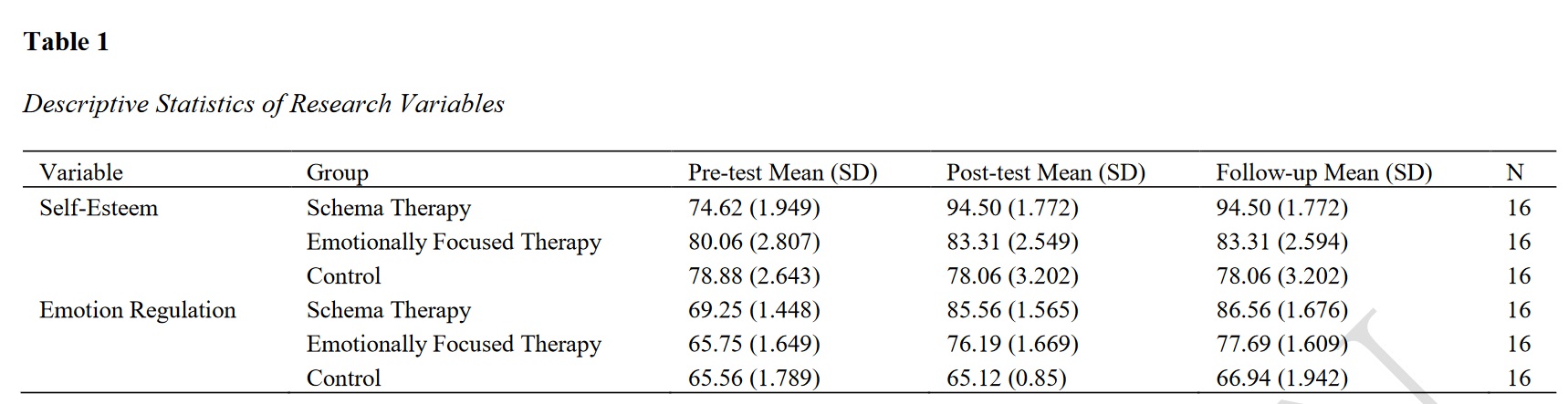
Findings: The results indicated that both therapeutic approaches were effective in enhancing self-esteem and cognitive emotion regulation (P<0.05), though Schema Therapy showed a greater impact than Emotionally Focused Couples Therapy. A significant difference was observed between the experimental groups and the control group in terms of self-esteem and cognitive emotion regulation variables.
Conclusion: Schema Therapy is more effective than Emotionally Focused Couples Therapy in increasing self-esteem and cognitive emotion regulation. These findings underscore the importance of Schema Therapy in improving marital relationships and reducing conflicts.
Downloads
References
Acosta-Gonzaga, E. (2023). The Effects of Self-Esteem and Academic Engagement on University Students’ Performance. Behavioral Sciences, 13(4), 348. https://doi.org/10.3390/bs13040348
Almurumudhe, L. K. A., Mahdad, A., Abdulkadhim Johni, A., & Yousefi, Z. (2024). The Mediating Role of Self-Esteem in the Relationship between Psychological Capital, Academic Engagement, and Academic Procrastination with Academic Performance among Students in Al-Diwaniyah, Iraq [Research Article]. Iranian Journal of Educational Sociology, 7(3), 1-9. https://doi.org/10.61838/kman.ijes.7.3.1
Arshad, M., Imran Haider Zaidi, M., & Mahmood, K. (2015). Self-Esteem & Academic Performance among University Students. Journal of Education and Practice, 6(1), 156-162. https://www.sid.ir/FileServer/JF/10005013961904
Bahrami, Z., & Akbari Borang, M. (2023). The Relationship Between Self-Esteem and Marital Conflicts in College Students [Research]. journal of Psychology new Ideas, 16(20), 0-0. http://jnip.ir/article-1-938-en.html
Bautista, Z., Gamosa, M., Pacia, J., Parjan, A., Pepito, J., Soberano, A., & Tolentino, J. (2017). The Relationship between Self-Esteem and Academic Performance among College Students of the Polytechnic University of the Philippines-Biñan Campus
Dattilio, F. M. (2012). Cognitive-behavioral therapy with couples and families: A comprehensive guide. Arjmand Press. https://www.researchgate.net/publication/283332023_Cognitive-Behavior_Therapy_with_Couples_and_Families_A_Comprehensive_Guide_for_Clinicians
Deldadeh mehraban, M., Hasanzadeh, R., & Karimi, R. (2023). The effectiveness of couple therapy based on schema and ACT on marital boredom and emotion regulation in nurses with marital conflicts. Applied Family Therapy Journal (AFTJ), 4(2), 315-332. https://doi.org/10.61838/kman.aftj.4.2.20
Faro, L., Palmer, K., Johnson, S., Fowler, M., & Palmer-Olsen, L. (2019). Emotion regulation strategies in EFT. Journal of Marital Therapy, 45(4), 380-395.
Ferreira, T., Matias, M., Carvalho, H., & Matos, P. M. (2024). Parent-partner and parent-child attachment: Links to children's emotion regulation. Journal of Applied Developmental Psychology, 91, 101617. https://doi.org/10.1016/j.appdev.2023.101617
Finney, S. R., & Karantzas, G. (2018). Conflict resolution in close relationships. Journal of Interpersonal Relationships, 45(3), 311-325.
Gies-Davis, J., Paim, J., Dillon, J., & Tuerbat, L. (2018). Regulating emotions in emotionally focused couples therapy. Journal of Emotionally Focused Therapy, 22(3), 301-318. https://doi.org/10.4324/9780429480478-1
Gossel, M., Nicholas, T., Schmiedler, S., & Segrer, H. (2020). Marital conflict and mental health referrals. Journal of Family Psychology, 40(3), 150-160.
Harvey, D. (2013). Emotionally focused therapy for couples. Jungle Press.
Kavosh Meli, F., & Moheb, A. (2022). Schema therapy and its effect on marital satisfaction in Iranian couples. Journal of Counseling Psychology, 44(2), 145-162.
Khamseh, M. (2020). Communication Issues and Divorce in Transitional Societies. Family Psychology Journal, 23(1), 35-45.
Khantzian, E. J. (1997). The Self-Medication Hypothesis of Substance Use Disorders: A Reconsideration and Recent Applications. Harvard Review of Psychiatry, 4(5). https://journals.lww.com/hrpjournal/fulltext/1997/01000/the_self_medication_hypothesis_of_substance_use.1.aspx
Lee, H.-S. (2019). The mediating effects of self-esteem in the relationship between marital conflict and school adjustment for adolescents. Journal of Convergence for Information Technology, 9(12), 175-183. https://koreascience.kr/article/JAKO201908559987088.pdf
Lee, Y.-E. (2023). Relations between childhood emotional insecurity, self-esteem, and adulthood marital conflict in South Korea. Family Relations, 72(4), 1926-1941. https://doi.org/10.1111/fare.12743
Malekzadeh, l., Emadi, S. Z., & naghsh, z. (2024). The Effectiveness of Group Schema Therapy on Cognitive Emotion Regulation and Emotional Behavior Regulation in Mothers with Children with Learning Disabilities. Psychology of Exceptional Individuals, 14(53), 201-227. https://doi.org/10.22054/jpe.2023.71499.2524
Mohammadi, S., Hafezi, F., Ehteshamzadeh, P., Eftekhar Saadi, Z., & Bakhtiarpour, S. (2020). The effect of schema therapy on sexual self-esteem in the women involved in marital conflicts. Women’s Health Bulletin, 7(2), 49-55. https://womenshealthbulletin.sums.ac.ir/article_46717.html
Montgomery, B. (2002). Interactive processes in marital conflict In - Denkob, P. & Mirza, H. (Eds.) Conflict and marriage. In (pp. 88-102). Science Publishers.
Moradi, A., Tabrizi, N., Koohi, M., & Azimzadeh, A. (2021). Emotionally focused couples therapy in Iranian context. Iranian Journal of Counseling and Psychotherapy, 14(3), 180-195.
Rostaei, F., & Mostafaei, S. (2023). The impact of schema therapy on marital conflict resolution. Journal of Psychological studies, 42(1), 97-112. https://jnip.ir/article-1-923-fa.html
Shalchi, B., Vahidnia, B., Dadkhah, M., Alipouri Niaz, M., & Moghimifam, P. (2017). Comparation of Affective -Behavioral Disorders and Social Skills among Normal Adolescents and institutional children of Social Welfare Bureau. Yektaweb_Journals, 17(67), 173-201. http://refahj.uswr.ac.ir/article-1-3094-en.html
Tahmasebi, Z. (2022). The effect of schema therapy on reducing marital conflicts. Journal of Family Therapy Studies, 19(3), 210-225.
Vajapillai, S., & Reese, D. (2019). Satisfaction in marital relationships: The role of emotional focus. Journal of Interpersonal Relationships, 41(3), 315-330.
Van Wijck-Herbrink, M., Visser, H., & Finckenauer, J. (2021). Schema therapy for couples: Improving emotional regulation. Journal of Psychological Therapy, 29(4), 267-283.
Walter, M., & Johnson, T. (2018). Schema therapy and its effect on anxiety and depression. Journal of Clinical Psychology, 35(1), 40-55.
Welch, T., Lachmer, A., & Whiteborn, S. (2019). The positive impact of EFT on marital satisfaction. Journal of Couple Therapy, 32(1), 140-156.
Wiebe, S., Johnson, S., Burgess-Moser, M., Dalgleish, T., & Tasca, G. (2017). Emotionally focused therapy for couples: Enhancing trust and intimacy. Journal of Family Therapy, 38(2), 230-245.
Wilson, G. E., Andridge, R., Bailey, M., Maralchi, S., & Kiecolt-Glaser, J. K. (2017). Marital conflict and power dynamics. Journal of Family Relations, 32(4), 207-220.
Young, J. E. (2012). Theories and techniques in schema therapy. Ravan Press.
Young, J. E., Klosko, J. S., & Weishar, M. E. (2014). Schema therapy: A practitioner's guide. Danjeh Publications. https://books.google.com/books/about/Schema_Therapy.html?id=vScjGGgJEZgC
Zhou, Y., & Buhler, J. (2019). Divorce and marital problems in modern societies. Journal of Social Psychology, 52(2), 120-135.
Downloads
Additional Files
Publication Timeline
- Submitted
- Revised
- Accepted
Issue
Section
License
Copyright (c) 2025 Aida Nosrat Talab Haghi (Author); Mahmoud Jajarmi (Corresponding Author); Abolfazl Bakhshipour (Author)

This work is licensed under a Creative Commons Attribution-NonCommercial 4.0 International License.