Evaluating the Validity and Reliability of the Persian Version of the Cyber-Relationship Motives Questionnaire
DOI:
https://doi.org/10.61838/kman.jarac.2340Abstract
Objective: This study aimed to evaluate the validity and reliability of the Persian version of the Cyber-Relationship Motives (CRM) questionnaire among Iranian university students.
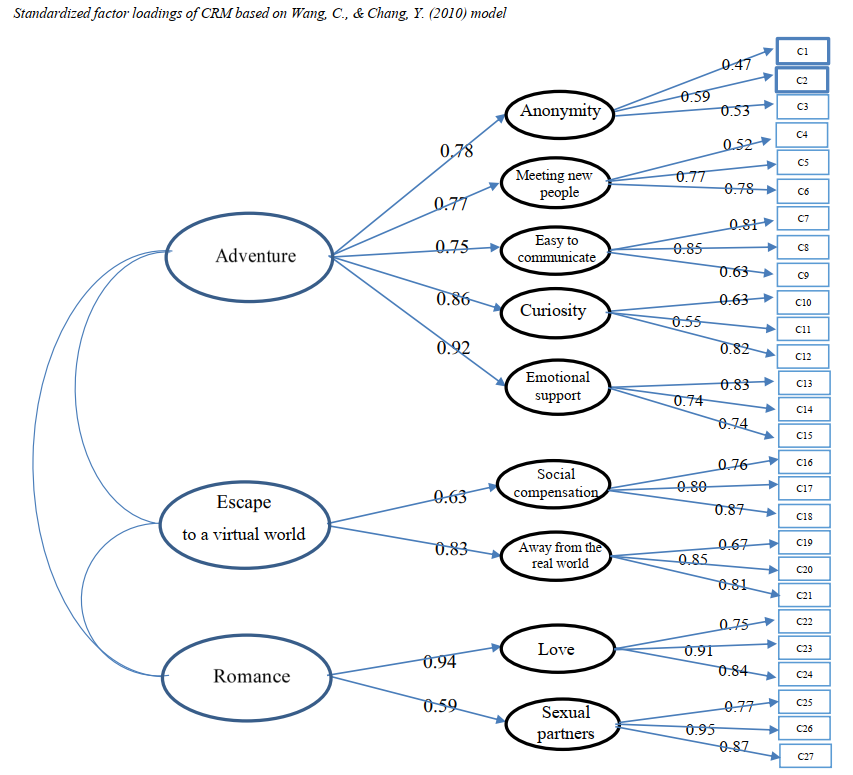
Methods and Materials: A total of 475 students from the University of Kurdistan (70.5% female; mean age = 22, SD = 3) completed the CRM and the Internet Affective Relationships Inventory (IARI). The CRM was translated into Persian using a forward–backward translation method, reviewed by expert committees, and refined through iterative revisions. Data collection employed paper-based surveys, and 100 additional participants with internet access but no preference for online social interactions were included for discriminant validity testing. Structural validity was examined via confirmatory factor analysis (CFA) using AMOS-25, with model fit assessed through indices including CMIN/df, AGFI, GFI, CFI, PNFI, TLI, and RMSEA. Internal consistency was evaluated using Cronbach’s alpha, test–retest reliability through Pearson correlation, and convergent and concurrent validity via correlations with IARI.
Findings: CFA confirmed the nine-factor structure of the CRM, showing acceptable fit indices (CMIN/df = 2.741; CFI = 0.92; TLI = 0.91; RMSEA = 0.061). Cronbach’s alpha coefficients ranged from 0.47 to 0.97 across subscales, with the overall scale α = 0.92, indicating good internal consistency. Test–retest reliability over one month ranged from r = 0.71 to r = 0.92 (p < 0.01). Significant positive correlations were found between CRM subscales and IARI dimensions, supporting convergent validity. Discriminant validity testing revealed that participants preferring online interactions scored significantly higher on adventure, escape to a virtual world, and romance dimensions (p < 0.01). Gender differences emerged in the romance dimension, with men scoring higher than women, particularly in the “finding a sexual partner” subscale.
Conclusion: The Persian version of the CRM questionnaire demonstrated robust psychometric properties, confirming its validity and reliability for assessing motives behind cyber-relationships in Iranian contexts. Its stable factor structure, strong internal consistency, and meaningful correlations with related constructs support its applicability for future research and practical assessments in both academic and counseling settings.
Downloads
References
Aichner, T., Grünfelder, M., Maurer, O., & Jegeni, D. (2021). Twenty-five years of social media: a review of social media applications and definitions from 1994 to 2019. Cyberpsychology, Behavior, and Social Networking, 24(4), 215-222. https://doi.org/10.1089/cyber.2020.0134
Al-Menayes, J. J. (2015). Motivations for using social media: An exploratory factor analysis. International Journal of Psychological Studies, 7(1), 43. https://doi.org/10.5539/ijps.v7n1p43
Andrews, N. P., Yogeeswaran, K., Wang, M., Nash, K., Hawi, D. R., & Sibley, C. G. (2020). Is social media use changing who we are? Examining the bidirectional relationship between personality and social media use. Cyberpsychology, Behavior, and Social Networking, 23(11), 752-760. https://doi.org/10.1089/cyber.2019.0744
Arbuckle, J. L., & Wothke, W. (2006). AMOS user's guide 7.0. AMOS Development Corporation.
Austermann, M. I., Thomasius, R., & Paschke, K. (2021). Assessing problematic social media use in adolescents by parental ratings: Development and validation of the social media disorder Scale for parents (SMDS-P). Journal of Clinical Medicine, 10(4), 617. https://doi.org/10.3390/jcm10040617
Bonebrake, K. (2002). College students' internet use, relationship formation, and personality correlates. CyberPsychology and Behavior, 5(6), 551-557. https://doi.org/10.1089/109493102321018196
Brailovskaia, J., & Margraf, J. (2020). Relationship between depression symptoms, physical activity, and addictive social media use. Cyberpsychology, Behavior, and Social Networking, 23(12), 818-822. https://doi.org/10.1089/cyber.2020.0255
Bryant, K., & Sheldon, P. (2017). Cyber dating in the age of mobile apps: Understanding motives, attitudes, and characteristics of users. American Communication Journal, 19(2), 1-15. https://www.academia.edu/download/55426444/Cyber_Dating_in_the_Age_of_Mobile_Apps.pdf
Clemens, C., Atkin, D., & Krishnan, A. (2015). The influence of biological and personality traits on gratifications obtained through online dating websites. Computers in Human Behavior, 49, 120-129. https://doi.org/10.1016/j.chb.2014.12.058
Gil de Zúñiga, H., Diehl, T., Huber, B., & Liu, J. (2017). Personality traits and social media use in 20 countries: How personality relates to frequency of social media use, social media news use, and social media use for social interaction. Cyberpsychology, Behavior, and Social Networking, 20(9), 540-552. https://doi.org/10.1089/cyber.2017.0295
Gupta, S., & Bashir, L. (2018). Social networking usage questionnaire: development and validation in an Indian higher education context. Turkish Online Journal of Distance Education, 19(4), 214-227. https://doi.org/10.17718/tojde.471918
Hooper, D., Coughlan, J., & Mullen, M. (2008). Structural equation modelling: Guidelines for determining model fit. Electronic Journal of Business Research Methods, 6(1), 53-60. https://doi.org/10.21427/d7cf7r
Huang, Y., & Su, S. F. (2018). Motives for Instagram use and topics of interest among young adults. Future Internet, 10(8), 77. https://doi.org/10.3390/fi10080077
Katz, E., Blumler, J. G., & Gurevitch, M. (1974). Uses and gratifications research. The Public Opinion Quarterly, 37, 509-523. https://doi.org/10.1086/268109
Katz, J., & Rice, R. E. (2009). Technical opinion Falling into the net: main street America playing games and making friends online. Communications of the ACM, 52(9), 149-150. https://doi.org/10.1145/1562164.1562201
Krasnova, H., Veltri, N. F., Eling, N., & Buxmann, P. (2017). Why men and women continue to use social networking sites: The role of gender differences. Journal of Strategic Information Systems, 26(4), 261-284. https://doi.org/10.1016/j.jsis.2017.01.004
Lawson, H. M., & Leck, K. (2006). Dynamics of internet dating. Social Science Computer Review, 24(2), 189-208. https://doi.org/10.1177/0894439305283402
Lin, J., Lee, Y., Jin, Y., & Gilbreath, B. (2017). Personality traits, motivations, and emotional consequences of social media usage. Cyberpsychology, Behavior, and Social Networking, 20(10), 615-623. https://doi.org/10.1089/cyber.2017.0043
Maneesriwongul, W., & Dixon, J. K. (2004). Instrument translation process: A methods review. Journal of Advanced Nursing, 48(2), 175-186. https://doi.org/10.1111/j.1365-2648.2004.03185.x
Masciantonio, A., & Bourguignon, D. (2023). Motivation scale for using social network sites: Comparative study between Facebook, Instagram, Twitter, Snapchat and LinkedIn. Psychologica Belgica, 63(1), 30. https://doi.org/10.5334/pb.1161
Mesch, G. S., & Talmud, I. (2006). Online friendship formation, communication channels, and social closeness. International Journal of Internet Science, 1(1), 29-44. https://www.academia.edu/download/78289270/ijis1_1_mesch.pdf
Nunnally, J. C. (1975). Psychometric theory-25 years ago and now. Educational Researcher, 4(10), 7-21. https://doi.org/10.3102/0013189X004010007
Pertegal, M. Á., Oliva, A., & Rodríguez-Meirinhos, A. (2019). Development and validation of the Scale of Motives for Using Social Networking Sites (SMU-SNS) for adolescents and youths. PLoS One, 14(12), e0225781. https://doi.org/10.1371/journal.pone.0225781
Punyanunt-Carter, N. M., Cruz, J. D. L., & Wrench, J. S. (2018). Analyzing college students' social media communication apprehension. Cyberpsychology, Behavior, and Social Networking, 21(8), 511-515. https://doi.org/10.1089/cyber.2018.0098
Rodgers, R. F., McLean, S. A., Gordon, C. S., Slater, A., Marques, M. D., Jarman, H. K., & Paxton, S. J. (2021). Development and validation of the motivations for social media use scale (MSMU) among adolescents. Adolescent Research Review, 6, 425-435. https://doi.org/10.1007/s40894-020-00139-w
Rubin, R. B., Perse, E. M., & Barbato, C. A. (1988). Conceptualization and measurement of interpersonal communication motives. Human Communication Research, 14(4), 602-628. https://doi.org/10.1111/j.1468-2958.1988.tb00169.x
Schredl, M., & Göritz, A. S. (2019). Social media, dreaming, and personality: an online study. Cyberpsychology, Behavior, and Social Networking, 22(10), 657-661. https://doi.org/10.1089/cyber.2019.0385
Sheldon, P., & Bryant, K. (2016). Instagram: Motives for its use and relationship to narcissism and contextual age. Computers in Human Behavior, 58, 89-97. https://doi.org/10.1016/j.chb.2015.12.059
Shin, N. Y., & Lim, Y. J. (2018). Development and validation of a social network site use motives scale for college students in South Korea. Journal of Psychoeducational Assessment, 36(8), 808-815. https://doi.org/10.1177/0734282917713499
Taber, K. S. (2018). The use of Cronbach's alpha when developing and reporting research instruments in science education. Research in Science Education, 48(6), 1273-1296. https://doi.org/10.1007/s11165-016-9602-2
Timmermans, E., & De Caluwé, E. (2017). Development and validation of the Tinder Motives Scale (TMS). Computers in Human Behavior, 70, 341-350. https://doi.org/10.1016/j.chb.2017.01.028
Van Den Eijnden, R., Koning, I., Doornwaard, S., Van Gurp, F., & Ter Bogt, T. (2018). The impact of heavy and disordered use of games and social media on adolescents' psychological, social, and school functioning. Journal of Behavioral Addictions, 7(3), 697-706. https://doi.org/10.1556/2006.7.2018.65
Wang, C., & Chang, Y. (2010). Cyber relationship motives: Scale development and validation. Social Behavior and Personality: An International Journal, 38(3), 289-300. https://doi.org/10.2224/sbp.2010.38.3.289
Whiting, A., & Williams, D. (2013). Why people use social media: a uses and gratifications approach. Qualitative Market Research: An International Journal, 16(4), 362-369. https://doi.org/10.1108/QMR-06-2013-0041
Yee, N., Ducheneaut, N., & Nelson, L. (2012). Online gaming motivations scale: development and validation. Proceedings of the SIGCHI Conference on Human Factors in Computing Systems, 2803-2806. https://doi.org/10.1145/2207676.2208681
Downloads
Additional Files
Publication Timeline
- Submitted
- Revised
- Accepted
Issue
Section
License
Copyright (c) 2026 Omid Isanejad, Asrin Mohamadi (Author)

This work is licensed under a Creative Commons Attribution-NonCommercial 4.0 International License.