Modeling the Relationship of Need-Supportive and Need-Thwarting Behaviors with Subjective Vitality among Iraqi and Iranian Athletes: The Mediating Role of Psychological Well-Being
Keywords:
Need Support, Need Thwarting, Subjective Vitality, Psychological Well-Being, Athletes, VolleyballAbstract
Objective: This study aimed to model the relationships of need-supportive and need-thwarting behaviors with subjective vitality among Iraqi and Iranian athletes, considering the mediating role of psychological well-being.
Methods and Materials: This applied quantitative study employed a correlational structural equation modeling design. The participants were 148 volleyball players from Karbala, Iraq, and Tabriz, Iran, selected through purposive and convenience sampling. Data were collected using questionnaires assessing basic need satisfaction in sport, basic need thwarting in sport, psychological well-being, and subjective vitality. Data were analyzed using structural equation modeling, the Sobel test, and independent-samples t-tests in SPSS version 23 and SmartPLS version 3.1.1. The significance level was set at .05.
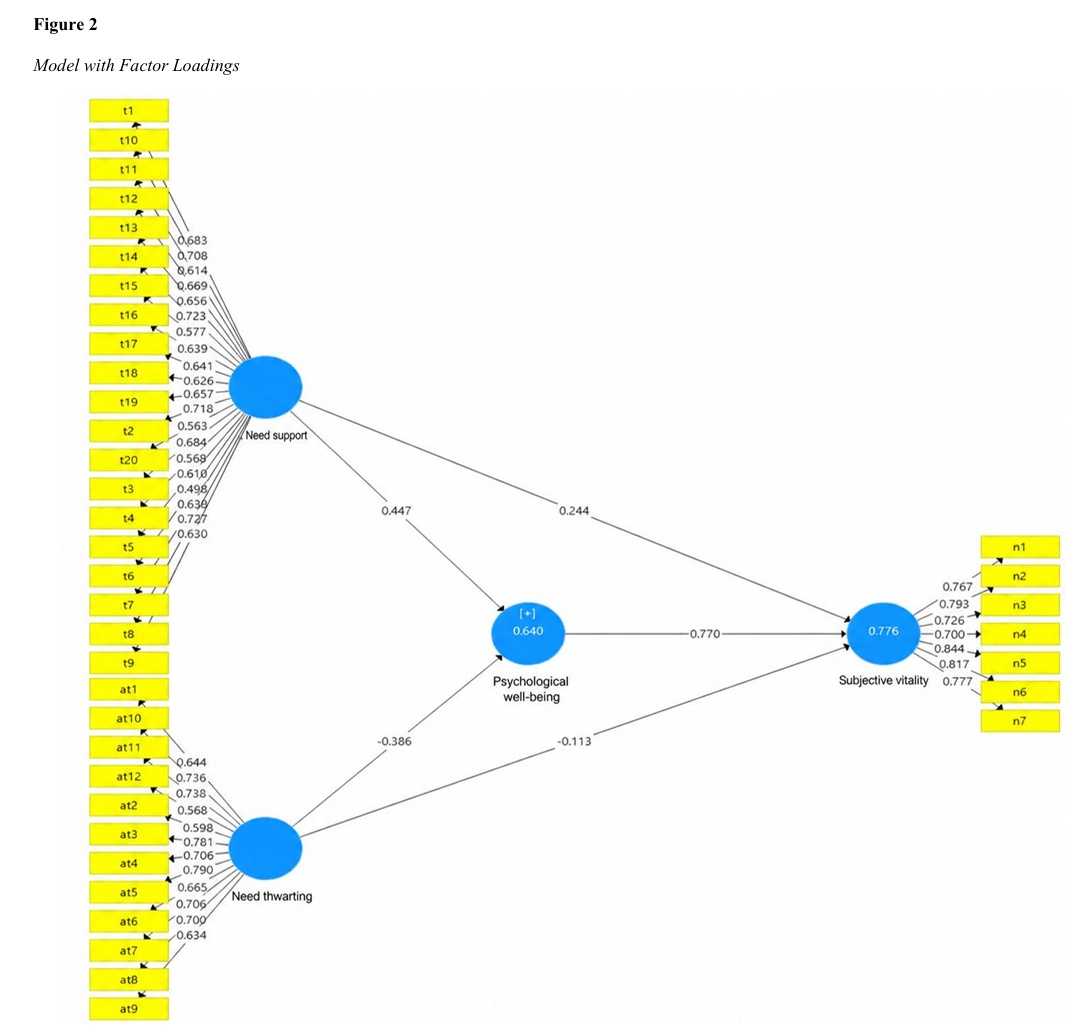
Findings: Need-supportive behavior had significant positive relationships with subjective vitality and psychological well-being, whereas need-thwarting behavior had significant negative relationships with both variables (p < .05). Psychological well-being was positively and significantly associated with subjective vitality (p = .001). Moreover, psychological well-being significantly mediated the relationship between need-supportive behavior and subjective vitality by strengthening this positive association, while it mediated the relationship between need-thwarting behavior and subjective vitality by reducing its adverse association (p = .001). Independent-samples t-test results showed no significant differences between Iraqi and Iranian athletes in need-supportive behaviors, subjective vitality, or psychological well-being (p > .05).
Conclusion: The findings indicate that athletes’ subjective vitality is closely associated with the extent to which their basic psychological needs are supported or thwarted, both directly and indirectly through psychological well-being. Therefore, volleyball training environments should emphasize the satisfaction of athletes’ basic psychological needs while fostering positive psychological functioning, positive thinking, and constructive interpersonal relationships to promote greater psychological well-being and subjective vitality.
Downloads
References
Abuzari, H., Afrooz, G., Pournaghash-Tehran, S. S., Lavasani, G., & Sharifinia, M. H. (2023). Development and Evaluation of the Effectiveness of a Family-Centered Integrated Monotheistic Treatment Program on Psychological Well-Being, Increasing Self-Esteem, Spiritual Vitality and Addiction Cessation in Drug-Addicted Men University of Tehran].
Ahmadi, A., & Eskandarnejad, M. (2021). The Relationship between the Satisfaction and Thwarting of Basic Psychological Needs, Autonomous Motivation, Affective Outcomes and Behavioral Intentions in Adolescents' Educational Sport Environment: Modeling Based on Basic Psychological Needs Theory. Journal of Sport Management and Motor Behavior, 17(33), 19-34. https://doi.org/10.22080/jsmb.2020.10489.2412
Arabzadeh, M. (2017). Relationship Between Basic Psychological Needs and Mental Vitality in the Elderly. Salmand: Iranian Journal of Ageing, 12(2), 170-179. https://doi.org/10.21859/sija-1202170
Bartholomew, K. J., Ntoumanis, N., Ryan, R. M., & Thøgersen-Ntoumani, C. (2011). Psychological Need Thwarting in the Sport Context: Assessing the Darker Side of Athletic Experience. Journal of Sport and Exercise Psychology, 33(1), 75-102. https://doi.org/10.1123/jsep.33.1.75
Basson, N. (2008). The Influence of Psychosocial Factors on the Subjective Well-Being of Adolescents University of the Free State].
Deci, E. L., & Ryan, R. M. (2012). Self-Determination Theory. In. Sage Publications.
Diener, E., Oishi, S., & Tay, L. (2018). Advances in Subjective Well-Being Research. Nature Human Behaviour, 2(4), 253-260. https://doi.org/10.1038/s41562-018-0307-6
Dustkafi, H., Heidari, H., Davoodi, H., & Zare BahramAbadi, M. (2019). Comparison of the Effectiveness of Group Counseling by Gestalt Therapy and Positive Psychology Approach on Psychological Well-Being in Women with Lung Cancer. Qom University of Medical Sciences Journal, 13(9), 80-90. https://doi.org/10.29252/qums.13.9.80
Gerodimos, V., Karatrantou, K., Papazeti, K., Batatolis, C., & Krommidas, C. (2022). Workplace Exercise Program in a Hospital Environment: An Effective Strategy for the Promotion of Employees' Physical and Mental Health. A Randomized Controlled Study. International Archives of Occupational and Environmental Health, 95(7), 1491-1500. https://doi.org/10.1007/s00420-022-01856-6
Gómez, M. S., Rodríguez-Fernández, A., Mota, E. U., & Azpiazu-Izagirre, L. (2025). Emotional Well-Being in Primary Education: The Role of Self-Concept and Basic Psychological Needs. In. IntechOpen. https://doi.org/10.5772/intechopen.1009002
Granero-Jiménez, J., López-Rodríguez, M. M., Dobarrio-Sanz, I., & Cortés-Rodríguez, A. E. (2022). Influence of Physical Exercise on Psychological Well-Being of Young Adults: A Quantitative Study. International journal of environmental research and public health, 19(7), 4282. https://doi.org/10.3390/ijerph19074282
Lonsdale, C., Hodge, K., & Jackson, S. A. (2007). Athlete Engagement: II. Developmental and Initial Validation of the Athlete Engagement Questionnaire. International Journal of Sport Psychology. https://doi.org/10.1037/t50268-000
Martela, F., & Sheldon, K. M. (2019). Clarifying the Concept of Well-Being: Psychological Need Satisfaction as the Common Core Connecting Eudaimonic and Subjective Well-Being. Review of General Psychology, 23(4), 458-474. https://doi.org/10.1177/1089268019880886
Moustaka, F. C., Vlachopoulos, S. P., Kabitsis, C., & Theodorakis, Y. (2012). Effects of an Autonomy-Supportive Exercise Instructing Style on Exercise Motivation, Psychological Well-Being, and Exercise Attendance in Middle-Age Women. Journal of Physical Activity and Health, 9(1), 138-150. https://doi.org/10.1123/jpah.9.1.138
Najd, M. R., Mosahebi, M. R., & Atashpour, H. (2014). Prediction of Psychological Well-Being through Components of Self-Efficacy, Psychological Hardiness, and Perceived Social Support. Thoughts and Behavior in Clinical Psychology, 8(30), 47-56. https://sanad.iau.ir/fa/Article/1118276
Rahman, R. J., Hudson, J., Thøgersen-Ntoumani, C., & Doust, J. H. (2015). Motivational Processes and Well-Being in Cardiac Rehabilitation: A Self-Determination Theory Perspective. Psychology, Health & Medicine, 20(5), 518-529. https://doi.org/10.1080/13548506.2015.1017509
Rodrigues, F., Faustino, T., Santos, A., Teixeira, E., Cid, L., & Monteiro, D. (2022). How Does Exercising Make You Feel? The Associations between Positive and Negative Affect, Life Satisfaction, Self-Esteem, and Vitality. International Journal of Sport and Exercise Psychology, 20(3), 813-827. https://doi.org/10.1080/1612197X.2021.1907766
Ryff, C. D., & Singer, B. H. (2006). Best News Yet on the Six-Factor Model of Well-Being. Social science research, 35(4), 1103-1119. https://doi.org/10.1016/j.ssresearch.2006.01.002
Samienia, M., Nikbakhsh, R., & Safania, A. M. (2019). Perfectionism, Burnout and Engagement Model in Athlete: The Mediating Role of the Self-Determination Theory. Sport Psychology Studies, 7(26), 121-132. https://doi.org/10.22089/spsyj.2018.5560.1583
Samienia, M., Nikbaksh, R., & Safania, A. M. (2022). Perfectionism, Burnout and Engagement Model in Physically Disabled Elite Athletes: The Mediating Role of the Self-Determination Theory. Sport Management Journal, 13(4), 1381-1399. https://doi.org/10.22059/jsm.2020.307839.2551
Sharifi, F., Marziyeh, A., & Jenaabadi, H. (2018). The Relationship between Achievement Goals and the Sense of Connectedness with School and Subjective Vitality among Students. Journal of School Psychology, 6(4), 99-119. https://doi.org/10.22098/jsp.2018.606
Sheikholeslami, R., & Daftarchi, E. (2015). The Prediction of Students' Subjective Vitality by Goal Orientations and Basic Psychological Needs. Journal of Psychology.
Taylor-Piliae, R. E., & Finley, B. A. (2020). Tai Chi Exercise for Psychological Well-Being among Adults with Cardiovascular Disease: A Systematic Review and Meta-Analysis. European Journal of Cardiovascular Nursing, 19(7), 580-591. https://doi.org/10.1177/1474515120926068
Turgeon, S., Martin, L., Rathwell, S., & Camiré, M. (2024). The Influence of Gender on the Relationship between the Basic Psychological Needs and Mental Health in High School Student-Athletes. International Journal of Sport and Exercise Psychology, 22(3), 721-738. https://doi.org/10.1080/1612197X.2022.2161103
Wang, W., Schweickle, M. J., Arnold, E. R., & Vella, S. A. (2025). Psychological Interventions to Improve Elite Athlete Mental Wellbeing: A Systematic Review and Meta-Analysis. Sports medicine, 55(4), 877-897. https://doi.org/10.1007/s40279-024-02173-3
Wong, M. Y. C., Fung, H. W., & Yuan, G. F. (2023). The Association between Physical Activity, Self-Compassion, and Mental Well-Being after COVID-19: In the Exercise and Self-Esteem Model Revised with Self-Compassion (EXSEM-SC) Perspective. Healthcare, 11(2), 233. https://doi.org/10.3390/healthcare11020233
Downloads
Additional Files
Publication Timeline
- Submitted
- Revised
- Accepted